
You are currently browsing the tag archive for the ‘Residential Schools’ tag.
Canada did not need less concern for possible graves at former residential schools. It needed more truth, earlier. The residential school record contains real wrongs: family separation, cultural suppression, abuse, neglect, disease, and documented deaths. But when the Kamloops announcement broke in 2021, the public story moved very quickly from ground-penetrating radar findings to language of “discovered remains” and “mass graves.” That distinction mattered. Ground-penetrating radar does not find bodies. It identifies disturbances, anomalies, and possible grave-like features that require verification.
The mechanism is familiar: narrative hardened faster than evidence. Grief became certainty. Certainty became accusation. Accusation became permission. A country already primed to view churches as historical villains suddenly had a simple moral script: children had been found, churches were responsible, rage was righteous. After that, Canada saw a wave of church fires and vandalism. A CBC investigation later reported that at least 33 Canadian churches had burned to the ground since May 2021; 24 were confirmed arsons, two were ruled accidental, and the remaining cases were suspicious or under investigation.
That caveat matters. We should not replace one sloppy narrative with another. Not every burned church was necessarily revenge for residential schools. Not every vandal was acting from the same motive. Some Indigenous leaders condemned the arsons, and some churches destroyed or damaged were themselves part of Indigenous communities. But it is also dishonest to pretend the atmosphere had nothing to do with it. The grave announcements were absorbed into a wider moral panic, and churches became symbols onto which anger could be poured.
This is the disservice. Public institutions, media, and political leaders helped sanctify a narrative before the evidence was ready to carry it. Then, when churches burned, the response was often strangely muted, hedged, or morally embarrassed. The same society that had no trouble speaking in grand certainties about historical guilt suddenly discovered nuance when actual churches were being attacked.
The answer is not denial of residential-school harms. It is truth over narrative, regardless of whose narrative is being protected. Children suffered. Families were broken. Some children died. Some claims also outran the evidence. A serious country should be able to say all of that at once. If Canada wants reconciliation rather than ritualized accusation, it has to stop treating careful factual distinctions as blasphemy. Truth does not become less necessary because the cause is emotionally powerful.
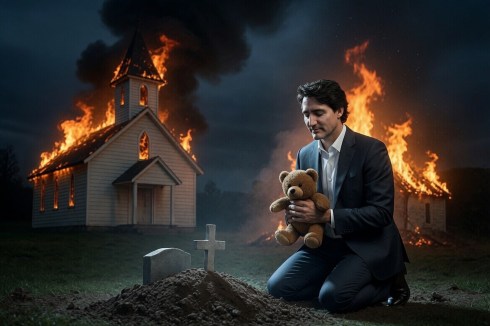
Canada needed truth, not ritual certainty. When narrative outran evidence, churches became symbols for rage.
Works Referenced
Tk’emlúps te Secwépemc. “Remains of Children of Kamloops Indian Residential School Discovered.” May 27, 2021.
https://tkemlups.ca/wp-content/uploads/05-May-27-2021-TteS-MEDIA-RELEASE.pdf
Sarah Beaulieu. “Ground-Penetrating Radar Preliminary Survey: Kamloops Indian Residential School.” Canadian Archaeological Association PDF.
https://canadianarchaeology.com/sites/default/files/page/gpr_at_kamloops_irs_sarah_beaulieu.pdf
Tk’emlúps te Secwépemc. “Media Release.” July 15, 2021.
https://tkemlups.ca/wp-content/uploads/July15_Media-Release_Final.pdf
Terry Reith, CBC News. “At least 33 Canadian churches have burned to the ground since May 2021. So far, 24 are confirmed arsons.” January 10, 2024.
https://www.cbc.ca/news/canada/edmonton/church-fires-canada-1.7055838
Angelus News. “Report: 33 churches in Canada destroyed since May 2021.” January 17, 2024.
https://angelusnews.com/news/nation/canada-churches-destroyed/
CBC News. “‘Unacceptable and wrong’: Trudeau condemns attacks on churches.” July 2, 2021.
https://www.cbc.ca/news/politics/trudeau-churches-arson-attacks-1.6088237
“The failed attempt to criminalize “denialism” should not end the argument. It should begin a more honest one.”
Canada has just been given a useful lesson in how not to defend historical truth.
A Senate committee recently amended Bill C-9, the federal government’s anti-hate bill, to include a new offence for “residential school denialism.” The amendment passed committee by a vote of 7–1, then failed in the full Senate by a vote of 41–32. The broader anti-hate bill continued, but this particular amendment was defeated.
That defeat matters, but not because the residential school system was harmless, invented, or benign. It was not. More than 150,000 First Nations, Inuit, and Métis children attended residential schools, often far from their families and communities. The National Centre for Truth and Reconciliation describes the system as explicitly designed to separate Indigenous children from their families and cultures.
The historical record is ugly: forced removal, family rupture, cultural suppression, underfunded institutions, abuse, neglect, disease, and deaths are not fringe claims. No serious account of Canadian history should pretend otherwise.
But seriousness cuts both ways. The record is not made more honest by flattening it into a morality play. Some former students did gain literacy, language skills, vocational training, religious formation, discipline, shelter, or relationships with individual staff who treated them decently. Some may have experienced school as an escape from poverty, instability, disease, or family circumstances that were already difficult. Those facts do not redeem the system. They do not cancel forced removal, cultural suppression, abuse, neglect, or death. But they do belong in the record, because truth does not improve when inconvenient evidence is treated as betrayal.
That is why criminalizing “denialism” is such a dangerous move.
What exactly would the law punish? Denying that residential schools existed? Denying that abuse occurred? Denying that children died? Questioning a specific claim about a specific site? Asking whether a radar anomaly is a confirmed grave? Objecting to the phrase “mass grave” where no excavation has confirmed one? Disputing the legal or moral use of the word genocide? Challenging a death count?
These are not all the same act, morally or historically. A liberal society should be extremely careful before treating them as if they belong in the same criminal category.
This is where the Streisand effect begins. Tell citizens that a subject is so sacred it may need criminal protection from questioning, and many will not become more trusting. They will become more curious. Worse, they will start to wonder what parts of the official story cannot survive scrutiny without a law standing guard.
Some of that suspicion will be crude, resentful, or motivated by bad faith. There are people who would like to minimize the residential school system because they do not want Canada, churches, or public institutions to bear moral responsibility for what happened.
But not all skepticism is denial. Some of it is ordinary democratic distrust, especially when public history becomes entangled with settlements, land claims, curriculum mandates, activist organizations, government funding, institutional prestige, and careers built around a particular moral narrative. Once those incentives exist, citizens are entitled to ask for precision.
Canada does not need denial. It also does not need another official morality play. It needs a deeper reckoning with the residential school period than our public institutions often seem willing to allow. That means holding several truths in view at once: the system involved coercion, assimilation, family rupture, abuse, neglect, disease, and deaths; some students also received education, training, religious formation, shelter, or stability they may not otherwise have had; some claims are well established, some are plausible but unverified, and some have been rhetorically inflated beyond the evidence.
A serious country should be able to say all of that without reaching for the Criminal Code.
The better answer is evidence: open archives, careful forensic verification, precise death counts, and honest distinctions between confirmed graves, suspected burials, cemetery sites, radar anomalies, neglect, abuse, disease, and deliberate killing. The documented record is already ugly enough. It does not need exaggeration, and it does not need state protection from hard questions.
If the story is true, it does not need blasphemy law. If parts of the story have been overstated, then criminalization only delays the reckoning Canada eventually has to have.
The state cannot protect historical truth by owning permissible memory. It can only make the eventual reckoning harder.
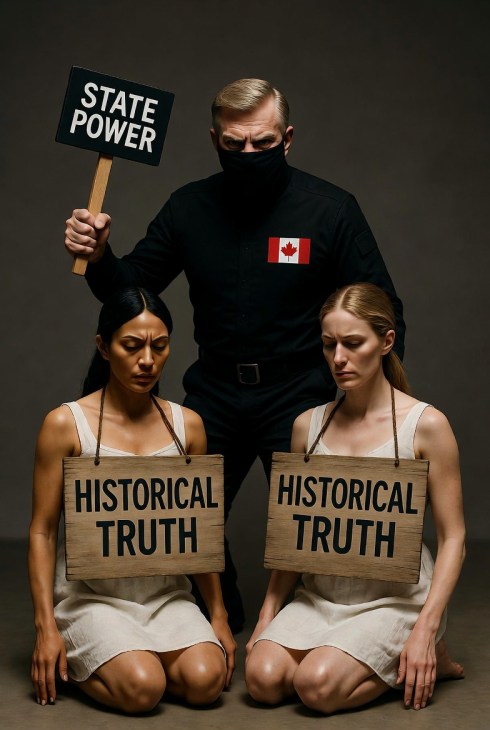
Historical truth does not become more trustworthy when the Criminal Code stands behind it.
To think that these individuals are going to be in charge soon is positively frightening.
The documentary presents unedited footage of a Spectrum Street Epistemology session conducted by Frances Widdowson at the University of Regina on October 3, 2024, facilitated with Indigenous psychologist Lloyd Hawkeye Robertson. It contextualizes the event within Widdowson’s broader conflicts over academic freedom, detailing the cancellation of her scheduled talks titled “Indigenization and Academic Freedom: Lessons from the Frances Widdowson Case” and “The Grave Error at Kamloops: Should It Be Described as a ‘Hoax’?”
Key background: Widdowson, formerly terminated from Mount Royal University amid disputes over “wokeism” and identity politics, arranged the talks through librarian Robert Thomas. University administrators, including Provost David Gregory and Associate Vice President John Smith, canceled room bookings citing “safety concerns,” particularly proximity to the National Day for Truth and Reconciliation. Widdowson defied warnings, invoking Charter protections for public universities, and proceeded with the informal epistemology exercise in a student center, filmed by former faculty member Daniel Page.
The session examines claims via positioned mats (strongly agree to strongly disagree). Core claim: “The University of Regina protects academic freedom.” Robertson places himself at “slightly agree,” citing institutional policies like collective agreements but noting exceptions (e.g., pressures on Page and computer scientist Trevor Tomesh for LGBTQ-related criticisms and social media posts, respectively). Widdowson highlights her own case and systemic failures.
Related claims probed:
– Academic freedom equates to unrestricted speech: Robertson slightly disagrees, viewing it as narrower (professorial judgment in expertise) yet inseparable from broader expression.
– Professors may claim residential schools benefited Indigenous people: Robertson agrees in principle for academic freedom but personally disagrees overall, acknowledging abuses while noting some schools provided successes and First Nations lobbied to retain them post-1960s closures.
– Residential schools were harmful: Robertson agrees, referencing “residential school syndrome” (PTSD-like symptoms including rage), physical/sexual abuse, and underfunding, but not “strongly” due to variations across institutions.
Interactions escalate with students and a professor (Russell Fayant, from the Teacher Education Program), who arrives with a primed class. Participants accuse Widdowson of denialism, hate, and harming reconciliation; one claims her presence spikes blood pressure and causes distress. Widdowson counters with evidence gaps, e.g., Kamloops’ 2021 announcement of “215 children’s remains” (initially ground-penetrating radar anomalies, unexcavated) and William Combes’ unsubstantiated claim of Queen Elizabeth II abducting 10 children in 1964 (contradicted by royal itineraries). Disruptions include threats to an elderly attendee, projector unplugging, and event relocation from Regina Public Library due to organized opposition by coordinator Rachel Jean and journalism professor Trish Elliot.
Verifiable outcomes: No physical violence; security (Brad Anderson) monitors without intervention. Widdowson maintains composure, emphasizing evidence over emotion. Comments (242 visible) overwhelmingly praise her patience and critique students’ emotionalism, immaturity, and evasion of substantiation—e.g., prioritizing “therapeutic mythologies” over facts, fearing critical thought’s social costs.
Core tension: Widdowson’s insistence on verifiable evidence (e.g., excavations, historical records) clashes with appeals to lived experience, oral knowledge, and relational healing. She argues truth precedes reconciliation; opponents prioritize avoiding harm and building ties, viewing scrutiny as divisive. The session exposes institutional suppression—cancellations without due process—and student unpreparedness for rigorous debate, underscoring academic freedom’s erosion under indigenization mandates. No evidence supports mass murder claims at Kamloops; anomalies remain unconfirmed graves. The exercise, though chaotic, demonstrates dialogue’s possibility despite hostility, affirming verifiable truth as essential to intellectual integrity.
I’ve summarized the article here.
In challenging the prevailing narrative of unmitigated harm in Canada’s residential schools, Michelle Stirling scrutinizes Phyllis Webstad’s story, the inspiration behind Orange Shirt Day. Webstad boarded at St. Joseph’s in 1973, a facility under federal oversight where she attended public school alongside local children, not a cloistered religious institution. Stirling points out the absence of Catholic nuns in daily operations by that time, with Indigenous staff predominant, and questions the portrayal of familial abandonment on the Dog Creek Reserve amid documented violence, suggesting her placement served as a safeguard rather than an act of cultural erasure.
Vivian Ketchum’s recollection of being removed at age five to the Presbyterian-run Cecilia Jeffrey school is similarly contextualized as a welfare intervention, particularly against the backdrop of tuberculosis ravaging her community, which left her with lung scars. Stirling dismantles media distortions, such as those in “The Secret Path,” which erroneously inject Catholic elements into a Presbyterian setting, while citing Robert MacBain’s compilation of affirmative student letters that refute widespread abuse claims and highlight the school’s role as a refuge from dire home conditions.
Stirling ultimately cautions against the pitfalls of relying on childhood memories in legal compensation processes, where leading questions can shape recollections, and contrasts dominant tales with positive accounts like Lena Paul’s depiction of the school as a haven from familial turmoil. By exposing fabrications in works like the “Sugarcane” documentary, the article advocates for a balanced historical lens that prioritizes verifiable facts over emotive victimhood, fostering genuine reconciliation free from manipulated animosity.
Dallas Brodie, once the MLA for Vancouver-Quilchena, has emerged as a lightning rod in British Columbia’s political landscape due to her insistence on questioning the narrative surrounding the Kamloops Indian Residential School. Expelled from the BC Conservative Party on March 7, 2025, Brodie’s assertion that “zero” child burials have been confirmed at the site—technically accurate, as no remains have been excavated—ignited a firestorm. Her refusal to retract her February 2025 social media post, despite pressure from party leader John Rustad, and her subsequent mockery of subjective “truths” in a March 6 online discussion, underscored her quest to challenge what she sees as unverified claims. Brodie’s stance, while divisive, reflects a broader frustration among some Canadians with the lack of empirical evidence behind widely accepted residential school narratives, positioning her as a figure demanding factual accountability in a debate often steeped in emotion.
The Canadian media, however, has largely framed Brodie’s actions as denialism, amplifying a narrative that paints her as a villain rather than a skeptic. Outlets like CBC and The Globe and Mail emphasized her expulsion and her inflammatory tone—such as mimicking survivors’ testimonies—while downplaying the absence of physical evidence at Kamloops, a point she repeatedly highlighted. This selective reporting constructs a fabricated storyline that prioritizes moral outrage over nuanced discussion, failing Canadian society by stifling inquiry into a complex issue. By focusing on Brodie’s personal conduct rather than engaging with her central argument, the media has diverted the conversation from truth-seeking to character assassination, leaving the public with a polarized, oversimplified version of events that obscures the need for factual clarity.
Compounding this failure is the response from some Indigenous leaders and communities, whose rejection of Brodie’s evidence-based critique has hardened the discourse. Groups like the Métis Nation British Columbia condemned her as a denialist, dismissing her call for verification of the Kamloops claims as an attack on reconciliation itself. This reflex to brand dissent as heresy—rather than address the lack of excavated remains—entrenches a narrative that equates questioning with disrespect, sidelining legitimate debate. Such denial of the truth, or at least its ambiguities, transforms a potentially unifying pursuit of facts into a battleground of identity and guilt, alienating Canadians who seek clarity rather than dogma.
The fallout from Brodie’s case reveals how these dynamics erode public trust and degrade civic dialogue. Her expulsion from the BC Conservatives, followed by the defection of two MLAs on March 7, 2025, signals internal party fractures but also mirrors a broader societal rift. Media-driven narratives that vilify skepticism, paired with Indigenous insistence on unchallengeable “truths,” have created a climate where questioning official accounts invites ostracism rather than answers. This poisonous blend has left Canadians less equipped to grapple with the residential school legacy, as discussion deteriorates into accusations of racism or betrayal instead of a shared pursuit of what actually happened—a failure that undermines reconciliation more than Brodie’s provocations ever could.
Ultimately, Dallas Brodie’s quest, however flawed in delivery, exposes a critical flaw in Canadian society: the inability to confront uncomfortable questions without fabricated narratives or entrenched denialism. The media’s rush to condemn rather than investigate, and the refusal of some Indigenous voices to entertain factual uncertainty, have roughened a debate that demands precision and honesty. As Brodie sits as an independent MLA, unrepentant in her stance, her case serves as a warning—Canadian society risks losing its capacity for truth when inquiry is sacrificed for comfort. Until the media prioritizes evidence over outrage and all parties embrace open scrutiny, the dialogue around residential schools will remain a casualty of its own abrasiveness, failing the very history it seeks to honor.

“Patriotism assumes that our globe is divided into little spots, each one surrounded by an iron gate. Those who have had the fortune of being born on some particular spot, consider themselves better, nobler, grander, more intelligent than the living beings inhabiting any other spot. It is, therefore, the duty of everyone living on that chosen spot to fight, kill, and die in the attempt to impose his superiority upon all the others.”
-EMMA GOLDMAN, Anarchism and Other Essays
Celebrating Canada’s ‘nationhood’ seems a little trite and ephemeral to me. Woo, ethnic cleansing, woo cultural genocide and the rest of the checkered past gets layered under the cheers drunken yahoos happy to have another excuse to get pissed out of their minds while waving the Canadian flag.
Meh.
I choose this day to bring attention to something that Rachel Notley and the NDP Alberta Government chose to do, not too long ago.
“Premier Rachel Notley delivered an emotional apology for Alberta’s failure to take action against the residential school system on Monday and joined a growing call for a public inquiry into murdered and missing aboriginal women.
The announcement came nearly three weeks after the Truth and Reconciliation Commission concluded that almost a century of abuses at residential schools funded by the Canadian government amounted to “cultural genocide.”
Native Canadians have been marginalized and forgotten in Canadian society. We are aware of the stereotypes and misconceptions, but too often we choose to feed them and not try to reform ideas like “the lazy drunken Indian”. News-flash here friends – if people like your own ethnicity had been forcibly removed from their homes, put into schools where abuse and torture were the norm and punished for speaking your native language or performing your cultural practices, your generation – let me assure you – would be pretty fucked up.
 Canadians approved of the residential school system and thought *somehow* that the 1960’s Scoop was a good thing.
Alberta Premier Rachel Notley has finally addressed the issue:
“We were shocked and at times rendered speechless as we learned of the First Nation, Métis and Inuit children forcibly removed from their homes,” Ms. Notley said in the Alberta legislature.
“Although the province of Alberta did not establish this system, members of this chamber did not take a stand against it. For this silence, we apologize.”
A small, but very important first step. The last residential school closed in 1996, so 19 years is way overdue for the government and people of Alberta to step up and recognize the trauma inflicted on our First Peoples.
Hope. For such a long time I have not associated that word with our governance. The apology would have been enough, but Rachel Notley continued:
“I want the issue of missing and murdered aboriginal women to come out of the shadows and be viewed with compassion and understanding in the clear light of day,” Ms. Notley said. “The silence that once was, has long since passed. We will not fail these women. Not this time. Now is the time for their voices to be heard.”
I might be persuaded that this government has interests other than the oil/gas industry if this sort of thing keeps up. Of course, switching levels of governance, one can always find the dark cloud to the silver lining; case in point being Stephen Harper and his merry band of shit-lords that happen to be running the Federal Government:
“Prime Minister Stephen Harper has so far rejected calls for an inquiry, saying that authorities are already taking the proper steps to combat the issue and a further inquiry is not necessary.
In 2008, Mr. Harper issued an apology for residential schools and said at the time that the abuses inflicted by the system helped contribute to lasting social problems in First Nations communities.
According to an RCMP report, 206 of Canada’s 1,017 female aboriginal homicides between 1980 and 2012 were in Alberta. The report also noted that 28 per cent of Alberta’s female homicides between 1980 and 2012 involved indigenous women.”
Yah, these fine Conservative individuals need to be voted out of office in the upcoming federal election and a government like Alberta’s NDP that cares about people rather than profit, needs to be installed.
So there ya go.
Happy Canada Day!











 bleatmop
 Mystro


 Dead Wild Roses
Your opinions…