
You are currently browsing the tag archive for the ‘State Power’ tag.
“The failed attempt to criminalize “denialism” should not end the argument. It should begin a more honest one.”
Canada has just been given a useful lesson in how not to defend historical truth.
A Senate committee recently amended Bill C-9, the federal government’s anti-hate bill, to include a new offence for “residential school denialism.” The amendment passed committee by a vote of 7–1, then failed in the full Senate by a vote of 41–32. The broader anti-hate bill continued, but this particular amendment was defeated.
That defeat matters, but not because the residential school system was harmless, invented, or benign. It was not. More than 150,000 First Nations, Inuit, and Métis children attended residential schools, often far from their families and communities. The National Centre for Truth and Reconciliation describes the system as explicitly designed to separate Indigenous children from their families and cultures.
The historical record is ugly: forced removal, family rupture, cultural suppression, underfunded institutions, abuse, neglect, disease, and deaths are not fringe claims. No serious account of Canadian history should pretend otherwise.
But seriousness cuts both ways. The record is not made more honest by flattening it into a morality play. Some former students did gain literacy, language skills, vocational training, religious formation, discipline, shelter, or relationships with individual staff who treated them decently. Some may have experienced school as an escape from poverty, instability, disease, or family circumstances that were already difficult. Those facts do not redeem the system. They do not cancel forced removal, cultural suppression, abuse, neglect, or death. But they do belong in the record, because truth does not improve when inconvenient evidence is treated as betrayal.
That is why criminalizing “denialism” is such a dangerous move.
What exactly would the law punish? Denying that residential schools existed? Denying that abuse occurred? Denying that children died? Questioning a specific claim about a specific site? Asking whether a radar anomaly is a confirmed grave? Objecting to the phrase “mass grave” where no excavation has confirmed one? Disputing the legal or moral use of the word genocide? Challenging a death count?
These are not all the same act, morally or historically. A liberal society should be extremely careful before treating them as if they belong in the same criminal category.
This is where the Streisand effect begins. Tell citizens that a subject is so sacred it may need criminal protection from questioning, and many will not become more trusting. They will become more curious. Worse, they will start to wonder what parts of the official story cannot survive scrutiny without a law standing guard.
Some of that suspicion will be crude, resentful, or motivated by bad faith. There are people who would like to minimize the residential school system because they do not want Canada, churches, or public institutions to bear moral responsibility for what happened.
But not all skepticism is denial. Some of it is ordinary democratic distrust, especially when public history becomes entangled with settlements, land claims, curriculum mandates, activist organizations, government funding, institutional prestige, and careers built around a particular moral narrative. Once those incentives exist, citizens are entitled to ask for precision.
Canada does not need denial. It also does not need another official morality play. It needs a deeper reckoning with the residential school period than our public institutions often seem willing to allow. That means holding several truths in view at once: the system involved coercion, assimilation, family rupture, abuse, neglect, disease, and deaths; some students also received education, training, religious formation, shelter, or stability they may not otherwise have had; some claims are well established, some are plausible but unverified, and some have been rhetorically inflated beyond the evidence.
A serious country should be able to say all of that without reaching for the Criminal Code.
The better answer is evidence: open archives, careful forensic verification, precise death counts, and honest distinctions between confirmed graves, suspected burials, cemetery sites, radar anomalies, neglect, abuse, disease, and deliberate killing. The documented record is already ugly enough. It does not need exaggeration, and it does not need state protection from hard questions.
If the story is true, it does not need blasphemy law. If parts of the story have been overstated, then criminalization only delays the reckoning Canada eventually has to have.
The state cannot protect historical truth by owning permissible memory. It can only make the eventual reckoning harder.
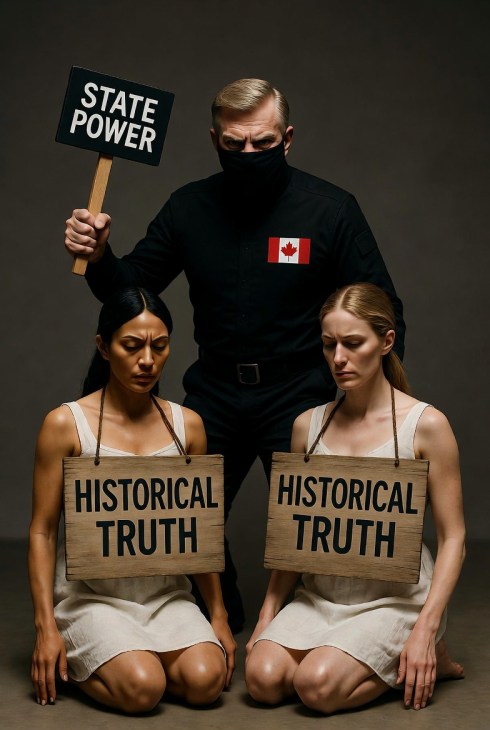
Historical truth does not become more trustworthy when the Criminal Code stands behind it.
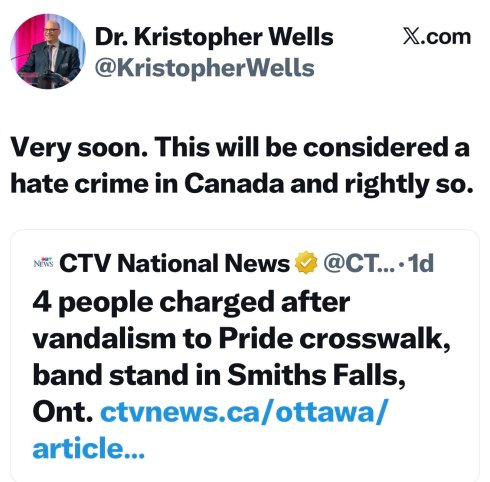
The Smiths Falls rainbow crosswalk incident is useful because it is small enough to see the pattern clearly.
Someone vandalized a municipal rainbow crosswalk. That is wrong. Public property was damaged, and ordinary criminal law already covers it: mischief, property damage, fines, restitution, cleanup. Use those tools.
The escalation is the problem. Kristopher Wells suggested this kind of vandalism should soon be treated as a hate crime, and “rightly so.” That turns damaged paint on a road into something much larger: an attack on an entire community, a public safety event, and a test of whether the state will treat disrespect toward a progressive symbol as criminal hatred.
Hate motivation can matter. A swastika on a synagogue, threats painted on a family’s home, or targeted destruction meant to intimidate a minority community is not just graffiti. The act carries a message. The law can recognize that.
But evidence has to do the work. Not activist framing, media amplification, institutional pressure, or the assumption that because a symbol represents a protected group, contempt for the symbol must be treated as hatred toward the group.
A rainbow crosswalk is not private expression. It is a public installation, approved by a municipality, painted on shared civic property, and usually funded through public money. Citizens are allowed to support it. They are also allowed to dislike it, object to it, mock it, or argue that local governments should not turn infrastructure into moral messaging.
None of that excuses vandalism. The vandal still damaged property. Charge the conduct.
The problem is what happens after the spray paint dries. Activists demand the heaviest moral and legal frame available. Police and prosecutors are pressured to read ideological meaning into the act. Media coverage turns a local property offence into a symbolic attack on “the community.” The damaged object becomes less important than the ritual around it.
That is the weaponization problem. Progressive causes increasingly try to convert contested public symbols into protected civic relics. Once that happens, the state is no longer being asked only to punish damage. It is being asked to police the meaning of disrespect.
The older liberal case for gay rights had force because it demanded equal treatment under the law: no jailing, no firing, no harassment, no denial of ordinary civic dignity. That case asked the state to stop treating gay people as legal outsiders.
This newer pattern asks the state to do something different. It asks the state to affirm symbols, language, and institutional rituals, then treat resistance as suspect. The public notices the difference, even when it lacks the vocabulary for it.
Smiths Falls should handle this as vandalism unless clear evidence of targeted intimidation, threats, organized harassment, or explicit hatred toward identifiable people emerges. If that evidence exists, bring it forward. If it does not, damaged municipal paint should not be inflated into a hate-crime drama.
A society can punish vandalism without sacralizing public symbols. It can protect actual people without letting activists turn insult, contempt, or disrespect into presumptive criminal hatred.
That distinction is not a technicality. It is one of the ways a free society keeps criminal law from becoming a tool of ideological management.











 bleatmop
 Mystro
 The Arbourist


 Dead Wild Roses
Your opinions…