
You are currently browsing the tag archive for the ‘Rainbow Crosswalks’ tag.
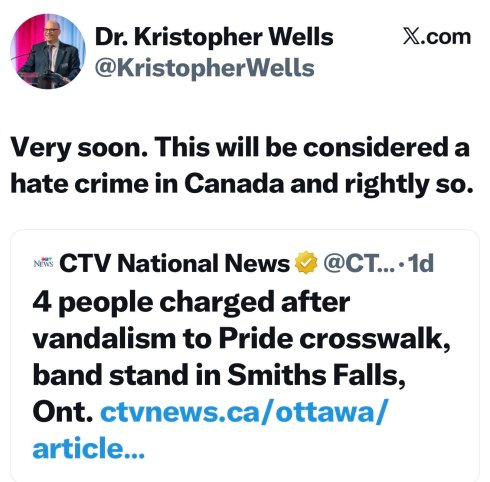
The Smiths Falls rainbow crosswalk incident is useful because it is small enough to see the pattern clearly.
Someone vandalized a municipal rainbow crosswalk. That is wrong. Public property was damaged, and ordinary criminal law already covers it: mischief, property damage, fines, restitution, cleanup. Use those tools.
The escalation is the problem. Kristopher Wells suggested this kind of vandalism should soon be treated as a hate crime, and “rightly so.” That turns damaged paint on a road into something much larger: an attack on an entire community, a public safety event, and a test of whether the state will treat disrespect toward a progressive symbol as criminal hatred.
Hate motivation can matter. A swastika on a synagogue, threats painted on a family’s home, or targeted destruction meant to intimidate a minority community is not just graffiti. The act carries a message. The law can recognize that.
But evidence has to do the work. Not activist framing, media amplification, institutional pressure, or the assumption that because a symbol represents a protected group, contempt for the symbol must be treated as hatred toward the group.
A rainbow crosswalk is not private expression. It is a public installation, approved by a municipality, painted on shared civic property, and usually funded through public money. Citizens are allowed to support it. They are also allowed to dislike it, object to it, mock it, or argue that local governments should not turn infrastructure into moral messaging.
None of that excuses vandalism. The vandal still damaged property. Charge the conduct.
The problem is what happens after the spray paint dries. Activists demand the heaviest moral and legal frame available. Police and prosecutors are pressured to read ideological meaning into the act. Media coverage turns a local property offence into a symbolic attack on “the community.” The damaged object becomes less important than the ritual around it.
That is the weaponization problem. Progressive causes increasingly try to convert contested public symbols into protected civic relics. Once that happens, the state is no longer being asked only to punish damage. It is being asked to police the meaning of disrespect.
The older liberal case for gay rights had force because it demanded equal treatment under the law: no jailing, no firing, no harassment, no denial of ordinary civic dignity. That case asked the state to stop treating gay people as legal outsiders.
This newer pattern asks the state to do something different. It asks the state to affirm symbols, language, and institutional rituals, then treat resistance as suspect. The public notices the difference, even when it lacks the vocabulary for it.
Smiths Falls should handle this as vandalism unless clear evidence of targeted intimidation, threats, organized harassment, or explicit hatred toward identifiable people emerges. If that evidence exists, bring it forward. If it does not, damaged municipal paint should not be inflated into a hate-crime drama.
A society can punish vandalism without sacralizing public symbols. It can protect actual people without letting activists turn insult, contempt, or disrespect into presumptive criminal hatred.
That distinction is not a technicality. It is one of the ways a free society keeps criminal law from becoming a tool of ideological management.











 bleatmop
 Mystro


 Dead Wild Roses
Your opinions…