
You are currently browsing the tag archive for the ‘Historical Truth’ tag.
Canada did not need less concern for possible graves at former residential schools. It needed more truth, earlier. The residential school record contains real wrongs: family separation, cultural suppression, abuse, neglect, disease, and documented deaths. But when the Kamloops announcement broke in 2021, the public story moved very quickly from ground-penetrating radar findings to language of “discovered remains” and “mass graves.” That distinction mattered. Ground-penetrating radar does not find bodies. It identifies disturbances, anomalies, and possible grave-like features that require verification.
The mechanism is familiar: narrative hardened faster than evidence. Grief became certainty. Certainty became accusation. Accusation became permission. A country already primed to view churches as historical villains suddenly had a simple moral script: children had been found, churches were responsible, rage was righteous. After that, Canada saw a wave of church fires and vandalism. A CBC investigation later reported that at least 33 Canadian churches had burned to the ground since May 2021; 24 were confirmed arsons, two were ruled accidental, and the remaining cases were suspicious or under investigation.
That caveat matters. We should not replace one sloppy narrative with another. Not every burned church was necessarily revenge for residential schools. Not every vandal was acting from the same motive. Some Indigenous leaders condemned the arsons, and some churches destroyed or damaged were themselves part of Indigenous communities. But it is also dishonest to pretend the atmosphere had nothing to do with it. The grave announcements were absorbed into a wider moral panic, and churches became symbols onto which anger could be poured.
This is the disservice. Public institutions, media, and political leaders helped sanctify a narrative before the evidence was ready to carry it. Then, when churches burned, the response was often strangely muted, hedged, or morally embarrassed. The same society that had no trouble speaking in grand certainties about historical guilt suddenly discovered nuance when actual churches were being attacked.
The answer is not denial of residential-school harms. It is truth over narrative, regardless of whose narrative is being protected. Children suffered. Families were broken. Some children died. Some claims also outran the evidence. A serious country should be able to say all of that at once. If Canada wants reconciliation rather than ritualized accusation, it has to stop treating careful factual distinctions as blasphemy. Truth does not become less necessary because the cause is emotionally powerful.
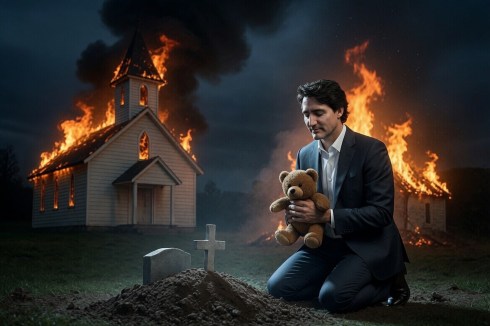
Canada needed truth, not ritual certainty. When narrative outran evidence, churches became symbols for rage.
Works Referenced
Tk’emlúps te Secwépemc. “Remains of Children of Kamloops Indian Residential School Discovered.” May 27, 2021.
https://tkemlups.ca/wp-content/uploads/05-May-27-2021-TteS-MEDIA-RELEASE.pdf
Sarah Beaulieu. “Ground-Penetrating Radar Preliminary Survey: Kamloops Indian Residential School.” Canadian Archaeological Association PDF.
https://canadianarchaeology.com/sites/default/files/page/gpr_at_kamloops_irs_sarah_beaulieu.pdf
Tk’emlúps te Secwépemc. “Media Release.” July 15, 2021.
https://tkemlups.ca/wp-content/uploads/July15_Media-Release_Final.pdf
Terry Reith, CBC News. “At least 33 Canadian churches have burned to the ground since May 2021. So far, 24 are confirmed arsons.” January 10, 2024.
https://www.cbc.ca/news/canada/edmonton/church-fires-canada-1.7055838
Angelus News. “Report: 33 churches in Canada destroyed since May 2021.” January 17, 2024.
https://angelusnews.com/news/nation/canada-churches-destroyed/
CBC News. “‘Unacceptable and wrong’: Trudeau condemns attacks on churches.” July 2, 2021.
https://www.cbc.ca/news/politics/trudeau-churches-arson-attacks-1.6088237
“The failed attempt to criminalize “denialism” should not end the argument. It should begin a more honest one.”
Canada has just been given a useful lesson in how not to defend historical truth.
A Senate committee recently amended Bill C-9, the federal government’s anti-hate bill, to include a new offence for “residential school denialism.” The amendment passed committee by a vote of 7–1, then failed in the full Senate by a vote of 41–32. The broader anti-hate bill continued, but this particular amendment was defeated.
That defeat matters, but not because the residential school system was harmless, invented, or benign. It was not. More than 150,000 First Nations, Inuit, and Métis children attended residential schools, often far from their families and communities. The National Centre for Truth and Reconciliation describes the system as explicitly designed to separate Indigenous children from their families and cultures.
The historical record is ugly: forced removal, family rupture, cultural suppression, underfunded institutions, abuse, neglect, disease, and deaths are not fringe claims. No serious account of Canadian history should pretend otherwise.
But seriousness cuts both ways. The record is not made more honest by flattening it into a morality play. Some former students did gain literacy, language skills, vocational training, religious formation, discipline, shelter, or relationships with individual staff who treated them decently. Some may have experienced school as an escape from poverty, instability, disease, or family circumstances that were already difficult. Those facts do not redeem the system. They do not cancel forced removal, cultural suppression, abuse, neglect, or death. But they do belong in the record, because truth does not improve when inconvenient evidence is treated as betrayal.
That is why criminalizing “denialism” is such a dangerous move.
What exactly would the law punish? Denying that residential schools existed? Denying that abuse occurred? Denying that children died? Questioning a specific claim about a specific site? Asking whether a radar anomaly is a confirmed grave? Objecting to the phrase “mass grave” where no excavation has confirmed one? Disputing the legal or moral use of the word genocide? Challenging a death count?
These are not all the same act, morally or historically. A liberal society should be extremely careful before treating them as if they belong in the same criminal category.
This is where the Streisand effect begins. Tell citizens that a subject is so sacred it may need criminal protection from questioning, and many will not become more trusting. They will become more curious. Worse, they will start to wonder what parts of the official story cannot survive scrutiny without a law standing guard.
Some of that suspicion will be crude, resentful, or motivated by bad faith. There are people who would like to minimize the residential school system because they do not want Canada, churches, or public institutions to bear moral responsibility for what happened.
But not all skepticism is denial. Some of it is ordinary democratic distrust, especially when public history becomes entangled with settlements, land claims, curriculum mandates, activist organizations, government funding, institutional prestige, and careers built around a particular moral narrative. Once those incentives exist, citizens are entitled to ask for precision.
Canada does not need denial. It also does not need another official morality play. It needs a deeper reckoning with the residential school period than our public institutions often seem willing to allow. That means holding several truths in view at once: the system involved coercion, assimilation, family rupture, abuse, neglect, disease, and deaths; some students also received education, training, religious formation, shelter, or stability they may not otherwise have had; some claims are well established, some are plausible but unverified, and some have been rhetorically inflated beyond the evidence.
A serious country should be able to say all of that without reaching for the Criminal Code.
The better answer is evidence: open archives, careful forensic verification, precise death counts, and honest distinctions between confirmed graves, suspected burials, cemetery sites, radar anomalies, neglect, abuse, disease, and deliberate killing. The documented record is already ugly enough. It does not need exaggeration, and it does not need state protection from hard questions.
If the story is true, it does not need blasphemy law. If parts of the story have been overstated, then criminalization only delays the reckoning Canada eventually has to have.
The state cannot protect historical truth by owning permissible memory. It can only make the eventual reckoning harder.
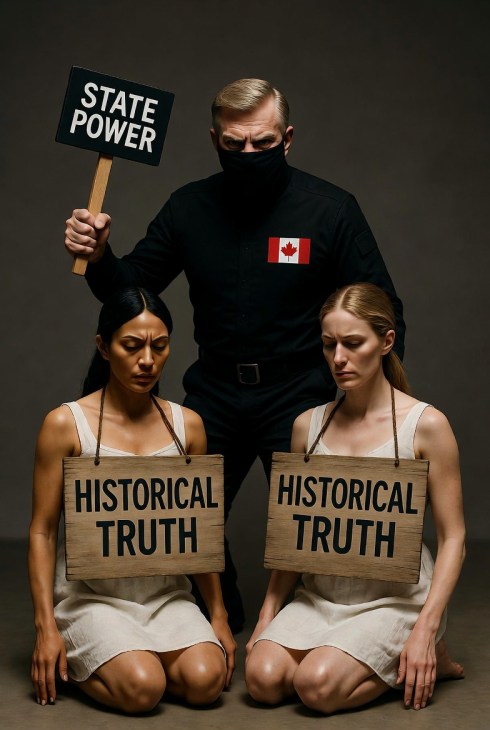
Historical truth does not become more trustworthy when the Criminal Code stands behind it.











 bleatmop
 Mystro


 Dead Wild Roses
Your opinions…