
You are currently browsing the tag archive for the ‘Kamloops’ tag.
Canada did not need less concern for possible graves at former residential schools. It needed more truth, earlier. The residential school record contains real wrongs: family separation, cultural suppression, abuse, neglect, disease, and documented deaths. But when the Kamloops announcement broke in 2021, the public story moved very quickly from ground-penetrating radar findings to language of “discovered remains” and “mass graves.” That distinction mattered. Ground-penetrating radar does not find bodies. It identifies disturbances, anomalies, and possible grave-like features that require verification.
The mechanism is familiar: narrative hardened faster than evidence. Grief became certainty. Certainty became accusation. Accusation became permission. A country already primed to view churches as historical villains suddenly had a simple moral script: children had been found, churches were responsible, rage was righteous. After that, Canada saw a wave of church fires and vandalism. A CBC investigation later reported that at least 33 Canadian churches had burned to the ground since May 2021; 24 were confirmed arsons, two were ruled accidental, and the remaining cases were suspicious or under investigation.
That caveat matters. We should not replace one sloppy narrative with another. Not every burned church was necessarily revenge for residential schools. Not every vandal was acting from the same motive. Some Indigenous leaders condemned the arsons, and some churches destroyed or damaged were themselves part of Indigenous communities. But it is also dishonest to pretend the atmosphere had nothing to do with it. The grave announcements were absorbed into a wider moral panic, and churches became symbols onto which anger could be poured.
This is the disservice. Public institutions, media, and political leaders helped sanctify a narrative before the evidence was ready to carry it. Then, when churches burned, the response was often strangely muted, hedged, or morally embarrassed. The same society that had no trouble speaking in grand certainties about historical guilt suddenly discovered nuance when actual churches were being attacked.
The answer is not denial of residential-school harms. It is truth over narrative, regardless of whose narrative is being protected. Children suffered. Families were broken. Some children died. Some claims also outran the evidence. A serious country should be able to say all of that at once. If Canada wants reconciliation rather than ritualized accusation, it has to stop treating careful factual distinctions as blasphemy. Truth does not become less necessary because the cause is emotionally powerful.
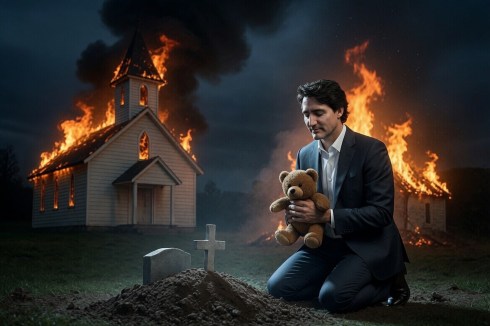
Canada needed truth, not ritual certainty. When narrative outran evidence, churches became symbols for rage.
Works Referenced
Tk’emlúps te Secwépemc. “Remains of Children of Kamloops Indian Residential School Discovered.” May 27, 2021.
https://tkemlups.ca/wp-content/uploads/05-May-27-2021-TteS-MEDIA-RELEASE.pdf
Sarah Beaulieu. “Ground-Penetrating Radar Preliminary Survey: Kamloops Indian Residential School.” Canadian Archaeological Association PDF.
https://canadianarchaeology.com/sites/default/files/page/gpr_at_kamloops_irs_sarah_beaulieu.pdf
Tk’emlúps te Secwépemc. “Media Release.” July 15, 2021.
https://tkemlups.ca/wp-content/uploads/July15_Media-Release_Final.pdf
Terry Reith, CBC News. “At least 33 Canadian churches have burned to the ground since May 2021. So far, 24 are confirmed arsons.” January 10, 2024.
https://www.cbc.ca/news/canada/edmonton/church-fires-canada-1.7055838
Angelus News. “Report: 33 churches in Canada destroyed since May 2021.” January 17, 2024.
https://angelusnews.com/news/nation/canada-churches-destroyed/
CBC News. “‘Unacceptable and wrong’: Trudeau condemns attacks on churches.” July 2, 2021.
https://www.cbc.ca/news/politics/trudeau-churches-arson-attacks-1.6088237
To think that these individuals are going to be in charge soon is positively frightening.
The documentary presents unedited footage of a Spectrum Street Epistemology session conducted by Frances Widdowson at the University of Regina on October 3, 2024, facilitated with Indigenous psychologist Lloyd Hawkeye Robertson. It contextualizes the event within Widdowson’s broader conflicts over academic freedom, detailing the cancellation of her scheduled talks titled “Indigenization and Academic Freedom: Lessons from the Frances Widdowson Case” and “The Grave Error at Kamloops: Should It Be Described as a ‘Hoax’?”
Key background: Widdowson, formerly terminated from Mount Royal University amid disputes over “wokeism” and identity politics, arranged the talks through librarian Robert Thomas. University administrators, including Provost David Gregory and Associate Vice President John Smith, canceled room bookings citing “safety concerns,” particularly proximity to the National Day for Truth and Reconciliation. Widdowson defied warnings, invoking Charter protections for public universities, and proceeded with the informal epistemology exercise in a student center, filmed by former faculty member Daniel Page.
The session examines claims via positioned mats (strongly agree to strongly disagree). Core claim: “The University of Regina protects academic freedom.” Robertson places himself at “slightly agree,” citing institutional policies like collective agreements but noting exceptions (e.g., pressures on Page and computer scientist Trevor Tomesh for LGBTQ-related criticisms and social media posts, respectively). Widdowson highlights her own case and systemic failures.
Related claims probed:
– Academic freedom equates to unrestricted speech: Robertson slightly disagrees, viewing it as narrower (professorial judgment in expertise) yet inseparable from broader expression.
– Professors may claim residential schools benefited Indigenous people: Robertson agrees in principle for academic freedom but personally disagrees overall, acknowledging abuses while noting some schools provided successes and First Nations lobbied to retain them post-1960s closures.
– Residential schools were harmful: Robertson agrees, referencing “residential school syndrome” (PTSD-like symptoms including rage), physical/sexual abuse, and underfunding, but not “strongly” due to variations across institutions.
Interactions escalate with students and a professor (Russell Fayant, from the Teacher Education Program), who arrives with a primed class. Participants accuse Widdowson of denialism, hate, and harming reconciliation; one claims her presence spikes blood pressure and causes distress. Widdowson counters with evidence gaps, e.g., Kamloops’ 2021 announcement of “215 children’s remains” (initially ground-penetrating radar anomalies, unexcavated) and William Combes’ unsubstantiated claim of Queen Elizabeth II abducting 10 children in 1964 (contradicted by royal itineraries). Disruptions include threats to an elderly attendee, projector unplugging, and event relocation from Regina Public Library due to organized opposition by coordinator Rachel Jean and journalism professor Trish Elliot.
Verifiable outcomes: No physical violence; security (Brad Anderson) monitors without intervention. Widdowson maintains composure, emphasizing evidence over emotion. Comments (242 visible) overwhelmingly praise her patience and critique students’ emotionalism, immaturity, and evasion of substantiation—e.g., prioritizing “therapeutic mythologies” over facts, fearing critical thought’s social costs.
Core tension: Widdowson’s insistence on verifiable evidence (e.g., excavations, historical records) clashes with appeals to lived experience, oral knowledge, and relational healing. She argues truth precedes reconciliation; opponents prioritize avoiding harm and building ties, viewing scrutiny as divisive. The session exposes institutional suppression—cancellations without due process—and student unpreparedness for rigorous debate, underscoring academic freedom’s erosion under indigenization mandates. No evidence supports mass murder claims at Kamloops; anomalies remain unconfirmed graves. The exercise, though chaotic, demonstrates dialogue’s possibility despite hostility, affirming verifiable truth as essential to intellectual integrity.
To unpack the Kamloops unmarked graves story, we need a French philosopher—Jean Baudrillard. He loved poking holes in modernity, especially how culture twists itself around shaky narratives. His big idea, hyperreality, describes a state where the line between reality and representation blurs so much the representation becomes more real—a world of signs pointing to other signs, not facts. It’s a four-stage slide into a simulation that outshines truth. Let’s see how Kamloops fits.
The Four Stages of Hyperreality
First Stage (A Sign Reflects Reality): You’ve got a symbol that points to something real. A photo of a mountain—it’s not the mountain, but it shows what’s out there. Clear connection, no tricks.
Second Stage (A Sign Distorts Reality): Now the symbol starts messing with the real. Think of a touched-up Instagram pic—still a photo of a mountain, but filters make it look “better” than the actual thing. Reality’s skewed, but you can still trace it back.
Third Stage (A Sign Pretends to Reflect Reality): Here’s where it gets dicey. The symbol acts like it’s tied to something real, but that real thing doesn’t exist. Baudrillard uses Disneyland as an example—a fake Main Street that sells nostalgia for a past that never was. It’s not reflecting reality; it’s inventing one.
Fourth Stage (Hyperreality—Signs Without Reality): Now the symbol doesn’t even pretend to care about reality—it’s a closed loop, a simulation of a simulation. Think reality TV: scripted drama sold as “real life,” but nobody’s asking what’s real anymore—they’re just hooked on the drama. The loop’s all that matters.
Got all that? Now let’s strap on our simulacra goggles and map this onto the Kamloops unmarked graves story—watch how reality gets buried.
Kamloops Through the Hyperreal Lens
First Stage: Sign Reflects Reality
If this were just about the radar findings, we’d start here—a report saying, “Hey, we found some weird soil patterns, might be graves, might not.” It’d point to a real investigation, grounded in facts. Residential schools left real scars, no question—but the Kamloops story spun into something else: a hyperreal mess where symbols outran facts. We didn’t linger here long.
Second Stage: Sign Distorts Reality
The initial framing—calling them “unmarked graves of children”—already stretched things. Ground-penetrating radar doesn’t show bodies; it shows anomalies. Media outlets, hungry for clicks, and activists, hungry for justice, ran with the graver version (pun intended). Headlines screamed “mass graves” (think CBC’s early “215 children found”), even though Tk’emlúps clarified it wasn’t that. Reality got airbrushed into something more dramatic.
Third Stage: Sign Pretends to Reflect Reality
Here’s where it gets spicy. The “215 children” became a cultural artifact—orange ribbons, vigils, government apologies—all built on a reality that wasn’t confirmed. It wasn’t lying outright; it just acted like the graves were a done deal. The media and public didn’t need proof—they needed a symbol. And boy, did they get one. Every Child Matters morphed into a movement, not a question.
Fourth Stage: Hyperreality—Signs Without Reality
Now we’re in 2025, and the simulation’s running the show. The “graves” aren’t just unproven—they’re beside the point. The story’s spawned funding (millions allocated for searches), laws (like bills to criminalize “denialism”), and endless X debates where “deniers” and “believers” slug it out over a phantom. It’s not about what’s under the ground anymore; it’s about what the idea of those graves does—how it shapes identity, guilt, policy, and power. That’s hyperreality: the menu’s tastier than the meal, and we’re all eating it up.
The Canadian Media’s Role
The media should be our first defense against false narratives and hyperreal incursions. Our Canadian media—particularly the CBC—ran headlong away from their duty to inform with facts. They chose style over substance, leaning hard into emotional hooks—“215 children,” “mass graves”—with little reporting on what ground-penetrating radar can reliably identify or the ground’s composition (leading to false positives). Objective reporting got tossed aside to boost the narrative and reactions to it. Stories about protests, church burnings, and government responses fed the loop, making the “graves” realer in discourse than in dirt. The simulacra’s at stage four—no reality needed for the story to keep going.
In Baudrillard’s world, this is how hyperreality wins—when the media trades facts for feelings, the simulation doesn’t just obscure reality; it replaces it. What happens when the next narrative rolls in—no dirt, all discourse?
The reporting around Kamloops isn’t about graves anymore; it’s about what simulacra we’ll fall for next. Baudrillard’s spinning in his grave—wherever that happens to be. So what’s the next simulacrum Canada’s media will peddle—more graves, more guilt, or something fresh? Drop your guess below.











 bleatmop
 Mystro
 The Arbourist


 Dead Wild Roses
Your opinions…