
Canada has entered the space race, and by “entered” I mean we appear to have placed a rectangle of concrete in the woods and surrounded it with gravel.
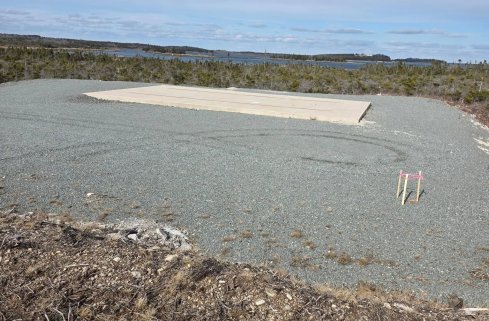
Canada’s space race appears to be stuck in Phase One: gravel.
This is not nothing. In government terms, it may already count as Phase One.
Somewhere, no doubt, there is a strategic framework, a ministerial announcement, a regional development grant, a climate lens, an Indigenous consultation pathway, a diversity procurement plan, and a glossy PDF featuring a child looking up at the stars. Canada loves a working group. It is how we convert urgency into chairs.
Meanwhile, private industry keeps doing the irritating thing it sometimes does: building things. Not perfectly, not gently, not without waste, ego, or spectacle. But the rockets exist. The launches happen. The failures produce data. The next version gets built. The machine moves.
Government moves too, but differently. It studies, regulates, announces, pauses, re-announces, commissions, rebrands, and eventually unveils a pad of poured concrete as evidence that the future has been properly consulted into existence.
This is the broader Canadian problem. We have become excellent at the language of ambition and strangely bad at the discipline of execution. We can describe innovation. We can fund innovation. We can convene panels on innovation. We can produce national strategies about innovation. But at some point, a serious country has to build the thing.
The comparison is unfair, of course. SpaceX is a private company with immense capital, a high tolerance for risk, and a founder constitutionally incapable of leaving well enough alone. Government has different responsibilities: accountability to citizens, laws, budgets, safety rules, and public interest.
Fair enough.
But accountability cannot become an alibi for paralysis. Regulation cannot become a substitute for competence. Process cannot become the product.
A country that wants a space industry needs more than a space-shaped clearing in the gravel. It needs permission to fail, speed to iterate, and institutions that understand the difference between managing decline and building capacity.
Canada does not lack talent, land, brains, or engineering ability. What it lacks is a governing culture that can still turn intention into machinery.
Until that changes, our space program may remain perfectly Canadian: safe, inclusive, fully consulted, and still waiting for liftoff.











 bleatmop
 Mystro
 The Arbourist


 Dead Wild Roses
3 comments
Comments feed for this article
June 18, 2026 at 8:44 am
tildeb
Two dollars of investment leave Canada for every dollar invested in Canada. What effect might this have over time, I ponder deeply?
We need to form a politically correct and gender balanced committee to find out if a Commission should be struck about delving into this issue right after we announce how many hundreds of millions of borrowed dollars will be used to appoint the right number of people with the right amount of representative identities to travel the country coast to coast to coast to listen to group leaders who represent various constituencies to write an inclusive policy paper whether or not to recommend further ‘action’ be taken by various levels of government right after community groups potentially affected as stakeholders have an opportunity to engage in the process and have their marginalized voices heard. But first, an environmental review of all potential effects must be undertaken, prepared, and presented.
It is amazing to me that the ratio of investment leaving to staying is not in the triple digits.
LikeLiked by 1 person
June 18, 2026 at 8:59 am
The Arbourist
Imagine if we could just do the thing and just skip the committee step. Wouldn’t that be nice?
LikeLike
June 18, 2026 at 9:07 am
tildeb
Job creation is an important government role, donchaknow. Not wealth creation that funds it all; job creation that sucks it dry.
LikeLike