
You are currently browsing the daily archive for July 28, 2026.
I have been a teacher for nearly twenty years, and one of the things we are purportedly supposed to teach is critical thinking. Yet I have rarely seen its meat and potatoes taught directly: how to examine a claim, distinguish evidence from inference, recognize our own incentives and ask what might prove us wrong. Epistemic hygiene seldom makes it to the table.
Knowing the difference between a transitive and intransitive verb is useful, but it does not teach someone how to interrogate their own cognition. Basic knowledge must come first because nobody can think critically about material they do not understand. After that, however, education often supplies more intricate content without spending much time on how beliefs are constructed, defended and corrected. Mastery means being able to teach the material reliably; thinking begins when you can examine its assumptions and identify what evidence would change your mind.
Genuine critical thinking—something different from applying the predetermined categories of critical theory—is harder still. On consequential subjects, truth must be extracted from incomplete evidence, interested testimony, competing interpretations and our capacity for self-deception. We are confirmation-seeking machines with an extraordinary ability to turn motivated reasoning into moral certainty.
My own intellectual progress—and I use the word progress lightly—began with enormous amounts of reading in my twenties and thirties: Noam Chomsky, Nick Turse, Chris Hedges, Naomi Klein, Arundhati Roy, Michael Moore and other writers overwhelmingly critical of the West, capitalism and American power.
Had I studied critical theory, dependency theory or post-colonialism, or grappled seriously with Derrida and Foucault? No. Nor had I read Milton Friedman or Friedrich Hayek; even now, I know much of their work through summaries rather than sustained engagement with the originals.
That was the trap. It was not that left-wing writers had gathered in a secret room and conspired to conceal their philosophical machinery. It was that the popular polemical writing I consumed rarely required me to inspect that machinery at all. Its conclusions arrived with their moral valence already installed. Capitalism was not merely an economic arrangement with strengths, failures and trade-offs; it was exploitation. Western power was not something to be judged according to particular actions and outcomes; it was presumptively imperial. Conservatives were not people advancing arguments I had considered and rejected. They were regressive people who wanted others to suffer.
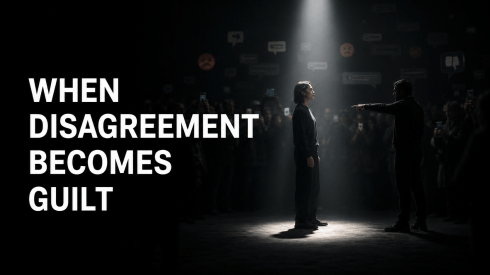
I had learned the conclusion—and the moral posture that protected it—before I understood the underlying dispute. Once that posture is established, disagreement no longer arrives as information. It arrives as evidence of guilt.
Consider a question that has become common in political conversation: “Surely you oppose the genocide Israel is committing in Gaza?”
It is grammatically a question but structurally a package of conclusions. Genocide is among the worst crimes human beings can commit; therefore, any decent person must oppose it. That part is easy. The difficulty is that the sentence quietly joins this uncontested moral premise to a disputed factual and legal conclusion: that Israel’s conduct in Gaza constitutes genocide.
To pause before accepting the second proposition is not to endorse dead civilians, starvation, collective punishment or war crimes. It is to ask whether the term has been established. Genocide requires specified acts accompanied by the intent to destroy, in whole or substantial part, a protected national, ethnic, racial or religious group. At the time of writing, the International Court of Justice has not issued a final judgment on South Africa’s case against Israel.
A responsible answer might begin: “I oppose genocide without qualification. I am not yet persuaded that genocide is the legally accurate description of Israel’s conduct in Gaza.”
Yet this distinction is often where the moral mechanism activates. Why are you reluctant to condemn genocide? How can you defend what Israel is doing? What kind of person needs more evidence while children are dying? The demand for factual discrimination is recoded as moral indifference, and uncertainty becomes complicity. If the exchange deteriorates far enough, racism, fascism and comparisons to Hitler soon follow.
Notice what has disappeared. We are no longer examining conduct, casualties, official statements or evidence of intent, nor distinguishing genocide from war crimes, crimes against humanity or the legally different consequences of urban warfare. The person who questioned the premise has been placed on trial instead.
Once you have been called a racist and had your ethical character placed under suspicion, what are you supposed to do? Real conversations occur within a social fabric of friendships, workplaces, institutions and reputations. People who know little about the original dispute still understand that proximity to an alleged racist can carry costs.
The rational response is often retreat: qualify what you said, apologize for how it was received or remain silent. None of this determines whether the original claim was true.
Being told to “do the work” can operate in much the same way. There are circumstances in which nobody is obligated to provide an introductory seminar to a belligerent stranger. But when someone advances a disputed public claim, the burden of supporting it does not transfer automatically to anyone who asks for evidence. “Educate yourself” is not an argument, and a reading list assembled entirely within one intellectual tradition is not a substitute for demonstrating the claim.
The accusation creates an enormous asymmetry. It takes seconds to call someone racist, transphobic, fascist or complicit in genocide. Answering may require reconstructing what was said, the evidence behind it and the distinctions being made. By then, the accusation has travelled farther than the rebuttal ever will. Whether intended or not, the effect disciplines everyone watching: this is what happens when the approved conclusion is questioned. What has been established is the price of examining it.
Social media does not create this mechanism, but it forms an unusually effective positive feedback loop around it. Ordinary conversation contains corrective signals: tone of voice, facial expression, hesitation, familiarity and the opportunity to clarify a sentence before it hardens into a verdict. Social media amputates those cues and places the exchange before an audience.
In its place, the platforms provide numbers. Likes, reposts, replies and impressions become crude heuristics for approval and importance, neither of which should be confused with truth. A careful argument that introduces uncertainty may appear weak beside a morally certain accusation that can be understood and shared in seconds. “That claim lacks evidence” requires examination. “You are a racist” requires only allegiance.
The economic structure reinforces the tendency. X allows eligible creators to earn money from content that generates impressions and interaction. Engagement measures activity, not truth value. A correction and a furious denunciation both count; the denunciation may travel farther because anger recruits participants more efficiently than qualification. Moral certainty produces engagement, engagement produces visibility, and visibility is mistaken for consensus.
None of this means moral judgment should be banished from argument. Some propositions are morally repugnant. An argument for racial supremacy, the deliberate murder of civilians or the legal subordination of women should be examined and condemned in moral terms. Refusing to make moral distinctions would not produce intellectual neutrality. It would produce moral cowardice.
The challenge is determining whether the judgment follows from honest examination or merely records our reaction to the person making it. The tribal animal in us is never far beneath the surface. When something important to our identity is questioned, we can experience disagreement as hostility, identify an enemy and begin assembling reasons why a bad person would say such a thing. Evidence is recruited for prosecution rather than examined for understanding.
This tendency is not confined to the activist left. Conservatives, religious communities, nationalists and every other group capable of forming a moral identity can protect their conclusions in the same way. The subject here is the moral vocabulary prevalent in contemporary progressive activism, not because progressives invented tribal cognition, but because terms such as racist, transphobic, fascist and complicit in genocide have become powerful instruments for enforcing its boundaries.
Some people earn those descriptions. The obligation is to demonstrate how. What exactly did the person claim? Was the disagreement factual, definitional or moral? What evidence supports the accusation? Are we applying the same standard to our allies? What would convince us that we had judged the person unfairly?
Charity does not mean weakening the conclusion until nobody can object to it, nor does it require endless patience with someone acting dishonestly. It means identifying the strongest fair version of an argument before criticizing it, locating the actual source of disagreement and leaving open the possibility that either participant may be wrong.
That final possibility is what the prefabricated moral accusation removes. Once disagreement proves guilt, the accuser no longer needs an error-correcting mechanism. The righteous cannot learn from the wicked; they can only expose, discipline or silence them.
The alternative is less emotionally satisfying and considerably more difficult. Return to the proposition. Separate the moral premise from the factual claim. Demand evidence without pretending that evidence eliminates moral responsibility. Judge conduct when the judgment has been earned, and remain willing to correct the judgment when it has not.
A society capable of disagreement must make room for people to be mistaken without making them monsters. Otherwise, moral language ceases to guide inquiry and becomes the means by which inquiry is brought to an end.
References
- International Court of Justice. “Application of the Convention on the Prevention and Punishment of the Crime of Genocide in the Gaza Strip (South Africa v. Israel).” https://www.icj-cij.org/case/192
- United Nations Office on Genocide Prevention and the Responsibility to Protect. “Definitions of Genocide and Related Crimes.” https://www.un.org/en/node/218413
- X Help Center. “Creator Revenue Sharing.” https://help.x.com/en/using-x/creator-revenue-sharing











 bleatmop
 Mystro


 Dead Wild Roses
Your opinions…