
You are currently browsing the daily archive for February 15, 2026.
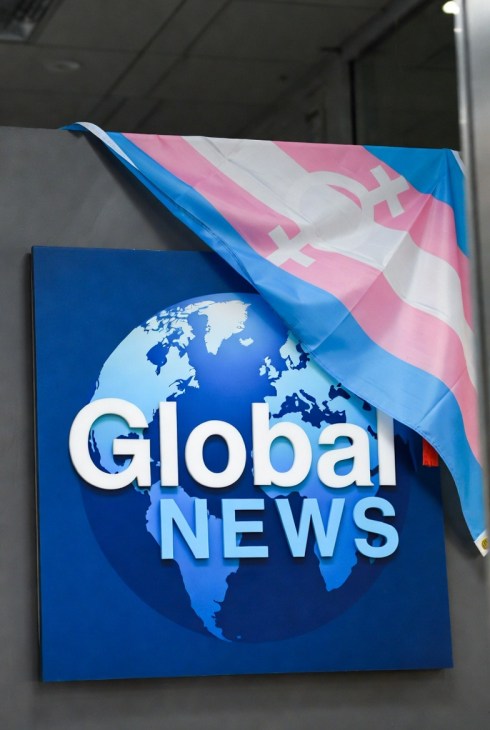
Global National ran an “overnight” segment after the Tumbler Ridge massacre under a framing that is, in its own way, a confession: “Anti-trans disinformation circulates after mass shooting.” (Global News)
Not Who died? Not How did this happen? Not What failed? Not What do we change Monday morning?
The story, as packaged, is not forensic. It’s prophylactic. The first institutional instinct is not to look hard at systems and sequences, but to manage reputational spillover: prevent a narrative from becoming “dangerous,” protect a constituency from backlash, and pre-label certain lines of inquiry as moral contamination.
That choice matters, because a town is burying children.
And because when journalism reaches for a firewall before it reaches for an autopsy, it stops being a public service and becomes a public-relations function.
What Actually Happened: Sequence Before Sermon
On February 10, 2026, an 18-year-old, Jesse Van Rootselaar, killed people at home and then attacked Tumbler Ridge Secondary School before dying by suicide. Multiple accounts report that the attack began with the killing of the shooter’s mother and 11-year-old half-brother, followed by the school shooting. (The Wall Street Journal)
The victims include five students (ages 12–13) and a 39-year-old education assistant, with the mother and half-brother killed beforehand. Names and details have been published widely and confirmed in Canadian Press reporting and related coverage. (People.com) The BC RCMP also issued a public confirmation of deceased victims. (RCMP)
That’s the baseline: a chain of events with a clear order—home, then school—ending in a pile of dead kids and a town whose grief will not be solved by better discourse hygiene.
Sequence matters because it points to systems:
- What warnings existed and where?
- What interventions were attempted and by whom?
- How were firearms stored and accessed?
- What did the school know, and when?
- What did police know, and what tools were used (or not used)?
- What gaps exist between “we did a wellness check” and “we prevented a catastrophe”?
Reporting indicates a history of mental-health-related police interactions and investigators reviewing digital footprint and online activity. (The Wall Street Journal)
These are the questions you chase when you treat murder as a real event in the world—not as a pretext for messaging.
What Global Chose to Do Instead
Global’s piece does not begin at the crime scene. It begins in the information ecosystem.
In the related Global coverage and clip description, the emphasis is on how the suspected shooter’s trans identity is “being used to fuel misinformation online,” and the segment elevates advocacy voices concerned about anti-trans sentiment. (Global News)
To be blunt: they treat the massacre as a vector for disinformation, rather than as a symptom of institutional failure.
This isn’t a claim that concerns about backlash are always illegitimate. It’s a claim about priority and timing.
You can caution against scapegoating without making that caution the lead, the thesis, and the moral center—while the basic forensic questions remain unasked in the same breath.
Worse, the frame is fortified by official moral language. BC’s Human Rights Commissioner issued a statement warning against conflating trans identity with violence and calling such conflation “incorrect, irresponsible and frankly dangerous.” (bchumanrights.ca)
Again: that statement may be true as a general principle—identity is not destiny—but it is also rhetorically useful as a solvent. It dissolves scrutiny by implying that scrutiny is the harm.
And in the current media climate, once a question is placed inside the “dangerous” bucket, it stops being investigated and starts being policed.
That is what narrative-commitment looks like: not lying, necessarily—just selecting a reality tunnel and treating alternate tunnels as morally suspicious.
Why This Reads as Out of Touch
Because the public is not asking for a sermon. The public is asking for accountability you can measure.
When parents hear “anti-trans disinformation” as the headline after a school attack, the implied hierarchy is:
- protect the narrative
- protect the vulnerable (as defined by the segment)
- later, perhaps, protect the public
That hierarchy does real damage.
It tells the bereaved: “We have already decided what the real emergency is.”
It tells the skeptical: “Your questions are morally tainted.”
It tells institutions: “If your policies intersect with a protected narrative, you will be insulated from the normal post-disaster autopsy.”
And it tells everyone else to stop trusting the gatekeepers.
Journalism doesn’t lose trust because it has values. It loses trust because it has values that pre-empt facts.
What a Forensic Post-Tumbler Ridge Agenda Looks Like
If you want a serious follow-up—one that serves victims, not narratives—here are the obvious “system” targets. None of this requires scapegoating an identity. It requires the courage to audit failures like adults.
1) A full public timeline, cross-agency
A public accounting that stitches together: school records, police contacts, mental-health interventions, family context, and warning signs—chronologically, with decision points. This is how you find the failure nodes.
2) Firearms access: storage, compliance, and enforcement gaps
Reporting indicates multiple firearms were used and investigators are examining how they were obtained. (The Wall Street Journal)
The question is not “gun control” as a slogan. The question is: What specific mechanisms failed—safe storage, licensing, supervision, enforcement, reporting? Fix the mechanism, not the talking point.
3) Threat assessment and school safety protocols that actually bite
Most institutions are good at paperwork and bad at escalation. Schools need a protocol that converts “concerning behavior” into structured threat assessment, and threat assessment into action—without letting “this might stigmatize” become the veto.
4) Mental-health intervention that doesn’t stop at “wellness checks”
If repeated mental-health-related police visits are part of the story—as reporting suggests—then the system question is: what happens after the tenth check? (NBC 5 Dallas-Fort Worth)
Communities need a bridge between crisis contact and sustained containment: follow-up, risk management, family support, and clear thresholds for escalation.
5) Media standards: separate “backlash management” from “causal inquiry”
A newsroom can do both—but not in a way that treats one as taboo. Post-massacre coverage should have a simple rule:
- Name the victims.
- Lay out the timeline.
- Identify plausible failure points.
- Present what is known, what is not, and what must be investigated.
- Only then: address secondary narratives (backlash, misinformation, online dynamics).
Right now, too many outlets reverse that order.
The Real Test: Can We Ask the Questions Without Being Moralized Into Silence?
There is a difference between scapegoating and scrutiny.
Scrutiny is what you owe dead children.
If the media class cannot bring itself to treat Tumbler Ridge as a forensic event first—if it must immediately translate it into a morality play about discourse—then it is not merely “out of touch.” It is structurally incapable of learning.
And systems that cannot learn repeat.
Not because people are evil, but because the firewall held—until it didn’t.












 bleatmop
 Mystro
 The Arbourist


 Dead Wild Roses
Your opinions…