
You are currently browsing the tag archive for the ‘Land Back’ tag.
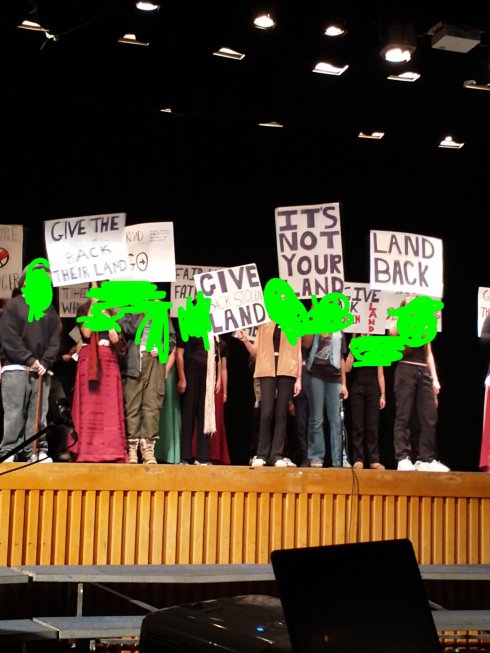
In recent years, Canadian public schools have increasingly incorporated political themes into extracurricular events, including winter concerts. A widely discussed example occurred at Karen Kain School of the Arts in Toronto, where Grade 8 students performed a skit during a December “winter concert” featuring protest‑style signs such as “Give Back Stolen Land” and “Land Back.” The performance replaced traditional seasonal programming with messaging aligned with the contemporary “Land Back” movement. While the intent may have been to highlight Indigenous history, the choice of format and venue raises important questions about the appropriate boundaries between education and activism in publicly funded schools.
To evaluate this incident fairly, it is essential to distinguish between curricular education—which is mandated, necessary, and valuable—and extracurricular political advocacy, which carries different expectations and responsibilities.
Ontario’s curriculum explicitly requires students to learn about Indigenous histories, treaties, residential schools, and the Truth and Reconciliation Commission’s Calls to Action. These topics are not optional; they are embedded in the Social Studies and History curriculum for Grades 1–8. Teaching them is not activism—it is education grounded in historical fact and national responsibility. When taught in the classroom, these subjects can be explored with nuance, context, and opportunities for critical thinking.
The issue at Karen Kain is not the subject matter itself, but the format and framing. A winter concert is traditionally a community‑building event: inclusive, celebratory, and accessible to families of all backgrounds. Parents attend expecting music, dance, or drama that reflects seasonal themes or showcases student creativity. Transforming such an event into a protest‑style performance shifts the purpose from celebration to advocacy. It also removes the pedagogical safeguards—balanced discussion, guided inquiry, and contextual explanation—that exist in the classroom.
The “Land Back” movement, while rooted in legitimate discussions about Indigenous rights and historical treaties, is also a politically contested movement with a wide range of interpretations and significant implications for land ownership, governance, and public policy. Presenting it through slogans and protest imagery, without space for analysis or alternative perspectives, risks conveying a single ideological stance rather than fostering informed understanding. For 13‑ and 14‑year‑old students, who are still developing the ability to evaluate complex political claims, this can blur the line between learning about a movement and being encouraged to endorse it.
This concern is not hypothetical. Surveys consistently show that many Canadian parents prefer schools to avoid pushing students toward political activism, even on causes they personally support. Parents generally want schools to prioritize academic learning, critical thinking, and balanced instruction rather than advocacy. When extracurricular events adopt activist framing, it can erode trust by making families feel blindsided or excluded from decisions about what messages their children are asked to perform publicly.
None of this means schools should avoid difficult topics or silence discussions of Indigenous rights. On the contrary, these subjects deserve thoughtful, rigorous treatment. But context matters. A winter concert is not the venue for dramatizing contested political movements. Doing so risks reducing complex issues to slogans, bypassing critical engagement, and placing students in the role of political actors rather than learners.
A healthier approach would preserve the distinction between education and advocacy. Teach Indigenous history thoroughly in the classroom, as the curriculum requires. Encourage students to analyze movements like Land Back with intellectual seriousness. But keep extracurricular performances focused on inclusive, community‑oriented themes that unite rather than divide.
By maintaining this boundary, schools can honour both their educational mission and their responsibility to provide neutral, welcoming environments for all families—ensuring that learning remains grounded in inquiry, not activism, and that public events remain spaces of shared celebration rather than ideological theatre.
References
Original Incident and Reporting
Pfahl, Chanel (@ChanLPfa). “A parent at the Toronto District School Board sent me these pictures from the ‘Winter Concert’…” X (formerly Twitter), 18 Dec. 2025. https://x.com/ChanLPfa/status/2001719861723173203
“Toronto Grade 8 students stage ‘Land Back’ protest at school ‘winter concert’.” Juno News, 19 Dec. 2025. https://www.junonews.com/p/toronto-grade-8-students-stage-land
Ontario Curriculum Requirements
Ontario Ministry of Education. “Indigenous Education in Ontario.” Government of Ontario, updated 2 Sept. 2025. https://www.ontario.ca/page/indigenous-education-ontario
“Indigenous history, culture now mandatory part of Ontario curriculum.” CBC News, 8 Nov. 2017. https://www.cbc.ca/news/indigenous/indigenous-history-culture-mandatory-ontario-curriculum-1.4393527
Context on the “Land Back” Movement
“The Indigenous ‘Land Back’ Movement: A Land Mine for Canadians.” C2C Journal, 28 Oct. 2024. https://c2cjournal.ca/2024/10/the-indigenous-land-back-movement-a-land-mine-for-canadians/
Parental Attitudes Toward Activism in Schools
Zwaagstra, Michael, and Alex MacPherson. “Canadian parents don’t want schools to push students into political activism.” Fraser Institute, 2024. https://www.fraserinstitute.org/commentary/canadian-parents-dont-want-schools-to-push-students-into-political-activism











 bleatmop
 Mystro


 Dead Wild Roses
Your opinions…