
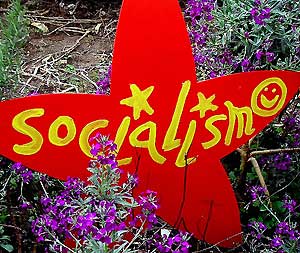
 It is nice to establish base definitions everyone once and awhile. With all the rambling going on in the blogosphere it seems that certain basic terminology needs a good going over. Socialism happens to be one of those terms as suddenly in the US healthcare debate it has been repeatedly mischaracterized as misanthropically evil. Socialism, like Capitalism, has its flaws but it is certainly not intrinsically evil. A system based on exploitation of another however might qualify….
I grabbed this definition from a ytube video that attempts to define what Socialism is. The video is a little bombastic, but gets the point across. Socialism is a political economic philosophy that is based on a democratically cooperative society in which the means of production and distribution are owned by the people.
Or see what dictionary.com has to say about Socialism:
so⋅cial⋅ism
| 1. | a theory or system of social organization that advocates the vesting of the ownership and control of the means of production and distribution, of capital, land, etc., in the community as a whole. |
| 2. | procedure or practice in accordance with this theory. |
| 3. | (in Marxist theory) the stage following capitalism in the transition of a society to communism, characterized by the imperfect implementation of collectivist principles. |











 bleatmop
 Mystro


 Dead Wild Roses
5 comments
August 29, 2009 at 1:19 pm
jonolan
Even in it’s truest form, it’s a failed and pernicious idea. Remember, under true Socialism everything is own by the people as a whole and nothing by the individual. As such, individual endeavor is discouraged.
LikeLike
August 30, 2009 at 10:23 am
The Arbourist
The truest form of any political system tends to have less than desirable results.
In Socialism the means of production and distribution of goods is owned by the people, a far stretch from ‘everything’. Private property still exists. Rather than having companies sacrifice all for profit, a more egalitarian framework is used. People who work for the company benefit when the company does well, as opposed to being thrown a few crumbs, exonerated to work harder and then promptly laid off when the bottom line demands it. The production of goods for the people, by the people should not be considered a radical notion. Cooperation instead of direct competition; a society less divided along lines of wealth and class is a more harmonious society. Socialism is a viable economic solution.
I wrote this post to encourage debate and help shed some light on Socialism. The idea that individual endeavour is discouraged under Socialism comes straight from the Randian camp of Objectivism, which outside libertarian circles holds little merit in discussion. I believe this criticism of Socialism to be false, or at least mischaracterization of what Socialism is about. Not being exploited by the bourgeois and working to make profit for (yourself) the worker instead of someone else is a very good incentive to be productive and innovative.
LikeLike
August 30, 2009 at 11:52 am
jonolan
In practical terms what you’re describing can only – unless mankind completely changes its behaviors – be accomplished through force of the State. That results in the State Socialism that has failed so many times in the past and that will most likely continue fail every time a nation is fool enough to try it.
Look at was has happened in America. Every time the workers – the proletariat if you will – has taken a large part of the control of production, the result has been failure ala the steel industry and the USW and the auto industry and the UAW.
One bourgeois group’s power is merely replaced by another’s.
I think it is better to encourage Capitalism and the Free Market without the protections from the State which are so common for large corporations. A broader base of production provides more options and control to the worker.
LikeLike
August 31, 2009 at 2:13 pm
The Arbourist
Mankind has been and is capable of collaborative and co-operative behaviours, as a matter of fact most of our history has been spent in this particular mode of existence.
Only with the introduction of the state do we see the class divisions and the crushing inequities that are part and parcel of our current system.
State socialism seems to be doing rather well in China, I’m not really a big fan of how they have implemented the system, but the example is relevant enough to refute your claim that socialism fails the majority of the time.
Choosing the US as an example of union power is not a particularly charitable example of Unions in action (the US as of 2006 only had 12% of its workforce unionized). Furthermore, the failures of the steel and auto industry should not squarely be placed on the shoulders of the Unions. There were many factors that contributed to the downfall of those industries: NAFTA, draconian ‘right-to-work’ laws, outsourcing, and business model inertia in the case of the auto-industry all had more to do with the demise of those industries than the demands of the workers.
Capitalism and the Free Market go hand in hand with exploitation and the disequilibrium that are the cause of so many social ills. The Free Market has yet to be seen; on any sort of large scale we see oligarchic and monopolistic interests bend the market to their will enriching themselves at the cost of fleecing the rest of society.
That is the fundamental truth of capitalism, exploitation and ruination for the workers while the corporate elite and bourgeois fatten themselves on the fruits of others labour. Capitalism eats itself, Enron, World.COm, Citigroup, Bank of America – founded on greed and destroyed by greed, unless of course saved by a bail out. Which of course is socialism for the rich, which in the US, the people have never had a problem with because it is an inherent part of the system and not questioned*.
*The recent bailouts have caused a blip of concern because of their magnitude, but historically the socialism of the rich flies under the radar.
LikeLike
November 18, 2009 at 4:15 pm
Rutherford
Socialism is the communism of the 2000’s. It is used as a “scare” word. The big question with capitalism or socialism is what will be the role of government. In a capitalistic society government can stand back and let the system ruin the lives of the middle class. In a socialist society, government can intervene oppressively.
The trick with these systems is how the economic construct is implemented by government. That’s where things get sticky.
LikeLike