
You are currently browsing the monthly archive for August 2010.
The books we read define who we are. The books we choose inform our world view and how we look at the events in the world. The dissident viewpoint is not particularly fun or easy to hold as every point must be scrupulously backed up with ample evidence to be even considered in conversations and debate. This list, as the title says, is not complete nor will it probably ever be as education and learning never stops during a lifetime.
This post serves also to provide insight into the how and why I talk about issues and the positions I take while debating.
The first, and probably most important work to my education as a rational human being would have to be the grand tomb by Edward S. Herman and Noam Chomsky – Manufacturing Consent. It is an acutely precise documented look at the American Media. Manufacturing Consent also offers a propaganda model to assist in analyzing and understanding how the media works, the reason for the prevalent rightward bias, and why that bias exists.
MC really started my adult education, as it caused me to become skeptical of what I had been taught in school and question the assumptions and point of view of how most my classes where taught.
I should mention Hegemony or Survival and The Fateful Triangle and Year 501: The Conquest Continues as well. They all brought clarity to the questions about how the world works and more importantly the structures in place that work against justice, egalitarianism and freedom.
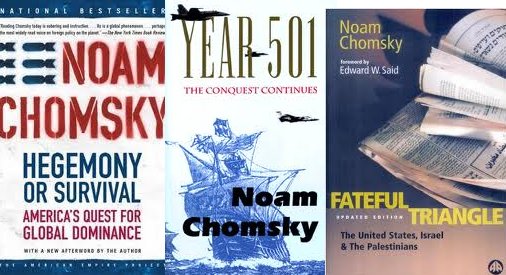
I have read more Chomsky, particularly to understand the Vietnam War but I would single out these four works as being particularly important.
 Howard Zinn is another major figure in my interpretation of history. It was his A People’s History of the United States that really reinforced the idea of history being written by the victor and how important alternate narratives are in understanding history. Out of the rest of his works, I have read War and Terrorism, which I also recommend as it is also very informative and illuminating.
In a similar vein, Major General Smedley Butler‘s work War is a Racket also ranks prominently in my readings of Western History because he simply tells it like it was for him, as a member of the United States Armed forces. His prescient observations are ever more true today.
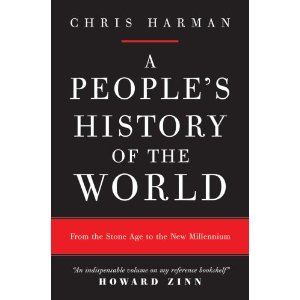 I came upon Chris Harman’s book A People’s History of the World, like Zinn’s work it is a depressingly good read. I have only read it once, but it is coming back into rotation as is a valuable reference and starting point for further historical analysis.
It sits beside my copy of Zinn’s work as part of the spine of my history collection.
A fiery excerpt from one of his speeches.
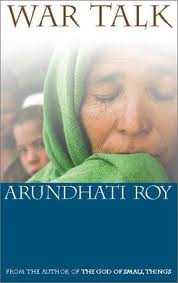 War Talk, An Ordinary Person’s Guide to Empire by Arundhati Roy, and Taraq Ali’s Pirates Of The
 Caribbean: Axis Of Hope (2006), Bush in Babylon (2003), and Clash of Fundamentalisms: Crusades, Jihads and Modernity (2002). Both Roy and Ali provide external analysis of our situation in the West and how we are viewed by the rest of the world. Ali is a powerful speaker and I had the opportunity to listen to him when he came to the University in 2008. His eloquence and arguments made for an evening to remember. External points of view are necessary, but sometimes a homegrown view is necessary to provide more perspective on the important issues of our time.
The Canadian Naomi Klein and her works fits nicely into the puzzle giving a Canadian view of the world as it. I did not enjoy NoLogo very much but found The Shock Doctrine to be a necessary and informative read about how the elites do what they must to rule the world. The Shock Doctrine explains how countries are jolted into submission before neoliberal reforms are forced on them. Again, file under good but depressing reading.
I almost forgot one of the most important works of history that I have read. It is called The Great War for Civilization by Robert Fisk. It is a huge work spanning most of Fisk’s journalistic career. It is history close up, a punch in the nose of a wake up call as for what trouble with Middle East and ‘civilizing influence’ there.
This list is a longer than I first expected, as even after 500 words I have covered only a couple of areas of the literature that informs my view and opinion on the world (in retrospect, probably a good thing). I will cover other areas of my interests in future posts.
 I am going to use the discussion points found on RichardDawkins.net as the basis of this feature.
Calilasseia is the author of the post and deserves many rich accolades for assembling so much useful information in one spot. This constitutes an open thread of sorts, please leave your opinions and observations in the comment section.
Enjoy!
[11] The tiresome conflation of evolutionary theory with abiogenesis (with Big Bang side salad).
A favourite one, this, among the creationists who come here. Which always results in the critical thinkers going into petunias mode (read Douglas Adams in order to understand that reference). Since so many creationists are woefully ill-educated in this area, I shall now correct that deficit in their learning.
Evolutionary theory is a theory arising from biology, and its remit consists of explaining the observed diversity of the biosphere once living organisms exist. The origin of life is a separate question, and one which is covered by the theory of naturalistic abiogenesis, which is a theory arising from a different scientific discipline, namely organic chemistry. Learn this distinction before posting, otherwise you will simply be regarded as ignorant and ill-educated.
While we’re at it, evolutionary theory does not consider questions about the origin of Planet Earth itself, nor does it consider questions about the origin of the universe. The first of these questions is covered by planetary accretion theory, the second by cosmology, both of which arise from physics. As a consequence of learning this, if you subsequently erect the tiresome conflation of evolutionary theory with the Big Bang or the origin of the Earth, be prepared to be laughed at.
Strike that. Give us your perimeter fences, surveillance drones and border guards.
“U.S. President Barack Obama on Friday signed into law a bill to improve security at his country’s border with Mexico.
The $600-million US measure will pay for the hiring of 1,000 new Border Patrol agents and the purchase of new communications gear — including surveillance drones.”
 I guess the poor and tired masses need to go to a different country as the US is plum full up.
“But his administration has come under fire from many Republicans for not doing enough to prevent huge of numbers of Mexicans from illegally crossing the border into the U.S. The issue seems likely to play prominently in this fall’s mid-term elections.
The controversy over how best to deal with Mexican migrants came to wide public attention earlier this year, when Arizona passed a controversial law that required law enforcement officers to check the immigration status of anyone they reasonably suspect of being an illegal immigrant.”
Past the glaring police-state provisions that were once part of the Arizona bill, Obama guessed he would have to do something to support the xenophobic undercurrent that swirls in the southern states. As the article says, mid term elections are coming, which I guess is code for pandering to the Republicans and putting ones own liberal democratic base into a deeper category of “ignore”.
I hypothesize that his move will only further alienate the people who elected Obama as president and will make the US electoral choice of the lesser of two evils a closer call.
“On Wednesday, Florida lawmakers introduced their own immigration bill that would require immigrants to carry valid documentation or be jailed for up to 20 days.”
Well, I guess Arizona cannot have all the authoritarian fun. :/
Wonder why things are generally going as they are? Start here.

The people at Cognitive Media are really quite brilliant. They take speeches from experts in a myriad of fields and then as they speak, an artist conceptualizes the points the speaker makes on a white board in real-time (well, artists white board is sped up, as drawing is not as fast as speaking).
Dan Pink’s talk on motivation illustrates some of the myths we have come to embrace about motivating and rewarding people. Money is definitely not everything. Unsurprisingly what counts is autonomy, mastery and purposefulness; throwing more money into the equation tends to give poorer, sometimes even disastrous results.











 bleatmop
 Mystro


 Dead Wild Roses
Your opinions…