
You are currently browsing the daily archive for February 5, 2026.
If a government’s job is to steward the conditions for ordinary people to build, trade, invest, and plan a life, then our federal leadership has been doing that job badly.
Not because Canadians are lazy. Not because the world is easy. But because the governing reflex is wrong: when something breaks, Ottawa reaches for a new program, a new credit, a new rebate, a new subsidy, a new “strategy.” It treats the economy like a patient that can be stabilized indefinitely with IV drips.
That approach can buy headlines. It cannot buy prosperity.
The best indicator is per-person performance. We can argue about which yardstick matters most, but the story is consistent: Canadians are producing less per person than we should be, relative to peers and especially relative to the United States. When per-capita output stagnates, everything gets harder at once: housing feels unaffordable, healthcare feels strained, wages feel thin, and every problem becomes a fight over slices instead of a discussion about baking more bread.
The policy style matters because it shapes incentives. When governments patch symptoms with cash transfers while leaving the cost structure and the approval structure untouched, they teach the country the wrong lesson: don’t fix the machine; keep bribing the machine not to squeal.
The mechanism: why “more programs” keeps failing
Here’s the basic mechanism, stripped of moral drama:
- High costs and slow approvals choke supply.
Housing, energy, infrastructure, major projects, even small-business expansions: Canada is a country that says “no” and “later” far more often than it says “yes” and “go.” Every delay is a tax. Every duplicated review is a tax. Every veto point is a tax. - Government then tries to “help” people pay the tax it created.
Rebates, credits, subsidies, targeted relief. It’s a strange kind of compassion that insists on first inflating the cost of living and then offering a coupon to survive it. - Those programs don’t increase productivity.
They redistribute purchasing power. Sometimes that’s justified in emergencies. But as a governing model it becomes a treadmill: you need ever-larger transfers to offset the same underlying frictions. - Meanwhile investment goes elsewhere.
Capital avoids uncertainty, delays, and politicized approvals. If the return on effort is higher across the border, it doesn’t matter how many committees we convene about “competitiveness.” The money leaves. So do the high-productivity jobs.
That’s the loop.
Steelman: “But the government is trying to protect people”
Yes. There are real hardships and real shocks: pandemic aftershocks, energy volatility, inflation waves. A modern state can’t pretend none of that exists.
But a serious government distinguishes relief from policy habit.
Relief is temporary and humble. It treats symptoms while it removes the causes.
Policy habit is permanent and proud. It treats symptoms and declares victory.
Canada’s problem is not that government ever helps. It’s that government too often helps in a way that replaces fixing the constraints. Then it wonders why the constraints keep biting.
The verdict
If your economic model is “make life expensive, then subsidize the expense,” you don’t get abundance. You get dependency, resentment, and a widening gap with jurisdictions that still know how to build.
You also get a politics where every election becomes a bidding war over who will mail the bigger cheque, because structural reform has been quietly taken off the table.
That’s not leadership. It’s managed decline with better graphics.
Three solutions that trust Canadians
These aren’t “one weird trick” fixes. They’re principles that put choice back in the hands of households and entrepreneurs rather than bureaucracies.
1) Let people keep more of what they earn, especially on essentials
If Ottawa wants to help with affordability, it should stop pretending price pressures are solved by “targeted” programs. The cleanest help is broad, simple tax relief that lets people choose.
- Cut taxes that hit basics hardest (and stop layering cost-pushers into the production chain).
- Prefer lower rates and fewer carve-outs over boutique credits that require a rulebook and a caseworker to access.
- If a policy goal requires a price signal, keep it simple and transparent, not buried across permits, compliance, and pass-through.
This trusts Canadians because it doesn’t tell them what to buy. It stops taking their money and then re-selling it back to them with a government logo.
2) Slash approval times and regulatory duplication so builders can build
Canada does not have a “housing feelings” problem. It has a permission structure problem.
- Set hard timelines for approvals and treat missed deadlines as automatic escalation or approval, not “we’ll get back to you.”
- Collapse overlapping reviews and require agencies to coordinate rather than serially veto.
- Align incentives so provinces and municipalities that approve homes and infrastructure fast aren’t punished for growth.
This trusts Canadians because it assumes the default answer to a lawful project is “yes,” and it lets builders, trades, and communities respond to demand without waiting years for permission.
3) Open the country internally: real competition, real mobility, real choice
A country shouldn’t feel like 10 small markets with paperwork toll booths between them.
- Remove internal trade barriers so goods, services, and workers can move freely across provinces.
- Make credential recognition faster for skilled trades and professionals so talent isn’t trapped behind provincial gatekeeping.
- Reduce the habit of picking “future sectors” by subsidy and instead create conditions where any sector can win if it serves customers.
This trusts Canadians because it relies on competition and mobility, not bureaucratic selection. It lets consumers choose, lets workers move, and lets businesses scale without needing a lobbyist.
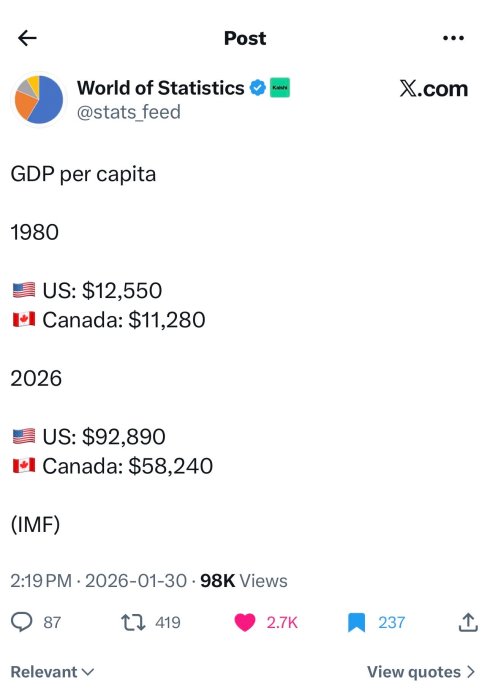
If Ottawa keeps governing by bandage, the next few years will look like the last: higher spending, louder announcements, thinner per-person results, and a country that feels like it’s working harder for less. The gap won’t close by intention. It will close only when we stop confusing “more government activity” with “more national competence.”











 bleatmop
 Mystro


 Dead Wild Roses
Your opinions…