
You are currently browsing the category archive for the ‘Canada’ category.
 China’s interference in Canada and its politics involves a mix of economic leverage, influence operations, and clandestine activities aimed at shaping outcomes to favor Beijing’s interests. Based on what’s been uncovered so far, here’s how it’s playing out.
Economically, China has sunk deep roots into Canada. They’ve snapped up significant chunks of Vancouver’s real estate and farmland in British Columbia’s interior, giving them a tangible stake in the country’s resources and infrastructure. This isn’t just investment—it’s leverage. When you control housing markets or food production, you’ve got a say in local pressures and politics without firing a shot. Add to that the 2014 FIPA deal—a 31-year agreement giving Chinese businesses in Canada special protections, including the right to secretly sue the government if laws hurt their profits. It’s a quiet foothold, locking in influence for decades.
Politically, the interference gets murkier. Canada’s spy agency, CSIS, has tracked China’s hand in the 2019 and 2021 federal elections. A February 2023 briefing straight to the Prime Minister’s Office laid it out: China “clandestinely and deceptively” meddled, pushing for candidates who’d either back Beijing or at least not rock the boat. Tactics included funneling cash—possibly $250,000 in one case—through proxies like community groups tied to the Chinese consulate in Toronto. They’ve also used disinformation, like WeChat campaigns smearing Conservative candidates as “anti-China” to scare Chinese-Canadian voters away from them. Think Kenny Chiu in 2021—his riding flipped after a barrage of messaging tied to Beijing’s playbook. The goal? Keep the Liberals in power, preferably with a minority government reliant on softer voices like the NDP.
Then there’s the personal angle. Take Michael Chong, a Conservative MP who got on China’s bad side by calling out their Uyghur policies. In 2021, Beijing allegedly targeted his family in Hong Kong, using a diplomat in Toronto to dig up dirt. Canada booted that guy, Zhao Wei, in 2023, but only after a stink was raised—showing how slow the response can be. And it’s not just MPs. CSIS says China’s Ministry of State Security and United Front Work Department have been cozying up to officials at all levels, sometimes with “honey pots” or trips to China funded by groups like the Chinese People’s Institute of Foreign Affairs. Between 2006 and 2017, parliamentarians took 36 of those sponsored jaunts.
Beyond elections, China’s reach extends to intimidation and control. Reports of “overseas police stations” in cities like Toronto and Vancouver—denied by China’s embassy—suggest they’re keeping tabs on the diaspora, pressuring Chinese nationals to toe the line or face family back home paying the price. CSIS calls this a “sophisticated tool kit”—cyberattacks, economic coercion, even military flexing—all to bend Canada’s democracy without leaving fingerprints.
The kicker? Despite all this, the interference often skates by legally. The Commissioner of Canada Elections found China’s 2021 voter influence didn’t break election laws—free speech, even if it’s foreign-orchestrated, gets a pass. And while CSIS says it’s the “greatest strategic threat” to Canada’s security, the government’s been criticized for dragging its feet. Trudeau’s team got warnings as early as 2017 about PRC agents infiltrating “all levels of government,” yet responses—like expelling Zhao—only came under pressure.
So, China’s playing a long game: buy influence, sway votes, intimidate dissenters, and exploit Canada’s openness. It’s not about flipping the whole system—just nudging it enough to keep Beijing’s interests safe. How much it’s changed actual outcomes is debated, but the stain on trust is real. What’s Canada doing about it? Not enough, if you ask the folks who’ve been targeted.
 Jim McMurtry, a seasoned Canadian high school history teacher with nearly 40 years of experience, found himself at the center of a storm in May 2021 when he dared to question the explosive narrative surrounding the Kamloops Indian Residential School. Following the Tk’emlúps te Secwépemc First Nation’s announcement of 215 “unmarked graves” detected by ground-penetrating radar, the nation erupted in grief and outrage, fueled by claims of mass murder and secret burials. While substituting for a Calculus 12 class at a school in Abbotsford, British Columbia, McMurtry responded to a student’s assertion that priests had tortured and murdered Indigenous children by stating that most deaths at residential schools were due to diseases like tuberculosis—not deliberate killings. Within an hour, he was escorted out of the building by administrators, accused of “extremely serious professional misconduct” for contradicting the district’s message of reconciliation.
McMurtry’s statement wasn’t a wild guess; it aligned with findings from the Truth and Reconciliation Commission (TRC), which spent years documenting that tuberculosis and other illnesses were the leading causes of death among residential school students. Yet, the Abbotsford School District didn’t care about historical accuracy—they wanted a compliant narrative. Suspended indefinitely, McMurtry faced a barrage of allegations, including claims he’d made insensitive remarks, though the only evidence was a vague, handwritten note from a principal relaying a student’s complaint via a counselor. No bodies had been exhumed at Kamloops, no forensic proof of murder emerged, but the district clung to the emotional weight of the story, prioritizing optics over facts. McMurtry, with a master’s in educational history and a Ph.D. in philosophy of education specializing in Indigenous history, was suddenly the villain for refusing to parrot unverified claims.
The injustice deepened as the school board’s disciplinary process unfolded. After a year of suspension, McMurtry spoke out publicly, refusing to be “muzzled” and criticizing the district’s handling of his case. This defiance sealed his fate. On February 21, 2023, the Abbotsford School District fired him, citing his unwillingness to follow orders and his insistence on free speech as reasons he could no longer be employed. The board’s report framed his historical corrections as undermining their “truth and reconciliation work,” as if truth itself was negotiable. Meanwhile, the lack of transparency—denying him a proper hearing for over three years and relying on hearsay—exposed a system more interested in protecting its image than fostering honest discourse.
The fallout didn’t stop with his termination. McMurtry’s teaching regulator, the British Columbia Teacher Regulation Branch (TRB), piled on, pressuring him to retire and threatening to cancel his teaching certificate unless he admitted to misconduct for not labeling residential school deaths as part of a “government strategy of cultural genocide.” His refusal to bend to ideological demands turned him into a pariah, despite his impeccable record, two teaching awards, and stints as a college lecturer and junior college principal. The TRC’s own data supported his classroom comments, yet the establishment doubled down, with figures like NDP MP Leah Gazan pushing for laws to criminalize “denialism” of such narratives—laws that could’ve targeted McMurtry directly. His career was sacrificed not for falsehoods, but for challenging a politically charged myth with inconvenient facts.
This saga reveals a chilling injustice: a teacher punished not for lying, but for teaching. McMurtry’s case underscores a broader cultural shift in Canada, where questioning sacred narratives—however dubious—can end a livelihood. The Kamloops story, still unproven years later with no excavated remains, became a cudgel to silence dissent, leaving McMurtry jobless and vilified. Supported by writers like Conrad Black and Barbara Kay, he’s since found solidarity among those who see his firing as an attack on free thought. Yet, the damage is done—a decorated educator, armed with expertise and evidence, was cast aside by a system that valued conformity over truth, proving that in today’s Canada, history isn’t a subject to explore, but a script to obey.
Oh, gather ’round, folks, for the grand tale of the Canadian Kamloops Grave Hoax—a story so gripping it turned the nation into a collective mourning parade faster than you can say “ground-penetrating radar.” Back in May 2021, the Tk’emlúps te Secwépemc First Nation dropped a bombshell: 215 little skeletons supposedly tucked away in an apple orchard near the old Kamloops Indian Residential School, detected by some high-tech wizardry. Cue the nationwide meltdown—flags drooped to half-mast, churches got torched, and the media spun a yarn of mass graves and murdered kids that had everyone clutching their pearls and reaching for the teddy bears. It was a tragedy so perfectly cinematic, it could’ve been scripted by Hollywood, if Hollywood cared about Canadian history.
But wait, plot twist! Turns out, this blockbuster had a few holes—like, say, the complete absence of actual bodies, graves, or, you know, evidence. Academics and skeptics started poking around, pointing out that the radar “anomalies” might just be old septic trenches or tree roots, not a secret kiddie cemetery. No excavations, no forensic digs, just a lot of hot air and $8 million in government cash handed over to the band with no receipts required. The narrative shifted from “mass genocide” to “oops, maybe we got carried away,” but not before the Pope schlepped over for an apology tour and the UN got all huffy about human rights. It’s almost like everyone forgot to check the facts before lighting the match—classic Canada, eh?
So here we are, years later, with the Kamloops saga looking less like a dark chapter and more like a masterclass in collective gullibility. The media’s still patting itself on the back for “raising awareness,” while the Tk’emlúps folks quietly admit those 215 “remains” are now just “anomalies”—no bones, no proof, just vibes. Meanwhile, the nation’s been left with a hangover of shame, a pile of burned churches, and a shiny new holiday to remind us all to feel bad about something that might not have even happened. Moral of the story? Next time someone yells “mass grave,” maybe wait for a shovel to hit dirt before rewriting history—unless, of course, you’re into fiction, in which case, this was a bestseller.
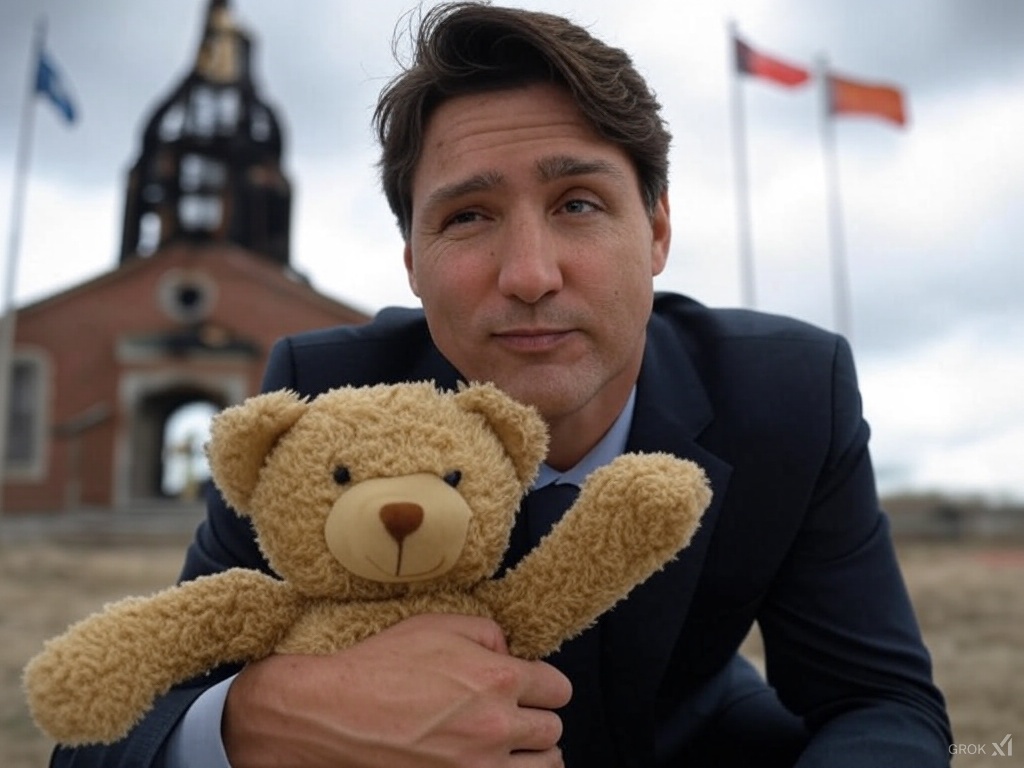

This is why people call part of the Left “Looney”.
There is no current, direct evidence from official U.S. government channels suggesting an intention to annex Canada. However, there are several historical and contemporary discussions and actions that have fueled speculation on this topic:
Historical Context: Historically, there have been moments when the U.S. considered or discussed annexing parts or all of Canada, notably during the War of 1812 and in various post-war planning scenarios. For instance, the U.S. had plans like “War Plan Red” in the 1930s, which included strategies for dealing with Canada in the event of a conflict with Britain.
Recent Political Rhetoric: More recently, comments from U.S. President-elect Donald Trump in 2025 have stirred debate. Trump has suggested using “economic force” to make Canada the 51st state, mentioning this during a press conference and on social media. This rhetoric has been interpreted by some as serious intent, while others see it as negotiation tactics or bluster aimed at influencing trade or other policy negotiations.
Public and Media Reaction: Posts on X and articles from various news outlets have discussed these comments, with some expressing concern over U.S. intentions. However, these are often framed as speculative or as reactions to Trump’s statements rather than evidence of a formal policy.
Legal and Practical Considerations: Legally, annexation would require constitutional amendments and referendums in both countries, processes that are complex and politically unfeasible without mutual consent. The practicalities of annexation, including military and economic implications, are also significant deterrents.
Canadian Response: Canadian leaders, including Prime Minister Justin Trudeau, have strongly rejected these ideas, with statements indicating no possibility of Canada becoming a U.S. state. This reflects a strong national sentiment against such a move.
While there is no concrete evidence of an active plan to annex Canada, the historical interest, coupled with recent provocative political rhetoric, keeps the topic in public discourse. However, without a formal policy or legislative action, these discussions remain speculative or part of political posturing rather than actual policy intent.
This is what people have a problem with, don’t let the activist play word games with you.
The dynamic at play is this: Inclusivity ONLY comes into play when people and the ideas that they share agree with what the activists say. Messages contrary to woke activist ideology therefore are not included under the umbrella of inclusivity.
Thus, be wary when you see the term “inclusive” because it is often used to perform the polar opposite function.

The Liberal Party of Canada’s decision to remove Chandra Arya from the leadership race is a concerning display of undemocratic behavior.
Arya, having met the necessary criteria and raised the required funds, should have been allowed to compete on an equal footing with other candidates. This exclusion smacks of internal manipulation, suggesting that the party leadership might be more interested in controlling the outcome than in fostering a fair and open contest.
Such actions raise serious questions about the integrity of the leadership selection process and whether it truly reflects the will of party members or is instead orchestrated by a select few. This move not only disenfranchises Arya’s supporters but also undermines the democratic ethos that the Liberal Party should champion.
It’s a clear indication that the party might prioritize maintaining a particular narrative or candidate over the democratic ideals it claims to uphold, thereby casting a shadow over the legitimacy of the entire leadership race and, by extension, the future governance of the country.
The decision by the current Liberal Government in Canada to prorogue Parliament is a stark demonstration of political opportunism trumping democratic principles.
By shutting down Parliament, they’ve effectively silenced the legislative body’s ability to hold the government accountable at a crucial juncture, especially with the looming leadership change. This move appears less about a necessary “reset” for government action and more about buying time to manage internal party politics ahead of a potential vote of non-confidence.
It’s particularly egregious given the backdrop of significant national and international issues that demand parliamentary attention, including economic recovery and international relations.
The prorogation not only delays important legislative work but also undermines the democratic process by preventing timely scrutiny of government actions, further eroding public trust in a government that seems more focused on self-preservation than public service. This is not governance; it’s a blatant manipulation of parliamentary procedure for partisan gain.











 bleatmop
 Mystro


 Dead Wild Roses
Your opinions…