
You are currently browsing the category archive for the ‘Ethics’ category.
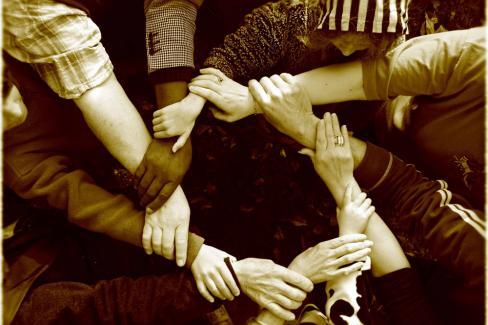 The ongoing media campaign to make the economy the monofocus of our societies continues on unabated. Do almost any news search and you will see economic principles overlaid and tied to the idea that somehow they are related to how healthy and how “good” a society actually is. Economic health is but one part of a successful society as a strength of a society not only lies in its economy but in its culture and even more importantly, its people. Jeffry Sachs opines on a better way of analyzing and structuring a society:
“We live in a time of high anxiety. Despite the world’s unprecedented total wealth, there is vast insecurity, unrest, and dissatisfaction. In the United States, a large majority of Americans believe that the country is “on the wrong track”. Pessimism has soared. The same is true in many other places.
Against this backdrop, the time has come to reconsider the basic sources of happiness in our economic life. The relentless pursuit of higher income is leading to unprecedented inequality and anxiety, rather than to greater happiness and life satisfaction. Economic progress is important and can greatly improve the quality of life, but only if it is pursued in line with other goals.”
Let me reassure you skeptical reader, a more egalitarian society is not only better for its people, it is better for productivity as well. What its bad for, capital accumulation and socialism for the rich.
“First, we should not denigrate the value of economic progress. When people are hungry, deprived of basic needs such as clean water, health care, and education, and without meaningful employment, they suffer. Economic development that alleviates poverty is a vital step in boosting happiness.
Second, relentless pursuit of GNP to the exclusion of other goals is also no path to happiness. In the US, GNP has risen sharply in the past 40 years, but happiness has not. Instead, single-minded pursuit of GNP has led to great inequalities of wealth and power, fueled the growth of a vast underclass, trapped millions of children in poverty, and caused serious environmental degradation.”
I would add here, the growth of the courtier corporate media whose job it is to reframe the massive inequality and unjust conditions prevalent in the US as “normal” and manage to get the poor people to actually fight against reforms that would benefit them (see the dismal failure instituting universal healthcare in the US).
“Third, happiness is achieved through a balanced approach to life by both individuals and societies. As individuals, we are unhappy if we are denied our basic material needs, but we are also unhappy if the pursuit of higher incomes replaces our focus on family, friends, community, compassion, and maintaining internal balance. As a society, it is one thing to organise economic policies to keep living standards on the rise, but quite another to subordinate all of society’s values to the pursuit of profit.
Yet politics in the US has increasingly allowed corporate profits to dominate all other aspirations: fairness, justice, trust, physical and mental health, and environmental sustainability. Corporate campaign contributions increasingly undermine the democratic process, with the blessing of the US Supreme Court”
Profits before people, who rather than rightly blame the corporate oligarchy for their misery funnel their discontent toward their government. Of course, the government corrupted by corporate interests, should be a focus of scrutiny but at the moment, the focus of the rage and anger of the American people is mostly displaced.
“Fourth, global capitalism presents many direct threats to happiness. It is destroying the natural environment through climate change and other kinds of pollution, while a relentless stream of oil-industry propaganda keeps many people ignorant of this. It is weakening social trust and mental stability, with the prevalence of clinical depression apparently on the rise. The mass media have become outlets for corporate “messaging”, much of it overtly anti-scientific, and Americans suffer from an increasing range of consumer addictions.”
Consumption is not a way to happiness, it is but a mere false paradise of shallow contrivances, moral turpitude and ethical decay.
“Fifth, to promote happiness, we must identify the many factors other than GNP that can raise or lower society’s well-being. Most countries invest to measure GNP, but spend little to identify the sources of poor health (like fast foods and excessive TV watching), declining social trust, and environmental degradation. Once we understand these factors, we can act.
The mad pursuit of corporate profits is threatening us all. To be sure, we should support economic growth and development, but only in a broader context: one that promotes environmental sustainability and the values of compassion and honesty that are required for social trust.”
What? A balance between rapacious capitalism and social, ethical and environmental concerns? Is it possible? Of course it is possible, but needs to come from outside the current political superstructure of Canada and the United States. The people of the Western countries need to organize (labour unions are a great place to start, as the represent people as opposed to business interests) and campaign for a balanced society, as opposed to the GNP fixated, world destroying paradigm we currently inhabit.

Easy values to follow for a better society.
I’m always a bit flabbergasted when people start making pronouncements about moral issues and backing up their claims with biblical proof. You may as well be saying that your beliefs are decisively supported by the ham sandwich you had for lunch. Qualia Soup dissects the inanity and lack of intellectual rigour of theists who claim to have absolute morality on their side. Unsurprisingly, the theist’s position turns out to be quite immoral when all is said and done. Colour me shocked.

The Panopticon come to life.
Prison is not supposed to be a walk in the beach. I understand that. People that commit offences need to be consequenced for their transgressions against what society deems to be the proper set of standards. Consequences should not include psychological torture, self-mutilation and degradation.
“Supermax prisoners’ daily lives are chock full of alienating and undignified experiences, so empty of positive human interaction, thousands are willing to risk death than endure such inhumane conditions. That alone speaks volumes about the reality of life in supermax prisons.
One of the most humiliating aspects of life for inmates are the frequent strip searches – forced to be naked, ordered to bend over by guards and spread the buttocks apart to have the anus inspected for contraband while coughing. Strip searches are the old normal. The photos of nude prisoners in Abu Ghraib in Iraq shocked the world, but to be stripped naked for hours or even days is standard operating procedure in supermaxes.
Nelson explained: “Every time you leave your cell you’re strip searched … They do this to degrade and shock you…Sometimes the guards would make ‘homosexual’ comments like: ‘Hey baby, spread your cheeks’. Darrell Cannon, a survivor of a nine-year stretch in Tamms, described the strip search: ‘They tell you to open your mouth, raise your tongue, hold your hands up, they go through your fingers and toes and tell you to turn around and spread your cheeks up against the chuckhole … It’s degrading to have two other human beings looking at you like you’re some kind of specimen. It is extremely degrading.”
Conditions certainly look promising for an orderly transition back into society.
“Prisoners on suicide watch are routinely left naked in their cells. And inmates have been punished by “caging”, they’re held naked or partially clothed in outdoor holding cages in inclement weather.
There is no pretence of rehabilitation in supermax prisons; the purpose is harsh punishment. Prisoners endure supersized portions of psychological punishment as a result of strict and prolonged solitary confinement. Inmates are confined for 23 to 24 hours a day, every day, in cells that measure 7-by-12 square feet. It is psychological torture.
Supermax prisons are intended to isolate prisoners and to deny human contact. Cannon said: “Everything you do, you do alone … It [supermax] was designed to break you mentally, by not allowing you to have another human being right there with you that you can interact with.”
This extreme environment of sensory deprivation and social seclusion makes men go mad. Supermax prisons are filled with inmates with mental illnesses diagnosed. Laurie “It is a form of insanity to put people in a place that provokes mental illness … Either they went in crazy, or they go crazy once they are there,” said Jo Reynolds, an organiser for the Tamms Ten Year Committee and a Soros Justice Fellow.”
Straight punishment does not fix people. Remove the authority or system that is enforcing said strict punishment and old behaviours will return. So much money is being spent on incarceration in the face of all we’ve learned about how human beings work. We can build the supermax prison but can we build the services and support necessary to transition people back into society? Hell no, we are just ‘coddling’ criminals then and appearing to be ‘soft’ on crime.
Horsepucky.
“Prisoners resort to cutting their flesh: A form of self-mutilation that results in thick scarring. Small shavings of concrete, plastic ‘sporks’ or paper clips are used to cut and cause bleeding to arms, legs and genitals. Cannon remembers some prisoners cutting themselves, “just to feel something … they were willing to do anything to get out of their cell and into the infirmary to be around other people”.
Nelson recalled an inmate who continually tightened a piece of string around his finger. It became gangrenous and was amputated. Men who injured themselves told him: “I need the pain, to feel real”.
“Gassing” is also common in supermax prisons. It is a word used to describe prisoners throwing urine and faeces at guards. Gassing is treated as a security threat and is met with excessive force by a tactical team.
Prison mental health staff label inmates who engage in cutting and gassing as malingering and “acting out”, not as suffering from mental illness. And yet there is decades of indisputable, well-documented evidence that solitary confinement causes mental breakdown and self-injurious behaviour.
Dr Terry A Kupers, a psychologist who has conducted hundreds of assessments of prisoners in supermax prisons, explained in an article in the Belleville News-Democrat. “Twenty-three hours a day alone in a cell causes many inmates to brutally attack themselves,” he wrote. “In the adult male population of the United States, self-mutilation occurs only in solitary confinement. It’s an epidemic across the country. They’re not faking.”
23 hours a day of solitary confinement? The line between prison and torture-camp is blurring.
“Supermax prisons are modern, high-tech, taxpayer funded concentration camps. The architecture is a twisted blend of Fascist-Stripped-Classical and Functionalist designed to facilitate the One Flew Over the Cuckoos Nest punishment of inmates. They are located in rural areas in small, conservative, majority white towns desperate for jobs. Pelican Bay was built on an abandoned logging site and is completely cut off from its surroundings. Tamms supermax is located in the far corner of Illinois in the village of Tamms, population: 724. The remote location of supermax prisons keeps them hidden and away from public scrutiny and protest. Media are not allowed in.
On the perimeter of supermax prisons loom large and imposing guard towers with gun turrets and floodlights that resemble German Flak towers.
The interior of supermax prisons is built on the architectural principles of isolation, surveillance and über-control. Doors and gates are controlled electronically. A panoptic central guard tower is encircled by prisoner “pods” and closed-circuit TV cameras allow guards to see into every cell. Privacy is nonexistent. Concrete cells contain a poured concrete bed, immovable concrete desk/stool, stainless steel sink, toilet and mirror. Metal wire mesh cell doors have a slot to deliver food and other items. Some doors have Plexiglas covers that insulate cells from sound, air and vision.”
Contemplating or threatening suicide? Well, well just add more restraints and there we have it, problem solved! (NSFW, violence and language)
To reiterate, yes prisons are necessary. Torture and inhumane treatment is not if we want to honour the claim that we are civilized society.
*April 15th, 2012 Update* – Al Jazeera has continued the series on incarceration in the United States.
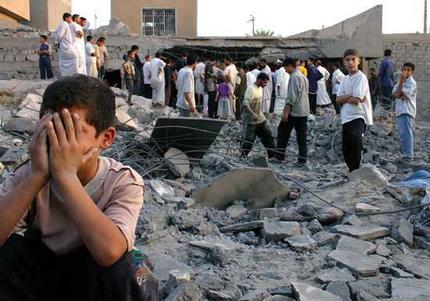 The following is an excerpt from John McMurtry’s book Value Wars – The Global Market Versus the Life Economy p. 40 – 41.
The value-set that selects for the destruction of a human society is based on an absolutist first premise that whatever serves its unilateral globalization is good, and whatever obstructs or resists its universal advance is evil. No fact can disturb this presupposition if it is locked into the ruling group-think and remains credible to the collaborating publics. To comprehend the depth of mind-lock and its mass murderous consequences, consider the following sequence of official US policy in Iraq after the war was over. US Defense Intelligence documents silently released years later in 1995 demonstrate that the global market’s first power knowing selected for the consequences of infrastructural bombing, including the disease-killing of hundreds of thousand of children. For example, a US Defense Intelligence document entitled ‘Iraq Water Treatment Vulnerabilities’, January 1991, spells out exactly how postwar sanctions against Iraq were constructed to prevent any public authority from providing clean water to citizens. Extensive technical detail then reports that ‘with no domestic sources of water treatment replacement or chemicals like chlorine’ and ‘no desalinization membranes’ and with water ‘laded with biological pollutants and bacteria’, ‘epidemics of such diseases as cholera. hepatitis, and typhoid’ will occur, but ‘it will probably take six months [of sanctions] before the system is fully degraded’. One is reminded of Adolf Eichmann’s punctilious attention to detail in administrating another and less painful form of mass death implementation.
A second document, ‘Disease Information/Effects of Bombing on Disease’, also dated January 22, 1991, reports: ‘Conditions are favorable for communicable disease outbreaks by coalition bombing’, with the ‘most likely diseases during the next sixty-ninety days (descending order): diarrhial diseases (particularly children); measles, diphtheria, and pertussis (particularly children); meningitis including meningococal (particularly children), cholera’. The third document in the US Defense Intelligence series, ‘Medical Problems in Iraq’ is dated March 15, 1991. It reports that the US-British-enforced sanctions by interdiction of needed civilian water-treatment resources and bombing [Tony Blair’s ‘humanitarian sanctions’, comes to mind here] have succeeded in ensuring that ‘water is [now] less than 5 percent of the original supply… diarrhea is four times above normal levels… Conditions in Baghdad remain favourable for disease outbreaks.’. The fourth document of May 1991 reports: ‘Cholera and measles have emerged at refugee camps’ and the fifth document in June, ‘Health Conditions in Iraq is still heavily censored, but can be deciphered as reporting observations that ‘almost all medicines were in critically shorty supply’ and ‘Gastroenteritis was killing children… In the south 80% of the deaths were children’
Observe the repeated use of the phrase ‘favorable for disease outbreaks’. It discloses the pathologically inverted value-set regulating official perception and speech. Us and British political and military commands are undoubtedly war criminals under law, and guilty of the gravest crimes against humanity. To conclude that they are also ‘terrorists’ of the most virulent nature in ‘the killing of innocent civilians to achieve political goals’ – the official definition – is a conclusion which reason is constrained to admit. In connecting the fanatic mind-set across its expressions, we see the US state’s systematic operation of projection since September 11th, 2001 revealed with breathtaking clarity.
Documents in question can be found at http://www.gulflink.osd.mil . The first document referenced is here.
There really is no limit to what we’ll do to win. Shame on us.
*Update*: Digesting all of what McMurtry has to say takes a bit. I find that his commentary mostly jives with other authors who write about Empire and its effects on people. It really is disquieting because one has to relive the horror and revulsion experienced when the realization dawns that you are part of the nightmare system that is destroying other people because they believe in different things that we do.
It is not ‘progress’ but quite the opposite, it is like a snake hungrily devouring it’s own tail, we wield the such fearsome capacity to destroy and exploit but with each ‘victory’ we become a little less human and less connected to what we would esteemedly call ‘morality’ or virtue. Replacing our morality is the ethic of consumption and a perverted notion of darwinism in which we somehow deem ourselves the most fit and therefore justified in carrying out or being complicit in the atrocities perpetrated in the name of ‘Freedom and Democracy’.
Only by getting outside the realm of official though and approved notions can one appreciate the monstrous nature of what our oligarchic society has become.
Qualia Soup continues his series on Morality with a look at the bible and why it is not the place to go when looking for morality. At fourteen minuets it is long by youtube standards, but well worth watching.
 How we act when we have full control over another animal is indicative of the state of our morality. Peter Singer proposes how humanly we treat our animals reflects on how well we treat each other.
“Mahatma Gandhi acutely observed that “the greatness of a nation and its moral progress can be judged by the way its animals are treated”. To seek to reduce the suffering of those who are completely under one’s domination, and unable to fight back, is truly a mark of a civilised society.
Charting the progress of animal-welfare legislation around the world is therefore an indication of moral progress more generally. Last month, parallel developments on opposite sides of the world gave us grounds for thinking that the world may, slowly and haltingly, be becoming a little more civilised.
First, the British House of Commons passed a motion directing the government to impose a ban on the use of wild animals in circuses. The motion followed the release of undercover footage, obtained by Animal Defenders International, of a circus worker repeatedly beating Anne, an elephant. The measure was, at least initially, opposed by the Conservative government, but supported by members of all political parties. In a triumph for parliamentary democracy, the motion passed without dissent.”
If you’re feeling weak of stomach, I recommend not following the elephant link. It is not particular graphic by hollywood standards, what is chilling though is the routine nature of what was going on. It looks like the beatings were ‘par for the course’ and normalized behaviour for the staff members. To stop thinking, to stop your empathic instincts and turn off your feelings cause your ‘just gett’n the job done’, that is what is most disquieting.
“One recent sign again concerns circuses. Chinese zoos have drawn crowds by staging animal spectacles, and by allowing members of the public to buy live chickens, goats, and horses in order to watch them being pulled apart by lions, tigers, and other big cats. Now the Chinese government has forbidden state-owned zoos from taking part in such cruelty.
Welcome as these initiatives are, the number of animals in circuses and zoos is tiny compared to the tens of billions of animals suffering in factory farms. In this area, Western countries have set a deplorable example.
Recently, however, the European Union has recognised that the intensive confinement of farm animals has gone too far. It has already outlawed keeping veal calves in individual stalls, and, in six months, it will be illegal in all 27 EU countries, from Portugal to Poland and from Britain to Greece, to keep laying hens in the bare-wire cages that today dominate the egg industry around the world. In January 2013, keeping breeding sows in individual stalls will also be prohibited.
The United States lags behind Europe in getting rid of the worst forms of abuse of farm animals. The problem does not lie with voters, who, in states such as Florida, Arizona, and California, have shown that they want farm animals to have better protection than the animal industries typically provide. The biggest problems are in those states that lack a mechanism for citizens to initiate a referendum on how farm animals should be treated. Unfortunately, this group includes the Midwestern and southern states, where the majority of America’s farmed animals are produced.”
Incremental progress. Easy enough for us.











 bleatmop
 Mystro
 The Arbourist


 Dead Wild Roses
Your opinions…