
You are currently browsing the category archive for the ‘International Affairs’ category.
 They are getting washed away in Bangkok. The rains have not abated, and the flood waters grow higher and more dangerous every day.
“Residents of Bangkok are escaping the flooded Thai capital in their tens of thousands due to worsening weather forecasts and the government’s evacuation orders.
Flood waters were already seeping into central parts of Bangkok on Thursday morning, with waters entering the Grand Palace, near the swollen Chao Phraya river, the AFP news agency reported.
Al Jazeera’s Wayne Hay, reporting from Bangkok, said the number of districts that have been ordered to evacuate is increasing by the hour.
“The water level is only expected to rise when the floodwaters combine with high tides that are on the way,” he said.
Sukhumbhand Paribatra, the Bangkok governor, said on Thursday that he expected to soon announce an evacuation warning for Sai Mai district, located on the city’s northern outskirts, where waist-high water has turned roads into virtual rivers and swamped petrol stations and homes.
A day earlier, Sukhumbhand said residents of two of the city’s 50 districts – Don Muang and Bang Phlat, both already partially submerged – should leave for shelters.”
I mention Bangkok here because my best friend called me last night from Suvarnabhumi airport. He said everything was in very short supply. Water, food, petrol were all extremely hard to come buy. Transportation is sketchy at best. He ended up taking a tuk-tuk to the airport in a harrowing 6 hour journey. He assured me that he was getting the heck out of Dodge as fast as a plane darn near anywhere would take him. 
Mass disruption
In the district of Sai Mai, on Bangkok’s northern outskirts, hundreds of residents clambered aboard packed military vehicles with their belongings, desperate to leave.
Yingluck said this week that central Bangkok could be swamped by up to 1.5 metres of water in some places if barriers broke and told residents to get their belongings up to high ground.
“After assessing the situation, we expect floodwater to remain in Bangkok for around two weeks to one month before going into the sea,” she said on Wednesday.
Authorities would guard important places such as the royal palace and power stations, she said.
The floods in the north, northeast and centre of Thailand have disrupted the lives of nearly 2.5 million, with more than 113,000 in shelters and 720,000 people seeking medical attention.
Flooding has already forced the closure of seven industrial estates, causing billions of dollars of damage, disrupting international supply chains for industry and putting about 650,000 people temporarily out of work.
 The ongoing media campaign to make the economy the monofocus of our societies continues on unabated. Do almost any news search and you will see economic principles overlaid and tied to the idea that somehow they are related to how healthy and how “good” a society actually is. Economic health is but one part of a successful society as a strength of a society not only lies in its economy but in its culture and even more importantly, its people. Jeffry Sachs opines on a better way of analyzing and structuring a society:
“We live in a time of high anxiety. Despite the world’s unprecedented total wealth, there is vast insecurity, unrest, and dissatisfaction. In the United States, a large majority of Americans believe that the country is “on the wrong track”. Pessimism has soared. The same is true in many other places.
Against this backdrop, the time has come to reconsider the basic sources of happiness in our economic life. The relentless pursuit of higher income is leading to unprecedented inequality and anxiety, rather than to greater happiness and life satisfaction. Economic progress is important and can greatly improve the quality of life, but only if it is pursued in line with other goals.”
Let me reassure you skeptical reader, a more egalitarian society is not only better for its people, it is better for productivity as well. What its bad for, capital accumulation and socialism for the rich.
“First, we should not denigrate the value of economic progress. When people are hungry, deprived of basic needs such as clean water, health care, and education, and without meaningful employment, they suffer. Economic development that alleviates poverty is a vital step in boosting happiness.
Second, relentless pursuit of GNP to the exclusion of other goals is also no path to happiness. In the US, GNP has risen sharply in the past 40 years, but happiness has not. Instead, single-minded pursuit of GNP has led to great inequalities of wealth and power, fueled the growth of a vast underclass, trapped millions of children in poverty, and caused serious environmental degradation.”
I would add here, the growth of the courtier corporate media whose job it is to reframe the massive inequality and unjust conditions prevalent in the US as “normal” and manage to get the poor people to actually fight against reforms that would benefit them (see the dismal failure instituting universal healthcare in the US).
“Third, happiness is achieved through a balanced approach to life by both individuals and societies. As individuals, we are unhappy if we are denied our basic material needs, but we are also unhappy if the pursuit of higher incomes replaces our focus on family, friends, community, compassion, and maintaining internal balance. As a society, it is one thing to organise economic policies to keep living standards on the rise, but quite another to subordinate all of society’s values to the pursuit of profit.
Yet politics in the US has increasingly allowed corporate profits to dominate all other aspirations: fairness, justice, trust, physical and mental health, and environmental sustainability. Corporate campaign contributions increasingly undermine the democratic process, with the blessing of the US Supreme Court”
Profits before people, who rather than rightly blame the corporate oligarchy for their misery funnel their discontent toward their government. Of course, the government corrupted by corporate interests, should be a focus of scrutiny but at the moment, the focus of the rage and anger of the American people is mostly displaced.
“Fourth, global capitalism presents many direct threats to happiness. It is destroying the natural environment through climate change and other kinds of pollution, while a relentless stream of oil-industry propaganda keeps many people ignorant of this. It is weakening social trust and mental stability, with the prevalence of clinical depression apparently on the rise. The mass media have become outlets for corporate “messaging”, much of it overtly anti-scientific, and Americans suffer from an increasing range of consumer addictions.”
Consumption is not a way to happiness, it is but a mere false paradise of shallow contrivances, moral turpitude and ethical decay.
“Fifth, to promote happiness, we must identify the many factors other than GNP that can raise or lower society’s well-being. Most countries invest to measure GNP, but spend little to identify the sources of poor health (like fast foods and excessive TV watching), declining social trust, and environmental degradation. Once we understand these factors, we can act.
The mad pursuit of corporate profits is threatening us all. To be sure, we should support economic growth and development, but only in a broader context: one that promotes environmental sustainability and the values of compassion and honesty that are required for social trust.”
What? A balance between rapacious capitalism and social, ethical and environmental concerns? Is it possible? Of course it is possible, but needs to come from outside the current political superstructure of Canada and the United States. The people of the Western countries need to organize (labour unions are a great place to start, as the represent people as opposed to business interests) and campaign for a balanced society, as opposed to the GNP fixated, world destroying paradigm we currently inhabit.

Easy values to follow for a better society.
Strap on the feedbags y’all. Because if you have not maxed out your gluttony meters yet have we got a deal for you. All the goodness of a cheese burger cradled in the sugary luxury of a glazed maple doughnut.

- 1500 calories and wating in quantity at a Fair near you…

Oh! It is that news story that got bumped off the radar because the two business parties of the US cannot decide how best to rid their society of the evilz of the pesky socialism. The famine in the horn of Africa continues…

The most recent (and continuing) episode of people dying miserable deaths due to starvation and lack of potable water...
Future historians, if we have future historians, will look back and wonder, “What the frack were their priorities back then?”. We can talk of geopolitics and of population control or even government corruption. Really, just choose your scapegoat and then you can feel better and justified about the state of the world and your position in it.
With the great intersection of science and technology we can send vehicles to Mars, or produce a precision guided missile that can guide itself to within 10m of the intended target. We can garner resources to bury a 27 kilometer length of concrete tunnel, ring it with superconductors and smash atoms, yet we cannot figure out how to feed people who are starving to death in another part of the world.

This is happening right now. We are culpable for our actions. This is our watch. We’re failing, on a grand scale, in the most basic aspects of altruism and empathy for others. We worship consumption and continue to celebrate our civilization blind to our own history and struggle, nestled within the tenuous safety of our technological achievements.
The world burns and we revel in our cheese-burger-doughnuts. A civilized culture indeed.
*update* Oh! Food is a no-go…but tobacco, that friends is a different story.
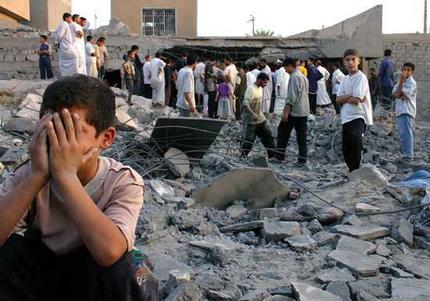 The following is an excerpt from John McMurtry’s book Value Wars – The Global Market Versus the Life Economy p. 40 – 41.
The value-set that selects for the destruction of a human society is based on an absolutist first premise that whatever serves its unilateral globalization is good, and whatever obstructs or resists its universal advance is evil. No fact can disturb this presupposition if it is locked into the ruling group-think and remains credible to the collaborating publics. To comprehend the depth of mind-lock and its mass murderous consequences, consider the following sequence of official US policy in Iraq after the war was over. US Defense Intelligence documents silently released years later in 1995 demonstrate that the global market’s first power knowing selected for the consequences of infrastructural bombing, including the disease-killing of hundreds of thousand of children. For example, a US Defense Intelligence document entitled ‘Iraq Water Treatment Vulnerabilities’, January 1991, spells out exactly how postwar sanctions against Iraq were constructed to prevent any public authority from providing clean water to citizens. Extensive technical detail then reports that ‘with no domestic sources of water treatment replacement or chemicals like chlorine’ and ‘no desalinization membranes’ and with water ‘laded with biological pollutants and bacteria’, ‘epidemics of such diseases as cholera. hepatitis, and typhoid’ will occur, but ‘it will probably take six months [of sanctions] before the system is fully degraded’. One is reminded of Adolf Eichmann’s punctilious attention to detail in administrating another and less painful form of mass death implementation.
A second document, ‘Disease Information/Effects of Bombing on Disease’, also dated January 22, 1991, reports: ‘Conditions are favorable for communicable disease outbreaks by coalition bombing’, with the ‘most likely diseases during the next sixty-ninety days (descending order): diarrhial diseases (particularly children); measles, diphtheria, and pertussis (particularly children); meningitis including meningococal (particularly children), cholera’. The third document in the US Defense Intelligence series, ‘Medical Problems in Iraq’ is dated March 15, 1991. It reports that the US-British-enforced sanctions by interdiction of needed civilian water-treatment resources and bombing [Tony Blair’s ‘humanitarian sanctions’, comes to mind here] have succeeded in ensuring that ‘water is [now] less than 5 percent of the original supply… diarrhea is four times above normal levels… Conditions in Baghdad remain favourable for disease outbreaks.’. The fourth document of May 1991 reports: ‘Cholera and measles have emerged at refugee camps’ and the fifth document in June, ‘Health Conditions in Iraq is still heavily censored, but can be deciphered as reporting observations that ‘almost all medicines were in critically shorty supply’ and ‘Gastroenteritis was killing children… In the south 80% of the deaths were children’
Observe the repeated use of the phrase ‘favorable for disease outbreaks’. It discloses the pathologically inverted value-set regulating official perception and speech. Us and British political and military commands are undoubtedly war criminals under law, and guilty of the gravest crimes against humanity. To conclude that they are also ‘terrorists’ of the most virulent nature in ‘the killing of innocent civilians to achieve political goals’ – the official definition – is a conclusion which reason is constrained to admit. In connecting the fanatic mind-set across its expressions, we see the US state’s systematic operation of projection since September 11th, 2001 revealed with breathtaking clarity.
Documents in question can be found at http://www.gulflink.osd.mil . The first document referenced is here.
There really is no limit to what we’ll do to win. Shame on us.
*Update*: Digesting all of what McMurtry has to say takes a bit. I find that his commentary mostly jives with other authors who write about Empire and its effects on people. It really is disquieting because one has to relive the horror and revulsion experienced when the realization dawns that you are part of the nightmare system that is destroying other people because they believe in different things that we do.
It is not ‘progress’ but quite the opposite, it is like a snake hungrily devouring it’s own tail, we wield the such fearsome capacity to destroy and exploit but with each ‘victory’ we become a little less human and less connected to what we would esteemedly call ‘morality’ or virtue. Replacing our morality is the ethic of consumption and a perverted notion of darwinism in which we somehow deem ourselves the most fit and therefore justified in carrying out or being complicit in the atrocities perpetrated in the name of ‘Freedom and Democracy’.
Only by getting outside the realm of official though and approved notions can one appreciate the monstrous nature of what our oligarchic society has become.
 Afghanistan destroys Empires. Ask Great Britain, ask the Russians. The US is well along the same course, but rather than being blinded by nationalism, or ideology the American poison of choice is the continued mismanagement of priorities by the corporate elite. The corporate elite are running the foreign policy bus off a cliff and bankrupting the US in the process.
“Among multiple layers of deception and newspeak, the official Washington spin on the strategic quagmire in Afghanistan simply does not hold.
No more than “50-75 ‘al-Qaeda types’ in Afghanistan”, according to the CIA, have been responsible for draining the US government by no less than US $10 billion a month, or $120 billion a year. “
120 billion is a tidy sum that would go a long way in the ‘butter’ rather than the ‘guns’ department.
“A recent, detailed study by the Eisenhower Research Project at Brown University revealed that the war on terror has cost the US economy, so far, from $3.7 trillion (the most conservative estimate) to $4.4 trillion (the moderate estimate). Then there are interest payments on these costs – another $1 trillion.
That makes the total cost of the war on terror to be, at least, a staggering $5.4 trillion. And that does not include, as the report mentions, “additional macroeconomic consequences of war spending”, or a promised (and undelivered) $5.3 billion reconstruction aid for Afghanistan.
Who’s profiting from this bonanza? That’s easy – US military contractors and a global banking/financial elite.”
Well, it is good to see that someone is making money during this downturn of the economy, although I’d hate to be the person having to explain the American public why the coffers fly open so easily when it comes to Military contractors and yet seem welded shut when it comes to public expenditures such as social security and health care.
“In the famous November 1, 2004 video that played a crucial part in assuring the reelection of George W. Bush, Osama bin Laden – or a clone of Osama bin Laden – once again expanded on how the “mujahedeen bled Russia for 10 years until it went bankrupt and was forced to withdraw in defeat.” That’s the exact same strategy al-Qaeda has deployed against the US; according to Bin Laden at the time, “all that we have to do is to send two mujahedeen to the farthest point East to raise a piece of cloth on which is written al-Qaeda in order to make the generals race there to cause America to suffer human, economic, and political losses without their achieving for it anything of note, other than some benefits to their private companies.”
The record since 9/11 shows that’s exactly what’s happening. The war on terror has totally depleted the US treasury – to 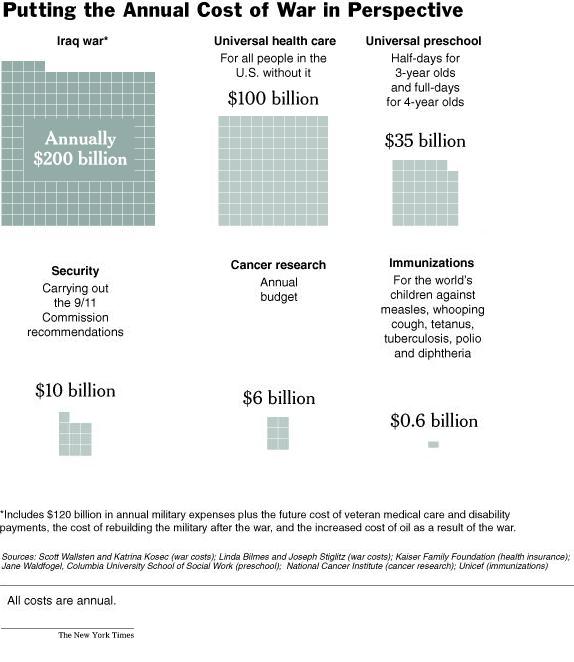 the point that the White House and Congress are now immersed in a titanic battle over a $4 trillion debt ceiling.
What is never mentioned is that these trillions of dollars were ruthlessly subtracted from the wellbeing of average Americans – smashing the carefully constructed myth of the American dream.”
The problem, back in the US, is that ordinary people are not being represented in Congress. Americans, for the most part are a kind, generous people. They may hold some funny notions about egalitarianism (and religion and…), but on the whole they are not the ignorant, jingoistic warmongers that the media often paint them to be. If the interests of the majority of American’s were actually respected, instead of a small section of the elites, the US would truly be that ‘shining city on the hill’. Yet the prosperity of the average American is being sacrificed on the altar of war so that a narrow slice of the populace can profit.
 “It all comes back, once again, to Pipelineistan – and one of its outstanding chimeras; the Turkmenistan/Afghanistan/Pakistan (TAP) gas pipeline, also known once as the Trans-Afghan Pipeline, which might one day become TAPI if India decides to be on board.
The US corporate media simply refuses to cover what is one of the most important stories of the early 21st century.
Washington has badly wanted TAP since the mid-1990s, when the Clinton administration was negotiating with the Taliban; the talks broke down because of transit fees, even before 9/11, when the Bush administration decided to change the rhetoric from “a carpet of gold” to “a carpet of bombs”.
TAP is a classic Pipelineistan gambit; the US supporting the flow of gas from Central Asia to global markets, bypassing both Iran and Russia. If it ever gets built, it will cost over $10 billion.
It needs a totally pacified Afghanistan – still another chimera – and a Pakistani government totally implicated in Afghanistan’s security, still a no-no as long as Islamabad’s policy is to have Afghanistan as its “strategic depth”, a vassal state, in a long-term confrontation mindset against India.”
Is the War all about the pipeline as the article suggests? More research is needed into the topic, but it would be hardly surprising to observe that this is one of the overarching goals of the war in Afghanistan.
“It’s mind-boggling that 10 years and $5.4 trillion dollars later, the situation is exactly the same. Washington still badly wants “its” pipeline – which will in fact be a winning game mostly for commodity traders, global finance majors and Western energy giants.
From the standpoint of these elites, the ideal endgame scenario is global Robocop NATO – helped by hundreds of thousands of mercenaries – “protecting” TAP (or TAPI) while taking a 24/7 peek on what’s going on in neighbours Russia and China.
Sharp wits in India have described Washington’s tortuous moves in Afghanistan as “surge, bribe and run”. It’s rather “surge, bribe and stay”. This whole saga might have been accomplished without a superpower bankrupting itself, and without immense, atrocious, sustained loss of life, but hey – nobody’s perfect.”
Are the strategic resources in the region worth the devastation of the Western world’s largest economy? The movers and the shakers in the US seem to think so.
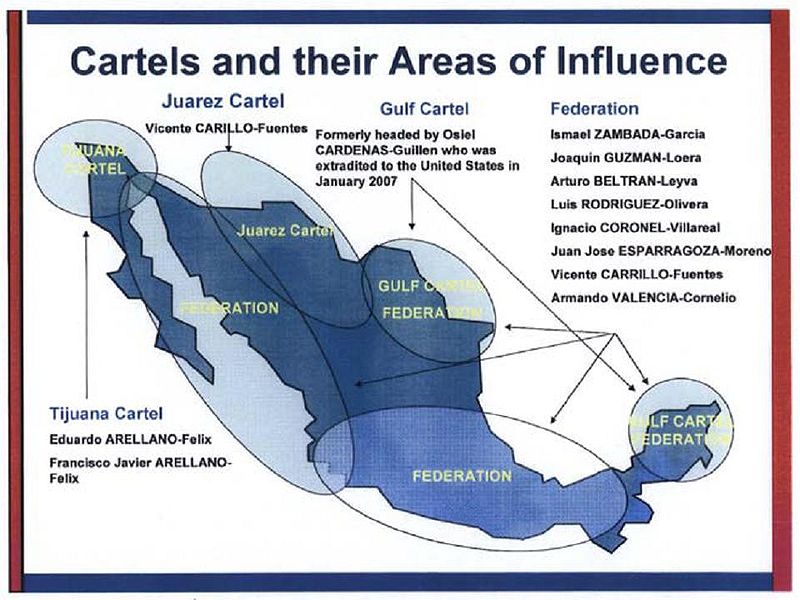 Destroy enough of the domestic economy, deny the people access to basic welfare and state services and you get the drug fuelled cartel driven country wide chaos that is engulfing Mexico. People in Mexico are dying in violent drug related deaths every day but the Mexican media is not covering these stories. The coverage is not there because they tend to start loosing reporters when they focus too much on the drug cartels dangerous activities.
“Violence linked to Mexico’s drug war has claimed more than 36,000 lives since President Felipe Calderon declared all-out war on cartels in December 2006.”
The War on Cartels smacks of the same bankrupts ideas that the War on Drugs featured. Going after supply rather than demand for narcotics is a recipe for disaster. The disaster is largely unreported except for in blogs that have sprung up to fill some of the gaps in the Mexican mainstream media’s coverage.
“The images are gruesome and unedited: a dead man in a sports jersey with his face covered in dried red blood and grey sand; a woman hanging from a rope above a busy urban over-pass and naked bodies lined up on the ground displaying clear, uncensored, signs of torture.
You have reached Mexico’s narco blog: Click to continue.
“The narco blog uses much of the information citizens upload to other social networking sites,” says Pedro Perez, president of the democratic union of journalists in Tamaulipas, one of the states on the US-Mexico border hit hardest by drug violence. “Organised crime gangs don’t use it [social media] to inform, they use it for issuing threats.”
Anonymous blogging seems to be the only way that the chaos in Mexico is being covered.
“While much of Mexico’s mainstream media, especially television stations and local newspapers, has shied away from covering killings and naming the cartels involved, the narco blog and its anonymous curator, publish graphic details of spiraling violence.”
“Individuals journalists are doing the best they can, but in general I don’t think the media has done a fair job in covering drug violence,” says Lucila Vargas, a professor of journalism at the University of North Carolina who studies Mexico’s media landscape. “The media in Mexico are commercial enterprises and their first concern is with the bottom line,” she told Al Jazeera.
Like most large scale industries in Mexico, the media – particularly television stations – are highly concentrated in a few hands. Mexicans are more likely to own a television set than to have access to running water but two TV stations – Televisa and TV Azteca – control 94 per cent of television entertainment content, according to the Mexican Right to Information Association.”
Ah, the wonders of corporate media concentration. None of the news, none of the time.
“Mexico has become one of the world’s most dangerous countries for journalists: Between 2005 and 2010 at least 66 reporters were killed, with 12 more disappeared, according to a report by the National Human Rights Commission (NHRC). There have only been convictions in 10 per cent of the cases.
Violence, fear and impunity don’t just hurt reporters and their families, they decimates the quality of coverage.
“Local journalists have made a pact to just cover official acts like government activities, local policemen and local activities, things that are not dangerous,” says Perez, who has been threatened by cartels while working with journalists in one of the most violent border-states. “We would like to be heroes, but we are being shot at by criminals.”
A 2010 analysis of drug war coverage from the Fundacion MEPI, and investigate journalism center, found that regional newspapers in Mexico are failing to report most execution style killings linked to cartels. Journalists interviewed for the study said threats, bribes and other forms of pressure influenced their decisions not to cover killings or name the suspected cartels involved.
“Organised crime members have tried to bribe or influence traditional media [and] that is the importance of social media,” says Raul Trejo Delabre, an independent media analyst in Mexico City.”
With large scale media rendered ineffective the small scale citizen level journalism is doing what it can to pick up the slack and report the horror that is going on Mexico.
Mexico provides a grim case study of what can happen when the state has been rendered deficient almost to the point or being irrelevant in carrying out the basic functions necessary for its citizenry.

Important Update: It is also nice to see the skeptical community is doing its job and calling the Zeitgeist Movement on its bullshit. The site Conspiracy Science has a great breakdown of the gaping holes in the ‘logic’ and ‘reasoning’ used in the the first two films. I suspect the third film, posted here is also as full as crap as the first two.
It is nice to see a director break down such complex topics in our society. Peter Joseph places capitalism and our society under a critical lens and examines the system that is methodically stripping our planet of resources and turning it into items we really do not need.
Fractional reserve banking? Covered in within the context of this film, as well as inflation, the business cycle and how the structural features of our system are grossly inefficient and are actually harming the social fabric of our society.
I’m very glad this film points out that it is the egalitarian societies ( yes, the evil spectre of socialism once again) that fare better in almost all categories that measure a societies health, productivity and innovation. It caught my particular attention because I’m constantly bombarded with the notion that “competition drives innovation and because that’s what capitalism is ergo its all good.” This particular meme is exploded as you are shown graph after graph of data pointing out that the societies that redistribute wealth acutely are the ones that do better in the world, economically, politically and socially.
I’m not entirely happy with the movie as it gets a little tinfoil hatty around the idea of Big Medicine and Big Pharma…but one must take the bad with the good. I link to the trailer and the movie for your viewing pleasure.
I’ve only seen the first two parts, but they have been generally quite good. Its LOTHR length, so make sure you have your popcorn and comfy chair ready if you intend to watch the entire film. The website to see the first Zeitgeist and the Zeitgeist Addendum can be found here.
The content of the documentaries mentioned are pretty much guaranteed to rile my conservative readers…I look forward to the comment section of this particular post. :)
Note: Please where possible reference specific points in the movie, I’m going nuts trying to find the specific parts when referenced by name alone.
Important Update: It is also nice to see the skeptical community is doing its job and calling the Zeitgeist Movement on its bullshit. The site Conspiracy Science has a great breakdown of the gaping holes in the ‘logic’ and ‘reasoning’ used in the the first two films. I suspect the third film, posted here is also as full as crap as the first two.











 bleatmop
 Mystro


 Dead Wild Roses
Your opinions…