
You are currently browsing the category archive for the ‘International Affairs’ category.
 The West has a long history of supporting autocratic regimes that are ‘stabilizing influences’ in various regions across the world. The autocrats keep the inspirations of the local population in check by whatever means necessary (read violence and repression) to keep the doors open for (western) business. This particular model crumbles eventually as people do eventually come together and throw out their oppressors. Witness Tunisia, they are fighting for their country now and they may just win their freedom.
“The Tunisian uprising, which succeeded in toppling Zine El Abidine Ben Ali, the Tunisian president, has brought down the walls of fear, erected by repression and marginalisation, thus restoring the Arab peoples’ faith in their ability to demand social justice and end tyranny.
It is a warning to all leaders, whether supported by international or regional powers, that they are no longer immune to popular outcries of fury.
It is true that Ben Ali’s flight from the country is just the beginning of an arduous path towards freedom. It is equally true that the achievements of the Tunisian people could still be contained or confiscated by the country’s ruling elite, which is desperately clinging to power.
But the Tunisian intifada has placed the Arab world at a crossroads. If it fully succeeds in bringing real change to Tunis it will push the door wide open to freedom in Arab word. If it suffers a setback we shall witness unprecedented repression by rulers struggling to maintain their absolute grip on power.
Either way, a system that combined a starkly unequal distribution of wealth with the denial of freedoms has collapsed. (italics mine)
The maldistribution of wealth is a one of the prime motivating factors for revolution. It is a feature of many popular revolts and will continue to be so until the elites realize that insulating themselves from the rest of people ultimately leads to their ruinous downfall. It is the actions of the elite that determine whether societies prosper and fail. I suggest reading Ronald Wright’s short book – A Short History of Progress to see how this story plays out repeatedly through history.
The people of Tunisia are revolting against a regime that restricted, repressed and tortured them, it is a lesson being played out in the Arab world about what can be done about their own situations, it would be wise of the people of the west also watched what has been wrought in their names, and how it is being rejected.
“Tunis may have been an extreme example, but all Arab regimes are variations on the same model, which obediently follows Western-instructed economic ‘liberalisation’ while strangling human rights and civil liberties.
The West has long admired the Tunisian system, praising its “secularism” and “liberal economic policies”, and, in its quest to open world markets and maximise profit, has turned a blind eye to human rights violations and the gagging of the media – two functions at which the Ben Ali regime excelled.
But Tunis, under Ben Ali, was not a model of secularism but a shameless model of tyranny. It turned “secularism” into an ideology of terror – not merely in the name of countering Islamic extremism but in an attempt to crush the spirit of opposition – Islamic, secular, liberal and socialist alike.
As with previous examples of countries it deemed to have embraced ‘successful economic models’, like Chile under the late dictator Augusto Pinochet, the West, particularly the US and France, backed the Ben Ali regime – prioritising forced stability over democracy.
But even when such governments remain in power for decades, thanks to Western support and a security apparatus that suppresses the people with immunity, it is only a matter of time before they come to a humiliating end.
The West, and the US in particular, has always abandoned its allies – a memorable example is the way in which Washington dropped Mohammad Reza Pahlavi, the late shah of Iran, when popular anger threatened the country’s stability.
Seems like the West is about to, once again, wash its hands of another abysmal failure successful economic model country. The infection is spreading, that contagion the freedom of people to choose the destiny for their own country.
“The people of Tunisia have spoken and, most significantly, the Arab people are listening.
The Tunisian protests have already triggered peaceful demonstrations in Jordan, where people have protested over inflation and government efforts to undermine political liberties and press freedoms and have demanded the departure of Samir al-Rifai, the prime minister.”
I imagine the planners in the West are fretting as they once did during the 1950’s where the stemming the “Red Tide” was so vitally important to Western Interests. Blocking the dreaded domino effect some 2 million Vietnamese were slaughtered. Thankfully, military resources are not available right now that would be allocated normally to crush revolutions the like of what is happening in Tunisia.
“Arabs of all generations are also expressing their sentiments online – not only congratulating Tunisians but also calling for similar movements in their own countries. And on Facebook, many have replaced their profile pictures with images of the Tunisian flag, as though draping themselves in the colours of an Arab revolution.
The failure of one of the Arab world’s most repressive security forces to quell people power has been met with jubilation. Bloggers have compared the event to the fall of the Berlin wall, suggesting that it will usher in a new era in which the Arab people will have a greater say in determining their future. Mohamed Bouazizi, the young Tunisian who set himself on fire in protest against unemployment and poverty, has become a symbol of Tunisian sacrifices for freedom. Activists across the region have called for the “Tunisation” of the Arab street – taking Tunis as a model for the assertion of people power and aspirations for social justice, the eradication of corruption and democratisation.
But the celebratory atmosphere dominating the blogosphere and wide sectors of Arab society is tainted by a prevailing sense of caution and fear: Caution because the situation in Tunis remains unclear and fear that there may be a coup d’état, which would impose security but stifle popular aspirations.”
Jubilation and caution all mixed together. The people in the region have seen what happened in Iran and Iraq, how meddling Western Powers can quickly destroy a nation. Is Tunisia flying high enough above the radar to warrant Imperial attention. Many rightfully feel trepidation because of the threat of foreign intervention.
The article ends with a quote from a Tunisian poet:
“History has shown that security forces can silence people but can never crush the simmering revolt that lies beneath the ashes. Or in the words of the beloved Tunisian poet Abul-Qasim al-Shabi in his poem To the Tyrants of the World:
Wait, don’t let the spring, the clearness of the sky and the shine of the morning light fool you …
Because the darkness, the thunder’s rumble and the blowing of the wind are coming toward you
from the horizon
Beware because there is a fire underneath the ash
 It is really quite silly. The U.A.E wanted more airplane births here in Canada. Canada said no. The U.A.E has responded with a series of measure that makes entering and doing business in the U.A.E, for Canadians, much more inconvenient. The latest hiccup has been with two Canadian business people:
“Darius Mosun and his business partner, Jonathan Mark, spent more than 15 hours stranded at the Abu Dhabi airport because of confusion over new visa rules imposed on Canadian travellers. Although their visa allowed them to enter the U.A.E. last week, they were blocked from entering that country a second time on Friday after making a side trip to Saudi Arabia. They were told their visas were only valid for a single entry, even though that rule wasn’t written on the document itself.”
I’m not really sure why Harper and his merry men have denied the U.A.E more landing births in Canada, but the result is that Canadians travelling to the U.A.E they are facing trial by red-tape as soon as enter the airport.
“Mosun also said he noticed that Canadians were singled out at the airport for additional screening, something he hadn’t experienced on previous trips. After arriving in Toronto, Mosun, 42, said such “major inconveniences” make it tough for Canadian companies to compete in foreign markets. He said he’ll be contacting officials in Ottawa to urge them to protect Canadians travelling for business who may be affected by the diplomatic spat. The new rules were imposed at the start of the month after Canada refused last fall to grant the U.A.E.’s two major airlines increased landing rights.”
The whole situation just seems a bit childish to be perfectly honest. It is not like we are the US or anything and simply threaten and bully the U.A.E to acquiesce to our demands/rules. We must come to a settlement that benefits both parties, a compromise that benefits both parties poorly. It is the Canadian way after all. :)
“Last year was the bloodiest yet in Mexico’s war against organised crime as drug-related deaths jumped to a record high.
More than 15,000 people lost their lives in Mexico’s conflicted with the traffickers in 2010.”
Watch, read and be depressed. I’m curious as to how long the US is going to ignore the Mexican Meltdown. Maybe when the death toll doubles? Triples?
What was particularly interesting was the poll cited during the interview saying that the Mexican government strategy of using the Army to tackle the Drug Lords was wrong, and rather a negotiated settlement between the government and the drug dealers should be reached, as the current plan is causing too much death and upheaval.
Not mentioned is the idea that the major consumers of Mexican drug trade, the US and Canada could probably do away with a large portion of this violence by simply legalizing and taxing the heck out of these substances.
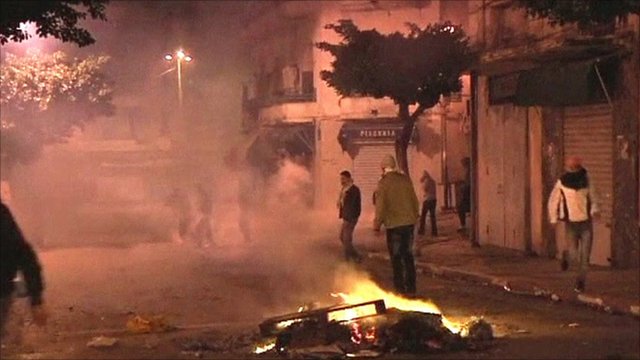
People riot over the prices of food and cooking oil on the streets of Algeria.
What ruins societies? The maldistribution of wealth between the very rich and the very poor. Inequalities that are magnified by state apparatus that legislates for and caters to the the class that holds the power. This particular drama is being played out in Algeria.
“Algerian authorities have vowed to punish those responsible for nationwide food riots in which at least four people were reported killed and more than 800 injured.
Press reports on Sunday quoted Dahou Ould Kablia, interior minster, saying that troublemakers “will not go unpunished”.
It is important to mobilize the coercive agents of the state to keep the people in line. The status quo, after all, needs defending.
“The government on Saturday said it will cut taxes and import duties on some staple foods, amid a series of deadly riots that have killed at least three people.
According to state media, a meeting of ministers in the capital Algiers agreed to measures which would reduce the price of sugar and cooking oil by 41 per cent.
“Nothing can cast doubt on the resolute will of the state, under the direction of the president of the republic, to intervene whenever necessary to preserve the purchasing power of citizens in the face of any price increase,” a government statement said.
Algeria has seen three days of unrest over the rising costs of living and unemployment, which government figures show standing at about 10 per cent, but which independent organisations put closer to 25 per cent.
Layachi Ansar, professor of sociology at Qatar University, told Al Jazeera that the cutting of food taxes and duties was “a superficial measure” that doesn’t address “the deep crisis” going on in Algeria, connected with the “unequal distribution of wealth – this wealth is spoilt by corruption, by bad governance and lack of accountability of government officials and state civil servants”.
Throw them some crusts and curds and hope they ignore the lavish feast going on in the background.
“Mohamed Zitout, a former Algerian diplomat, told Al Jazeera: “It is a revolt, and probably a revolution, of an oppressed people who have, for 50 years, been waiting for housing, employment, and a proper and decent life in a very rich country.
“But unfortunately it is ruled by a very rich elite that does not care about what is happening in the country – because they did not give people what they want, even though the government has the means to do so, the people are now revolting.”
Young people clashed with police in Algiers and several other towns across the country on Friday despite appeals for calm from imams. In Annaba, 600km west of the capital, rioting broke out after Friday prayers in a poor neighbourhood of the city and continued late into the night. A local government office was ransacked, according to witnesses. Protesters also cut down electricity poles during the night, cutting off power to the working class suburb of Auzas.”
Breaking points are reached, the poor majority finally can take no more of a country being run for the benefits of a small segment of society. Will it be popular revolution or even more repression when it comes to Algeria? It is too soon to make a prediction.
 It is encouraging to see capitalism used to actually do something, as opposed to swish money around a hollow economy and proclaim “Profit!” at the end as what has been the North American trend since the 1980’s.
“Researchers in China, the world’s leading provider of wind turbines and solar panels, are working toward making renewable energy cheaper, more efficient and a bigger part of the country’s power grid. But despite China’s rapid leap to being a global leader in the renewable energy field, more government investment is needed for research and development if China is to truly blaze a path toward a clean energy future, researchers say.
Zhao Xingzhong, professor at Wuhan University’s School of Physics and Technology, is researching dye-sensitised solar cells, a low-cost, high-efficiency alternative to more prevalent solid-state semiconductor solar cell technology.”
Go go China. The dependence on fossil fuels will be with us for awhile, but it nice to see some nations actually take the future seriously and begin to plan for it.
“Although Zhao’s team’s research is unique at home and abroad, he says support from the Chinese government is far from enough. He notes that Japan and South Korea have jointly invested about 1.6 billion U.S. dollars on research on third-generation solar technology since 2000. In China, however, Zhao says there have been just five native projects in the solar field in the last decade, with spending of around 4.5 million dollars per project.
“It is difficult to break through the technological bottleneck because of the inadequacy of (financial) input,” Zhao says”
Like most breakthrough products and technologies, renewable power innovation has come through the spending of the state who pays for the R&D of projects and then farms them out to the private sector where they can be made readily available to the public. (Although boo on China for what seems to be, at least in Zhao’s case underfunding his work.) It is one of the great myths of capitalism that private business is the dynamo that runs the economy, it is significant but far from the primary driver. It is the State, through Universities and publicly funded R&D institutes that contribute a great deal to the ‘innovation’ of our economies and societies.
“In recent years, China has become the global leader in renewable energy technology manufacturing, surpassing the United States in terms of both the number of wind turbines and solar panels it makes. The accounting firm Ernst & Young in September named China the best place to invest in renewable energy.
Chinese companies, led by the Jiangsu-based Suntech, have one-quarter of the world’s solar panel production capacity and are rapidly gaining market share by driving down prices using low-cost, large-scale factories. China’s 2009 stimulus package included subsidies for large solar installation projects.
In terms of wind power, home-grown companies have rapidly gained market share in recent years after the government raised local partnership requirements for foreign companies to 70 percent from 40 percent (the government has since removed local partnership requirements) and introduced major new subsidies and other incentives for Chinese wind power companies.”
The day is approaching when solar panels will not be out of range of most people. That will be a good day.
“Critics say China’s interest in renewable energy is essentially a business opportunity – most of what it produces is sold abroad – and that it is less interested in applying the more expensive technology at home. China has not yet caught up to the United States in terms of renewable energy production. The country is the biggest consumer of coal in the world and is expected to burn 4.5 billion tonnes of standard coal by 2020, according to figures from the National Energy Administration.
While coal will still make up two-thirds of China’s energy capacity in 2020, the government has promised to invest billions of dollars into the development of wind, solar and nuclear power. The country’s top legislature, the National People’s Congress, now requires power grid companies buy 100 percent of the electricity produced from renewable energy generators.”
For all the strides China has made in renewable energy, the magnitude of their economy and power needs dictates they well need to rely on coal well into the foreseeable future, as we do in North America. Hopefully, with another major power taking the lead in the development and manufacture of solar panels a renewable energy race might start and really kick things off here in North America where we have both the know how and the consumer base to make renewable energy feasible.
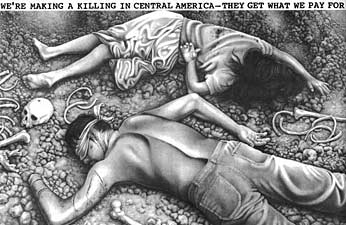 Like every US president to date, Ronald Reagan is responsible for prosecutable war crimes. Of course, we being the “good-guys” do not apply the same standards to ourselves that we expect the rest of the world to follow. It is little wonder you see the ironic smirks in the UN and other international bodies when the US is discussing “law and order” and commitment to human rights, because outside of the memory hole that defines our imperial culture the picture is quite clear cut. The national interest of the US trumps human rights, justice and law almost every time. We just do not get to hear about it here in fortress North America. What we also do not get to easily see is how we sow the seeds of our own discord, as in the case of Afghanistan and the current imperial war taking place there.
Here is what Rasil Basu, UN Developmental Program, senior advisor to the Afghan government for women’s development (1986 – 88) had to say.
“She reported “enormous strides” for women under the Russian occupation:
“Illiteracy declined from 98% to 75%, and they were granted equal rights with men in civil law, and in the Constitution… Unjust patriarchal relations still prevailed in the workplace and in the family with women occupying lower level sex-type jobs. But the strides [women] took in education and employment were very impressive… In Kabul I saw great advances in industry, factories, government offices, professions and the media. With large numbers of men killed or disabled, women shouldered the responsibility of both family and country. I met a woman who specialized in war medicine with dealt with trauma and reconstructive surgery for the war wounded. This represented empowerment to her. Another woman was a road engineer. Roads represented freedom – an escape from the oppressive patriarchal structures.”
By 1988, however, Basu “could see the early warning signals” as Russian troops departed and the fundamentalist Islamist extremists favoured by the Reagan administration took over, brushing aside the more moderate mujahideen groups. Saudi Arabian and American arms and ammunition “have been vital in giving fundamentalist groups an edge over the 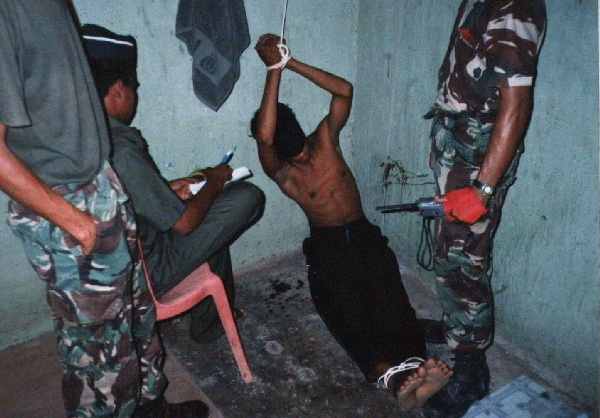 moderates,” providing them with military hardware used,” according to Amnesty International, to target unarmed civilians, most of them women and children.” Then followed much worse horrors as the U.S – Saudi favorites overthrew the Najibullah government. The suffering of the population was so extreme that the Taliban were welcomed when they drove out Reagan’s freedom fighters. Another chapter in the triumph of Reaganite reactionary ultranationalism, worshiped today by those dedicated to defaming the honourable term “conservative”.
– Noam Chomsky, Hopes and Prospects pages 245 – 246.
Hardly surprising considering the gross injustices wrought in Central America by Reagan and the United States. The 1980’s were grim years for Central America plagued by torture, terrorism and death all sponsored by the US.
More people need to educate themselves and do the reading into what exactly their foreign policy entails, because the American populace would certainly not endorse the terror wrought in their name if it was properly publicized and discussed realistically.
 Let us not take lessons from the religiously addled with regards to running our justice system.
“An Iranian court has ruled that a man must lose his eye and part of an ear after he blinded and burnt an ear of another man in an acid attack . Judge Aziz Mohammadi gave the order against the man, who was only identified as Hamid, after convicting him of throwing acid on the victim, named as Davoud, hardline Kayhan newspaper reported on Wednesday.
The judge also ordered Hamid to pay blood-money for the burn injuries suffered by Davoud, who was 22 at the time of the attack, in a ruling issued under the Islamic Republic’s eye-for-an-eye justice code. Hamid told the court he had mistaken Davoud for a classmate who had bullied him in hfigh school, saying that even after moving, he remained tormented by the memory of the bullying.”
The Iranians will not be getting any bonus points for human rights any time soon if they continue with this sort of activity.
“The report, quoting other sources, including Iran’s Fars news agency, did not say whether the authorities would, in fact, carry out the punishment by using acid or via surgery.”
Wow. By surgery or by acid, so many wonderful options. How about imprisonment? How about monetary compensation? Or other options that do not involve maiming the individual in question.











 bleatmop
 Mystro
 The Arbourist


 Dead Wild Roses
Your opinions…