
You are currently browsing the category archive for the ‘Music’ category.
Piazzolla’s nuevo tango was distinct from the traditional tango in its incorporation of elements of jazz, its use of extended harmonies and dissonance, its use of counterpoint, and its ventures into extended compositional forms. As Argentine psychoanalyst Carlos Kuri has pointed out, Piazzolla’s fusion of tango with this wide range of other recognizable Western musical elements was so successful that it produced a new individual style transcending these influences.[22] It is precisely this success, and individuality, that makes it hard to pin down where particular influences reside in his compositions, but some aspects are clear. The use of the passacaglia technique of a circulating bass line and harmonic sequence, invented and much used in 17th- and 18th-century baroque music but also central to the idea of jazz “changes”, predominates in most of Piazzolla’s mature compositions. Another clear reference to the baroque is the often complex and virtuosic counterpoint that sometimes follows strict fugal behavior but more often simply allows each performer in the group to assert his voice. A further technique that emphasises this sense of democracy and freedom among the musicians is improvisation, that is borrowed from jazz in concept, but in practice involves a different vocabulary of scales and rhythms that stay within the parameters of the established tango sound-world. Pablo Ziegler has been particularly responsible for developing this aspect of the style both within Piazzolla’s groups and since the composer’s death.
With the composition of Adiós Nonino in 1959, Piazzolla established a standard structural pattern for his compositions, involving a formal pattern of fast-slow-fast-slow-coda, with the fast sections emphasizing gritty tango rhythms and harsh, angular melodic figures, and the slower sections usually making use of the string instrument in the group and/or Piazzolla’s own bandoneon as lyrical soloists. The piano tends to be used throughout as a percussive rhythmic backbone, while the electric guitar either joins in this role or spins filigree improvisations; the double bass parts are usually of little interest, but provide an indispensable rugged thickness to the sound of the ensemble. The quintet of bandoneon, violin, piano, electric guitar and double bass was Piazzolla’s preferred setup on two extended occasions during his career, and most critics consider it to be the most successful instrumentation for his works.[23] This is due partly to its great efficiency in terms of sound – it covers or imitates most sections of a symphony orchestra, including the percussion, which is improvised by all players on the bodies of their instruments – and the strong expressive identity it permits each individual musician. With a style that is both rugged and intricate, such a setup augments the compositions’ inherent characteristics.
Not quite baroque, but everyone needs a good thumpy track to dance with once in awhile.
Life is a mystery,
Everyone must stand alone
I hear you call my name
And it feels like home
[Chorus:]
When you call my name it’s like a little prayer
I’m down on my knees, I wanna take you there
In the midnight hour I can feel your power
Just like a prayer you know I’ll take you there
I hear your voice, it’s like an angel sighing
I have no choice, I hear your voice
Feels like flying
I close my eyes, Oh God I think I’m falling
Out of the sky, I close my eyes
Heaven help me
[Chorus x2]
Life is a mystery, everyone must stand alone
I hear you call my name
And it feels like…
[Chorus x2 (with Choir)]
(Just like a prayer, I’ll take you there
It’s like a dream to me)
Just came back from a vacation/choral music workshop. This is one of the round we sang. Simple, haunting, and beautiful.
Appreciate the difficulty of A cappella and maintain a steady tempo and intonation. ( I know I certainly did) :)
——-
Sarah Williams’s poetry is where the text for the round originated.
Williams was born in December 1837[a] in Marylebone, London, to Welsh father Robert Williams (c. 1807–1868) and English mother Louisa Ware (c. 1811–1886).[2][3] She was very close to her father and considered her “bardic” interests to come from him.[4] As a young child unable to pronounce ‘Sarah’, she inadvertently gave herself the nickname ‘Sadie’.[1] An only child, she was educated first by her doting parents and later governesses.[4]
Although Williams was only half Welsh by birth and never lived outside London, she incorporated Welsh phrases and themes in her poems and Sadie was considered a Welsh poet.[5]
Robert Williams died in January 1868 of a sudden illness. Already suffering from cancer and devastated by the loss of her father, Sarah’s condition deteriorated.[4] After three additional months of hiding the cancer from her friend and mother, she agreed to surgery despite knowing it might kill her. She died in Kentish Town, London during surgery on April 25, 1868.[3][6]
Her second book of poetry, Twilight Hours: A Legacy of Verse, was published in late 1868. The collection included “The Old Astronomer” (also known as “The Old Astronomer to His Pupil”, as it was titled in a 1936 U.S. reprint), now the most famous of her poems. The second half of the fourth stanza is widely quoted:
Though my soul may set in darkness, it will rise in perfect light;
I have loved the stars too truly to be fearful of the night.[7]
Ian Rankin titled his Inspector Rebus novel Set in Darkness after the lines and quoted them in the introduction. In an interview, Rankin linked the quote to the rise of a restored Scottish Parliament and the redemption of the Inspector in the novel.[8] The poem is written from the perspective of an aged astronomer on his deathbed bidding his student to continue his humble research. The lines have been chosen by a number of professional and amateur astronomers as their epitaphs.[3][9]
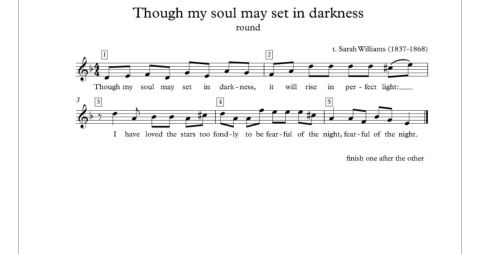
We did it in A minor, but this is the tune.











 bleatmop
 Mystro
 The Arbourist


 Dead Wild Roses
Your opinions…