
You are currently browsing the category archive for the ‘Science’ category.
 I’ve almost finished Susan Jacoby’s book titled the Age of American Unreason. There are a few passages that wanted to make me stand up and cheer and qualified themselves as sharing material on the blog. Of course, I can never find them when I want to do the actual transcription, but here is one quote from the chapter on “junk thought’ stating how important grounding in scientific principles are.
“It ought to be unnecessary to have to state that scientific literacy and respect for the scientific method should not be equated with blind trust in experts and scientists and that antagonism toward evidence based science should not be confused with an entirely healthy concern about the need for ethical oversight of scientific research. But junk-thought has become so pervasive in the United States that as soon as someone criticized, say, religion-based restriction on stem cell research, the hucksters of illogic inevitably remind the public about Nazi doctors who performed cruel and scientifically useless experiments on human subjects; about Lysenkoist biology in the Soviet Union; and, last but not least, about the false and widely publicized claims of successful embryonic cloning by South Korean researches. The last were of course exposed by other scientists, because all real scientific research must be and is subjected to rigorous scrutiny by peers. That is what separates science for pseudoscience and junk thought. Without a basic understanding of what constitutes good science, neither ordinary citizens nor the politicians that represent them can hope to make thoughtful judgments separating quacks, con men, and practitioners of bad science from thoughtful experts whose advice ought to be taken seriously.”
-Excerpt from Susan Jacoby’s The Age of American Unreason. p.230
Wave-particle duality is just one on a huge list of phenomena that we cannot intuitively understand. 1veritasium does a nice job of walking us through the steps and sharing the science behind the experiment.
Oh BEDMASS my reliable guide, you were actually lying to me all this time.
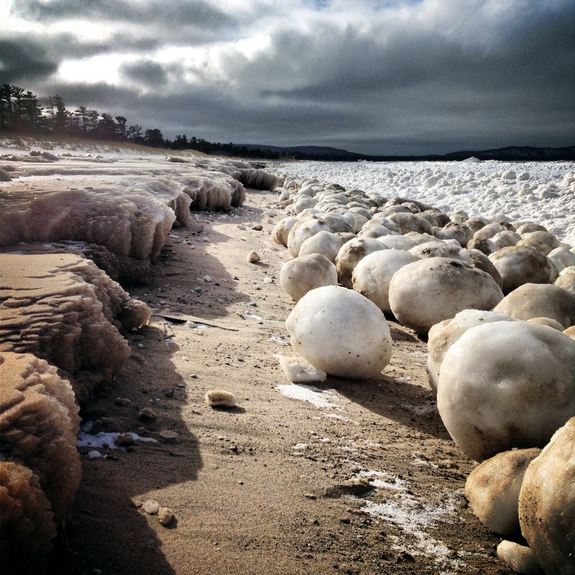
This happened in February of this year on Lake Michigan.
“Weighing in at up to 50 pounds (22 kilograms) each, the ice spheres are a winter weather phenomenon resulting from wind and wave action along the shore, according to reporting by NASA‘s Earth Science Picture of the Day. Small fragments of floating ice act like seeds, with layers upon layers of supercooled lake water freezing around them as the balls churn in the waves. Wind then pushes the ice concretions onshore.”
I sometimes complain about the landlocked status of my home here in Alberta, then I see stuff like what is pictured below, or what happened in Manitoba and I think to myself, “hmm…not so bad here after all.”

Ice Wall in Manitoba
I’ll admit it, I’m a sucker for popular astronomy shows. How amazingly small and insignificant our place is in the Universe is always humbles me when I am reminded of the fact. It is a humility I wish the religious minded among us could understand, instead of wasting time and energy faffing away on their sky daddies and magic books.
Anyhow, here is a 24 minute exploration of the cosmic phenomenon known as black holes, I hope you enjoy it as much as I did. :)
“Our Milky Way may harbor millions of black holes… the ultra dense remnants of dead stars. But now, in the universe far beyond our galaxy, there’s evidence of something far more ominous. A breed of black holes that has reached incomprehensible size and destructive power. Just how large, and violent, and strange can they get?
A new era in astronomy has revealed a universe long hidden to us. High-tech instruments sent into space have been tuned to sense high-energy forms of light — x-rays and gamma rays — that are invisible to our eyes and do not penetrate our atmosphere. On the ground, precision telescopes are equipped with technologies that allow them to cancel out the blurring effects of the atmosphere. They are peering into the far reaches of the universe, and into distant caldrons of light and energy. In some distant galaxies, astronomers are now finding evidence that space and time are being shattered by eruptions so vast they boggle the mind.
We are just beginning to understand the impact these outbursts have had on the universe: On the shapes of galaxies, the spread of elements that make up stars and planets, and ultimately the very existence of Earth. The discovery of what causes these eruptions has led to a new understanding of cosmic history. Back in 1995, the Hubble space telescope was enlisted to begin filling in the details of that history. Astronomers selected tiny regions in the sky, between the stars. For days at a time, they focused Hubble’s gaze on remote regions of the universe.
These hubble Deep Field images offered incredibly clear views of the cosmos in its infancy. What drew astronomers’ attention were the tiniest galaxies, covering only a few pixels on Hubble’s detector. Most of them do not have the grand spiral or elliptical shapes of large galaxies we see close to us today.
Instead, they are irregular, scrappy collections of stars. The Hubble Deep Field confirmed a long-standing idea that the universe must have evolved in a series of building blocks, with small galaxies gradually merging and assembling into larger ones.”
The more I learn about Quantum Mechanics the more interested I become. The counter-intuitive nature of how the fundamental particles operate requires reliance on the scientific method, there is no other way that we could be making these discoveries (I’m looking at you religion). Enjoy learning about how empty space is actually far from empty.
The people over at the numberphile channel have a knack for explaining interesting mathematical concepts and this is one of the better explanations of what some of Zeno’s Paradoxes are and how we “solve” them.











 bleatmop
 Mystro
 The Arbourist


 Dead Wild Roses
Your opinions…