
You are currently browsing the tag archive for the ‘DWR Feminist Quote of the Day’ tag.
“In the United States, with its distinctly racist character, the very fear of the dark is manipulated, often subliminally, into fear of black, of black men in particular, so that the traditional association between rape and black men that is our national heritage is fortified. In this context, the imagery of black night suggests that black is inherently dangerous. In this context, the association of night, black men, and rape becomes an article of faith. Night, the time of sex, becomes also the time of race – racial fear and racial hatred. The black male, in the South hunted at night to be castrated and/or lynched, becomes in the racist United States the carrier of danger, the carrier of rape. The use of a racial despised type of male as a scapegoat, a symbolic figure embodying the sexuality of all men, is a common male-supremacist strategy. Hitler did the same to the Jewish male. In the urban United States, the prostitute population is disproportionally made up of black women, streetwalkers who inhabit the night, prototypical female figures, again scapegoats, symbols carrying the burden of male-defined female sexuality, of woman as commodity. And so, among the women, night is the time of sex and also of race: racial exploitation and sexual exploitation are fused, indivisible. Night and black: sex and race: the black men are blamed for what all men do; the black women are used as all women are used, but they are singularly and intensely punished by law and social mores; and to untangle this cruel knot, so much a part of each and every night, we will have to take back the night so that it cannot be used to destroy us by race or by sex.”
-Andrea Dworkin, The Night and Danger, 1979

Ah..patriarchy the gift that keeps on giving – like metastasizing cancer.. ;/
“Madness and witchery… are conditions commonly associated with the use of the female voice in public, in ancient as well as modern contexts. Consider how many female celebrities of classical mythology, literature and cult make themselves objectionable by the way they use their voice. For example there is the heartchilling groan of the Gorgon, whose name is derived from a Sanskrit word garg meaning “a guttural animal howl that issues as a great wind from the back of the throat through a hugely distended mouth.” There are the Furies whose highpitched and horrendous voices are compared by Aiskhylos to howling dogs or sounds of people being tortured in hell. There is the deadly voice of the Sirens and the dangerous ventriloquism of Helen and the incredible babbling of Kassandra and the fearsome hullabaloo of Artemis as she charges through the woods. There is the seductive discourse of Aphrodite which is so concrete an aspect of her power that she can wear it on her belt as a physical object or lend it to other women. There is the old woman of Eleusinian legend Iambe who shrieks and throws her skirt up over her head to expose her genitalia. There is the haunting garrulity of the nymph Echo (daughter of Iambe in Athenian legend) who is described by Sophokles as “the girl with no door on her mouth.”
Putting a door on the female mouth as been an important project of patriarchal culture from antiquity to present day. Its chief tactic is an ideological association of female sound with monstrosity, disorder and death.
-The Gender of Sound, Anne Carson
“Male propagation of the idea that men, too, are feminine – particularly through feminine behaviour by males – distracts attention from the fact that femininity is a man-made construct, having essentially nothing to do with femaleness.”
-“Gyn/Ecology” Mary Daly p.49

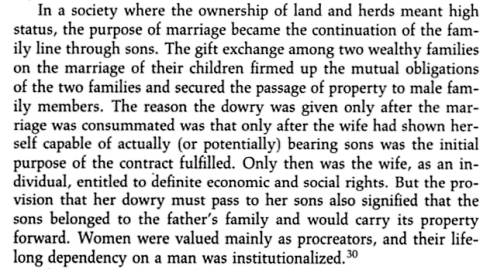
“Advertisers must convince young women that they are in need of constant improvement—largely to get and keep boys’ attention—without threatening young women’s views of themselves as intelligent, self-directed, and equal. Buzz words like “empowerment,” “self-determination,” and “independence” are sprinkled liberally across their pages. But this seemingly progressive rhetoric is used to sell products and ideas that keep girls doing gender in appropriately feminine ways, leading them to reproduce, rather than challenge, gender hierarchies. An ad for a depilatory cream, for instance, tells girls that they are “unique, determined, and unstoppable,” so they should not “settle… for sandpaper skin.” Feminist demands for political and economic equality—and the refusal to settle for low-wages, violence, and second-class citizenship—morph into a refusal to settle for less than silky skin. Pseudo-feminist language allows young women to believe that they can “empower” themselves at the checkout counter by buying the accoutrements of traditional femininity.”
— Amanda M. Gengler, Selling Feminism, Consuming Femininity.


“…But I do feel a special place of contempt for the absolute army of twenty-something, socially privileged, very well educated, young white women, who speak about prostitution in terms of “sex work” and “empowerment” and this utter nonsense when they have spent years educating themselves… in order to keep themselves out of the social class of women who are most commonly used in prostitution.“And you know… formally prostituted women like myself have been delivered and expected to digest the most galling lie about our own histories, that is, we have been told that our imprisonment was liberty – that our slavery was freedom. And when we talk about prostitution, we’re talking about an area of life where women are ritualistically coerced, abused, forced, and silenced. And somehow, in some magical realm that is dressed up as reality, we are expected to believe that these deeply dis-empowering elements add up to empowerment. This is bulls**t, and it is dangerous bulls**t – so blatant that it is worthy not only of our utmost contempt, but of our relentless resistance. And it comes from one particular category most forcefully: and those are the women, the young, white, privileged, college educated women I’ve just described.”
—Rachel Moran, Irish feminist activist and author and founder of SPACE International (Survivors of Prostitution-Abuse Calling for Enlightenment) speaking in an interview with Resistance Radio.
“Queer theory and politics became involved in a gender rescue mission against the radical feminist campaign to abolish it. This may be because, for most women and men under male dominance, sexual desire is constructed precisely from eroticising the power difference between the sexes that is embodied in gender. Equality is unsexy and the very idea of dismantling gender is, therefore, as Catharine MacKinnon explains, ‘detumescent’ (Jeffreys, 1990; MacKinnon, 1989).”











 bleatmop
 Mystro


 Dead Wild Roses
Your opinions…