
You are currently browsing the tag archive for the ‘Friday Classical Music Interlude’ tag.
Greetings fair readers. A slightly different format for the DWR classical music interlude. Its Haydn, and all four movements in the same post. Commentary from wikipedia appears below. Enjoy.
First movement
Haydn distinguishes each section of the sonata form in this movement by use of strong contrasts of stability and instability. Before revealing the first theme of the symphony, Haydn opens this movement with a slow introduction that begins in the tonic G major and modulates through to the parallel minor and then to the dominant. He begins the first theme in the tonic but on a dominant seventh chord. This is very unusual of symphonies of the time but it reflects an aspect of Haydn’s unique compositional characteristics. Because the rest of the Oxford will reflect many of the ideas presented in this first theme, this symphony has been termed monothematic.
Following the first theme is the transition, which allows Haydn to modulate to the dominant. The second theme begins with the opening idea of the movement, but in the dominant key. As this theme progresses it enters a section of minor-mode before entering into the closing theme. Haydn stays in the dominant key through the closing of the first movement. In the development section, Haydn borrows themes from the exposition, then “develops” and embellishes them. He adds sections of subject change and digression from the original theme as well as moments of rest or silence. These qualities of the development are all very characteristic of Haydn. Furthermore, he draws upon the older style of intricate counterpoint to enhance the galante style of the symphony.
Second movement
The second movement is in ternary form with a slow and song-like melody. Haydn, however, adds his own uniqueness to this movement by adding an intense middle section in minor. This minor interlude is based on a motive from the opening section. A shortened return of the major section precedes a section of the movement that features the winds.[3]
Third movement
Haydn composes the third movement in ABA form with a minuet and trio. Both the minuet and trio are in binary form with repeats. In order to create a more entertaining movement for the listener, Haydn composes the minuet with phrases of six measures as opposed to the normal four-measure phrase and adds syncopations and stops. All of these qualities were found to be humorous by the audiences of Haydn’s time because they were so unusual.
Fourth movement
Haydn’s final movement of the Oxford Symphony is centered on a feeling of tension and release. In order to convey this quality to the listener, Haydn writes this sonata form movement slightly faster and shorter than the first movement of the symphony to create a climactic ending.
Dvorak brings his symphony to a majestic close. In two parts due to youtube length limitations.
Like the first movement, the fourth begins not with its main theme but with an introduction. 00:00:47
|
|
|
|
|
|
|
|
|
|
|
|
|
|
|
|
|
|
|
|
|
|
|
|
|
|
|
|
|
|
Fantastic movement, keeps you on the edge of your seat. :)
Follow along with some of the musical highlights.
| 1. | Dvorak, Beethoven, and the Scherzo. Dvorak purposely confuses the listener’s expectations. 00:01:54 |
|
|
|
|
|
|
|
|
|
|
|
|
|
|
|
|
|
|
|
| 21. | Third movement (complete) 00:08:07 |
I apologize for switching orchestras, but the original had parts missing so we had to go to this edition of the symphony.
Musical highlights courtesy of the Naxos website.
| 0. | The very opening chords unmistakably herald the arrival of something special. 00:01:06 |
|
|
|
|
|
|
|
|
|
|
|
|
|
|
|
| 56. | Second movement (complete) 00:12:00 |
Romantic Music here we come!
Few works for the concert hall have won such immediate and continuing popularity as Dvořák’s Symphony No. 9 ‘From the New World’. Dramatic, lyrical, and spacious, it presents a rich panorama of ravishing and exciting orchestral colours, reflecting the experiences and emotions of the great Czech composer during his years in America towards the end of the nineteenth century. Its abiding magic might seem beyond analysis, but in this detailed and fascinating tour Jeremy Siepmann explores the inner-workings of a masterpiece, his enthusiasm not only intact but enhanced.
Dvořák’s ‘New World’ Symphony is undoubtedly a much-played, much-loved masterpiece – but why? What are the ‘New World’ connections, and how does it link with the 19th-century symphonic tradition that was so much the composer’s musical heritage? This informal but fascinating and detailed account enriches our appreciation of one of the most popular symphonies without the need for any theoretical knowledge of music.
 An Introduction to… DVORAK Symphony No. 9 ‘From the New World’
|
|
|
|
|
|
|
|
|
|
|
|
|
|
|
I cannot believe that this is the only recording of this particular song. I apologize for the poor video quality, but then again, the sound is fairly good, as well as the choir and soloist. This piece was also performed in Kaslo, and I have the intention to learn the solo and perform it with a choir. :)
**update** – Found a better version, now with harp. :)
For music geeks, the choir tenor part is actually signs higher notes than the soloist, going to all the way to a “A” while the soloist goes as high as “G”. As I’ll probably get the honour singing both parts, I’m doubly lucky…
A little of Gabriel Fauré’s history and his music, thank you Wikipedia.
Gabriel Urbain Fauré (pronounced: [ɡabʁiɛl yʁbɛ̃ fɔʁe]; 12 May 1845[n 1]– 4 November 1924) was a French composer, organist, pianist and teacher. He was one of the foremost French composers of his generation, and his musical style influenced many 20th century composers. Among his best-known works are his Nocturnes for piano, the songs “Après un rêve” and “Clair de lune”, his Pavane and his Requiem.
Born into a cultured but not unusually musical family, Fauré revealed his talent when he was a small boy. He was sent to a music college in Paris, where he was trained to be a church organist and choirmaster. Among his teachers was Camille Saint-Saëns, who became a lifelong friend. In his early years, Fauré earned a modest living as an organist and teacher, leaving him little time for composition. When he became successful, holding the important posts of organist of the Église de la Madeleine and head of the Paris Conservatoire, he still lacked time for composing, retreating to the countryside in the summer holidays to concentrate on composition.
 By his last years, Fauré was recognised in France as the leading French composer of his day. An unprecedented national musical tribute was held for him in Paris in 1922 headed by the President of the Republic. Fauré had many admirers in England, but his music, though known in other countries, took decades more to become widely accepted. His music has been described as linking the end of Romanticism with the modernism of the second quarter of the 20th century. When he was born, Chopin was still composing, and by the time of his death the atonal music of the Second Viennese School was being heard. The Grove Dictionary of Music and Musicians, which describes him as the most advanced composer of his generation in France, notes that his harmonic and melodic innovations affected the teaching of harmony for later generations. In contrast with the charm of his earlier music, his last works, written when increasing deafness had struck him, are elusive and withdrawn in character.
Vocal music
Fauré is regarded as one of the masters of the French art song, or mélodie.[1] In Copland’s view, the early songs were written under the influence of Gounod, and except for isolated songs such as “Après un rêve” or “Au bord de l’eau” there is little sign of the artist to come. With the second volume of the sixty collected songs, Copland judged, came the first mature examples of “the real Fauré”. He instanced “Les berceaux”, “Les roses d’Ispahan” and especially “Clair de lune” as “so beautiful, so perfect, that they have even penetrated to America”, and drew attention to less well known mélodies such as “Le secret”, “Nocturne”, and “Les présents”.[5] Fauré also composed a number of song cycles. Cinq mélodies “de Venise”, Op. 58, was described by Fauré as a novel kind of song suite, in its use of musical themes recurring over the cycle. For the later cycle La bonne chanson, Op. 61, there were five such themes, according to Fauré.[62] He also wrote that La bonne chanson was his most spontaneous composition, with Emma Bardac singing back to him each day’s newly written material.[63]
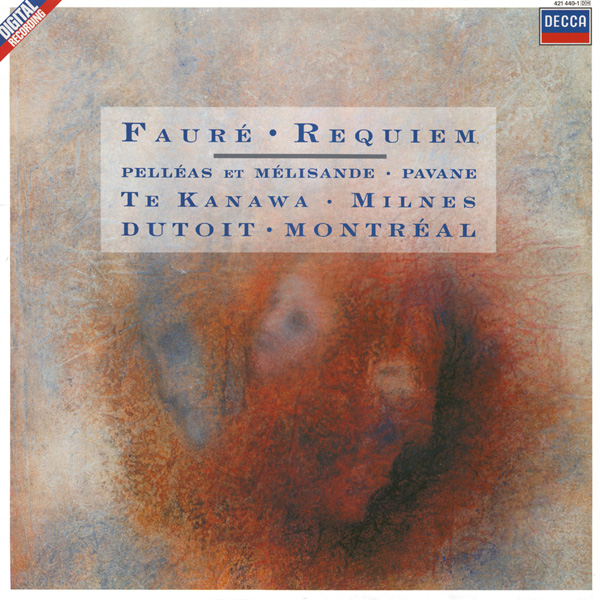
The Requiem, Op. 48, was not composed to the memory of a specific person but, in Fauré’s words, “for the pleasure of it.” It was first performed in 1888. It has been described as “a lullaby of death” because of its predominantly gentle tone.[64] Fauré omitted the Dies Irae, though reference to the day of judgment appears in the Libera me, which, like Verdi, he added to the normal liturgical text.[65] Fauré revised the Requiem over the years, and a number of different performing versions are now in use, from the earliest, for small forces, to the final revision with full orchestra.[66]Fauré’s operas have not found a place in the regular repertoire. Copland called Pénélope a fascinating work, and one of the best operas written since Wagner. He noted, however, that the music is, as a whole, “distinctly non-theatrical.”[5] The work uses leitmotifs, and the two main roles call for voices of heroic quality, but these are the only ways in which the work is Wagnerian. In Fauré’s late style, “tonality is stretched hard, without breaking.”[67]

These are short pieces in which two different melodies are played simultaneously. Usually, the right hand plays the higher voice, and the left hand plays the lower one. In each Bach invention, there is a motive (a short musical idea) that is repeated in various forms – each time slightly different, and is developed through the whole piece.











 bleatmop
 Mystro
 The Arbourist


 Dead Wild Roses
Your opinions…