
You are currently browsing the tag archive for the ‘History Hit’ tag.
Antonio Gramsci (1891–1937) was an Italian Marxist philosopher and revolutionary who reimagined the battlefield of socialism. Where Marx envisioned revolution through economic crisis and class struggle, Gramsci located the real battleground in culture—in the stories, moral codes, and institutions that shape how people perceive reality. His insight reshaped leftist strategy throughout the 20th century and remains the foundation of what has come to be known, often critically, as Cultural Marxism.
Gramsci’s imprisonment by Mussolini between 1926 and 1937 produced the Prison Notebooks, a collection of reflections on history, education, religion, and power that would change Marxism forever. Rather than calling for immediate insurrection, Gramsci argued that Western societies were held together not merely by force, but by consent—the consent of people whose minds had been molded by dominant cultural institutions. To overthrow capitalism, the revolution would first have to capture culture.
The Concept of Cultural Hegemony
Gramsci coined the term “cultural hegemony” to describe the way ruling classes maintain control by shaping what society considers “common sense.” Schools, churches, media, literature, and even family life all help reproduce the values that support the existing order. To Gramsci, the working class could never achieve political power until it produced a counter-hegemony—a rival moral and intellectual framework capable of displacing the dominant bourgeois worldview.
This insight was transformative. It shifted Marxist focus from economic structures to cultural superstructures—from factories to universities, from political parties to publishing houses. The revolution would be waged not only with rifles and manifestos, but with textbooks, art, and language itself.
The Five Pillars of Western Hegemony
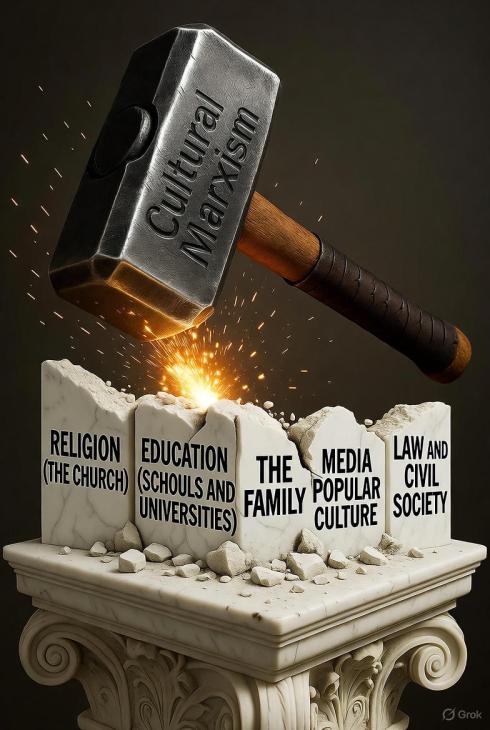
Gramsci identified several key arenas where cultural hegemony is maintained and where revolutionary transformation must occur. Though he never formally listed “five areas,” his writings consistently emphasize these interlocking domains as the loci of bourgeois cultural power:
- Religion (The Church) – The Church was, for Gramsci, the moral anchor of Western civilization. Its authority shaped notions of duty, sin, and redemption. For a new socialist order to take root, Marxists would need to displace religious authority with secular, materialist moral systems.
- Education (Schools and Universities) – Schools reproduce social hierarchies by transmitting the ideology of the ruling class. Gramsci saw education as the most potent tool for cultivating a new “collective will.” Intellectuals, teachers, and professors were to become “organic intellectuals” of the working class—agents of counter-hegemony.
- The Family – As the smallest unit of moral and cultural reproduction, the family passes on norms of obedience, gender roles, and private property. Gramsci argued that socialist transformation required reconfiguring family life to reflect collective rather than patriarchal or bourgeois values.
- Media and Popular Culture – Newspapers, radio, and entertainment function as instruments of social consent. Control over communication channels would allow the revolutionary movement to redefine reality itself—to make socialist ideas seem natural and just.
- Law and Civil Society – Beyond the coercive power of the state lies civil society: courts, voluntary associations, clubs, and unions. These mediate between individuals and the state, embedding ruling-class ideology in everyday life. The Left’s long march through these institutions, later theorized by figures like Rudi Dutschke, stems directly from Gramsci’s idea of building a counter-hegemonic presence within civil society.
From Class War to Culture War
Gramsci’s influence has proven far greater than his lifetime achievements would suggest. His Prison Notebooks became a cornerstone for postwar Marxist thinkers of the Frankfurt School—Herbert Marcuse, Theodor Adorno, and others—who expanded his ideas into critical theory. Together, they seeded what would evolve into the New Left, identity-based activism, and much of today’s academic “social justice” thought.
While critics argue that Gramsci’s ideas have fostered divisive cultural politics, even they concede his enduring genius: he saw that culture precedes politics. Whoever controls a society’s moral vocabulary ultimately controls its laws, institutions, and collective imagination.
Why Gramsci Matters Today
Understanding Gramsci is essential to understanding the modern cultural landscape. His legacy explains why ideological movements increasingly contest meanings—of gender, race, language, and history—rather than material production. The “long march through the institutions” that Gramsci inspired is visible across Western education, media, and bureaucracies.
Whether one views this as intellectual renewal or cultural subversion, Gramsci’s insight endures: power begins in the mind before it manifests in law.
References
- Gramsci, Antonio. Selections from the Prison Notebooks. Edited by Quintin Hoare and Geoffrey Nowell Smith. New York: International Publishers, 1971.
- Buttigieg, Joseph A. Antonio Gramsci: Prison Notebooks, Vols. I–III. Columbia University Press, 1992–2007.
- Crehan, Kate. Gramsci, Culture and Anthropology. University of California Press, 2002.
- Dutschke, Rudi. “The Long March Through the Institutions.” (Speech, 1967).
- Jay, Martin. The Dialectical Imagination: A History of the Frankfurt School and the Institute of Social Research, 1923–1950. University of California Press, 1973.











 bleatmop
 Mystro


 Dead Wild Roses
Your opinions…