
You are currently browsing the tag archive for the ‘International Forum of Philosophy’ tag.
The lack of reflection in North American society reflects in our policies and economic choices. Countries that have experienced the ripsaw of neo-liberal capitalism (essentially the unbalanced “free-market” reforms that we impose on other countries to savage their people and exploit their resources) are contemplating life after the free marketers have been kicked out and those countries must once again reform a nation from the hollow shell left by ‘free-market’ plundering. In this piece from Al-Jazeera we gain an inside look at what happened at the forum and some of the topics discussed.
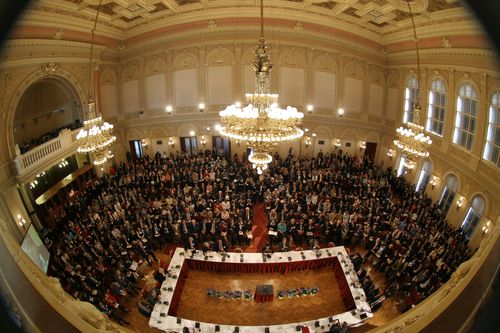 “I just returned from the sixth International Forum of Philosophy in Maracaibo, Venezuela, where philosophers from four continents were invited to discuss “State, Revolution and the Construction of Hegemony”.The event was inaugurated by the vice-presidents of Venezuela and Bolivia, televised by several channels, and on the last day, a prize of $150,000 was awarded to the best book presented within the Libertador Award for Critical Thinking of 2011.”
It is nice to see that somewhere in the world people can speak of the world as it is as opposed to the geo-political bias imposed by living in North America.
“Similar to the World Social Forum of Brazil, both the prize and forum aim to reflect not only upon the social progress that characterises these nations, but also the progress taking place in rest of the world; this is why only thinkers whose position is essentially leftist are invited, that is, those in the service of the weak, marginalised, and oppressed sectors of society.”
Before we jump on the ‘fair and balanced’ objection, let me remind you fair readers that the opposing point of view can be found by simply accessing any major newspaper of record, or any corporate media source.
“Regardless of how effective the conference’s statement is on the governors that read it, what is interesting for us – European academics – is the institutional significance that is given to philosophy in the region. Is there a philosophy conference or forum in the United States or EU where vice-presidents take time to inaugurate a similar event?
Before exploring this relation [between governance and philosophy], it is necessary to remember that most Latin American countries today are governed by socialist governments whose main objective is to elevate from poverty those citizens that were discarded by the neoliberal (and in some cases dictatorial) states that ruled the region in the past. This is why for more than a decade now, such renowned progressive intellectuals as Noam Chomsky, Naomi Klein, and many others have been endorsing Chavez, Morales, and other democratically elected presidents for their social programmes and economic independence from the IMF.
It might be nice to learn some of the lessons from these failed neoliberal experiments as the doctrines are still playing in Canada, US and Europe.
“But despite the social progress (since 2003, extreme poverty has been reduced by 72 per cent in Venezuela), ecological initiatives (Morales has been declared the “World Hero of Mother Earth” by the president of the United Nations General Assembly), and economic efficiency (unlike the EU, Latin American economies will grow by 4.7 per cent in 2012) of these governments, a campaign of hatred and disinformation has been taking place throughout our Western media in order to discredit these achievements.
Perhaps, as Oliver Stone pointed out in his brilliant documentary South of the Border, this campaign is a symptom of fear that citizens in the West might also begin to demand similar policies. After all, while in Europe we are cutting social services following the European Central Bank demands, Latin American states are increasing them, just as so many western protesters (“indignados”, Occupy Wall Street, and other courageous movements) demand.”
Ah, the threat of a good example. To the embattled North American Economies a threat worse than Iran, Iraq and the Taliban all rolled into one. The idea that a model focused on people rather than profit can and is working in the world. Fortunately for these Southern Cone countries they are now too big and well organized to be brought down, as Nicaragua was in the 90’s by the US.
“These Latin American countries are not calling philosophers to obtain from them rational justifications or hoping that some of us write propaganda articles for their policies. Rather, they are showing their awareness that history has not ended. I’m referring here to Francis Fukuyama’s famous theory of “the end of history” (“liberal democracy is the only legitimate form of government broadly accepted”), which has now been assimilated, if not completely incorporated, by our capitalist culture.
But history in Latin America has neither ended nor started anew. It’s simply proceeding as an alternate to our capitalist logic of economic enrichment, technological  progress and cultural superiority. The Latin American countries do not aim to dominate others, but simply to evoke those whom Walter Benjamin called the “losers of history”, that is, the ones who have not succeeded within our neoliberal democratic system. These unsuccessful “shareholders” are represented not only by underprivileged citizens, but also by underdeveloped nations and continents. In this condition, philosophy is called upon to think historically – that is, to maintain living history. But how?”
How refreshing to see another point of view being expressed and some of the tenets of neoliberalism thoughtfully challenged. And how do we see our “free press” respond to such a conference? Observe. The silence is deafening. Such an unscrupulous avoidance news is a regular feature of our corporate news media, that exists mostly to feed and reinforce the system that it profits from, and most certainly not to educate its populace.
Let’s hope that people can find out more about alternative points of view and learn about competing narratives so they can more effectively judge the systems that they currently inhabit. The OWS movement is a step in the right direction but need to ground themselves in the historical struggle for citizens rights and power within the state capitalist system. Looking toward Latin America and what people have and are achieving there would be a good start.











 bleatmop
 Mystro
 The Arbourist


 Dead Wild Roses
Your opinions…