
You are currently browsing the tag archive for the ‘Motte-and-Bailey Fallacy’ tag.
Know it when you see it.
“A very common (and newly-named) informal rhetorical trick I’ve been observing, both online and in real life, is this one right here. The motte-and-bailey fallacy (also known as the ‘motte-and-bailey doctrine’). Although it is often found in arguments made by supporters of social justice, a lot of extremist ideologies also use it.
Effectively, it is bait-and-switch. Example:
Monique: All white people are racist.
Joshua: Why do you believe that, when you don’t know every white person nor their beliefs?
Monique: Well, when we say “all whites are racist”, what we really mean is, all whites are racially biased as a result of being brought up with certain beliefs in the context of a racialised society.
Ignore the lack of specificity in Monique’s argument for a moment. Notice what she does. She asserts a controversial position (the bailey), which is desired, but hard to defend. When Joshua challenges her, she retreats to a less controversial position (the motte), which is easier to defend, but undesired. She then attempts to equate the two positions to obscure the fact that her claim was effectively stepped down.
The power of this fallacy lies in the ability to defend a less controversial, or “weaker” position, while giving the impression that a “stronger”, or more controversial one, was defended instead.
Another example of bait-and-switch:
Tim: Feminism is the radical notion that women are people. If you believe that, then surely, you must be a feminist.
This is motte-and-bailey as well, but without the bailey at first – call it the ‘Hidden Bailey’ fallacy. Tim gives an uncontroversial position, and equates it with his ideology – feminism – which is actually more than is implied in that statement. Virtually everyone will agree that women are people, yet, other concepts in feminism – like patriarchy theory, rape culture, etc. are far more contested and may not be agreed upon by people who accept the first statement. Tim is baiting people into thinking they agree with him, only to switch to his real beliefs afterwards.”

Did you want to learn about the Motte and Bailey with further context of how it is being used to leverage specious ‘social justice’ claims in our society? Take a listen to the New Discourses podcast on the topic.
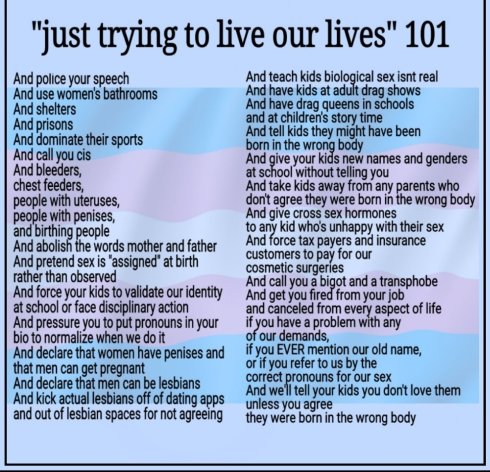
The use of opaque statements like “Trans people are just trying to LIVE our Lives” is a prime example of the motte and bailey fallacy.
“The motte-and-bailey fallacy (named after the motte-and-bailey castle) is a form of argument and an informal fallacy where an arguer conflates two positions that share similarities, one modest and easy to defend (the “motte”) and one much more controversial and harder to defend (the “bailey”).[1] The arguer advances the controversial position, but when challenged, they insist that they are only advancing the more modest position.[2][3] Upon retreating to the motte, the arguer can claim that the bailey has not been refuted (because the critic refused to attack the motte)[1] or that the critic is unreasonable (by equating an attack on the bailey with an attack on the motte).”
Mostly everyone in western democratic societies are free to reasonably live their lives – within the confines of what is currently acceptable in society. In this case, currently transpeople have *every* right afforded to other people that inhabit Canadian and American society. What transactivists and other parts of the activist Left don’t say is that they wish to radically alter society’s rules around *their* vision of the future (which,in my opinion, is mostly utopian dogshit).
So this is how this one works. If you call Activist Leftists out on their unreasonable claims such as biological sex isn’t real( The bailey) then they will retreat to the motte and say “Well you just don’t want trans people to live their lives” (the motte).
The solution is to not even grant them the motte. People in free societies CAN live their lives mostly as they see fit – with the proviso their ‘lifestyle’ doesn’t negatively impact others.
The denial of biological sex has significant detrimental impacts on female rights, boundaries, and safety in our society – most to the point the ‘inclusion’ of male rapists (because they fucking feel like women) in female prisons in Canada.
Always bomb their innocuous motte and raze their radical bailey.
Being able to freely discuss and share one’s thoughts in the public sphere is one of the hallmarks of a society that embraces freedom and freedom of speech. We, as responsible concerned citizens, should not be afraid to examine, discuss, and delve deeply into any topic that is important or relevant to our society and our social experience.
Authoritarians on the both the Right and the Left are opposed to citizenry in free societies discussing their pet issues in the public square and will use many tactics to shut down debate or at least increase the social cost of doing so, as to discourage most people from engaging.
Personally, I get this most when trying defend the notion that gender identity movement in its current form is actively harmful toward female rights, boundaries, and safety in our society. Trying to discuss the notion that men (regardless of how they identify) should not be in female prisons is a prime example of the rhetorical cartwheels seemingly engaged automatically when this topic is broached. “You hate trans people!” or “You’re transphobic!”…. Erm… No, it is just that there is a real safety problem with putting men into female single sex spaces that SHOULD have been discussed and debated before we actual did it here in Canadian society – So now we have to do it post hoc, ,and deal with the consequences of this foolish decision – that is females are being abused and sexually assaulted in female prisons by men who (falsely) claim they are women.
Men’s feelings about their gender should not outweigh the safety and security of women in institutional settings. This discussion needs to be had and should have been had in our public political landscape.
I digress a bit, but one of the many ways in which authoritarians attempt to discourage discussion – see the name calling example above – is the deployment of the motte-and-bailey fallacy. W.Alexander Bell tackles the fallacy in his essay quoted below:
“One way that happens is by using the motte-and-bailey fallacy. One modest and easy-to-defend position (the motte) is replaced by a much more controversial position (the bailey). A person will argue the bailey, but then replace it with the motte when questioned.
For example, a key concept of critical race theory and the broader social justice movement is the notion of lived experience, which means that marginalized people have better access to knowledge about their own experiences of oppression than privileged people do. On the surface, that seems quite reasonable. A white person can never know how it feels to be called the n-word, and a man might be oblivious to how it feels to be a woman in a male-dominated profession. Sexism and racism do exist, so it seems reasonable to assume that members of the majority are less likely to recognize such prejudices.
However, the proponents of critical race theory and intersectionality do not stop there. Smuggled into their notion of lived experience is an adherence to the more controversial “standpoint epistemology,” a postmodern theory of knowledge that rejects reaching for objectivity and argues that marginalized people have authoritative knowledge about complex systems of oppression and society itself.
For example, a colleague of mine at a Swedish university cited his lived experience when he argued that critics of Sweden’s immigration policies are all racists and should be banned from speaking at universities.
When I told him that his lived experience was just anecdotal—that there is no way he could generalize about millions of people based on a few bad encounters—he doubled down and replied, “that’s a very white male thing to say.” Initially, I worried that I wasn’t sympathetic enough to his experiences as an immigrant, despite being one myself. However, I now realize that I was being emotionally manipulated and shamed into silence through a very clever bait-and-switch. These tactics are not part of a good-faith debate, but rather a rhetorical strategy to claim epistemic authority and gain power.
Retreating to the motte of lived experience is a manipulative tactic that the disciples of the social justice movement use to exploit compassionate peoples’ desire not to offend others. The motte-and-bailey allows pseudo-academics and activists to shut down important discussions without making an argument or citing any credible scholarship or data. It also allows them to drown out well-reasoned arguments with selective anecdotes, emotional appeals, shaming tactics, and religious zealotry.
The idea that suffering brings enlightenment—that a class of “woke” individuals will lead us to the promised land with their “revealed knowledge”—has much more in common with religious mysticism than academic inquiry. In an age when we are dealing with increasingly urgent and complex issues such as climate change and a global pandemic, well-reasoned arguments have even greater importance. Personal experience doesn’t need to be ignored, but a personal anecdote cannot be a substitute for data and honest debate.”
Watch for it while you engage with (faux) progressives. Actually progressives want to make society better through thoughtful discussion and authentic inclusion of many different viewpoints. Faux-progressives will attempt to curate discussion and shutdown debate/discussion that is unpalatable to them.
For more on the Motte-and-Bailey fallacy see James Lindsey’s podcast on the topic.











 bleatmop
 Mystro


 Dead Wild Roses
Your opinions…