
You are currently browsing the tag archive for the ‘Music’ tag.
Ask any cellist. They’ll tell you about what’s it’s like to play the cello part of Pachebel’s Canon in D. It’s the same 8 notes over and over and over again. The good news is, it’s easy to memorize. The bad news is you don’t know when to stop. There’s a rumor floating around that says Pachelbel either died while writing it, never finishing the cello part, or that he dated a cellist and it did NOT go well. This arrangement is dedicated to all the cellists that have fallen asleep while playing this song…or at least wanted to fall asleep. Steven Sharp Nelson actually began writing this arrangment while bored at a wedding.
Ahem…all the bitter cello-malice aside, Pachelbel’s Canon in D (written in the 1600’s) has stood the test of time — celebrated as the most recognizable piece of classical music. We like to call it the “one-hit wonder of the 1600’s.” It really is an amazingly-catchy piece of music. It demonstrates the musical form of the “canon,” when a melody is played and then repeated in a round by other voices. (watch how the melodies are passed from one cello to the next — right to left)
ALL THE SOUNDS YOU HEAR WERE CREATED BY THE CELLO — bowing, plucking, strumming, and beating the cello any way possible.
The bane of many musicians gets the Piano Guys tender treatment. Enjoy. :)
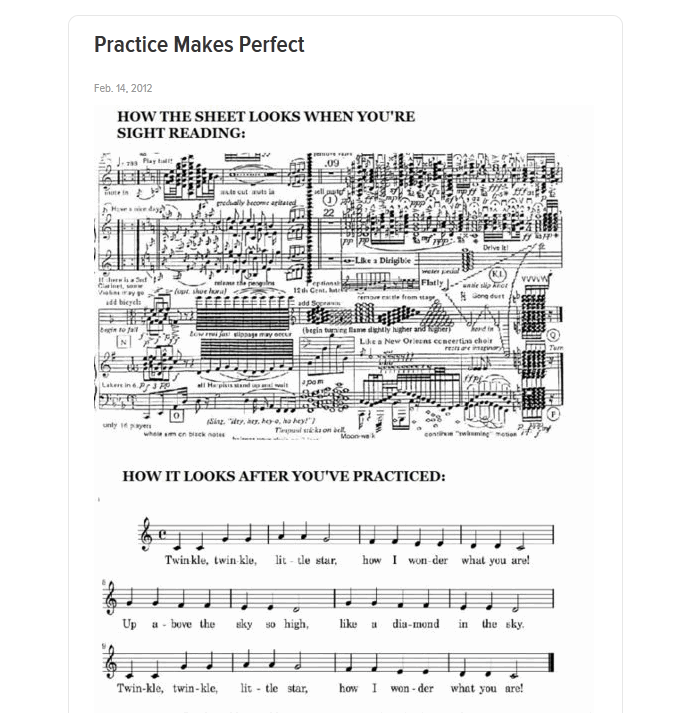
One way of understanding Jazz.
Mathematics and music are inseparable.
“Pearls Before Breakfast”
From the details on the Ytube vid.
“Can one of the nation’s great musicians cut through the fog of a D.C. rush hour? Let’s find out.
It was 9 minutes to eight in the morning on Friday, January 12 in 2007, the middle of the morning rush hour. L’Enfant Plaza is at the nucleus of federal Washington, and almost all of them were on the way to work, which meant, for almost all of them, a government job.
On that Friday, outside the Metro in an indoor arcade at the top of the escalators one of the finest classical musicians in the world played some of the most elegant music ever written on one of the most valuable violins ever made. His performance was arranged by The Washington Post. In the next 43 minutes, as the violinist performed six classical pieces, 1,097 people passed by.”
So, next performance you take in consider what makes a performance “great”, because it may not be just the music.
I possess a small amount of musical talent. I can carry a tune if I get a big enough bucket. Taking music lessons early in life only left me with a distaste for practicing. And that folks is at the crux of the problem. Talk about a major case of the coulda-woulda-shoulda’s.
If I had kept up with the music and actually dedicated myself to it, I could be well, above average by now. But I left it, went to school and did other things. Sure getting a degree is important, but the other recreational time, filled mostly with video games, seems like such a waste now.
 It is only now that I see how much time and effort is required to get good at playing piano and singing. (I’m partaking in both and am fully cognoscente of the amount of diligence, willpower and effort required to effectively play the piano and sing with confidence.
I have been blessed with the opportunity to learn with tremendously gifted piano instructor. It is at her piano I am exposed to exactly how much more still have to learn. It isa daunting, depressing, exhilarating challenging experience that it seems I cannot get enough of right now.
I mentioned earlier of my involvement in a Choir. My vocal chops are raw and undisciplined, but with the excellent vocal coaching our choir director I have made significant progress on the Choral side of things. Another steep hill, but the learning is so challenging and rewarding.
So, neophyte pianist, neophyte tenor; where does composing fit into all of this? Rather poorly, in my initial appraisal, as composing takes all the aspects of musicianship and wads them up so it lands like a cinder-block on your head as you’re trying to write down that elusive melody that is infesting your mind.
Composing is an art unto itself, and I am yet again having another Titanic moment as I’ve seen only the tip if the musical iceberg as I have recently tackled the notion that I should be able to write a traditional round for my choir to sing.
Well, I have a finished product of sorts, but no way of accurately judging the quality or internal musical structure inherent to all good music pieces. Fortunately my piano instructor teaches composition as well and is helping me with turning a raw product into something that is not only singable, but beautiful.
The moral of the story: Hate the piano lessons, but take the idea that often if it requires hard work it is often ultimately worth it in the end.











 bleatmop
 Mystro
 The Arbourist


 Dead Wild Roses
Your opinions…