
You are currently browsing the tag archive for the ‘Noam Chomsky’ tag.
I would recommend going to Alter.net and reading the full article as it also focuses on the nuclear threat that humanity faces and how we in the West have been merrily poking at the hornets nest of annihilation with a stick. The part I quoted (after the Idle No More manifesto) deals with the struggle between the so called civilized societies versus the indigenous societies that is going on in many countries.
 In Canada, our First Nations are organizing into a national movement called Idle No More. From their manifesto:
“We contend that: Currently, this government is trying to pass many laws so that reserve lands can also be bought and sold by big companies to get profit from resources. They are promising to share this time…Why would these promises be different from past promises? We will be left with nothing but poisoned water, land and air. This is an attempt to take away sovereignty and the inherent right to land and resources from First Nations peoples.
We contend that: There are many examples of other countries moving towards sustainability, and we must demand sustainable development as well. We believe in healthy, just, equitable and sustainable communities and have a vision and plan of how to build them. Please join us in creating this vision.”
They are pissed, and rightly so, and are demanding that we build a sustainable future in Canada as opposed to the Neo-Conservative capitalist trajectory we are currently on. Their movement is incrementally gaining traction in Canadian politics as their message, when and if it is heard, resonates with much of Canada’s populace.
INM and the indigenous people that Chomsky mentions understand that the market is not god and that the idea of a sustainable future runs counter-current to many of the practices Western societies take as the norm. The indigenous societies understand the link between the land and the people that live on it.
They get it. And we, fundamentally, do not.
The view from the business end of the colonial bludgeon provides a clarity that Western societies desperately, necessarily, need to listen to. Ignoring indigenous movements that demand sustainability over profitability such as Idle No More imperils the future for everyone.
So, at one extreme you have indigenous, tribal societies trying to stem the race to disaster. At the other extreme, the richest, most powerful societies in world history, like the United States and Canada, are racing full-speed ahead to destroy the environment as quickly as possible. Unlike Ecuador, and indigenous societies throughout the world, they want to extract every drop of hydrocarbons from the ground with all possible speed.
Both political parties, President Obama, the media, and the international press seem to be looking forward with great enthusiasm to what they call “a century of energy independence” for the United States. Energy independence is an almost meaningless concept, but put that aside. What they mean is: we’ll have a century in which to maximize the use of fossil fuels and contribute to destroying the world.
And that’s pretty much the case everywhere. Admittedly, when it comes to alternative energy development, Europe is doing something. Meanwhile, the United States, the richest and most powerful country in world history, is the only nation among perhaps 100 relevant ones that doesn’t have a national policy for restricting the use of fossil fuels, that doesn’t even have renewable energy targets. It’s not because the population doesn’t want it. Americans are pretty close to the international norm in their concern about global warming. It’s institutional structures that block change. Business interests don’t want it and they’re overwhelmingly powerful in determining policy, so you get a big gap between opinion and policy on lots of issues, including this one.
So that’s what the future historian — if there is one — would see. He might also read today’s scientific journals. Just about every one you open has a more dire prediction than the last.

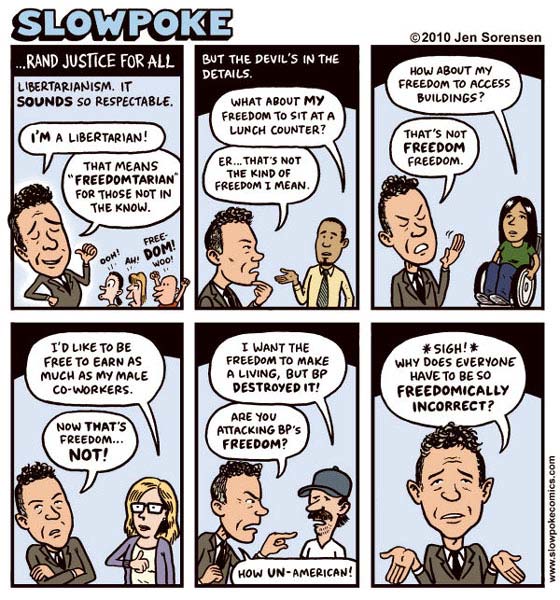 The uniquely toxic form of libertarianism in the US and is a symptom of private power and influence run amok.
This is just a snippet of the interview with Noam Chomsky, I recommend you go read the entire article on Alternet.
Wilson: Why should we choose anarchy, as opposed to, say, libertarianism?
Chomsky:Well what’s called libertarian in the United States, which is a special U. S. phenomenon, it doesn’t really exist anywhere else — a little bit in England — permits a very high level of authority and domination but in the hands of private power: so private power should be unleashed to do whatever it likes. The assumption is that by some kind of magic, concentrated private power will lead to a more free and just society. Actually that has been believed in the past. Adam Smith for example, one of his main arguments for markets was the claim that under conditions of perfect liberty, markets would lead to perfect equality. Well, we don’t have to talk about that! That kind of —
Wilson: It seems to be a continuing contention today …
Chomsky: Yes, and so well that kind of libertarianism, in my view, in the current world, is just a call for some of the worst kinds of tyranny, namely unaccountable private tyranny. Anarchism is quite different from that. It calls for an elimination to tyranny, all kinds of tyranny. Including the kind of tyranny that’s internal to private power concentrations. So why should we prefer it? Well I think because freedom is better than subordination. It’s better to be free than to be a slave. Its’ better to be able to make your own decisions than to have someone else make decisions and force you to observe them. I mean, I don’t think you really need an argument for that. It seems like … transparent.
The thing you need an argument for, and should give an argument for, is, How can we best proceed in that direction? And there are lots of ways within the current society. One way, incidentally, is through use of the state, to the extent that it is democratically controlled. I mean in the long run, anarchists would like to see the state eliminated. But it exists, alongside of private power, and the state is, at least to a certain extent, under public influence and control — could be much more so. And it provides devices to constrain the much more dangerous forces of private power. Rules for safety and health in the workplace for example. Or insuring that people have decent health care, let’s say. Many other things like that. They’re not going to come about through private power. Quite the contrary. But they can come about through the use of the state system under limited democratic control … to carry forward reformist measures. I think those are fine things to do. they should be looking forward to something much more, much beyond, — namely actual, much larger-scale democratization. And that’s possible to not only think about, but to work on. So one of the leading anarchist thinkers, Bakunin in the 19th cent, pointed out that it’s quite possible to build the institutions of a future society within the present one.
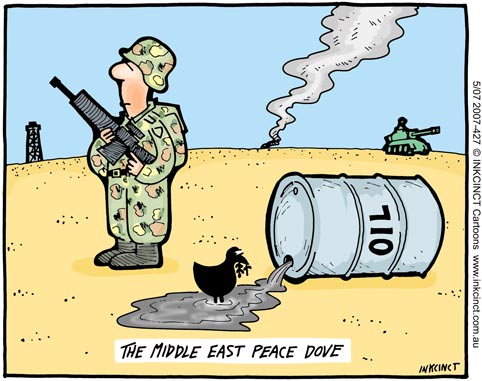 Noam Chomsky is considered a rogue commentator in the United States. His critiques of power illustrates the gross realpolitik that runs the US government and its foreign policy. Traditionally, we tend to think of ourselves as the “good guys”. In reality though, we seldom have that role. A look at the recent history of the Middle East confirms this hypothesis, excerpt from Alter.net.
Q: Does the United States still have the same level of control over the energy resources of the Middle East as it once had?
NC: The major energy-producing countries are still firmly under the control of the Western-backed dictatorships. So, actually, the progress made by the Arab Spring is limited, but it’s not insignificant. The Western-controlled dictatorial system is eroding. In fact, it’s been eroding for some time. So, for example, if you go back 50 years, the energy resources — the main concern of U.S. planners — have been mostly nationalized. There are constantly attempts to reverse that, but they have not succeeded.
Take the U.S. invasion of Iraq, for example. To everyone except a dedicated ideologue, it was pretty obvious that we invaded Iraq not because of our love of democracy but because it’s maybe the second- or third-largest source of oil in the world, and is right in the middle of the major energy-producing region. You’re not supposed to say this. It’s considered a conspiracy theory.
The United States was seriously defeated in Iraq by Iraqi nationalism — mostly by nonviolent resistance. The United States could kill the insurgents, but they couldn’t deal with half a million people demonstrating in the streets. Step by step, Iraq was able to dismantle the controls put in place by the occupying forces. By November 2007, it was becoming pretty clear that it was going to be very hard to reach U.S. goals. And at that point, interestingly, those goals were explicitly stated. So in November 2007 the Bush II administration came out with an official declaration about what any future arrangement with Iraq would have to be. It had two major requirements: one, that the United States must be free to carry out combat operations from its military bases, which it will retain; and two, “encouraging the flow of foreign investments to Iraq, especially American investments.” In January 2008, Bush made this clear in one of his signing statements. A couple of months later, in the face of Iraqi resistance, the United States had to give that up. Control of Iraq is now disappearing before their eyes.
Iraq was an attempt to reinstitute by force something like the old system of control, but it was beaten back. In general, I think, U.S. policies remain constant, going back to the Second World War. But the capacity to implement them is declining.
 Democracy, human rights, humanitarian intervention all fall at the wayside when it comes to the West supporting “stability” in the Middle East. We wonder why the residents are so pissed off at us and cheer when bad things happen to the West. I’m guessing it has a little something to do with the fact that while promoting “human rights and democracy” worldwide we simultaneously support vicious authoritarian regimes that cater to our interests while grinding their populace to dust.
Go figure.
Noam Chomsky summarizes the process quite nicely on article excerpted from Alter.net. Here are some of the highlights:
“So that wasn’t very pretty, but what about the other countries? Well, the countries that are most significant to the United States and the West, generally, are the oil dictatorships and they remain very stable. There were efforts to try and join the Arab Spring, but they were crushed, very harshly, with not a word from the Western powers. Sometimes it was quite violent, as in eastern Saudi Arabia and in Bahrain, which were Shiite areas, mostly, but it resulted in at most a tap on the wrist by the western powers. They clearly wanted the oil dictatorships to remain. That’s the center of their power.
In Tunisia, which had mostly French influence, the French supported the dictatorship until the very end. In fact, they were still supporting it after demonstrations were sweeping the country. Finally, at the last second, they conceded that their favorite dictator had to go. In Egypt, where the United States and Britain were the main influences, it was the same. Obama supported the dictator Mubarak until virtually the last minute – until the army turned against him. It became impossible to support him anymore so they urged him to leave and make a transition to a similar system.
All of that is quite routine. That’s the standard operating procedure for dealing with a situation where your favorite dictator is getting into trouble. There is case after case like that. What you do in that case is support the dictator to the very end, regardless of how vicious and bloody he is. Then when it becomes impossible, say because the army or the business classes have turned against him, then ease him out somewhere (sometimes with half the government’s treasury in his pocket), declare your love for democracy, and try to restore the old system. That’s pretty much what’s happening in Egypt.”
Chomsky called it. How long before we can get back to “business as usual?”
Just to darken your day a little –
 “The Obama campaign greatly impressed the public relations industry, which named Obama ‘Advertising Age’s marketer of the year for 2008,’ easily beating out Apple computers. A good predictor of the elections a few weeks later. The industry’s regular task is to create uninformed consumers who will make irrational choices, thus undermining markets as they are conceptualized in economic theory, but benefiting the masters of the economy. And it recognizes the benefits of undermining democracy in much the same way, creating uninformed voters who make often irrational choices between the factions of the business party that amass sufficient support from concentrated private capital to enter the electoral arena, then to dominate campaign propaganda.”
From Hopes and Prospects
Sometimes you get the that feeling that your vote won’t really matter in an election. It would help if the US was actually a democracy.
 Political theatre harms us all. Issues that are important to public are marginalized while supposedly “important” issues take the spotlight. (Yes, you women, under the bus, stat!)
Noam Chomsky summarizes what elections have become in the US –
“Elections are run by the public relations industry. Its primary task is commercial advertising, which is designed to undermine markets by creating uninformed consumers who will make irrational choices – the exact opposite of how markets are supposed to work, but certainly familiar to anyone who has watched television.It’s only natural that when enlisted to run elections, the industry would adopt the same procedures in the interests of the paymasters, who certainly don’t want to see informed citizens making rational choices. The victims, however, do not have to obey, in either case. Passivity may be the easy course, but it is hardly the honorable one.”
Call to arms or maybe just maybe a little of Mr.Jackson’s “wake the F**k up”, whatever it takes but for goodness sake cut through the noise and get people thinking for themselves again.











 bleatmop
 Mystro
 The Arbourist


 Dead Wild Roses

Your opinions…