
You are currently browsing the tag archive for the ‘Noam Chomsky’ tag.
Is it a Noam Chomsky Week? Maybe. Sometimes it is good to get back to basics. One lecture, delivered at Harvard University on April 13rd, 1996 in 5 parts. Enjoy. Transcript here.
Noam Chomsky again pushing debate to the margins where you get a glimpse of how the world works and how we have allowed our debate to be warped by the radical priorities of corporate culture.
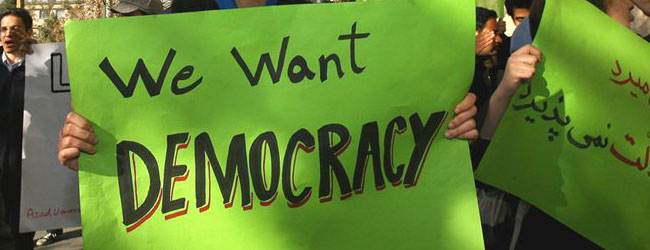 The parallel between the official line for public consumption and the actual realpolitik is quite thin, if you are willing to look. And therein lies the problem, we are not rewarding for looking, for being curious, for wanting to know what our policy actually is in the Middle East. Noam Chomsky discusses our role in the Middle East in a recent article posted at Mother Jones.
“The US and its Western allies are sure to do whatever they can to prevent authentic democracy in the Arab world. To understand why, it is only necessary to look at the studies of Arab opinion conducted by US polling agencies. Though barely reported, they are certainly known to planners. They reveal that by overwhelming majorities, Arabs regard the US and Israel as the major threats they face: the US is so regarded by 90% of Egyptians, in the region generally by over 75%. Some Arabs regard Iran as a threat: 10%. Opposition to US policy is so strong that a majority believes that security would be improved if Iran had nuclear weapons—in Egypt, 80%. Other figures are similar. If public opinion were to influence policy, the US not only would not control the region, but would be expelled from it, along with its allies, undermining fundamental principles of global dominance.”
Whoops, public opinion or what the people want is ignored in our client states, how surprising. The very last thing we want in the Middle East is Democracy.
“Support for democracy is the province of ideologists and propagandists. In the real world, elite dislike of democracy is the norm. The evidence is overwhelming that democracy is supported insofar as it contributes to social and economic objectives, a conclusion reluctantly conceded by the more serious scholarship.
Elite contempt for democracy was revealed dramatically in the reaction to the WikiLeaks exposures. Those that received most attention, with euphoric commentary, were cables reporting that Arabs support the US stand on Iran. The reference was to the ruling dictators. The attitudes of the public were unmentioned. The guiding principle was articulated clearly by Carnegie Endowment Middle East specialist Marwan Muasher, formerly a high official of the Jordanian government: “There is nothing wrong, everything is under control.” In short, if the dictators support us, what else could matter?
The Muasher doctrine is rational and venerable. To mention just one case that is highly relevant today, in internal discussion in 1958, president Eisenhower expressed concern about “the campaign of hatred” against us in the Arab world, not by governments, but by the people. The National Security Council (NSC) explained that there is a perception in the Arab world that the US supports dictatorships and blocks democracy and development so as to ensure control over the resources of the region. Furthermore, the perception is basically accurate, the NSC concluded, and that is what we should be doing, relying on the Muasher doctrine. Pentagon studies conducted after 9/11 confirmed that the same holds today.”
Dig a little deeper, read more about the Middle East and history from a variety of sources. Educate yourself about what you know or think you know about, questioning base assumptions is the all hallmark of the critical thinker and rational citizen.
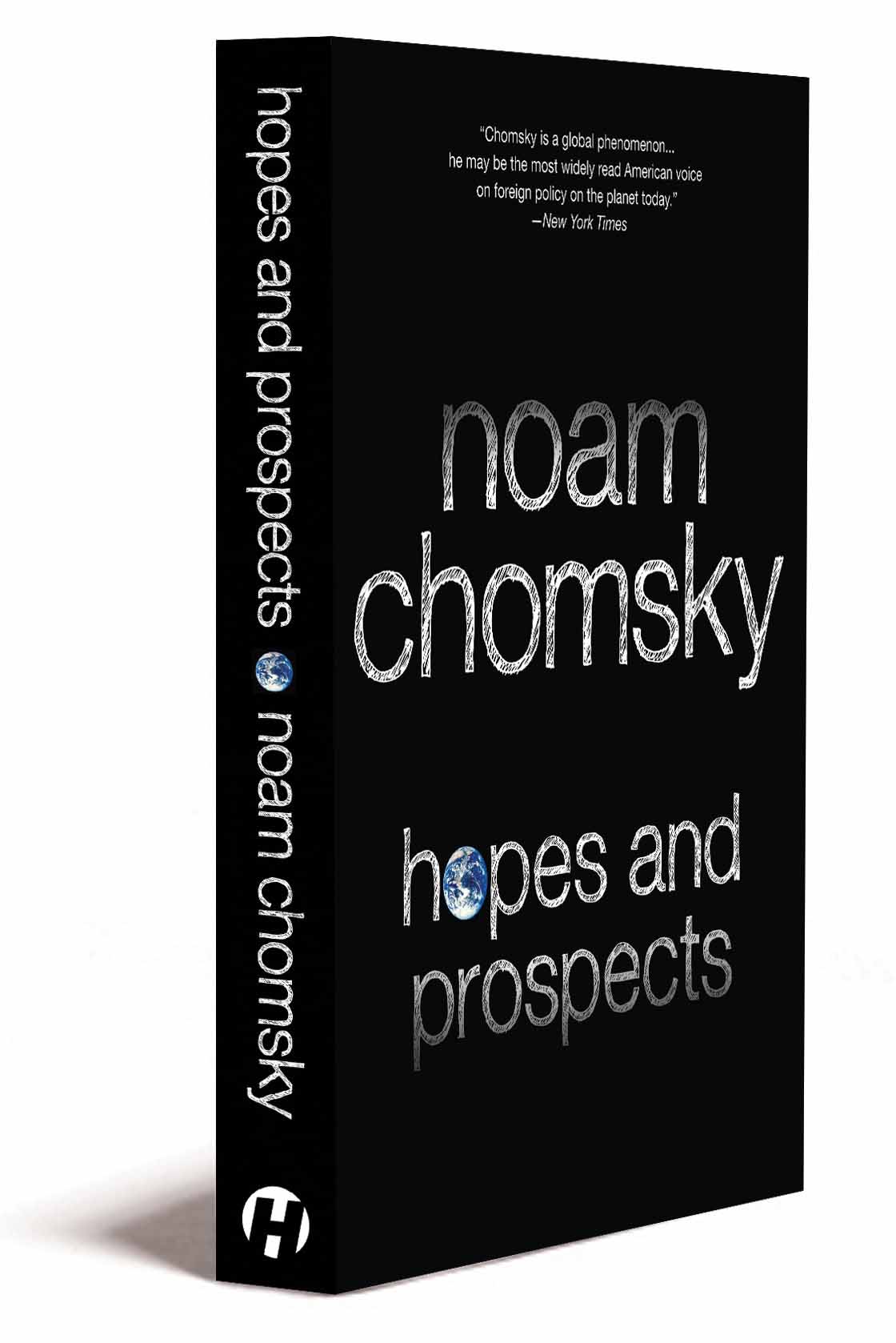 The underwhelming performance of the Democratic President Obama is really unsurprising considering the context of the current US political system. State capitalism continues to grind the general population into dust to enrich the business class with Obama at its helm. Considering where the majority where his contributions come from Obama is performing up to expectations. Noam Chomsky looks at the hollow brand of Obama and what really his particularly vacuous platform of “Hope & Change” really mean in his book “Hopes and Prospects” in the final chapters. I’ll reproduce some highlights from that last chapter.
“Labour journalist and lawyer Steve early wrote that “while running for office, Obama said he strongly backed the Employee Free Choice Act, a long overdue labour law reform measure that should be part of his promised economic stimulus plan.” However, when Obama introduced his top economic advisers on taking office “and talked about steps to ‘jolt’ the economy…the Act was not part of the package,” and Chief of Staff Emanuel “declined to say whether the White House will support the Employee Free Choice Act… [Workers] will be watching closely to see whether their plight merits the same helping hand so quickly extended to Wall Street.”
The answer has been sharp and clear, and working people did not have to wait very long to find it out. EFCA quickly vanished, And to make priorities even clearer, a few weeks after taking office, President Obama decided to show his solidarity with works by giving a talk at a factory in Illinois (February 12th, 2009). He choose a Caterpillar plant, over objections of chruch, peace, and human rights groups, who were protesting Caterpillar’s role in providing Israel with the means to devastate the territories it occupies and to destroy the lives of the population – also killing an American volunteer, Rachel Corrie, who tried to block the destruction of a home.
Apparently forgotten, however, was something else. Following Reagan’s lead with the dismantling of the air traffic controllers union, the new hardline CEO of Caterpillar, Donald Fites, rescinded the contract with the United Auto Workers in 1991, instituted a lockout, threatened to bring in “permanent replacement workers”, and later did so, for the first time in generations in manufacturing industry. The practice was illegal in other industrial countries apart from South Africa at the time; now the United States appears to be in splendid isolation. It is hard to imagine that Obama and his advisers purposely chose a corporation that led the way to undermine labour rights. More likely, they were unaware of the facts, which would be an even worse indictment of the business-run doctrinal system.
At the time of Caterpillar’s innovation in labour relations, Obama was a community organizer in Chicago and visiting fellow at the University of Chicago Law School. He must have been reading the Chicago Tribune, which ran a careful study of these events. They reported that the union was “stunned” to find that unemployed workers crossed the picket line with no remorse, while Caterpillar works found little ‘moral support’ in their community, one of the many where the union had “lifted the standard of living for entire communities.” Wiping out of those memories is another victory in the campaign to destroy workers’ rights and democracy that is relentlessly waged by the highly class-conscious American business sector, elementary facts about American society that the union leadership had stubbornly refused to understand. It was only in 1978 that the UAW president Doug Fraser recognized what was happening and criticized the “leaders of the business community” for having “chosen to wage a one-sided class war in this country – a war against working people, the unemployed, the poor, the minorities, the very young and very old, and even many in the middle class or our society,” and for having “broken and discarded the fragile, unwritten compact previously existing during a period of growth and progress.”
Placing one’s faith in a compact with owners and managers is suicidal. The UAW is discovering that again today, as the state-corporate leadership proceeds to eliminate the hard-fought gains of working people while dismantling the productive core of the American economy, with government assistance. “
– From Noam Chomsky’s Hope and Prospects pages 217 – 219.
I urge you faithful reader to purchase or get this book from the library as it provides depth and insight into the American body politic that you most definately will not find in your local newspaper.
It is hazy and smoky outside and I feel a bit under the weather, so I post another Chomsky interview, this time on from Russian Television topics include the Afghanistan War, Obama and the American Economy.
I have read much of what Mr.Chomsky has written, his historical accuracy and meticulous fact checking make him a great resource to better understand how our world works. This is a long interview, but worth every second of your time.
I found the transcripts and can highlight a few of the more poignant parts of the interview:
ES: You say one of the great hypocrisies here is that the United States, as you say, is a leading terrorist state…
Chomsky: Well, these two examples illustrate it. And these are minor ones. You know there are much more serious ones than this.
ES: The question that arises is if the United States is a leading terrorist state, if as you say, Britain is another example of a terrorist state, how do you distinguish between what you describe as terrorism and what they are saying — Osama Bin Laden who’s a terrorist? Make the distinction.
Chomsky: It’s very simple. If they do it, it’s terrorism. If we do it, it’s counter-terrorism. That’s a historical universal. Go back to Nazi propaganda. The most extreme mass murderers ever. If you look at Nazi propaganda, that’s exactly what they said. They said they’re defending the populations and the legitimate governments of Europe like Vichy from the terrorist partisans who are directed from London. That’s the basic propaganda line. And like all propaganda, no matter how vulgar, it has an element of truth. The partisans did carry out terror, they were directed from London. The Vichy government is about as legitimate as half the governments the US has installed around the world and supports, so yes, there was a minor element of truth to it, and that’s the way it works. If somebody else carries it out, it’s terror. If we carry it out, it’s counter-terror. I think perhaps one of the most dramatic examples right at this moment is a place where I just was a couple of weeks ago, southeastern Turkey. Southeastern Turkey is the site of some of the worst terrorist atrocities of the 1990s.
—–
ES: Robert Kaplan writes about foreign policy. I spoke to him recently about his book Warrior Politics, and I put some of your points to him and he said, about the distinction between the terrorist states that you call Israel, America, and the terrorist states that America calls the Taliban, “I wish Noam Chomsky had been with me in Romania in the 70s or the 80s, just one of the seven or eight Warsaw States, with just one of the 7 or 8 prison systems with 700,000 political prisoners. Adult choice of foreign policy is made on distinctions. The argument that Chomsky makes has no distinctions because there’s a difference between the quantity and the kind of dictators that America supported and the quantity and the kind of things that went on in the Communist world for 44 years.”
Chomsky: OK, so let’s take his example, Romania under Ceausescu. Hideous regime, which he forgot to tell you the United States supported. Supported right until the end, as did Britain. When Ceausescu came to London he was feted by Margaret Thatcher. When George Bush the First came into office, I think the first person he invited to Washington was Ceausescu. Yes, Romania was a miserable, brutal regime supported by the United States right to the end, as Robert Kaplan knows very well, so the example he gave is a perfect example.
ES: It wasn’t supported by the States in the 70s though?
Chomsky: In the 70s, in the 80s, right to the end of Ceausescu’s rule. It was supported by the United States. The reasons had to do with great power politics. They were sort of breaking Warsaw Pact policies and so on, but the very example he picks illustrates it and we can proceed onward.
So the very example he gives shows the absurdity of his position and it’s a small example because we support much more brutal regimes. It has nothing to do with Cold War issues.
I gave an example in South Eastern Turkey, several million refugees, tens of thousands of people killed, a country devastated, that’s rather serious.
Nobody accused Milosevic of that in Kosovo.
Suharto was one of the worst killers and torturers of the late twentieth century. The United States and Britain supported him throughout. He’s “our kind of guy,” as the Clinton administration said in 1995. Horrible atrocities, in fact, when he came into office in 1965 with a coup the CIA compared it to Hitler, Stalin and Mao.
It led to total euphoria in the United States and Britain, and massive support when he carried out even worse atrocities, comparable atrocities in East Timor — over 200,000 people killed — full support continued right through the end of his rule, in fact, continued past his rule. In late 1999 when they were rampaging and destroying what was left of East Timor, the US and Britain continued to support him and I can continue through the world like this…
—–
ES: Should there be an organizing hegemon, do we need a constabulary, a force, a central force? In this case it’s America because it’s a superpower. Sometimes it use unjust means in the service of just causes.
Chomsky: What are the just causes? What was the just cause in, for example, slaughtering Kurds in southeastern Turkey? What was the just cause in supporting Suharto? When he killed a couple hundred thousand landless peasants in Indonesia, went on to become one of the biggest torturers in the world and slaughtered one-third of the population in East Timor, what was the just cause?
What was the just cause when we invaded South Vietnam 40 years ago? This is the 40th anniversary of the public announcement of the U.S. attack on South Vietnam, ending up killing millions of people, leaving the country devastated. They’re still dying from chemical warfare. What was the just cause?
What was the just cause when we fought a war to a large extent against the Catholic Church in Central America in the 1980s, killing hundreds of thousands of people, every imaginable kind of torture and devastation, what was the just cause? The just cause for people like Kaplan was yes, we did it, therefore it’s a just cause. You can read that in the Nazi archives too.
Can Trust be Restored?
ES: It’s no great secret that we function by self-interest. Self-interest is part of foreign policy. We’re here to protect our policy, protect the interests of our policy, in this case of the Americans.
Chomsky: Was the self-interest of the American people served by slaughters in southeastern Turkey, or by destroying Vietnam, or by turning El Salvador and Guatemala into cemeteries?
Was the self-interest of the American people served by that? No. The self-interest served by that is foreign policy elites and the power-centers they represent, which are not protecting the American people, they’re protecting their own power, profit, dominance and hegemony, like others around the world.
And they count on intellectuals of the Robert Kaplan type to applaud any atrocity they carry out.











 bleatmop
 Mystro
 The Arbourist


 Dead Wild Roses
Your opinions…