
You are currently browsing the tag archive for the ‘Orange Man BAD’ tag.
“Trump Derangement Syndrome” (TDS) isn’t a medical condition. It’s a rhetorical label for a recognizable pattern: Donald Trump becomes the organizing centre of political perception, so that every event is interpreted through him, and every interpretation is pulled toward maximal moral heat. Even people who agree on the facts can’t agree on the temperature, because the temperature is the point. Psychology writers describe it as a derogatory term for toxic, disproportionate reactions to Trump’s statements and actions.
And when politicians try to literalize it as a clinical diagnosis, it collapses into farce. It is fundamentally a political phenomenon, not a psychiatric one.
The useful question isn’t “Is Trump uniquely bad?” Reasonable people can say yes on qualities character, norms, rhetoric, policy, whatever. The useful question is: when does valid criticism become TDS? The answer is: when Trump stops being an object of analysis and becomes a gravity well.
What TDS looks like (beyond normal criticism)
Normal criticism is specific: this policy, this consequence, this evidence, this alternative. TDS is different in kind.
-
Totalization: Trump isn’t a president with a platform; he’s a single-cause explanation for everything.
-
Asymmetry: Similar behaviour in other leaders is background noise; in Trump it becomes existential threat (or, on the other side, heroic 4D chess).
-
Incentive blindness: The critic’s emotional reward (“I signaled correctly”) overrides the duty to be precise.
-
Predictable misreads: Even when Trump does something ordinary or mixed, it must be either apocalypse or genius.
This is why the term persists. It points generallyat a real cognitive trap: a personality-driven politics that makes judgment brittle. (It also gets used cynically to dismiss legitimate criticism; that’s part of the ecosystem, too.)
Why Canadian media amplifies it
Canada didn’t invent Trump fixation. But Canadian legacy media has strong reasons to keep Trump on the homepage. The reasons, in question, are not purely ideological.
1) Material proximity (it’s not “foreign news” in Canada).
When the U.S. president threatens tariffs, trade reprisals, or bilateral negotiations, Canadians feel it directly: jobs, prices, investment, and national policy all move. In Trump’s second term, Canadian economic and political life has repeatedly been forced to react to U.S. pressure: tariffs, trade disputes, and negotiations that shape Ottawa’s choices.
That creates a built-in news logic: Trump coverage is “domestic-adjacent,” not optional.
2) An attention model that rewards moral theatre.
Trump is an outrage engine. Outrage is a business model. Canadian mediais operating in a trust-and-revenue squeeze, and that squeeze selects for stories that reliably produce engagement. Commentators on Canada’s media crisis have argued that the Trump era intensified the trust spiral and the incentives toward heightened, adversarial framing.
3) Narrative convenience: Trump as a single, portable explanation.
Complex stories (housing, health systems, provincial-federal dysfunction) are hard. Trump is easy: one villain (or saviour), one emotional script, one endless drip of “breaking.” This is where amplification turns into distortion. A real cross-border policy dispute becomes a morality play; a complicated negotiation becomes a personality drama.
4) Coverage volume becomes self-justifying.
Once a newsroom commits, it has to keep feeding the lane it created. Tools that track Canadian legacy-media coverage of Trump-related economic conflict like tariffs for example, show how sustained and multi-outlet that attention can become.
The more space Trump occupies, the more “newsworthy” he becomes, because “everyone is talking about it” (including the newsroom).
None of this requires a conspiracy. It’s mostly incentive alignment: relevance + engagement + a simple narrative hook.
The cost: Canadians inherit America’s temperature
The predictable result is that Canadians import not just U.S. events, but U.S. emotional calibration.
-
Canadian politics gets interpreted as a shadow-play of American factions.
-
Domestic accountability weakens (“our problems are downstream of Trump / anti-Trump”).
-
Readers get trained to react first and think second, a reinforcing heuristic, because that’s what the coverage rewards.
And it corrodes trust: if audiences can feel when coverage is performing emotional certainty rather than reporting reality, they stop believing the institution is trying to be fair.
A reader’s heuristic: the TDS check
If this is going to be useful (not tribal), it needs a diagnostic you can run on yourself and on coverage:
-
Specificity test: Is the criticism about a policy and its consequences, or about Trump as a symbol?
-
Symmetry test: Would you report/feel the same way if a different president did it?
-
Proportionality test: Does the language match the evidence, or does it leap straight to existential claims?
-
Update test: When new facts arrive, does the story change—or does the narrative stay fixed?
-
Trade-off test: Are costs and alternatives discussed, or is “opposition” treated as sufficient analysis?
Pass those tests and you’re probably doing real criticism. Fail them repeatedly and you’re in the gravity well regardless of whether the content is rage or adoration.
The verdict
Trump is a legitimate target for strong criticism especially in a second term with direct consequences for Canada.
But the deeper media failure is not “being anti-Trump.” It’s outsourcing judgment to a narrative reflex: a system that selects for maximal heat, maximal frequency, and minimal precision. That’s how valid critique curdles into derangement—because it stops being about what happened, and becomes about what the story needs.
The fix is boring, which is why it’s rare: lower the temperature, raise the specificity, and let facts earn the conclusion.
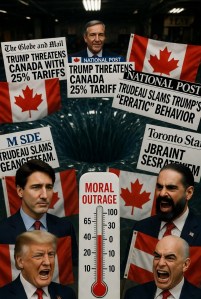
Psychology Today — “The Paradox of ‘Trump Derangement Syndrome’” (Sep 5, 2024)
https://www.psychologytoday.com/ca/blog/the-meaningful-life/202409/the-paradox-of-trump-derangement-syndrome
The Loop (ECPR) — “Is ‘Trump Derangement Syndrome’ a genuine mental illness?” (Oct 13, 2025)
CBS News Minnesota — “Minnesota Senate Republicans’ bill to define ‘Trump derangement syndrome’ as mental illness…” (Mar 17, 2025)
https://www.cbsnews.com/minnesota/news/trump-derangement-syndrome-minnesota-senate-republicans/
Reuters Institute — Digital News Report 2025: Canada (Jun 17, 2025)
https://reutersinstitute.politics.ox.ac.uk/digital-news-report/2025/canada
The Trust Spiral (Tara Henley) — The state of media/trust dynamics (May 2024)
Reuters — “Trump puts 35% tariff on Canada…” (Jul 11, 2025)
https://www.reuters.com/world/us/trump-puts-35-tariff-canada-eyes-15-20-tariffs-others-2025-07-11/
Financial Times — “Canada scraps tech tax to advance trade talks with Donald Trump” (Jun 30, 2025)
https://www.ft.com/content/4cf98ada-7164-415d-95df-43609384a0e2
The Guardian — “White House says Canadian PM ‘caved’ to Trump demand to scrap tech tax” (Jun 30, 2025)
https://www.theguardian.com/world/2025/jun/30/canada-digital-services-tax-technology-giants-us-trade-talks
The Plakhov Group — Trade War: interactive visualizations of Canadian legacy-media coverage of Trump’s tariffs (Feb–Sep 2025 dataset)
https://www.theplakhovgroup.ca/detailed-briefs/trade-war-interactive-visualizations











 bleatmop
 Mystro
 The Arbourist


 Dead Wild Roses
Your opinions…