
You are currently browsing the tag archive for the ‘Syria’ tag.
The disparity in global outrage between the conflicts in Gaza and Syria is a striking phenomenon that reveals much about media influence, geopolitical dynamics, and public perception. In Gaza, the Israel-Palestinian conflict, particularly since the escalation following Hamas’s attack on October 7, 2023, has garnered immense international attention. Over 46,000 Palestinians have been reported killed by March 2025, according to Gaza health officials, with widespread destruction reducing much of the territory to rubble. This has sparked massive protests worldwide, intense media coverage, and vocal condemnation from various governments and activist groups. The visibility of the conflict is amplified by its historical context, the involvement of Israel—a close Western ally—and the stark imagery of civilian suffering in a densely populated enclave.
In contrast, Syria’s civil war, which has claimed over 600,000 lives and displaced millions since 2011, has faded from the global spotlight despite its staggering toll. The prolonged nature of the conflict, coupled with its complexity involving multiple factions, has led to a sense of fatigue and desensitization among the international community, reducing the urgency and emotional resonance it once held.
Geopolitical interests and alliances further underscore this disparity. Israel’s role in Gaza, supported by significant U.S. military and political backing, places the conflict under a microscope, as it ties into broader narratives of Western imperialism, colonialism, and human rights that resonate deeply with activist movements and progressive audiences. The accessibility of Gaza’s narrative—framed as a David-versus-Goliath struggle—makes it a rallying point for outrage, with real-time accounts from Palestinian journalists and citizens amplifying its reach. Syria, however, lacks a similarly clear-cut antagonist in the eyes of the West. The Assad regime, while brutal, is opposed by a fractured array of rebel groups, some with extremist ties, complicating the moral clarity that drives public mobilization.
Moreover, Syria’s primary allies—Russia and Iran—are already at odds with Western powers, diluting the incentive for sustained Western outrage or intervention. This suggests that the absence of a Jewish or Western state as a central villain in Syria’s case may contribute to the muted response compared to the intense focus on Gaza, where such dynamics align with prevailing ideological currents.
Finally, the scale and speed of devastation also play a critical role in shaping outrage. In Gaza, the death rate has been extraordinarily high in a short period—half of Syria’s decade-long toll in just over a year—concentrated in a population ten times smaller, making the per-capita impact far more immediate and visceral. This intensity, combined with restricted humanitarian access and a blockade, heightens the sense of urgency and helplessness that galvanizes global responses. Syria’s war, by contrast, has unfolded over 14 years, with peaks of violence—like the siege of Homs—spaced out and overshadowed by other global crises, leading to a gradual numbing effect. The recent resurgence of fighting in Syria, such as the rebel offensive in Aleppo in late 2024, briefly rekindled interest, but it lacks the sustained momentum of Gaza’s coverage.
The disparity, then, is not just about numbers but about narrative coherence, media amplification, and the alignment of each conflict with broader political stakes. While both tragedies deserve attention, the uneven outrage reflects a world where emotional resonance and ideological alignment often dictate which crises capture our collective conscience.

The parochial attitude of North Americans is quite disturbing, and unjustified. We have unparalleled access to information and news from across the globe and by this feature alone we should be attuned to the plight of others and the injustice in the world. Yet, most of us are not. As long as shit happens ‘over there’ whether it be across an ocean, or the local river the daily pattern of our lives does not change.
Only when our routines are disrupted and our comfort zones threatened do we awake from our slumber. In our defence, there really isn’t another way to go about one’s life as the amount of horror in the world is a completely paralyzing notion and can only be examined at arms length if one wishes to remain sane.
But.
I think the balance between our safe cocoons and concern for the situations others needs to be reordered. The slow-fast human catastrophe that is Syria highlights exactly what I’m talking about.
“A chemical attack in Douma, the last rebel-held stronghold near Syria’s capital, Damascus, has killed at least 70 people and affected hundreds, rescue workers have told Al Jazeera.
The White Helmets, a group of rescuers operating in opposition-held areas in Syria, said on Saturday that most of the fatalities were women and children.
“Seventy people suffocated to death and hundreds are still suffocating,” Raed al-Saleh, head of the White Helmets, told Al Jazeera, adding that the death toll was expected to rise as many people were in critical condition.
Al-Saleh said that chlorine gas and an unidentified but stronger gas were dropped on Douma.”
We sit complicit while the Assad regime gasses its own people in their efforts to ‘stabilize’ their country.
“We are currently dealing with more than 1,000 cases of people struggling to breathe after the chlorine barrel bomb was dropped on the city. The number of dead will probably rise even further.”
The Douma Media Centre, a pro-opposition group, posted images on social media of people being treated by medics, and of what appeared to be dead bodies, including many women and children.
Rescue workers also posted videos of people appearing to show symptoms consistent with a gas attack. Some appeared to have white foam around their mouths and noses.
Symptoms of a chlorine attack include coughing, dyspnea, intensive irritation of the mucous membrane and difficulty in breathing.”
Being a civilian is Syria isn’t such a welcoming proposition. Chemical warfare is an agreed upon ‘no-go’ for most of the nations of the world. There is a treaty and everything.
“The Chemical Weapons Convention (CWC) is an arms control treaty that outlaws the production, stockpiling, and use of chemical weapons and their precursors. The full name of the treaty is the Convention on the Prohibition of the Development, Production, Stockpiling and Use of Chemical Weapons and on their Destruction and it is administered by the Organisation for the Prohibition of Chemical Weapons (OPCW), an intergovernmental organization based in The Hague, The Netherlands. The treaty entered into force in 1997.”
…
…

This image released early Sunday, April 8, 2018 by the Syrian Civil Defence White Helmets, shows a rescue worker carrying a child following an alleged chemical weapons attack in the rebel-held town of Douma, near Damascus, Syria. White Helmets via AP
Yet this happens. And most of NA placidly accepts this. Maybe some tsk-tisking and/or a lament on how horrible the gassing of civilians is. But then, most of us just scroll onward past this tragedy that has been disconnected from our consciousness.
What is missing, at least in part, is the feeling of responsibility (not to mention the empathy of what it must be like trying to survive during a civil war) of our part in their ordeal.
“Joseph Massad on Al Jazeera said the term was “part of a US strategy of controlling [the movement’s] aims and goals” and directing it towards western-style liberal democracy.[17] When Arab Spring protests in some countries were followed by electoral success for Islamist parties, some American pundits coined the terms “Islamist Spring”[20] and “Islamist Winter”.
Also this from The Atlantic:
“Egyptian military officials wagered, rightly, that they could get away with what became, according to Human Rights Watch, the worst mass killing in modern Egyptian history—as well as one of the worst single-day mass killings in recent decades anywhere in the world.
America’s relative silence was no accident. To offer a strong, coherent response to the killings would have required a strategy, which would have required more, not less, involvement. This, however, would have been at cross-purposes with the entire thrust of the administration’s policy. Obama was engaged in a concerted effort to reduce its footprint in the Middle East. The phrase “leading from behind” quickly became a pejorative for Obama’s foreign-policy doctrine, but it captured a very real shift in America’s posture. The foreign-policy analysts Nina Hachigian and David Shorr called it the “Responsibility Doctrine,” a strategy of “prodding other influential nations … to help shoulder the burdens of fostering a stable, peaceful world order.” In pursuing this strategy in the Middle East, the United States left a power vacuum—and a proxy struggle. During Morsi’s year-long tenure, Qatar became the single largest foreign donor to Egypt, at over $5 billion (with Turkey contributing another $2 billion). Just days after the military moved against Morsi, it was Saudi Arabia, the United Arab Emirates, and Kuwait that pledged a massive $12 billion to the new military-appointed government.
The United States, along with the conservative Gulf monarchies and many others, also viewed Islamist parties with considerable suspicion.”
Being a world power, only when convenient, isn’t being a world power. Behaving only to protect the national interest places us squarely in the realm of realpolitik and the (a)moral compass associated with that mode of thinking. Syria lies on the border of two spheres of influence. The Russian empire and the American Empire. Arguably, Russia has greater influence, not least of all because of geographical proximity, on Syria and the maintenance of the current regime is in their national self interest. Thus the frisson between the American tacit support for the revolution (toward a US friendly regime) and the Russian support for the status quo and continuation within their own sphere of self-interest are the only realpolitik concerns on the table. The humanitarian disaster resulting from this friction between empires is but a footnote and not really mainstream news worthy – at least not past the ratings ‘bump’ procured for showing disconnected images of human suffering.
a
a
A non-corporate real media would be all over the context of the situation portraying the real cost in human misery of what happens when spheres of influence collide and how little the ‘national interest’ cares about people dying ‘over there’. Yet with all our glitzy internet power and googleplexes of information at our fingertips has this sort of contextual analysis even been hinted at in North American mainstream media?
a
a
Not really.
a
a
Compare how the Associated Press and Al-Jazeera frame the article (also the sources on which this piece is based). A telling difference, the focus on the ‘facts’ versus the human angle that the Al-Jazeera piece. I think we need more of the second variety as we need to inspire empathy and the common human nature that binds us all together, so we can work toward a more peaceable future.
a
a
(Unlikely as it may be.)
Why is Russia so involved in the conflict in Syria? Robert Fisk looks into some possibilities.
“There are, however, other small Chechen ghosts floating over Syria. A large number of Chechen Islamists, fleeing the forests of Chechnya after Russia’s victory, arrived in Syria to attack the regime.
One of the Syrian army’s most devastating setbacks occurred on a mountain top south of the Turkish border, when a Chechen jihadi suicide-bombed a military base by driving a captured armoured car into the compound. He killed every one of the Syrian defenders. The explosion was so vast that an eyewitness on a neighbouring hilltop told me he saw fire reaching into the clouds – and then continuing above the clouds into the empty sky.
The Russians know exactly who they are fighting in Syria, which is why Russian pilot Roman Filipov blew himself up with his own grenade rather than be captured by Islamists. For Putin, those Chechens who resisted his firepower inside Russia are merely continuing their struggle inside a Russian ally further to the south.
Eliminate them, Putin believes, and then make peace with your erstwhile enemies later. It’s been a policy maintained, up to a point, by Damascus. The earlier siege of Deraya on the edge of Damascus was ended in a series of “reconciliation” committees and mutual ceasefire promises.
The distance between Grozny and Damascus is less than 900 miles. From the Kremlin walls, the minarets of Damascus are not in the “Middle East”; they are due south. Russian power doesn’t end at its own frontiers – nor did it in Stalin’s day. His Red Army did not halt at the Soviet frontier in 1945. It pursued the “fascist beast” to its lair in Berlin. And Chechnya remains very much in Putin’s mind today.”
Fascinating points, and of course never once mentioned in the mainstream news…
 The United States has placed, and continues to place a great deal of geopolitical importance on the Middle East. The problem is that, as the record shows, everything they touch turns to ash or is reborn as a even greater threat to America and American interests world wide.
Recent events have not done much to dissuade me that the American conflict in the Middle East is only going to get more intense, more bloody, and have greater ramifications for not onyl the US, but the rest of the world.
Of course, with the Commander in Cheetoh Chief at the helm of the American military, the situation is unlikely to get better. Case in point being the thought (and the following actions) that adding a cruise missile strike into an already chaotic civil war situation, is somehow going to make things better.
(?)
“Without any recourse to international law or the United Nations, the Trump administration has embarked on an act of international aggression against yet another sovereign state in the Middle East, confirming that neocons have reasserted their dominance over US foreign policy in Washington. It is an act of aggression that ends any prospect of détente between Washington and Moscow in the foreseeable future, considerably increasing tensions between Russia and the US not only in the Middle East but also in Eastern Europe, […]”
It’s like, hey we had really shit results with this whole intervention strategy, what can we do.
*insert institutional black memory hole* .
Oh! Hey! Let’s intervene with military strikes in Syria, what could go wrong?
*The noise of near infinite headdesking & facepalming from the rest of the world*
” […] only the most naïve among us could believe that this US airstrike against Syria was unleashed with justice in mind. How could it be when US bombs have been killing civilians, including children, in Mosul recently? And how could it be given the ineffable suffering of Yemeni children as a result of Saudi Arabia’s brutal military campaign there?
No, this US attack, reportedly involving 59 Tomahawk missiles being launched from ships in the eastern Mediterranean, was carried out with regime change in mind, setting a precedent that can only have serious ramifications for the entire region.”
And they will welcome us as liberators and greet us with flowers…
“Trump has proved with this unilateral military intervention that he can easily be dragged into conflict. Just a few days after his administration confirmed that regime change in Syria was off the table, that its focus was on defeating terrorism, he unleashes an airstrike that will only have emboldened the very forces of terrorism whose defeat he had stressed was the focus of his foreign policy previously.
So what now?
Clearly, this military action places Russia in a very difficult position. Since joining the conflict in Syria at the end of September 2015, at the behest of the country’s government, Moscow had been working tirelessly to bring about a negotiated settlement, one involving opposition forces and parties deemed moderate relative to the Salafi-jihadi fanatics of ISIS and Nusra, etc. It is a diplomatic process that has just been dealt a shattering blow, with the opposition now undoubtedly convinced that regime change is in the offing via Washington and therefore encouraged to work towards this end.”
From the dynamo that is George Orwell in his grave:
“The war is not meant to be won, it is meant to be continuous. Hierarchical society is only possible on the basis of poverty and ignorance. This new version is the past and no different past can ever have existed. In principle the war effort is always planned to keep society on the brink of starvation. The war is waged by the ruling group against its own subjects and its object is not the victory over either Eurasia or East Asia, but to keep the very structure of society intact.”
“On a wider note, the lack of short-term memory in Washington is staggering to behold. Fourteen years after the disastrous US invasion of Iraq, which only succeeded in opening the gates of hell out of which ISIS and other Salfi-jihadi groups emerged, and six years after turning Libya into a failed state, in the process sparking a refugees crisis of biblical proportions, here we have yet another act of aggression against a sovereign state in the Middle East by the US.
Destroying countries in order to save them is the story of every empire there has been. But as history reveals, every empire carries within itself the seeds of its own destruction. Donald Trump is now on course to end up going down in history as a leader who rather than save the US from itself, may only have helped speed it down the path to its ultimate demise.”
[Source:Counterpunch – John Wight]
Our corporate news media is very good at keeping inconvenient facts away from the public eye. A six minute video, by definition, cannot provide many startling revelations, but rather a starting point to become informed and hopefully take action.
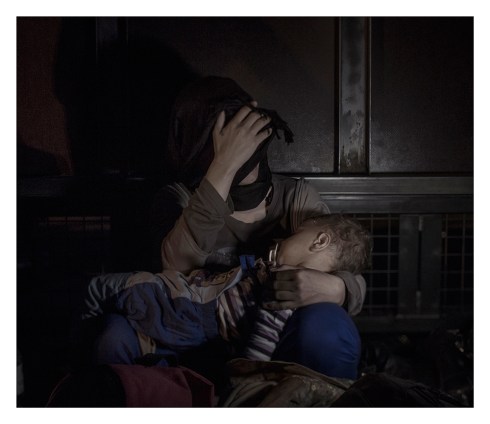
Sham, 1 year old
Roszke/Horgos. In the very front, just alongside the border between Serbia and Hungary by the 4-meter-high iron gate, Sham is laying in his mother’s arms. Just a few decimeters behind them is the Europe they so desperately are trying to reach. Only one day before, the last refugees were allowed through and taken by train to Austria. But Sham and his mother arrived too late, along with thousands of other refugees who now wait outside the closed Hungarian border. Image from: http://darbarnensover.aftonbladet.se/chapter/english-version
After the attacks in Paris, the Governors of Alabama, Arizona, Arkansas, Florida, Illinois, Indiana, Massachusetts, Michigan, Mississippi, New Hampshire, North Carolina, Wisconsin, and Texas, and the Premier of Saskatchewan, are opposed to receiving Syrian refugees.
I haven’t been able to find out if the Premier of Saskatchewan is a man of any particular faith, but it’s reasonable to assume all those American Governors do profess to be Christian. To them I say:
31“When the Son of Man comes in his glory, and all the angels with him, he will sit on his glorious throne. 32All the nations will be gathered before him, and he will separate the people one from another as a shepherd separates the sheep from the goats. 33He will put the sheep on his right and the goats on his left.
34“Then the King will say to those on his right, ‘Come, you who are blessed by my Father; take your inheritance, the kingdom prepared for you since the creation of the world. 35For I was hungry and you gave me something to eat, I was thirsty and you gave me something to drink, I was a stranger and you invited me in, 36I needed clothes and you clothed me, I was sick and you looked after me, I was in prison and you came to visit me.’
37“Then the righteous will answer him, ‘Lord, when did we see you hungry and feed you, or thirsty and give you something to drink?38When did we see you a stranger and invite you in, or needing clothes and clothe you? 39When did we see you sick or in prison and go to visit you?’
40“The King will reply, ‘Truly I tell you, whatever you did for one of the least of these brothers and sisters of mine, you did for me.’
41“Then he will say to those on his left, ‘Depart from me, you who are cursed, into the eternal fire prepared for the devil and his angels. 42For I was hungry and you gave me nothing to eat, I was thirsty and you gave me nothing to drink, 43I was a stranger and you did not invite me in, I needed clothes and you did not clothe me, I was sick and in prison and you did not look after me.’
44“They also will answer, ‘Lord, when did we see you hungry or thirsty or a stranger or needing clothes or sick or in prison, and did not help you?’
45“He will reply, ‘Truly I tell you, whatever you did not do for one of the least of these, you did not do for me.’
46“Then they will go away to eternal punishment, but the righteous to eternal life.”
Even if there are terrorists mingled among the refugees, what kind of country do we want to be? One that turns away thousands of innocents to be sure that not one terrorist gets in (at least, not through that particular process); or one willing to take the risk, to save literally thousands of lives? I know my answer. I stumbled across this tweet that sums it up perfectly:
I hate this idea that taking in Syrian refugees involves no danger. It does. But compassion demands boldness in the face of terror.
— Ferrett Steinmetz (@ferretthimself) November 16, 2015
//platform.twitter.com/widgets.js
Even before the terror attacks in Paris last week, the possibility of terrorists was the reason the Harper government gave for being so incredibly slow to accept Syrian refugees. When the news of the attacks broke Friday afternoon my time, it was literally minutes before I heard it in the office water cooler talk: “No wonder, there’s so many refugees there.” And of course we have the Governors of Alabama, Arizona, Arkansas, Florida, Illinois, Indiana, Massachusetts, Michigan, Mississippi, New Hampshire, North Carolina, Wisconsin, and Texas, saying their states will not accept refugees, and the Premier of Saskatchewan asking our Prime Minister to put his ambitious refugee resettlement program on ice.
This is racist, indecent and inhumane garbage, and pants-on-head levels of stupid.
As a pacifist-leaning liberal arts major, I am pretty much the opposite of a military strategist. And if somebody like me can see how low the ROI is for terrorists to try to infiltrate foreign countries under the guise of refugees, then I have to conclude wilful ignorance (or worse) on the part of officials in higher levels of government, whose job it is, last I heard, to think strategically.
Radicalizing and training up a terrorist is an investment. Are you seriously going to put that investment on a leaky boat that may or may not reach its destination, and then, assuming the boat makes it, have your investment walk for months, sleeping rough, with little to eat, and provisioned with only what he can personally carry, only to have his route to the target country barred by intermediary countries that may or may not let him through? Then, assuming he reaches his destination, he still needs to learn to fit in with the society he intends to attack, enough to walk the streets unnoticed, and you still have to arm him, because he probably opted to carry food rather than explosives on his long walk.
The refugees fleeing IS are unlikely to be a useful source of terrorist recruits – if they agreed with IS, they would presumably be staying and fighting under their banner.
As the attacks on Paris demonstrate, there’s a much higher-ROI way of blowing up people in a foreign country: have their own citizens do the dirty work for you.
The narrative emerging after these attacks is that IS wants to create division and hatred. That they want to destroy what they call the “grey zone” of society, where Muslims and non-Muslims live and work together productively and peacefully. What will ultimately destroy IS, is expanding and solidifying those grey zones.
Domestically, it means combating Islamophobia and the othering of Muslims, and ensuring that Muslims are not excluded from the benefits and opportunities inherent in living in a well-to-do secular democracy. Failure to do so will only produce disaffected angry youth who feel like they have nothing to lose, a rich recruiting ground for induction into radicalism and ultimately terrorism.
When it comes to the refugees fleeing Syria, we need to get them safe, get them homes, and provide them all the support they need to adapt to their new countries and become full and contributing citizens.
Or, we can do IS’s radicalization work for them. All we have to do is watch while more children drown; let children freeze this winter; not find a place for all these families to be safe and call home; not give them full opportunity to belong when they get here.











 bleatmop
 Mystro
 The Arbourist


 Dead Wild Roses
Your opinions…