
You are currently browsing the tag archive for the ‘The DWR Friday Musical Interlude’ tag.
A second musical interlude on one Friday? This one not from Arb? Something special and wonderful must be happening!
If you’re thinking something along these lines, you’ve never been more right in your life. Welcome friends to my very first musical interlude post. Why now? Because it’s the holiday season and you deserve a little extra love. Why me? Because I have a knack for finding those extra special somethings you just don’t see everyday and I’ve found an absolute gem for you today.
Leonard Solomon is a musical genius and craftsman extraordinaire. He has invented some marvellous instruments and arranged numerous pieces to fit his wondrous creations. Here for you now, Johannes Brahms’ Hungarian Dance #5 on the Majestic Bellowphone.
Singing is not about the notes. Singing is about putting words and sound together into a formless, yet structured package that allows you to express a feeling or sentiment. One aspect of making a performance “come to life” is correctly using the text of the song to express the feeling of the composer. This video is all about *not* doing that. :)
The three movements are:
- Nuages (“Clouds”) Modéré – Un peu animé – Tempo I – Plus lent – Encore plus lent.
- Fêtes (“Festivals”) Animé et très rythmé – Un peu plus animé – Modéré (mais toujours très rythmé) – Tempo I – De plus en plus sonore et en serrant le mouvement – Même Mouvement.
- Sirènes (“Sirens”) Modérément animé – Un peu plus lent – En animant, surtout dans l’expression – Revenir progressivement au Tempo I – En augmentant peu à peu – Tempo I – Plus lent et en retenant jusqu’à la fin.
The three movements were inspired by a series of impressionist paintings, also entitled “Nocturnes” by James Abbott McNeill Whistler.[1]
Debussy wrote an “introductory note” to Nocturnes as follows:
- “The title Nocturnes is to be interpreted here in a general and, more particularly, in a decorative sense. Therefore, it is not meant to designate the usual form of the Nocturne, but rather all the various impressions and the special effects of light that the word suggests. ‘Nuages’ renders the immutable aspect of the sky and the slow, solemn motion of the clouds, fading away in grey tones lightly tinged with white. ‘Fêtes’ gives us the vibrating, dancing rhythm of the atmosphere with sudden flashes of light. There is also the episode of the procession (a dazzling fantastic vision), which passes through the festive scene and becomes merged in it. But the background remains resistantly the same: the festival with its blending of music and luminous dust participating in the cosmic rhythm. ‘Sirènes’ depicts the sea and its countless rhythms and presently, amongst the waves silvered by the moonlight, is heard the mysterious song of the Sirens as they laugh and pass on.”[2]
Nuages and Fêtes were premiered by Camille Chevillard with the Lamoureux Orchestra on 9 December 1900 in Paris. The complete suite was first heard under the same forces on 27 October 1901. The initial performances met with a cool response from critics and the public, but today these are considered some of Debussy’s most accessible and popular works, admired for their beauty.[1] The music lasts for about 25 minutes.[1]
 In music theory, B major is a major scale based on B. The pitches B, C♯, D♯, E, F♯, G♯, and A♯ are all part of the B major scale. Its key signature has five sharps.
Although B major is usually thought of as a remote key (due to its distance from C major in the circle of fifths and its fairly large number of sharps), Frédéric Chopin regarded its scale as the easiest of all to play, as its black notes fit the natural positions of the fingers well; as a consequence he often assigned it first to beginning piano students, leaving the scale of C major till last because he considered it the hardest of all scales to play completely evenly (because of its complete lack of black notes).
A big thanks to the CBC and Paolo Pietropaolo for hosting the Signature Series.
Bill Moyers introduces a film that I, very much, want to see. Watch as Beethoven’s Ninth Symphony travels the globe and what it means to people and societies.
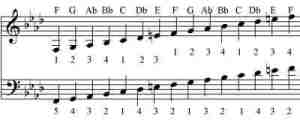 F minor is a minor scale based on F, consisting of the pitches F, G, A♭, B♭, C, D♭, and E♭. The harmonic minor raises the E♭ to E♮. Its key signature has four flats (see below: Scales and keys).
Its relative major is A-flat major, and its parallel major is F major.
F minor is a key often associated with passion. Two famous pieces in the key of F minor are Beethoven’s Appassionata Sonata, and Haydn’s Symphony No. 49 in F minor, La Passione.
Glenn Gould once said if he could be any key, he would be F minor, because “it’s rather dour, halfway between complex and stable, between upright and lascivious, between gray and highly tinted…There is a certain obliqueness.”[1]
In the Baroque period, music in F minor was usually written with a three-flat key signature and some modern editions of that repertoire retain that convention.
Again, many thanks to the CBC and Paolo Pietropaolo for bringing us the Signature Series.
I love the Beethoven interspersed with Vivaldi. : )
 Many thanks to Paolo Pietropaolo and the CBC for bringing us the Signature Series.
G minor is a minor scale based on G, consisting of the pitches G, A, B♭, C, D, E♭, and F. For the harmonic minor scale, the F is raised to F♯. Its relative major is B-flat major, and its parallel major is G major.
Changes needed for the melodic and harmonic versions of the scale are written in with accidentals as necessary. G minor is one of two flat key signatures that require a sharp for the leading-tone (the other is D minor).
Mozart’s use of G minor
Main article: Mozart and G minor
G minor has been considered the key through which Wolfgang Amadeus Mozart best expressed sadness and tragedy,[1] and many of his minor key works are in G minor, such as the Piano Quartet No. 1 and the String Quintet in G minor. Though Mozart touched on various minor keys in his symphonies, G minor is the only minor key he used as a main key for his numbered symphonies (No. 25, and the famous No. 40). In the Classical period, symphonies in G minor almost always used four horns, two in G and two in B-flat alto.[2] Another convention of G minor symphonies observed in Mozart’s No. 25 was the choice of E-flat major for the slow movement, with other examples including Haydn’s No. 39 and Johann Baptist Wanhal‘s G minor symphony from before 1771 (Bryan Gm1).[3]











 bleatmop
 Mystro
 The Arbourist


 Dead Wild Roses
Your opinions…