
You are currently browsing the tag archive for the ‘The DWR Friday Musical Interlude’ tag.
Featuring performance and visualization by Stephen Malinowski.
The third and most famous movement of Suite bergamasque is “Clair de lune,” meaning “moonlight” in French. Its name comes from Paul Verlaine‘s poem of the same name which also refers to ‘bergamasques‘ in its opening stanza: Votre âme est un paysage choisi / Que vont charmant masques et bergamasques / Jouant du luth et dansant et quasi / Tristes sous leurs déguisements fantasques
Are juicy harmonies your thing? Try this on for size. :)
This is a rerun I know, but after singing it you just have to hear it again. Enjoy folks.
Oh, and this is my part that I practiced with the other tenors. I’m sure they hate me by now for pestering them to rehearse with me, but wow did we nail it during the performance. :)
Fugue in G minor, BWV 578, “Little” (popularly known as the “Little Fugue”), is a piece of organ music written by Johann Sebastian Bach during his years at Arnstadt (1703–1707). It is one of Bach’s best known fugues and has been arranged for other voices, including in an orchestral version made by Leopold Stokowski.[1]
Early editors of Bach’s work attached this title to distinguish it from the later Great Fantasia and Fugue in G minor, BWV 542, which is longer in duration.
Many thanks to Stephen Malinowski for performing and translating the work into the visual medium presented above.
Fantastic ideas contained within this video by Vihart. Consider my knowledge of musical styles expanded, and hopefully your too. :)
Wikipedia blurb under the video.
Twelve-tone technique—also known as dodecaphony, twelve-tone serialism, and (in British usage) twelve-note composition—is a method of musical composition devised by Austrian composer Arnold Schoenberg (1874–1951). The technique is a means of ensuring that all 12 notes of the chromatic scale are sounded as often as one another in a piece of music while preventing the emphasis of any one note[3] through the use of tone rows, an ordering of the 12 pitches. All 12 notes are thus given more or less equal importance, and the music avoids being in a key. The technique was influential on composers in the mid-20th century.
Schoenberg himself described the system as a “Method of Composing with Twelve Tones Which are Related Only with One Another”.[4] However, the common English usage is to describe the method as a form of serialism.
Schoenberg’s countryman and contemporary Josef Matthias Hauer also developed a similar system using unordered hexachords or tropes—but with no connection to Schoenberg’s twelve-tone technique. Other composers have created systematic use of the chromatic scale, but Schoenberg’s method is considered to be historically and aesthetically most significant.
 The CBC Signature Series is hosted by Paolo Pietropaolo.
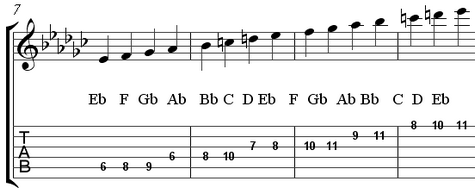
The E♭ (E-flat) minor scale consists of the pitches E♭, F, G♭, A♭, B♭, C♭, and D♭. In the harmonic minor, the D♭ is raised to D♮. Its key signature consists of six flats (see below: Scales and keys).
Its relative major is G-flat major, and its parallel major is E-flat major. Its enharmonic equivalent is D-sharp minor. Changes needed for the melodic and harmonic versions of the scale are written in with accidentals as necessary.
Despite the key rarely being used in orchestral music other than to modulate, it is encountered in a small fraction of keyboard music, and has been most popular in Russian pieces. For orchestration of piano music, some theorists recommend transposing to D minor or E minor.
This key is often popular with jazz or blues influenced keyboard players as, using all the black keys along with the A, it allows for an easily playable blues scale.
 In Book 1 of The Well-Tempered Clavier by Johann Sebastian Bach, Prelude No. 8 is written in E-flat minor while the following Fugue is written in D-sharp minor. In Book 2, both movements are in D-sharp minor.
One of the few symphonies written in this key is Prokofiev’s Symphony No. 6. A few other less well-known Soviet composers also wrote symphonies in this key, such as Andrei Eshpai, Janis Ivanovs (fourth symphony Atlantis, 1941), Ovchinnikov and Nikolai Myaskovsky. Aram Khachaturian wrote his Toccata in E-flat minor while studying under Myaskovsky.
It is also the key in which Dmitri Shostakovich composed his final string quartet.
Alexander Scriabin’s Prelude No. 14 from his 24 Preludes, Op. 11, is in E Flat Minor.
Sergei Rachmaninoff’s Elegie, Op. 3, No. 1, is in E-flat minor, as is his Étude-Tableau, Op. 39, No. 5. These pieces are noted for being dark and mysterious (a characteristic of this key), as shown even in the later jazz compositions “‘Round Midnight” and “Take Five”, which are also in the key.
Oskar Bohme’s Trumpet Sextet, Op. 30 is written in E-flat minor.
The extended orchestral introduction to Part II Gustav Mahler’s Eighth Symphony is in E-flat minor, as is the dark orchestral introduction to Beethoven’s only oratorio, Christ on the Mount of Olives. Jazz composer Thelonious Monk’s most famous composition, ‘Round Midnight is in E-flat minor.
Guitarist Yngwie Malmsteen has composed a number of pieces in E-flat minor, including the Concerto Suite for Electric
The CBC Signature Series hosted by Paolo Pietropaolo forges on with A-flat major.
A little bit more on A-flat major from Wikipedia:
The A-flat major scale consists of the pitches A♭, B♭, C, D♭, E♭, F, and G. Its key signature has four flats (see below: Scales and keys).
Its relative minor is F minor, and its parallel minor is A-flat minor.
It was used quite often by Franz Schubert; twenty-four of Frédéric Chopin‘s piano pieces[quantify] are in A-flat major, more than any other key.
Beethoven chose A-flat major as the key of the slow movement for most of his C minor works, a practice which Anton Bruckner imitated in his first two C minor symphonies and also Antonín Dvořák in his only C minor symphony.
Since A-flat major was not often chosen as the main key for orchestral works of the 18th Century, passages or movements in the key often retained the timpani settings of the preceding movement. For example, Beethoven’s Symphony No. 5 in C minor has the timpani set to C and G for the first movement. With hand tuned timpani, there is no time to retune the timpani to A-flat and E-flat for the slow second movement in A-flat; accordingly, the timpani in this movement are reserved for the passages in C major. In Bruckner’s Symphony No. 1 in C minor, however, the timpani are retuned between the first movement in C minor and the following in A-flat major.
Charles-Marie Widor considered A-flat major to be the second best key for flute music.[1]
Sir Edward Elgar‘s Symphony No. 1 in A-flat major is probably the best-known symphony in that key in the standard orchestral repertoire.[citation needed] However, Arnold Bax‘s 7th Symphony is also in the same key.
A-flat major was the flattest major key to be used in the keyboard and piano sonatas of Domenico Scarlatti, Joseph Haydn and Ludwig van Beethoven, with each of them using the key for two sonatas: Scarlatti’s K. 127 and K. 130, Haydn’s Hob XVI 43 and 46, and Beethoven’s Op. 26 and Op. 110, while Franz Schubert used it for one piano sonata. It was also the flattest major key to be used for the preludes and fugues in Johann Sebastian Bach‘s Well-Tempered Klavier, as flatter major keys were notated as their enharmonic equivalents.
Felix Mendelssohn, Johann Nepomuk Hummel, John Field, and Friedrich Kalkbrenner each wrote one piano concerto in A-flat (Mendelssohn’s being for two pianos); they had the horns and trumpet tuned to E-flat. Max Bruch‘s Concerto for Two Pianos in A-flat minor has its last movement in A-flat major, which is the parallel major; this concerto plays with the contrast between the two keys.
Works for stringed instruments in this key include Antonin Dvorak‘s String Quartet No. 14 and Benjamin Godard‘s Violin Sonata No. 4.











 bleatmop
 Mystro
 The Arbourist


 Dead Wild Roses
Your opinions…