
You are currently browsing the tag archive for the ‘Tom’s Dispatch’ tag.
Insightful essays not your bag? A window looking into current events as they happen, and not how the handlers say they happen a bit too much? Then don’t subscribe to Tom’s Dispatch.
This excerpt from ‘Bombs Away’ by Tom Engelhardt
“1. Success and Failure: Without a hint of exaggeration, you could say that, at the cost of $400,000 to $500,000, al-Qaeda’s 9/11 air assault created Washington’s multi-trillion-dollar Global War on Terror. With a microscopic hijacked air force and a single morning’s air campaign, that group provoked an administration already dreaming of global domination into launching a worldwide air war (with a significant ground component) that would turn the
Greater Middle East — then a relatively calm (if largely autocratic) region — into a morass of conflicts, failed or collapsed states, ruined cities, and refugees by the millions, in which extreme Islamic terror outfits now seem to sprout like so many mushrooms. This, you might say, was the brilliance of Osama bin Laden. Seldom has so little air power (or perhaps power of any sort) been leveraged quite so purposefully into such sweeping consequences. It may represent the most successful use of strategic bombing — that is, air power aimed at the civilian population of, and morale in, an enemy country — in history.
On the other hand, with only a slight hint of exaggeration, you might also conclude that seldom has an air campaign without end (almost 15 years and still expanding at the cost of untold billions of dollars) proven quite so unsuccessful. Put another way, you could perhaps conclude that, in these years, Washington has bombed and missiled a world of Islamist terror outfits into existence.
On September 11, 2001, al-Qaeda was the most modest of forces with militant followers in perhaps the low thousands in Afghanistan and tiny numbers of scattered supporters elsewhere on the planet. Now, there are al-Qaeda spin-offs and wannabe outfits, often thriving, from Pakistan to Yemen, Syria to North Africa, and of course the Islamic State (ISIS), that self-proclaimed “caliphate” of Abu Bakr al-Baghdadi, still holds a sizeable chunk of territory in Iraq and Syria while its “brand” has spread to groups from Afghanistan to Libya.
Minimally, the U.S. air campaign, which has certainly killed enough terror leaders, “lieutenants,” “militants,” and others over these years, has shown no ability to halt the process and arguably has ploughed remarkably fertile ground for it. Yet in response to the next terror outrage (as in Libya recently), the bombs continue to fall. It’s a curious record in the generally disappointing annals of air power and well worth considering in more detail.”

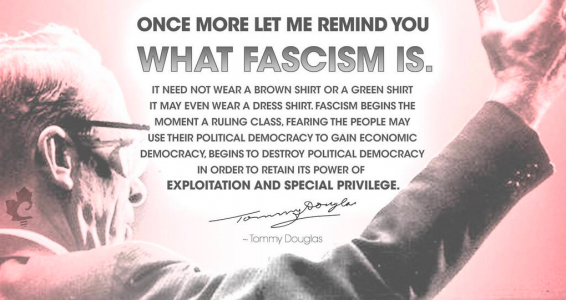
“It need not wear a brown shirt or a green shirt. It may even wear a dress shirt. Fascism begins the moment a ruling class, fearing the people may use their political democracy to gain economic democracy, begins to destroy political democracy in order to retains its power of exploitation and special privilege. – Tommy Douglas
Who doesn’t like to kick back and watch the US primary election campaign? I just scan the highlights, but John Feffer is big picture prognosticating with his recent article on Tom’s Dispatch titled Donald Trump and America B. The article examines the disaffected people who make up America B and who have bought into his faux-populist message. I encourage you to follow the above link and read the entire article as it is well written and laden with trenchant political observations that stretch into the near future.
In the 1990s, the United States changed its political economy. It was not quite as dramatic a shift as the regime changes that took place across Eurasia, but it had profound consequences for the realignment of voting patterns in America.
During that decade, the U.S. economy accelerated its shift from manufacturing — along with the well-paying blue-collar jobs that sector had once generated — to an ever more dominant service economy. In terms of employment, manufacturing jobs dropped from 18 million in 1990 to 12 million in 2014, while wages for such jobs tumbled as well. Over that same period, the health-care and social assistance sector alone grew from 9.1 million to more than 18 million jobs. At one end of that service economy were the 1% in financial services making stratospheric sums, particularly as compensation packages soared from the mid-1990s on. On the other end were the people who had to add shifts at McDonald’s or Walmart to their full-time jobs or monetize their spare time by driving for Uber just to make what they or their parents once earned with one job at the local factory.
America was not alone in undergoing this shift. Thanks to technological innovations like computers and robotics, greater access to cheap labor in places like Mexico and China, the rise of the Internet, and the deregulation of the financial world, the global economy was being similarly transformed. Blue-collar workers no longer played as vital a role in any advanced economy.
In the U.S., put bluntly, the imagination of America A no longer needed the muscle of America B.
[…]
“Falling behind economically and feeling betrayed by politicians on both sides of the aisle, America B might have moved to the left if the United States had a strong socialist tradition. In the 2016 primary campaign, many of the economically anxious did, in fact, support Bernie Sanders, particularly the younger offspring of America A fearful of being deported to America B. Unlike Europe B, however, America B has always been more about rugged individualism than class solidarity. Its denizens would rather buy a lottery ticket and pray for a big payout than rely on a handout from Washington (Medicare and Social Security aside). Donald Trump, politically speaking, is their Powerball ticket.
Above all, the inhabitants of America B are angry. They’re disgusted with politics as usual in Washington and the hypocritical, sanctimonious political elite that goes with it. They’re incensed by how the wealthy have effectively seceded from American society with their gated estates and offshore accounts. And they’ve focused their resentment on those they see as having taken their jobs: immigrants, people of color, women. They’re so desperate for someone who “tells it like it is” that they’ll look the other way when it comes to Donald Trump’s inextricable links to the very elite who did so much to widen the gap between the two Americas in the first place.”
[…]
“America B has a fondness for Donald Trump and his almost childlike audacity. (Gosh, kids say the darndest things!) Right now, his fans are attached to an individual, rather than a platform or a party. Many of his supporters don’t even care whether Trump means what he says or not. If he loses, he will fade away and leave nothing behind, politically speaking.
The real change will come when a more sophisticated politician, with an authentic political machine, sets out to woo America B. Perhaps the Democratic Party will decide to return to its more populist, mid-century roots. Perhaps the Republican Party will abandon its commitment to entitlement programs for the 1%.
More likely, a much more ominous political force will emerge from the shadows. If and when that new, neo-fascist party fields its charismatic presidential candidate, that will be the most important election of our lives.
As long as America B is left in the lurch by what passes for modernity, it will inevitably try to pull the entire country back to some imagined golden age of the past before all those “others” hijacked the red, white, and blue. Donald Trump has hitched his presidential wagon to America B. The real nightmare, however, is likely to emerge in 2020 or thereafter, if a far more capable politician who embraces similar retrograde positions rides America B into Washington.
Then it will matter little how much both liberals and conservatives rail against “stupid” and “crazy” voters. Nor will they have Donald Trump to kick around any more. In the end, they will have no one to blame but themselves.”
End game summary here is this – actual politicians are watching to see how successful DT is. The pull of false populism is strong and in the right(wrong) hands could be forged into a general election winning platform that will take America into a new darker age. So if we see in 2020 the new charming face of proto-fascism rise in the US, remember Tom Dispatch and DWR called it first in 2016.
 Our society is being influenced negatively by the consumerist culture that we, collectively, have taken our hands off the tiller and have let the market decide what is best for us and our cultures.
The idea that we can consume our way to happiness, well-being, or even a more just society would not compute without people being constantly conditioned to believe that individuality is end-goal of life. The power of community and people working together has been the dynamo that has pushed our societies forward for the benefit of everyone (well except for the status-quo) and it is this power that has been waning since corporate capitalism has kicked into high gear under the guise of neo-liberalism. Neo-liberalism undermines community, collective action, and critical thought it is a stupefying tonic – that when served to the masses – creates a calm disquiet that grinds societies away, but in return keeps people isolated, fixated on themselves, and most importantly: manageable.
This piece by Nick Turse is a preface for a America’s disconnect between its citizenry and the army said citizenry supports. The dissonance is palatable as one reads the article. What should concern you is that the disconnect described has been carefully and intentionally cultivated. A feature of our current system, and most certainly not a bug .
“I can’t tell you exactly why I clicked on the article, but it was probably the title: “The Double-Tap Couple.” To me, a “double tap” is the technique of firing two gunshots in quick succession or employing two strikes in a row, as when U.S. drones or Hamas carry out attacks and then follow-up strikes to kill first-responders arriving at the scene. But this piece was about something very different. The headline referred to the popular app Instagram where you double-tap to “like” a photo.
The article turned out to be a profile of two twenty-somethings, a married couple who go by the noms de social media, FuckJerry and Beige Cardigan. They are, says author David Yi, “micro-celebrities” of the modern age. He is “tall, with a chiseled face, handsome”; she “has big doe eyes with cherub-like cheeks.” They dropped out of college and — first he and then she — became Instagram meme curators; that is, they find photos with wry or funny captions elsewhere on the internet and post them for their millions of followers. “Though both are social media sensations, neither is quite content with what they’ve accomplished,” Yi tells us. She “wants to pursue her first love, fashion, but isn’t quite sure what she’d want to do.” He’s currently cashing in with FuckJerry merchandise — hats, t-shirts, even “Vape juice.”
I read the article to the point at which FuckJerry (née Elliot Tebele) told Yi about his long slog up the Instagram follower food-chain: “It took a shit ton of time to get to, and it took a long time with a lot of work.” I stared at my phone in abject confusion. Something wasn’t right, so I scrolled to the beginning of the article and started again. But it was just the same. Justin Bieber is a fan. Followers include the “Kardashian-Jenner family.” He wears “skinny jeans and vintage Nikes.” She sports a “statement coat and a pair of sparkling Chloe boots.” Then I hit that quote: “shit ton of time… a lot of work.” I still couldn’t make sense of it and began studying the article as if it were a riddle. I read it maybe five times and again and again when I hit those phrases about time and work my brain would buckle.
At that moment, I was nearing the end of a month-long reporting stint in South Sudan and waiting to find out if I’d be able to talk to a teenage girl, a late millennial with more than memes on her mind. She had rebuffed the 60-something man her family had arranged for her to marry and her relatives had displayed their displeasure by beating her to the point of unconsciousness. That conversation never happened, but I’d already logged several weeks’ worth of interviews with shooting survivors, rape victims, mothers of murdered sons, wives of dead husbands. All this in a country where, for firewood and water — that is, the means of life — women walk desperately far distances in areas where they know that men with AK-47s may be lurking, where many are assaulted and violated by one, two, or even five men. In other words, a land where few would consider meme curation to be “a lot of work.”
I’d obviously hit that unsettling juncture where voices from home become dulled and distorted, where you feel like you’re hearing them from deep underwater. I’m talking about the vanishing point at which your first-world life collides with your crisis-zone reality — the point of disconnect. Mark Wilkerson knows it well. He found himself in just such a state, serving with the U.S. Army in civil-war-torn Somalia during the 1990s. That’s where he begins his inaugural TomDispatch piece, a rumination on his journey from soldier to veteran to chronicler of the all-too-brief life of another veteran, in his recent and moving book, Tomas Young’s War.
I eventually gave up on Yi’s article, unsure why I couldn’t understand the life and times of FuckJerry. After I got back to the U.S., however, I signed up for Instagram and took a look at his account and Yi’s story began to make more sense to me, if only in a tragi-comic way. Later in the piece, he writes of his subjects being “caught in the maelstrom” when a competitor is criticized for “stealing” memes. It’s a strange society that produces both meme maelstroms and, in distant lands, lethal ones that leave millions dead, maimed, desperate, or displaced. So before you become FuckJerry’s 9,200,001st follower, let Wilkerson guide you through slivers of two American conflicts, their aftermaths, and the points of disconnect along the way.”
–Nick Turse’s Preface to Batman in a Hospital Bed by Mark Wilkerson @Tom’s Dispatch
The disconnection that Turse illustrates resonates with me enough though to make it the focus of my article, however Wilkerson’s article is also very good, so I recommend following the link.
I keep thinking about all of the rhetoric about how wasteful social spending is, and how programs for the poor are being taken advantage of, then I read something like this… then I get mad.
“From spending $150 million on private villas for a handful of personnel in Afghanistan to blowing $2.7 billion on an air surveillance balloon that doesn’t work, the latest revelations of waste at the Pentagon are just the most recent howlers in a long line of similar stories stretching back at least five decades. Other hot-off-the-presses examples would include the Army’s purchase of helicopter gears worth $500 each for $8,000 each and the accumulation of billions of dollars’ worth of weapons components that will never be used. And then there’s the one that would have to be everyone’s favorite Pentagon waste story: the spending of $50,000 to investigate the bomb-detecting capabilities of African elephants. (And here’s a shock: they didn’t turn out to be that great!) The elephant research, of course, represents chump change in the Pentagon’s wastage sweepstakes and in the context of its $600-billion-plus budget, but think of it as indicative of the absurd lengths the Department of Defense will go to when what’s at stake is throwing away taxpayer dollars.
Keep in mind that the above examples are just the tip of the tip of a titanic iceberg of military waste. In a recent report I did for the Center for International Policy, I identified 27 recent examples of such wasteful spending totaling over $33 billion. And that was no more than a sampling of everyday life in the twenty-first-century world of the Pentagon.
The staggering persistence and profusion of such cases suggests that it’s time to rethink what exactly they represent. Far from being aberrations in need of correction to make the Pentagon run more efficiently, wasting vast sums of taxpayer dollars should be seen as a way of life for the Department of Defense. And with that in mind, let’s take a little tour through the highlights of Pentagon waste from the 1960s to the present.”
Somehow I think that when neoconservative politicians talk about smaller government, they are not referring to the Offense spending, or state/corporate fixtures like the Pentagon.
Getting stuck on the US election race? Tired of hearing about how the authoritarian left is, yet again, stifling free speech? How about some Nuclear Armageddon to cleanse the palate? Dilip Hiro takes us to South East Asia and the conflict between India and Pakistan.
“Undoubtedly, for nearly two decades, the most dangerous place on Earth has been the Indian-Pakistani border in Kashmir. It’s possible that a small spark from artillery and rocket exchanges across that border might — given the known military doctrines of the two nuclear-armed neighbors — lead inexorably to an all-out nuclear conflagration. In that case the result would be catastrophic. Besides causing the deaths of millions of Indians and Pakistanis, such a war might bring on “nuclear winter” on a planetary scale, leading to levels of suffering and death that would be beyond our comprehension.
Alarmingly, the nuclear competition between India and Pakistan has now entered a spine-chilling phase. That danger stems from Islamabad’s decision to deploy low-yield tactical nuclear arms at its forward operating military bases along its entire frontier with India to deter possible aggression by tank-led invading forces. Most ominously, the decision to fire such a nuclear-armed missile with a range of 35 to 60 miles is to rest with local commanders. This is a perilous departure from the universal practice of investing such authority in the highest official of the nation. Such a situation has no parallel in the Washington-Moscow nuclear arms race of the Cold War era.
When it comes to Pakistan’s strategic nuclear weapons, their parts are stored in different locations to be assembled only upon an order from the country’s leader. By contrast, tactical nukes are pre-assembled at a nuclear facility and shipped to a forward base for instant use. In addition to the perils inherent in this policy, such weapons would be vulnerable to misuse by a rogue base commander or theft by one of the many militant groups in the country.”
Catch the rest of this sunny story at Tom’s Dispatch, I highly recommend you subscribe to their newsletter.











 bleatmop
 Mystro
 The Arbourist


 Dead Wild Roses
Your opinions…