
You are currently browsing the tag archive for the ‘US’ tag.
 Nationalism is one of the major currents in US society that is wearing away the roots of their democratic nation. The capitalist 1%’ers are using their political and media distractors in a desperate ploy to place the blame for working classes on immigrants and people who are not white.
Blaming the ‘other’ for your country’s problems is chapter one material in the corporatist manual. It so much easier to blame people with non-white skin for taking away our jobs than admit that the system we have in place systematically eliminates well paying jobs (via outsourcing or technological advancement) in pursuit of profit and efficiency.
We can see the roots of this game plan in what Trump and Bannon are on record as saying:
“President Donald Trump’s special adviser Steve Bannon has long disparaged South Asian high-tech workers such as Kuchibhotla and Madasani. In 2015, Bannon interviewed candidate Trump on the Breitbart News Daily radio show. Bannon suggested that there were far too many Asians in the high-tech industry in the U.S. and that perhaps there should be barriers placed on their entry. The H-1B visa, which allows high-tech workers to enter the U.S., is a particular grouse of Bannon’s. Trump expressed doubts about Bannon’s extreme views: “We have to be careful of that, Steve,” Trump said. “You know,” he continued, “we have to keep our talented people in this country.” Bannon would have none of it. “When two-thirds or three-quarters of the CEOs in Silicon Valley are from South Asia or from Asia, I think…,” he said, then hesitated. “A country is more than an economy,” Bannon said. “We’re a civic society.”
By “civic society”, Bannon meant that the first priority of the U.S. should be to its own “native” citizens. In other words, white Americans need to be the first in the queue for the benefits of the country. In March 2016, Trump absorbed Bannon’s position. “The H-1B programme,” Trump said, “is neither high-skilled nor immigration: these are temporary foreign workers, imported from abroad, for the explicit purpose of substituting for American workers at lower pay. I will end forever the use of the H-1B as a cheap labour programme and institute an absolute requirement to hire American workers first.” When the term “American workers” is used, people like Purinton and Page hear “white workers”. It is what they signal when they yell: “Go back to your country.”
In another radio show, in April 2016, Bannon said that the migrants to the U.S. “are not Jeffersonian democrats”. “These are not people with thousands of years of democracy in their DNA coming here,” he said. The idea of democracy in the DNA could only imply that certain “races” have democracy under their skin and that Asians are not in that company.”
Pretty chilling considering these mooks now have their clumsy hands on the levers of power in the US. We can see the nationalism – even white pride – glowering in the statements of Bannon and Trump. This present white nationalism flies in the face of the American demographic situation, one in which the US is become less white every year, and will only serve to increase the internal tension and strain on the democratic civic integrity of the US.
[Source: Vijay Prashad writing for Counterpunch]
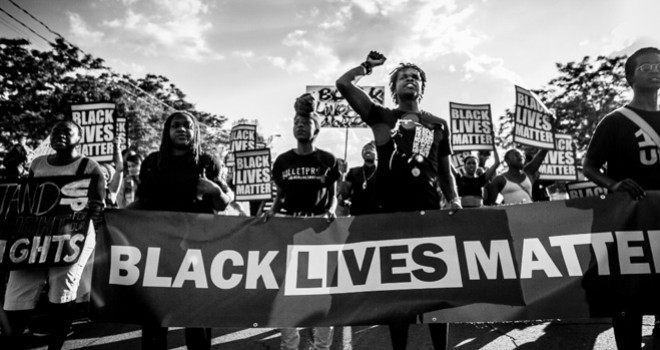 Some peoples lives are worth more than others.
In the context of American society one of the deciding factors of how much your life is worth is determined by the colour of your skin. Here in Canada a similar skin tone gradient applies as being First Nations in Canada gets you the special police attention you don’t deserve. Bonus features of being in First Nations in Canada include (but are not limited to), poverty, limited access to potable water, and an hostile educational system. Make no mistake, we have much to do in Canada to address the needs of our people. We have a Canadian Highway of Tears that sullies our escutcheon and is indicative of the racism that still permeates our society.
The inherent racism present in Canada pales before the horrendous shitshow that is running south of the border. Racial divisions and discrimination represent a clear and present danger to fabric of the civil society of the United States (necessarily so). The scale of protests against the racial violence of the white establishment is increasing – fuelled by social media that circumvents mainstream media and offers a small gory window into the lives of black people who are being murdered by the security apparatus of the state.
I cannot imagine the horror of witnessing your partner being shot to death in your car, having to be polite to the individual that just inflicted moral wounds on our loved one while having your child witness the entire blood spattered episode from the backseat.
…
Violence breeds violence.
The unidirectional nature of the violence was reversed as an individual who proclaimed his hatred for white police, killed five white police officers in Dallas. The shooter was a reservist and had seen a tour of duty in Afghanistan. Lives are being lost because we have tied how much humanity you’re allotted to the colour of your skin.
Madness. It is sheer madness that we have allowed our societies to be shaped by racism and that the status quo is in fact racist. Is this series of murders in the US the tipping point? It certainly seems like people have had enough and are willing to entertain a large spectrum means to achieve their ends. It should be (like the constant stream of black people being murdered by police hasn’t been) a wake up call to the American congress and its legislative position on systemic racism and gun control. Henry Giroux paints a darker picture when he says:
“In the increasingly violent landscape of anti-politics, mediation disappears, dissent is squelched, repression operates with impunity, the ethical imagination withers, and the power of representation is on the side of spectacularized state violence. Violence both at the level of the state and in the hands of everyday citizens has become a substitute for genuine forms of agency, citizenship, and mutually informed dialogue and community interaction.”
The response of the law makers will tell the tale though, because the disconnect between public opinion and public representatives is being brought into stark relief. Congress has been mostly bought and paid for – but they have to at least look like they are serving the needs of the public on occasion, will the murder of five police officers stir the sycophants into action? I really don’t know, because getting reelected seems to override important qualities of being a decent human being. Qualities like empathy, compassion, and morality seem strangely missing when it comes to societal issues that threaten idea of moving toward a just society.
The cynical side of me contemplates this question: Would the US have gun control if members of Congress were similarly subjected to the murder/assassination program the rest of America is being subject to?

Chris Hedges occasionally has some good ideas when it comes to the American body politic. Consider what we are seeing on the news, and is it really that far off from what is being stated here?
“As Arendt noted, the fascist and communist movements in Europe in the 1930s “… recruited their members from this mass of apparently indifferent people whom all other parties had given up as too apathetic or too stupid for their attention. The result was that the majority of their membership consisted of people who had never before appeared on the political scene. This permitted the introduction of entirely new methods into political propaganda, and indifference to the arguments of political opponents; these movements not only placed themselves outside and against the party system as a whole, they found a membership that had never been reached, never been ‘spoiled’ by the party system. Therefore they did not need to refute opposing arguments and consistently preferred methods which ended in death rather than persuasion, which spelled terror rather than conviction. They presented disagreements as invariably originating in deep natural, social, or psychological sources beyond the control of the individual and therefore beyond the control of reason. This would have been a shortcoming only if they had sincerely entered into competition with either parties; it was not if they were sure of dealing with people who had reason to be equally hostile to all parties.”
Fascism is aided and advanced by the apathy of those who are tired of being conned and lied to by a bankrupt liberal establishment, whose only reason to vote for a politician or support a political party is to elect the least worst. This, for many voters, is the best Clinton can offer.
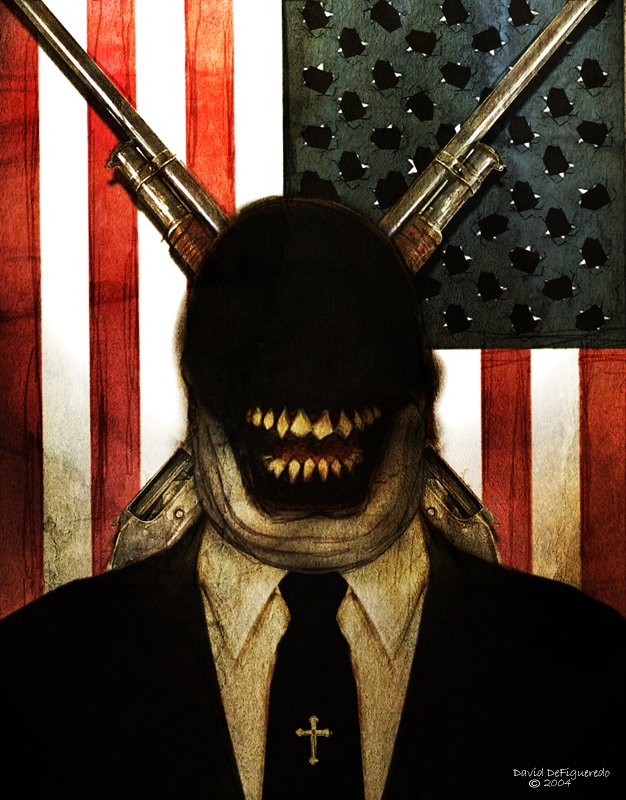
Fascism expresses itself in familiar and comforting national and religious symbols, which is why it comes in various varieties and forms. Italian fascism, which looked back to the glory of the Roman Empire, for example, never shared the Nazis’ love of Teutonic and Nordic myths. American fascism too will reach back to traditional patriotic symbols, narratives and beliefs.”
[…]
“There is only one way left to blunt the yearning for fascism coalescing around Trump. It is to build, as fast as possible, movements or parties that declare war on corporate power, engage in sustained acts of civil disobedience and seek to reintegrate the disenfranchised—the “losers”—back into the economy and political life of the country. This movement will never come out of the Democratic Party. If Clinton prevails in the general election Trump may disappear, but the fascist sentiments will expand. Another Trump, perhaps more vile, will be vomited up from the bowels of the decayed political system. We are fighting for our political life. Tremendous damage has been done by corporate power and the college-educated elites to our capitalist democracy. The longer the elites, who oversaw this disemboweling of the country on behalf of corporations—who believe, as does CBS Chief Executive Officer Leslie Moonves, that however bad Trump would be for America he would at least be good for corporate profit—remain in charge, the worse it is going to get.”
It would seem that the revival of class consciousness is going to play a large role in saving democracy in the United States. Remembering class interests and organizing to protect them may be a way to bring people back into the political fold.
 I’m consistently amazed by the audacity of organized religion and the amount of steamy-ripe-bullshit that it forces down our society’s throat. The fetid promotion and glorification of ignorance coupled with the consistent denial of science and fact is a burgeoning cataclysm for the human race. Organized stupidity, if left unchecked, will be the end of us.
There are bright spots though, in Canada organized religion is hollowing out as people move away from being scared of lights and ancient shadows (worshipping capitalism instead – woo-haa…). Baby steps and what not. Our progress though seems fruitless though as we live in the shadow of the towering mass of religious stupid that is the United States. In the US it seems as if the powers of fear and magic are still on the rise despite the fact that the rest of the world is gradually becoming more rational and more secular.
That is worrisome to say the least, as our blessed bible believers have access to enough nuclear weaponry to sterilize the earth several times over. Earth wiping out capacity isn’t something you give to people who believe in ghosts, magic, and assorted Ooga-Booga. It is unsettling to watch what is going down the GOP side of the run up to the presidential elections. There is no ‘safe’ candidate in this field of republicans, as all are afflicted, to one degree or another, with the virus of organized religious belief. Further comment on the republicans and their suicidal commitment to unreality is the topic of another post because the amount of stupid involved with their political strategy would break my blog if discussed all at once. Perhaps a more simple start to the religious problems in the US is answer?
I’m thinking that a good start in the US would be to remove the tax-exempt status of the Churches. If this info-graphic is even half true, it would be a step in the right direction for the people of the US.

I might (well not really) become a believer if the various testaments to human gullibility decided to dismantle their superstructure and actually help the poor.

Great mysteries of empire are always shrouded in mystery. One idea that I have lifted from terrible military fiction is the concept of the 6P’s.
They are:
Proper Planning Prevents Piss Poor Performance.
Can you guess which imperialistic nation didn’t do their homework?
“Sky said the United States led the invasion of Iraq in 2003 to oust a dictator, Saddam Hussein, and to help establish a democratic beachhead in the Middle East. But after the invasion, it was the military that was left with the job of trying to keep the country together.
“They had been told to go in and take care of Saddam and that was it. They were completely unaware of the situation there. They had to make the best of the situation they found themselves in.”
According to Sky, the administration of U.S. President George W. Bush believed that democracy would take hold on its own; they had no roadmap for how to make that happen.”
Yah. You would think after a grand statue toppling the rest of the piece of the ‘nation-building’ exercise would just fall into place. What could go wrong?
“These plans drawn up in Washington were all wishful thinking,” she said.
At one point, Sky recounts in the book, Donald Rumsfeld showed up for a military briefing in northern Iraq, and didn’t know where neighbouring Iran was on the map.”
Yep, the US had the smartest guys in the room in on this one. Predictably, they royally screwed the country up, destroying vital civilian infrastructure, murdering a bunch of civilians and of course setting the state for the next terrorist flavour of the month, ISIL. You’d think there would be some questions of accountability being asked as to who laid the foundation of this megalith of stupidity.
“No one has ever been held accountable for the decisions, for the false intelligence that led them to invade Iraq,” she says. “They should be. The people at the top should be held accountable for what went wrong.”
Sky was blunt in her assessment to General Odierno, telling him that America’s blundering in Iraq was the, “worst strategic failure since the foundation of the United States.”
 I’m guessing that if you arbitrarily declare victory at some point during the shit-show it somehow allows the drivers of the clown-car to be exculpated for all their sins. Of course having the biggest war machine on earth allows you to do pretty much as you please – Nuremberg and Geneva Conventions be damned.
But let’s not focus too much on the big picture yet, more cock-ups are yet to happen:
“But the biggest missed opportunity happened following the first national elections in 2010, when the sitting Prime Minister, Nouri al-Maliki, failed to gain a majority.
“Iraqis had become convinced that politics, not violence, was the way forward.” she says. “All the various groups came out to vote, and the bloc that won ran on a platform of ‘no to sectarianism.’
“Sky believes this presented an opportunity to oust Nouri al-Maliki, a man who was consolidating his own power base, in favour of a true – or at least fledgling – democracy.
“But it was a close result. Maliki refused to accept the results,” she said.
The U.S. decided that backing al-Maliki, even with his faults, was the best chance for stability. This wasn’t something the military supported.
“The ambassador at the time, Chris Hill, had no experience of Iraq and didn’t really want to be there.”
Sky writes that Hill spent most of his time trying to make the embassy in Baghdad “normal.” He even brought in rolls of sod to make a lawn where he could practise lacrosse.
“General Odierno was adamant that the U.S. should protect the political process, allow the winning group 30 days to form the government. Hill didn’t have the same feel for Iraq and he said ‘Maliki is our man, the strong man the country needs.’ In the end Biden went with the ambassador’s recommendation.”
Sky believes it was a huge mistake.
“Maliki’s politics were poisonous,” she said.”
Well he looked like Saddam Hussein 2.0 ( the one we liked and actively supported, economically and militarily)and that was a good thing! Oh wait…
“Sky was disheartened as she watched the Iraqi people lose confidence in the country’s leaders, especially groups such as Sunni Muslims, who felt there was no place for them and no chance to be part of the government.
“If you were Sunni, you made the unfortunate decision that supporting ISIS was a better option than supporting the central government in Baghdad,” she says.
Current Prime Minister Haider al-Abadi has been trying to reform the government. This week he cut the cabinet in an attempt to oust some of the old guard, and dropped quotas for government positions that were based on ethnicity.
Sky is cautiously hopeful that the new government may help turn things around, but says it will not be easy.”
Well and that brings us up to today – Can we get a ‘Mission Accomplished’ ?! Anyone? Anyone??
Is this thing even on?
 The concluding paragraphs from Michael Klare’s Essay on the Coming Cold War 2.0.
“For those of us residing outside Washington, this choice may appear to have few immediate consequences. The defense budget will rise in either case; troops will, as now, be shuttled desperately around the hot spots of the planet, and so on. Over the long run, however, don’t think for a second that the choice won’t matter.
A stepped-up drive to counter Russia will inevitably produce a grim, unpredictable Cold War-like atmosphere of suspicion, muscle-flexing, and periodic crises. More U.S. troops will be deployed to Europe; American nuclear weapons may return there; and saber rattling, nuclear or otherwise, will increase. (Note that Moscow recently announced a decision to add another 40 intercontinental ballistic missiles to its already impressive nuclear arsenal and recall Senator Cruz’s proposal for deploying U.S. anti-missile batteries in Eastern Europe.) For those of us who can remember the actual Cold War, this is hardly an appealing prospect.
A renewed focus on China would undoubtedly prove no less unnerving. It would involve the deployment of additional U.S. naval and air forces to the Pacific and an attendant risk of armed confrontation over China’s expanded military presence in the East and South China Seas. Cooperation on trade and the climate would be imperiled, along with the health of the global economy, while the flow of ideas and people between East and West would be further constricted. (In a sign of the times, China recently announced new curbs on the operations of foreign nongovernmental organizations.) Although that country possesses far fewer nuclear weapons than Russia, it is modernizing its arsenal and the risk of nuclear confrontation would undoubtedly increase as well.
In short, the options for American global policy, post-2016, might be characterized as either grim and chaotic or even grimmer, if more focused. Most of us will fare equally badly under either of those outcomes, though defense contractors and others in what President Dwight Eisenhower first dubbed the “military-industrial complex” will have a field day. Domestic needs like health, education, infrastructure, and the environment will suffer either way, while prospects for peace and climate stability will recede.
A country without a coherent plan for advancing its national interests is a sorry thing. Worse yet, however, as we may find out in the years to come, would be a country forever on the brink of crisis and conflict with a beleaguered, nuclear-armed rival.”
The geopolitics of the future continue to darken as the interests of the state and corporate elites once again trump the interests of the people of the world. The elephant in the room, of course, is climate change and no one in power seems to care. I imagine, when New York is underwater – action might be considered.
We tell ourselves the stories we need to hear. This is excerpt details American involvement in Afghanistan, but from a non-embedded reporters point of view and analysis.
“The central thesis of the American failure in Afghanistan — the one you’ll hear from politicians and pundits and even scholars — was succinctly propounded by Deputy Secretary of State Richard Armitage: “The war in Iraq drained resources from Afghanistan before things were under control.” In this view, the American invasion of Iraq became a crucial distraction from stabilization efforts in Afghanistan, and in the resulting security vacuum the Taliban reasserted themselves.
At its core, the argument rests upon a key premise: that jihadi terrorism could be defeated through the military occupation of a country. That formulation seemed natural enough to many of us in the wake of 9/11. But travel through the southern Afghan countryside, and you will hear quite a different interpretation of what happened. It comes in snippets and flashes, in the stories people tell and their memories of the time, and it points to a contradiction buried deep in the war’s basic premise.
You can find this contradiction embodied in a sprawling jumble of dust-blown hangars, barracks, and Burger Kings, a facility of barbed wire, gunmen, and internment cages: Kandahar Airfield, or KAF, as it came to be called, the nerve center for American operations in southern Afghanistan, home to elite units like the Navy SEALs and the Green Berets. A military base in a country like Afghanistan is also a web of relationships, a hub for the local economy, and a key player in the political ecosystem. Unravel how this base came to be, and you’ll begin to understand how war returned to the fields of Maiwand.
In December 2001, an American Special Operations Forces unit pulled into an old Soviet airbase on the outskirts of Kandahar city. They were accompanied by a team of Afghan militiamen and their commander, a gregarious, grizzly bear of a man named Gul Agha Sherzai. An anti-Taliban warlord, Sherzai had shot to notoriety in the 1990s following the death of his illustrious father, Hajji Latif, a onetime bandit turned mujahed known as “the Lion of Kandahar.” (Upon assuming his father’s mantle, Gul Agha had rechristened himself Sherzai, Son of the Lion. His first name, incidentally, roughly translates as “Respected Mr. Flower.”) With American backing, Sherzai seized the airfield, then in ruins, and subsequently installed himself in the local governor’s mansion — a move that incensed many, Hamid Karzai among them. Nonetheless, Sherzai brought a certain flair to the office, quickly catching notice for his fist-pounding speeches, tearful soliloquies, and outbursts of uncontrollable laughter, sometimes all in a single conversation.
Sherzai may not have had much experience in government, except a brief tenure as Kandahar’s “governor” during the anarchic mid-1990s, but he knew a good business opportunity when he saw one. The airbase where the Americans were encamped was derelict and weedy, strewn with smashed furniture and seeded with land mines from the Soviet era. Early on, one of Sherzai’s lieutenants met Master Sergeant Perry Toomer, a U.S. officer in charge of logistics and contracting. “I started talking to him,” Toomer said, “and found out that they had a knowledge of how to get this place started.” After touring the facilities, the Americans placed their first order: $325 in cash for a pair of Honda water pumps.
It would mark the beginning of a long and fruitful partnership. With Sherzai’s services, the cracked and cratered airstrip blossomed into a massive, sprawling military base, home to one of the world’s busiest airports. Kandahar Airfield would grow into a key hub in Washington’s global war on terror, housing top-secret black-ops command rooms and large wire-mesh cages for terror suspects en route to the American prison in Guantanamo Bay, Cuba.
For Sherzai, KAF would be only the beginning. In a few swift strokes, he made the desert bloom with American installations — and turned an extravagant profit in the process. He swiped land and rented it to U.S. forces to the tune of millions of dollars. Amid the ensuing construction boom, he seized gravel quarries, charging as much as $100 a load for what would normally have been an $8-a-load job. He furnished American troops with fuel for their trucks and workers for their projects, raking in commissions while functioning as an informal temp agency for his tribesmen.
With this windfall, he diversified into gasoline and water distribution, real estate, taxi services, mining, and, most lucrative of all, opium. No longer a mere governor, he was now one of the most powerful men in Afghanistan. Every morning, lines of supplicants would curl out of the governor’s mansion.
As his web of patronage grew, he began providing the Americans with hired guns, usually from his own Barakzai tribe — making him, in essence, a private security contractor, an Afghan Blackwater. And like the employees of that notorious American firm, Sherzai’s gunmen lived largely outside the jurisdiction of any government. Even as Washington pumped in funds to create a national Afghan army and police, the U.S. military subsidized Sherzai’s mercenaries, who owed their loyalty to the governor and the special forces alone. Some of his units could even be seen garbed in U.S. uniforms, driving heavily armed flatbed trucks through the streets of Kandahar.
How to Fight the War on Terror Without an Adversary
Of course, even in the new Afghanistan there was no such thing as a free lunch. In return for privileged access to American dollars, Sherzai delivered the one thing U.S. forces felt they needed most: intelligence. His men became the Americans’ eyes and ears in their drive to eradicate the Taliban and al-Qaeda from Kandahar.
Yet here lay the contradiction. Following the Taliban’s collapse, al-Qaeda had fled the country, resettling in the tribal regions of Pakistan and in Iran. By April 2002, the group could no longer be found in Kandahar — or anywhere else in Afghanistan. The Taliban, meanwhile, had ceased to exist, its members having retired to their homes and surrendered their weapons. Save for a few lone wolf attacks, U.S. forces in Kandahar in 2002 faced no resistance at all. The terrorists had all decamped or abandoned the cause, yet U.S. special forces were on Afghan soil with a clear political mandate: defeat terrorism.
How do you fight a war without an adversary? Enter Gul Agha Sherzai — and men like him around the country. Eager to survive and prosper, he and his commanders followed the logic of the American presence to its obvious conclusion. They would create enemies where there were none, exploiting the perverse incentive mechanism that the Americans — without even realizing it — had put in place.
Sherzai’s enemies became America’s enemies, his battles its battles. His personal feuds and jealousies were repackaged as “counterterrorism,” his business interests as Washington’s. And where rivalries did not do the trick, the prospect of further profits did. (One American leaflet dropped by plane in the area read: “Get Wealth and Power Beyond Your Dreams. Help Anti-Taliban Forces Rid Afghanistan of Murderers and Terrorists.”)
-Excerpted from No Good Men Among the Living: America, the Taliban, and the War Through Afghan Eyes by Anand Gopal, published by Metropolitan Books, an imprint of Henry Holt and Company, LLC.Copyright 2015 Anand Gopal











 bleatmop
 Mystro
 The Arbourist


 Dead Wild Roses
Your opinions…