
When I see Objectivist thinking or its equally bankrupt little brother Libertarianism brought into a serious conversation I always smile inwardly. Objectivism is based on the writings of Ayn Rand. Objectivist doctrine can be summarized in a short sentence, which happens to be the title of this post. Rand and others put forth the emphasis on rationality and making objective decisions but, risible ornamentation aside, her thoughts boil down to the idea that being selfish and greedy is a good thing and the net benefits accrued from this ego festival will benefit society.
Objectivism fits nicely with the Chicago school of neoliberalism as the selfish nature of objectivist thought fits well with the trickle down theory of wealth and laissez-faire market policy in general.
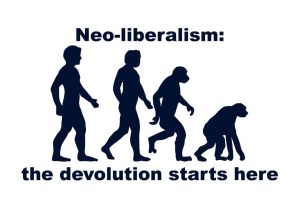 Before going any further with this post there are a couple of assumptions that I will be working from that will inherently colour my conclusions.
1) Laissez-faire capitalism is a farce. No one actually wants a completely unregulated free market.
2) The neoliberal economic plan put forth by Friedman and the Chicago school is an unmitigated disaster and has been thoroughly discredited.
3) Democracy and Capitalism are mutually antagonistic systems.
I have other tenets but listing them all would only further entangle an already long post. I just want to help establish the tone of what this piece is going to be about. As this is an introductory piece, it would be good to get the wisdom from its source. Ayn Rand in Atlas Shrugged says:
“[T]he most selfish of all things is the independent mind that recognizes no authority higher than its own and no value higher than its judgment of truth. You are asked to sacrifice your intellectual integrity, your logic, your reason, your standard of truth-in favor of becoming a prostitute whose standard is the greatest good for the greatest number.” (1957: 955-956)
Bruce Barry and Carrol Stephens in the Academy of Management Review (Volume 23, No. 1 January 1998) have taken Randian thought to task. Their reply is as follows:
“Objectivists assume that humans can reap value and attain virtue only through the satisfaction of the self. But, of course, in genuine societies we find ourselves mutually interdependent and often motivated to assist others in order to achieve broader out- comes that serve our own individual interests.” (165)
A Randian would disagree as altruism in her thoughts* is a corrupt notion that eats away at the heart of productive society. James Rachels from his Elements of Moral philosophy describes the Randian notion of altruistic behaviour:
[Rand depicts any degree of altruism as so self- abnegating that] “[N]obody, with the possible exception of certain monks, would find it congenial. As Ayn Rand presents it, altruism implies that one’s own interests have no value, and that any demand by others calls for sacrificing them. If that is the alternative, then any other view, including [objectivism], will look good by comparison. But this is hardly a fair picture of the choices.” (1986: 71; emphasis in original)
Rand essentially sets up a series of false dichotomies and strawmen that attempt to show how good Objectivism is versus the evils of altruism and other ‘misguided’ moral theories (see utilitarianism, moral relativism).
Of course, socialism gets similar treatment, from Atlas Shrugged:
“You … call it unfair that we, who had dragged you out of your hovels and provided you with modern apartments, with radios, movies and cars, should own our palaces and yachts-you decided that you had a right to your wages, but we had no right to our profits, that you did not want us to deal with your mind, but to deal instead, with your gun. Our answer to that was: “May you be damned!” Our answer came true. You are. (1957: 989)
Contrast that with Barry and Carrol’s response:
“Objectivists claim for all members of society the right to think and contribute and be left alone to pursue happiness but, at the same time, reserve for those who control intellectual capital the power to decide economic and social structure and to manage the institutions through which culture is created and disseminated. The objectivist tells relatively powerless members of society that they are free to think and act and grow and prosper yet preaches, at the same time, a radical laissez-faire interpretation of political economy (see Machan, 1984) that is more likely to solidify existing imbalances of power and preserve elite privilege than to create conditions for social transformation and upward mobility”. – (167)
 So what we have is a system that privileges the elite of society while marginalizing the rest. Kinda like what neoliberalism does for economics, forget the poor, if we cater to the rich and they do well everyone magically does better. It has worked well for the world… Ask Chile about how this school of thought plays out, or Argentina. The result has been everywhere every time a dismal failure for the country and its people (excluding the moneyed elites, after pillaging the country they move their capital elsewhere and start the process of exploitation again).
(* I will not grace the Objectivist theory with the title of it being a philosophy. Objectivism has been thoroughly discredited as a Moral Philosophy, but I will omit this salient feature of Objectivism in my post as it could be considered an argument from authority)











 bleatmop
 Mystro


 Dead Wild Roses
30 comments
September 20, 2009 at 8:14 pm
mtnrunner2
Laissez-faire capitalism has not been tried, so any assertion as to its failure is moot.
Neither Chile nor Argentina had anything close to capitalism; for many years, they were fascist dictatorships! This simply suggests that you do not know what Rand’s notion of capitalism is. See: http://aynrandlexicon.com/lexicon/capitalism.html
Nothing Ayn Rand wrote implies that social activity or cooperation is bad. In fact, it’s the opposite: a genuinely just society is one in which coercion is outlawed, and only in such a society can people interact peacefully. That social system is laissez-faire capitalism. After all, how could there be free trade without cooperation? Trade *IS* social cooperation.
The whole point of Rand’s moral critique is that the common view of altruism actually mixes two opposing ideas: 1) helping others, and 2) the notion that our primary moral purpose is duty to others. The first is fully compatible with rational egoism and capitalism, whereas the second is not.
Rand strips altruism down to the second definition, because it speaks to our fundamental moral relationship to others, whereas charity is an optional value that depends on circumstance, our means, and our personal values. Her view is that the idea that our primary purpose is to serve others is as absurd as saying the primary purpose of our lungs is to breathe for others. Therefore she regards it as inappropriate for human nature and survival, as morally wrong, and proceeds to show how it results in practical disaster. For example, Chile and Argentina under dictatorship.
I’m afraid you’ve refuted straw men.
Jeff Montgomery
http://funwithgravity.blogspot.com/
LikeLike
September 20, 2009 at 10:07 pm
The Arbourist
Then Laissez-faire capitalism should also be off the table for an ideal to aspire toward, if it is indeed a moot point. I have not stuck my hand in a blender, but I can make the reasonable assertion that it would a bad thing. The same would apply to putting full bore LFC to into action. Neo-Liberalism is a step toward LFC and Objectivist principles, it has been a dismal failure.
Duh! Of course they were dictatorships. Capitalism is not magically linked to manna from heaven or freedom or anything resembling a just society. Conversely, capitalism thrives under dictatorship as one can oppress the working classes without fear of social retribution as the apparatus of the state is geared toward insuring obedience of the population through any means necessary.
“Free-Trade” has not been tried, so it’s merits or disadvantages are moot. Hey…whoa..that is neat answer. Not particularly charitable in any light but good at squelching debate by citing certain topic as out of bounds. In the post I stated that capitalism and democracy are mutually antagonistic. Free trade does not equal free-dom. It has not happened in history nor will it. LFC is unbridled competition where profit and your attainment of wealth makes all other needs secondary. That does not jive with any sort coercion free society, in fact it is the antithesis of it.
Let’s take a peek at the strawman Rand sets up about altruism:
“Observe what this beneficiary-criterion of [the altruist] morality does to a man’s life. The first thing he learns is that morality is his enemy: he has nothing to gain from it, he can only lose; self-inflicted loss, self-inflicted pain and the gray, debilitating pall of an incomprehensible duty is all that he can expect. He may hope that others might occasionally sacrifice themselves for his benefit, as he grudgingly sacrifices himself for theirs, but he knows that the relationship will bring mutual resentment, not pleasure-and that, morally, their pursuit of values will be like an exchange of unwanted, unchosen Christmas presents, which neither is morally permitted to buy for himself. Apart from such times as he manages to perform some act of self-sacrifice, he possesses no moral significance: morality takes no cognizance of him and has nothing to say to him for guidance in the crucial issues of his life; it is only his own personal, private, “selfish” life and, as such, it is regarded either as evil or, at best, amoral.”
This is what she said. You seem to be rationalizing that fact that Rand could not argue against a charitable definition of something she claimed to oppose. Let’s take a peek at what the dictionary says about Altruism:
“al⋅tru⋅ism
–noun
1. the principle or practice of unselfish concern for or devotion to the welfare of others (opposed to egoism ).”
Not quite the canard that Rand floats up in her definition of Altruism.
I think I have to disagree with you on this point. When looking at what Rand says, her positions and strawmen are rather easy to refute. What might be considered special pleading on your behalf does not change the weight of Rand’s thoughts, nor the flaws in her conclusions.
LikeLike
September 21, 2009 at 4:00 am
attack_laurel
Very good post. Both Rand and LFC elevate money as the only worthwhile thing in life, and actively blame those who cannot get it, assuming that because they do not have money, they are therefore responsible for their ills.
Capitalism and Calvinism joined in unholy union, if you will.
Both theories refuse to acknowledge that people are by nature interconnected, like any other gregarious species, and that working for the good of all raises everyone’s prospects, including theirs (yes, even at the top level, because healthy workers produce more for your company, if money is what gives your life meaning).
LikeLike
September 21, 2009 at 4:46 am
kostas
“2) The neoliberal economic plan put forth by Friedman and the Chicago school is an unmitigated disaster and has been thoroughly discredited.”
This assumption is entirely false. The most free economies are actually the most successful ones. Here are the top ones from the 2008 Index of Economic Freedom:
Hong Kong, Singapore, Ireland, Australia, United States, New Zealand, Canada, Chile, Switzerland, UK, Denmark, Estonia, Netherlands, Iceland, Luxemburg, Finland, Japan etc.
Are these countries “unmitigated disasters”? It seems that the entirely opposite is true: countries that have NOT followed are umitigated disasters.
LikeLike
September 21, 2009 at 11:10 pm
The Arbourist
I would disagree with your evaluation of my assertion. The countries you mention are not structuring their economies to the extreme neo-liberal prescriptions that devastate economies and nation states. The term ‘free economies’ is a little loose in your statement. It could be taken to mean free from government regulations (toward LFC) or free in the sense of being democratic and as stated earlier in the post, democracy and capitalism are not necessarily interdependent. “Free economies” often sound good in theory but do not exist outside of textbook evaluations of economies.
The idea of free trade could also be brought up in terms foreign policy and the realpolitik that dominates world affairs. Translated: We in the world get Free Trade, everyone else gets the IMF and World Bank coerced austerity measures because it is we who hold the large stick.
Free Economies and Free Trade I think are very misleading terms.
LikeLike
September 21, 2009 at 11:15 pm
The Arbourist
Thank you for your comments.
I agree with you that another one of Objectivism’s blind-spots is the particular way they define the human condition. The idea that we ‘by nature’ are a intrinsically competitive species is categorically false. The majority of our history has been spent in cooperative, collective, egalitarian lifestyles. It has only been with the rise of nation states and capitalism has the stratification and exploitation (read competition) of one class by another become a dominant feature of our civilization.
LikeLike
September 21, 2009 at 11:47 pm
Libertarianism: A safe haven for US conservatives? « Dead Wild Roses
[…] I’ve written a little about how inane the Objectivist ideals are. It deserves another post, which is coming […]
LikeLike
September 22, 2009 at 1:23 pm
12stepgolf
I think some just hate taking responsibility for themselves as individuals. It is easier to blame some outside forces than look into one’s own soul.
“The majority of our history has been spent in cooperative, collective, egalitarian lifestyles. It has only been with the rise of nation states and capitalism has the stratification and exploitation (read competition) of one class by another become a dominant feature of our civilization.”
Well how in the world did we become nation states? Did it just drop down out of the sky and befall us? It is intrinsic-how do you think we moved out of the caves? We still traded and bartered historically-clan with other clan-yeah, I take care of my family, I have something of value to sell to your family, that is capitalism. We have had it since the beginning of time. To think it is modernity that has spawned capitalism is wrong.
I think more reading of Rand with an open mind will help those who can’t comprehend what she is saying to a whole new avenue of thought, one has to take the chip off one’s shoulder to truly appreciate what she is saying.
LikeLike
September 23, 2009 at 7:22 pm
Dalton
Hello Arbourist, thank you for your post.
I like to be as civil as possible, so I don’t intend to attack your way of thinking or offend you in any way.
The title of your post reveals that you have a slightly vague understanding of objectivism. While it does state “I’ve got mine,” it does not state “you can go to Hell.” Instead, it states, “You’ve got yours, I hope you choose not to go to Hell.”
I disagree with you completely. Laissez-faire capitalism is not a farce. It is the only morally acceptable economic system. As far as regulations go; people can control themselves with their own brains. And those who do not respect the rights of others will have objective laws to answer to.
I’m not familiar with the neoliberal economic plan (I’ll look more into it), but I am curious as to whom has discredited it. I just need a little credibility to base an opinion on something.
I have no arguments here .
I don’t understand how objectivist thinking caters to the rich. Each person is free to pursue his own happiness. There is no intrinsic favoritism in this philosophy. Also, no one is claiming that everything will magically get better if people are given complete economic freedom. The claim is that many people can benefit from the hard work of an individual. For instance, Sam Walton created a prodigious company from the ground up with his passion. His struggle has benefited millions of people.
The examples of Argentina and Chile cannot be used to refute laissez-faire capitalism (I’m not really sure if that’s what you were trying to do…).
–Dalton
LikeLike
September 24, 2009 at 4:32 pm
The Arbourist
The title of your post reveals that you have a slightly vague understanding of objectivism. While it does state “I’ve got mine,” it does not state “you can go to Hell.” Instead, it states, “You’ve got yours, I hope you choose not to go to Hell.”
Well thank you for taking time to read and respond to my post. What I base my title on is the idea that there is an equal playing field that we are starting out with and everyone has the same choice or set of choices available to them. The uneven distribution of resources and opportunities in a community guarantees that choices available to people will not always be the same. Objectivist theory ignores this fundamental inequality and focuses on the idea of rational self-interest, which is great if and only if you have means to exercise it. Therefore, Objectivism works great if you are well off, but not so much if one possesses limited socio-economic means.
For example, The poor might, in their rational self-interest decide to appropriate, societies means of production via violent means and would be justified by Objectivism. Conversely, bloody pogroms by the rich to protect their assets are also justifiable by the standards of rational self-interest. However, I have not mentioned that the state’s function is to prevent coercion so everyone can pursue their self interest. But in the situation described above who makes the decision as to whose ‘rational self interest’ is more important. I would assume the poor would get the business end of the riot police or armed forces, depending on the size of the uprising, because those who are successful (by chance, by birth, by skullduggery etc.) are rated more rational than the faceless masses.
I would proffer this is one of the reasons that Objectivism is popular in stratified capitalist society as it offers a unctuous vehicle to validate the inherent unequal distribution of wealth in society and justify perpetuating said unjust system.
The Arbourist: “Laissez-faire capitalism is a farce. No one actually wants a completely unregulated free market.”
I disagree with you completely. Laissez-faire capitalism is not a farce. It is the only morally acceptable economic system. As far as regulations go; people can control themselves with their own brains. And those who do not respect the rights of others will have objective laws to answer to.
LFC is one of the most inherently immoral economic systems. LFC presents us with two prominent features: Oligarchy and monopolist corporatist rule. These are cornerstones of LFC and are inherently unjust and immoral. There is no respect for others just the unbridled pursuit of profit; which also happens to be one of the key features of the recent neoliberal ‘revolution’.
The Arbourist: “The neoliberal economic plan put forth by Friedman and the Chicago school is an unmitigated disaster and has been thoroughly discredited..”
I’m not familiar with the neoliberal economic plan (I’ll look more into it), but I am curious as to whom has discredited it. I just need a little credibility to base an opinion on something.
I recommend The Shock Doctrine by Naomi Klein for a overview of neoliberalism.
The Arbourist: “…what we have is a system that privileges the elite of society while marginalizing the rest. Kinda like what neoliberalism does for economics, forget the poor, if we cater to the rich and they do well everyone magically does better.”
I don’t understand how objectivist thinking caters to the rich.
See the above how Objectivist thinking caters to the rich.
Each person is free to pursue his own happiness.
If by saying that starving to death is pursuing one’s happiness then I would agree to this. One of the fundamental tenets of Objectivism is an absolute disdain for altruistic behaviour. There is no positive moral code in objectivist morality to do anything about someone who is worse off than you. If you would gain nothing by helping another in distress, then you are not, by objectivist standards, in the wrong by doing anything about it.
There is no intrinsic favoritism in this philosophy.
I would disagree with this assumption as I mentioned earlier, objectivist thought dovetails nicely with the exploitative nature of Capitalism, thus objectivism is biased toward the elite of society.
The examples of Argentina and Chile cannot be used to refute laissez-faire capitalism (I’m not really sure if that’s what you were trying to do…).
Argentina and Chile were both proclaimed ‘economic miracles’ by the Western press while in reality the superstructure of the state was being hollowed out and privatized for the benefit of corporate elite. The Public sector was shredded, inequality skyrocketed and eventually both counties collapsed under the weight of corporate pillaging. With no regulation, no oversight, no government intervention in the economy, Capital runs amok and despoils a country. Chile and Argentina are still recovering from the IMP imposed neoliberal (thus pro-LFC) policies imposed on them.
LikeLike
September 24, 2009 at 9:15 pm
The Arbourist
I believe this observation applies across the entire spectrum of moral systems. This assumption seems better placed as a feature of maturation rather than a particular feature of Objectivism.
We have always had exploitation in human societies but we have not had capitalism until fairly recently (1850ish if you go by what wikipedia says). Calling trading ‘capitalism’ is an oversimplification of the term.
Selfishly following ones own self interest is not a particularly new avenue of thought. Rand’s assumptions are flawed (a=a, as an axiom is not realistic nor logical), her moral system is incomplete ( a charitable interpretation leads to little more than the golden rule), and immoral ( you have no duty to help others ).
LikeLike
September 25, 2009 at 10:14 am
Dalton
Objectivists do not deny that resources and opportunities are skewed for people born into different economic classes. But this is not a matter of fairness, and should not be corrected by coercing individuals to help their brothers. It could also be said that it is not fair to be born without limbs, without eyes, without living parents; but there are no natural laws that state all men must be born in perfect health with silver spoons in their mouths.
All individuals have the means to exercise their rational self-interest in a free society. Everyone is born under different circumstances, but hardships can be overcome with perseverance. Someone born into poverty must work harder to achieve his goals, but it can be done.
I’m afraid you’ve confused rational self-interest with hedonism. To reach one’s goals through the means of force is not in one’s self interest. Someone who uses this method of action can expect force and unrest in return. This is not something anyone would wish upon themselves if they thoroughly thought through the situation. Violence can never be justified by Objectivism unless it is in self-defense.
The only way a philosophy of rational self-interest can be justified is if all individuals of a society have the same rights. A common misconception about capitalism is that it puts workers at odds with CEOs. This is incorrect and irrational. The relationship between the two is mutual; they depend on each other for their respective sources of income.
Capitalism is a separation of government from economics; therefore it cannot have any of the features of an oligarchy. Monopolist corporatist rule is virtually impossible in a free economy. Competition between companies ensures this.
I agree, there is an intense dislike of altruistic behavior. This is why; altruism is defined as “unselfish regard for the welfare of others.” In objectivism, if something is unselfish, that means it is harmful and immoral. So, it’s just a matter of defining good and bad. Objectivism has no beef with giving to charity or helping others less well off than oneself. It has a problem with being forced to give, or giving when it is not in one’s self-interest to do so.
There is always something to gain by helping someone in distress; be it recognition or the satisfaction of giving aid. What objectivism states is that one does not have an obligation to save someone if his own life would be endangered by the rescue.
Imposing policies of laissez-faire capitalism is a contradiction in terms, but I do plan on reading The Shock Doctrine. Thanks for the recommendation.
LikeLike
September 26, 2009 at 9:51 am
The Arbourist
Dalton:Objectivists do not deny that resources and opportunities are skewed for people born into different economic classes. But this is not a matter of fairness, and should not be corrected by coercing individuals to help their brothers. It could also be said that it is not fair to be born without limbs, without eyes, without living parents; but there are no natural laws that state all men must be born in perfect health with silver spoons in their mouths.
All individuals have the means to exercise their rational self-interest in a free society. Everyone is born under different circumstances, but hardships can be overcome with perseverance. Someone born into poverty must work harder to achieve his goals, but it can be done.
It can be done, but it is not very likely. Grab the full article here, but it summarizes a lot about how the real world vs. objectivism seems to work.
Dalton: I’m afraid you’ve confused rational self-interest with hedonism. […] To reach one’s goals through the means of force is not in one’s self interest.
To get ahead in capitalist society, especially LFC, one must perpetrate economic violence on others. Capitalism is about the exploitation of labour by the bourgeois. Put another way, *someone* is going to have to clean the toilets and toil to support the upper classes. We all cannot belong to the heroic industrialist class.
Dalton:The only way a philosophy of rational self-interest can be justified is if all individuals of a society have the same rights.
We have societies that have founding documents that proclaim all people are to be treated equally; the US constitution, the Canadian Charter of Rights proclaim the same set of rights for their respective citizens under law. Yet despite this glaring inequities persist, with the salient feature that the inequalities in Canada are less because of Canada’s commitment to the redistribution of wealth via progressive taxation. One arguing against redistributive policies might argue that this is a disincentive for people and it would restrict social mobility, yet citing the previous article economic mobility is severely limited in Capitalist societies:
“In reality, as a study earlier this year by the Brookings Institution and Pew Charitable Trusts reported, the United States ranks near the bottom of advanced countries in its economic mobility. The study found that family background exerts a stronger influence on a person’s income than even his education level.”
Dalton: A common misconception about capitalism is that it puts workers at odds with CEOs. This is incorrect and irrational. The relationship between the two is mutual; they depend on each other for their respective sources of income.
I have to disagree with the assertion. Workers and CEO’s in most cases are working from a different playbook. It is the legally mandated role of the CEO to ensure the highest degree of return to shareholders. Workers do not share that same responsibility, rather they look for wages and benefits that allow them to exist and prosper in society. I think the term parasitic would be more apt description of the relationship between CEO as they make their profits off of the labour of the individuals they hire.
Dalton: Monopolist corporatist rule is virtually impossible in a free economy. Competition between companies ensures this.
I suspect this is a strongly utopian assertion, as unbridled competition has almost always produced a monopolistic situation, historically speaking.
LikeLike
October 10, 2009 at 1:43 pm
The Arbourist
Another great post on Libertarianism, from the blog Rationally Speaking by Prof. Massimo Pigliucci his thread comment thread was also graced by one espousing the glories of Objectivism – until they were promptly dissected and rebuked point by point. Good reading.
LikeLike
December 8, 2009 at 8:05 am
Objectivism: Another Casualty – Greenspan flies free! « Dead Wild Roses
[…] | Tags: Fail, Objectivism, Ayn Rand, Greenspan | by The Arbourist Objectivism remains one of my pet peeves. I meet and cross swords with many who are beguiled with this particularly noxious dogma. From […]
LikeLike
December 11, 2009 at 7:22 pm
Dalton
Hello, Monsieur Arbourist. I apologize for taking so long to get back to you. I’ve been busy busy.
(On overcoming poverty)
With this attitude, certainly not. Hardships are an unfortunate part of life. Some men must deal with more hard times than others. But the universe is not an evil place, and humans have control over their own lives. With hard work, progress is possible. Sitting back and giving up, i.e. taking others’ money through a democratic vote, does not encourage hard work. Do you disagree with this assertion? Capitalism allows man to have this control. Every other economic system does not.
Well, we have very different definitions of Capitalism. I use Ayn Rand’s definition; “capitalism is a social system based on the recognition of individual rights, including property rights, in which all property is privately owned.” There is no subscript stating that some men need to be exploited by others to make the system work. That’s because everyone can be wealthy. I’ll paraphrase an anecdote from Charles Wheelan; imagine a society where everyone is a graduate of Harvard. You have engineers, architects, lawyers, doctors, whatever. This poses a problem; who the hell is going to collect the garbage (or scrub the toilets)? Nobody wants to take a job that pays worse than what they are capable of earning. In this case, the job has to be done or there won’t be a clean place to live. Therefore, the salary of the job is increased as an incentive to encourage a lawyer or an engineer to take the job. Problem solved.
I should have been clearer. When I said all individuals must have the same rights, I didn’t mean the “rights” that society deems appropriate; i.e. the “right” to another man’s wealth. I meant the right to one’s own life, property, and achievements. Inequality in levels of income does not warrant government intervention.
The playbook is the same. A moral playbook reads like this; earn money honestly. That’s it. If the employees agree to all the conditions of working for a certain company, there is nothing parasitic about that. It seems to me that you are suggesting all the world’s CEOs should quit, and the Earth would be a better place. This is absurd to me. Absurd. They are the great minds. They create the wealth. They support the world.
Capitalism (in the Randian sense) has never existed, so it cannot be refuted based on history.
And I read The Shock Doctrine. It was a very emotionally charged book, for certain. It was not a refutation of capitalism, but of corporatism. Klein even acknowledges this in the text. Corporatism, by definition, requires the involvement of a corrupt government to keep it afloat. Capitalism requires the separation of government from economics.
Give me another source refuting capitalism please.
LikeLike
December 12, 2009 at 2:48 pm
The Arbourist
The Abourist: “ It can be done, but it is not very likely. ”
Dalton: With this attitude, certainly not. Hardships are an unfortunate part of life. Some men must deal with more hard times than others. But the universe is not an evil place, and humans have control over their own lives. With hard work, progress is possible. Sitting back and giving up, i.e. taking others’ money through a democratic vote, does not encourage hard work. Do you disagree with this assertion? Capitalism allows man to have this control. Every other economic system does not.
Humans have limited control over their lives. Our actions are circumscribed by the state almost in every facet of our existence. It is through the state structure that civilization has progressed.
I disagree with your assertion, and more fundamentally on the premise of your assertion. I envision you see the government as unjustly taking your money and redistributing it for the benefit of others. While you see this is as a egregious violation of your rights, I see it as a mandate to promote the overall well being of society and a needed tithe to support civilization we both enjoy. If part of the fruits of my labour go to keeping the system in which I earn money going, I am all for it.
Ruggedly heroic individualism does not build roads, nor does it provide electricity, or a myriad of other things.
Capitalism is not some sort of panacea that allows every person to magically have control of their lives. Conversely, the exploitation built into capitalism guarantees that a majority of people will work extremely hard and not get ahead ever. The working poor remain poor because Capitalism requires a pool of cheap labour to make it work. This is a feature of every capitalist system.
Socialism, or the ownership of the means of production by the workers, would provide more freedom for people as they could decide on how to better allocate resources not only for the bottom line, but for the health of their communities as well. Consider Anarcho-Syndicalism which would provide even more freedom and incentive for people to work hard toward a common outcome that would benefit their class instead of the capitalist class.
Well, we have very different definitions of Capitalism. I use Ayn Rand’s definition; “capitalism is a social system based on the recognition of individual rights, including property rights, in which all property is privately owned.”
Yes, well without the exploitation you can’t have the capitalism. So Ms.Rand and randites can pontificate about ‘if only’….and ‘just that if’… but that really slots objectivist beleifs into the same realm as utopian socialists, collectivists – untenable.
Therefore, the salary of the job is increased as an incentive to encourage a lawyer or an engineer to take the job. Problem solved.
And so why is not this happening? Because there are many sources of cheap exploitable labour that continue to feed the wage-slavery mill that capitalism is based on. I keep looking for the heroic toilet scrubber to foist themselves out of poverty, I very rarely see it. The necessity of an underclass is what capitalism is about. Heroic notions of private rights and property are of no concern to the exploited and impoverished.
Inequality in levels of income does not warrant government intervention.
I disagree. Income disparity and poverty are social ills that effect all members of society. If by giving a small portion of my income to help correct this imbalance society becomes more egalitarian and just I am more than willing to pay (and I do). I base this assumption that the majority of social ills are poverty based. Therefore addressing poverty via wealth redistribution reduces the amount of social ills, and is more efficient that dealing with the end products of poverty, namely the legal system and prolonged incarceration. (Although I hear that investing in private prisons is a great buy in the US atm, as the demand for locking up poor people continues to rise; way to go capitalism).
The playbook is the same. A moral playbook reads like this; earn money honestly. That’s it.
I’m not sure which iteration of reality or morality you are referring to. There are but two commandments in the business world.
1. Do whatever it takes to make money.
2. See rule 1.
So I agree there is a moral code of a sort, but it is of a rapacious and despicable nature.
It seems to me that you are suggesting all the world’s CEOs should quit, and the Earth would be a better place. This is absurd to me. Absurd. They are the great minds. They create the wealth. They support the world.
Given the mendacity and avaricious nature of the current crop, it might not be a bad idea. Well if you are fine with the roller coaster that is capitalism, go hard. I find it absurd that the people of the world subscribe to a system that exploits the majority of them for the benefit of a select few.
The workers create the wealth and support the world.
Capitalism (in the Randian sense) has never existed, so it cannot be refuted based on history.
Absolutely, the majority of Rand’s work should be relegated to realm of non-reality based ideologies. There are, however similarities between neoliberalism and randian economic thought. If you have indeed read Klein’s work then you can appreciate crude and vulgar an economic system the neoliberal mandate requires. Rand’s work is a crude amplification of these ideals. So using an analogue to critique rand’s work is a way to explore and refute her ideals.
Capitalism requires the separation of government from economics.
Not in any state that exists on the earth today. Capitalism and state involvement go hand in hand everywhere it exists; from social democracies to fascist dictatorships.
Give me another source refuting capitalism please.
To support ones position, one must know the strongest arguments both for and against one’s position. I would start with Das Capital and the Communist Manifesto for an idea of the case to be made against capitalism. Or see a short summary here.
LikeLike
December 14, 2009 at 11:58 am
Dalton
I have great freedom over my own life. Instead of being moocher, I’ve decided to work hard. This past semester at college I took 16 credit hours along with working 25 hours a week. I decided to work my ass off; and I am proud of my grades and my money. I should be the beneficiary of my own effort, not the state.
Individuals are the ones who have made the progress. Their achievements might be credited to the government, but government is also a product of man’s mind.
Thank you for the discussion. I hope we will both be changed for the better.
LikeLike
January 30, 2010 at 2:38 am
a
“To support ones position, one must know the strongest arguments both for and against one’s position.”
How funny you should mention this, as you’ve quite well proven that you don’t understand what you’re arguing against.
“1) Laissez-faire capitalism is a farce. No one actually wants a completely unregulated free market.”
incorrect assumption. you also incorrectly assume that “Laissez-faire” capitalism is not associated with freedom. you frequently mix up an understanding of “Laissez-faire” capitalism with State Capitalism which obviously cannot be “Laissez-faire” because it requires State intervention into free (as in, yes, freedom) markets. State intervention into free markets is what props up Monopolies which as stated earlier are not possible in a free market due to market forces, the State provides support for monopolies through creating excessive barriers to market entry. Same with cartels. Cartels require regulations passed by the State to make sure that cartel members can not undermine the cartel by competing with it.
Indeed “monopoly” was originally a term for for the government granting sanction over a market. The State itself is nothing more than a monopoly on certain services and markets, which maintains it’s control of said markets not by delivering the best service in spite of competition but through coercion, force, and violence. At the end of the day it is nothing more than a democratically “legitimized” mafia.
You are right in your assumption about State capitalism / Corporatism / Oligarchy being a social bane, this is true. But this is not Laissez-Faire or remotely close to it, and it also REQUIRES a marriage of Business and the State. Only the mighty hand of government with it’s violence and coercion can distort the market in such a powerful way.
Lastly, humorously enough, you maintained that “Free Market” capitalism is not equated to freedom, but democracy is.
Democracy is not freedom. Democracy is majority rule. Majority rule is the majority forcing it’s will on the minority through force of violence. Violence, force and coercion are the antithesis of freedom. When 51% can “legitimately” force 49% of people against their will, it is not freedom. Voting to take the sovereignty of your neighbors is not freedom.
The only freedom is the freedom of the individual to pursuit his goals in life without being influenced by force of violence or coercion. Democracy is incompatible with this. Capitalism, on the other hand… and mind you, I’m not talking about State-Capitalism/Oligarchy/Corporatism which obviously we are both against, in the “Laissez-Faire” term is compatible.
You should really take your own advice.
LikeLike
January 30, 2010 at 3:42 am
a
“Humans have limited control over their lives. Our actions are circumscribed by the state almost in every facet of our existence. It is through the state structure that civilization has progressed.”
no. It is *despite* the state structure that civilization has progressed.
Humans produce and trade wealth, which allows for higher standards of living. This is what causes human progression, and it is independent of the State apparatus. The state apparatus can only interfere with this process, from Monarchism to Fascism to Socialism to State Communism to whatever, they all interfere with this process. Nearly all the worst destruction to civilization apart from natural disasters are products of the State. The State brings national warfare, and poverty. the larger and more control the State has over it’s people the more damage it necessarily does, genocide, political violence, monetary and wealth debasement, police states, fear, propaganda, corruption, cronyism. Only the state has the resources and the power to cause the massive, massive devastation it does, and it gained that power through deceiving it’s citizens into thinking it’s there for their benefit, and by stealing those resources. Even your misgivings about capitalism refer to the State Capitalism.
The State can only impede human progression. You’ve got it backwards.
“Ruggedly heroic individualism does not build roads, nor does it provide electricity, or a myriad of other things.”
individualism itself doesn’t doesn’t, but a desire to profit does.
“Socialism, or the ownership of the means of production by the workers, would provide more freedom for people as they could decide on how to better allocate resources not only for the bottom line, but for the health of their communities as well.”
Well, the defining problem of Socialism and what doomed it to failure, as predicted, was precisely that it CAN NOT allocate resources properly. It is missing the pricing structure which tells the market how to allocate resources. This is exactly where the notorious queues and shortages come from.
This is the entire basis of the Economic Calculation Problem put forth by Ludwig von Mises and expounded upon by Hayek, and how they predicted Socialism would fall.
You have way too much faith in the human ability to understand the world we live in. Central economic control would require God-Men to understand the ebb and flow of the billions of humans interacting on their own individual goals and desires to understand the market and effectively control it. This is why ALL command economies tank, we are not gods, we are people and any mere person you put in charge of a force of nature is going to cause corruptions. The free market is naturally self organizing, and attempts to control this organization only cause distortions in it and with enough intervention eventually cause stagnation or damage or collapse.
LikeLike
February 4, 2010 at 10:49 pm
The Arbourist
The State can only impede human progression. You’ve got it backwards.
So then we should look for examples of where the state is weak to see how good things could be. Let us start with Afghanistan, essentially no state there…hmm…narcotrafficing, slavery, rape, murder…check.
No. Without the apparatus of the state, nothing gets done. There is incivility, there is chaos, there is strife. No economic system, including laissez-faire capitalism would work.
LikeLike
February 4, 2010 at 10:59 pm
The Arbourist
Same with cartels. Cartels require regulations passed by the State to make sure that cartel members can not undermine the cartel by competing with it.
The implicit assumption you are making here is that with a reduced state, these things would not happen. That is incorrect, without the state regulating the economy and limiting individuals we would have nothing but monopolies and corporate rule. Think the american robber barons of the 19th century only writ large.
LikeLike
May 20, 2010 at 5:20 pm
stena ocean
you are misinterpreting ayn rand. selfish behavior in light of the benefit of the human race. neoliberalism is against reason, and nature. The two are one, because we are nature we have reason. Reason is not based on the economy, society or any other external reality except that it provides the framework in conjunction with language to make sense of the internal reason.
LikeLike
May 26, 2010 at 5:13 am
Hairnet
1. Capitalism and what you call democracy are antagonistic. Not all representative governments are democracies though. A quick read of most of the founding father will show at the very least caution towards the idea of political democracy.
2. Objectivism is much more related to the Austrian school of economics, not the Chicago school. Objectivism is against the FED, the IMF, and all of those other pro-business interventions.
3. First of all dictionary definitions are not a good start when talking about philosophy. Secondly that definition in no way contradicts Ayn Rand’s analysis of altruism.
LikeLike
May 26, 2010 at 5:52 am
Hairnet
Just in general though…
You have absolutely no understanding of what egoism is. If you want a better understanding I suggest reading other egoists to get and idea of the diversity of thought in egoism. Plato, Aristotle, Spinoza, Max Stirner, and Nietzsche, and Ayn Rand were all egoists. If you know about any of these people you can see that egoism has a much wider definition than whatever Charles Dickens villain you have in your head.
For example, many follower of Max Stirner are radical communists/anarcho-syndicalists, like Emma Goldman.
“Objectivists assume that humans can reap value and attain virtue only through the satisfaction of the self. But, of course, in genuine societies we find ourselves mutually interdependent and often motivated to assist others in order to achieve broader out- comes that serve our own individual interests.”
I am going to demonstrate that your sources have no idea of what they are speaking of.
The first sentence doesn’t even make sense. Objectivism does not advocate that value can only be achieved through the “satisfaction of the self”. If you look at the language you can see that sentence means “Value can only be achieved by achieving satisfaction”. Depending on what satisfaction meant, that would be the definition of either hedonism or psychological egoism.
The second system in no way contradicts Objectivism. How would “…achieving broader out-comes that serve or own individual interests” contradict egoism? Do these people think that Objectivism is against long term thinking?
It is clear that the people you are quoting do not understand Objectivism.
I mean, do you seriously think that people raised with pro-altruist schooling and pro-altruist art had never thought of these objections?
Yeah, how about I try to refute whatever ethical system your support in one blog post.
LikeLike
May 26, 2010 at 11:24 am
The Arbourist
Plato, Aristotle, Spinoza, Max Stirner, and Nietzsche, and Ayn Rand were all egoists.
Putting Plato and Aristotle in the same category of Ayn Rand is mistake number one. That would be indicative that she actually had a coherent philosophy, which she does not.
It is clear that the people you are quoting do not understand Objectivism.
What is clear that you will use the ‘no true Scotsman fallacy’ in an attempt to defend what is a reprehensible way of living a life.
LikeLike
November 19, 2010 at 3:45 pm
TheWild Webster
typical unintellectual gloss over of a philosophy that challenges your irrationality. But you’re close. It’s more like this:
I’ll earn my own thank you, and if you don’t want to earn yours, you can go do whatever you want so long as it’s not at my expense.
LikeLike
November 19, 2010 at 3:50 pm
TheWild Webster
and, by the way, if you are involved in a community or societal project that produces for you mutual rewards, that does not preclude selfish motive. So nice quotes, but still fail. The difference is, that in an egalitarian, utilitarian or other pragmatic system, they force you to participate and dictate to everyone what is their ‘mutual benefit’ – whether it is or it isn’t. Generally speaking, whenever it involves coercive force, it is of no one’s mutual benefit – it is only for the benefit of whoever is holding the gun.
LikeLike
November 19, 2010 at 4:21 pm
TheWild Webster
LikeLike
December 20, 2012 at 6:29 pm
Justice as Fairness
“Contrast that with Barry and Carrol’s response”
Who are Barry and Carrol? What did they write?
I’m very interested.
LikeLike