
The books we read define who we are. The books we choose inform our world view and how we look at the events in the world. The dissident viewpoint is not particularly fun or easy to hold as every point must be scrupulously backed up with ample evidence to be even considered in conversations and debate. This list, as the title says, is not complete nor will it probably ever be as education and learning never stops during a lifetime.
This post serves also to provide insight into the how and why I talk about issues and the positions I take while debating.
The first, and probably most important work to my education as a rational human being would have to be the grand tomb by Edward S. Herman and Noam Chomsky – Manufacturing Consent. It is an acutely precise documented look at the American Media. Manufacturing Consent also offers a propaganda model to assist in analyzing and understanding how the media works, the reason for the prevalent rightward bias, and why that bias exists.
MC really started my adult education, as it caused me to become skeptical of what I had been taught in school and question the assumptions and point of view of how most my classes where taught.
I should mention Hegemony or Survival and The Fateful Triangle and Year 501: The Conquest Continues as well. They all brought clarity to the questions about how the world works and more importantly the structures in place that work against justice, egalitarianism and freedom.
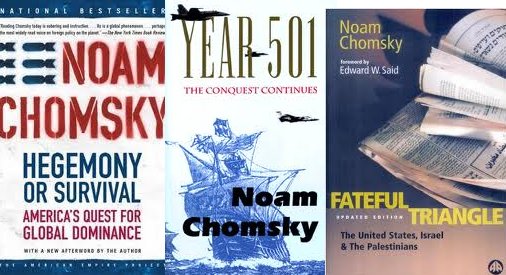
I have read more Chomsky, particularly to understand the Vietnam War but I would single out these four works as being particularly important.
 Howard Zinn is another major figure in my interpretation of history. It was his A People’s History of the United States that really reinforced the idea of history being written by the victor and how important alternate narratives are in understanding history. Out of the rest of his works, I have read War and Terrorism, which I also recommend as it is also very informative and illuminating.
In a similar vein, Major General Smedley Butler‘s work War is a Racket also ranks prominently in my readings of Western History because he simply tells it like it was for him, as a member of the United States Armed forces. His prescient observations are ever more true today.
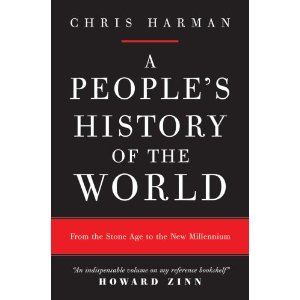 I came upon Chris Harman’s book A People’s History of the World, like Zinn’s work it is a depressingly good read. I have only read it once, but it is coming back into rotation as is a valuable reference and starting point for further historical analysis.
It sits beside my copy of Zinn’s work as part of the spine of my history collection.
A fiery excerpt from one of his speeches.
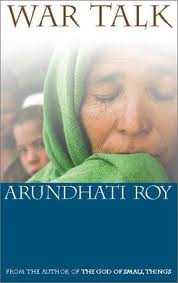 War Talk, An Ordinary Person’s Guide to Empire by Arundhati Roy, and Taraq Ali’s Pirates Of The
 Caribbean: Axis Of Hope (2006), Bush in Babylon (2003), and Clash of Fundamentalisms: Crusades, Jihads and Modernity (2002). Both Roy and Ali provide external analysis of our situation in the West and how we are viewed by the rest of the world. Ali is a powerful speaker and I had the opportunity to listen to him when he came to the University in 2008. His eloquence and arguments made for an evening to remember. External points of view are necessary, but sometimes a homegrown view is necessary to provide more perspective on the important issues of our time.
The Canadian Naomi Klein and her works fits nicely into the puzzle giving a Canadian view of the world as it. I did not enjoy NoLogo very much but found The Shock Doctrine to be a necessary and informative read about how the elites do what they must to rule the world. The Shock Doctrine explains how countries are jolted into submission before neoliberal reforms are forced on them. Again, file under good but depressing reading.
I almost forgot one of the most important works of history that I have read. It is called The Great War for Civilization by Robert Fisk. It is a huge work spanning most of Fisk’s journalistic career. It is history close up, a punch in the nose of a wake up call as for what trouble with Middle East and ‘civilizing influence’ there.
This list is a longer than I first expected, as even after 500 words I have covered only a couple of areas of the literature that informs my view and opinion on the world (in retrospect, probably a good thing). I will cover other areas of my interests in future posts.











 bleatmop
 Mystro
 The Arbourist


 Dead Wild Roses
9 comments
August 16, 2010 at 10:51 am
Vern R. Kaine
Interesting to see your reading list, Arb. I find that with the many “debates” or discussions as we’ve had, it may surprise you that our views are not as polar opposite as one might think.
As a nation and a culture, I do believe we often “bully” other nations and cultures through any number of means. Commercially, through advertising (basically a non-political form of propaganda), Financially through IMF loans and the like, Economically through trade, and sometimes, militarily.
Obviously we have different beliefs on how to correct these things (and perhaps even if they should be corrected), however I find it interesting that our beliefs about what’s actually going on in the world aren’t all that diverse.
Just some thoughts. :)
LikeLike
August 16, 2010 at 11:39 am
The Arbourist
I haven’t hit the Psychology, Science and Math parts of the literature tour yet. A lot of neat stuff still to come. If you have any germinative books that have informed you, please feel free to share them. I’d be interested to the degree of intersectionality we share.
I concur Vern, we are probably not too too far apart, but rather have viewpoints from within the belly of the beast, and from outside of it. Both, in my opinion, are useful ways of looking at and describing the world. I imagine the contrasts in our points of view do stir up thoughts, even if they are thoughts of ‘what utter bullcookery’, better to hash them out and discover new avenues of thought and points of view than let things bounce around in your own echo chamber.
LikeLike
August 16, 2010 at 8:47 pm
Vern R. Kaine
Agreed. I think we’re going to see a real paradigm shift in our culture over the next few years as a result of America’s values being put to the test. I don’t think they’ve ever been so tested all at once.
The economic crisis was a wake-up call where debt could no longer be put off until tomorrow, health care was the same thing, we’ve had a vote (and an unvote) on gay marriage, and now the matter of religious freedom with the proposed 9/11 mosque.
We may just start seeing some new symbols representing the “American Way” than ones we’ve been so familiar with in the past. Having lived on both sides of the border I don’t think it’s hardly as much of a “socialism” shock as some make it out to be, but regardless, I am very interested in seeing how this all plays out. I am curious to see what other people are reading and if they are going beyond the headlines to sources or critical thought that is any deeper.
LikeLike
August 16, 2010 at 8:58 pm
Vern R. Kaine
My “germinative” list starts with Emerson’s essay, “Self Reliance”. It is the one thing that I go back and read on a regular basis. I’ve read “A People’s History”, although it has been a while.
“Confessions of an Economic Hitman”, “The Hydrogen Economy”, and “The Narcissism Epidemic” are some of the books I’ve read recently which I’ve enjoyed and found to be very close to my beliefs of what’s going on in the world with culture, economics, and energy.
Re: where our readings intersect, as an interesting thought experiment I’d recommend grabbing John Kotter’s “Our Iceberg is Melting” if you can. It’s a very quick read, and a “parable”-type book which I’m normally not a fan of, but there are a lot of layers to the story that I think you’ll find intriguing and worthy of discussing at the academic level.
Kotter is Harvard & MIT, and considered North America’s leading expert on Change Management. The book is targeted at companies, but his change model is what I think is best practice for anyone or anything wanting or trying to change – even nations. It would be interesting to see how you and I both draw the parallels from his penguin parable to our respective worldviews; specifically how you and I view change.
LikeLike
August 18, 2010 at 8:25 am
Ben Hoffman
Have you watched Zeitgeist: the Movie? I heard it was interesting. I haven’t had time to watch it yet but there’s a companion guide that I’m going to read this evening.
Click to access Zeitgeist,%20The%20Movie-%20Companion%20Guide%20PDF.pdf
LikeLike
August 18, 2010 at 7:58 pm
Alan Scott
The Arbourist,
If I may be so humble as to comment on the last guy, Mr. Fisk. Like most liberals, the guy is not as smart as he believes himself to be. Send teachers, not soldiers.
How about, send medical teams not soldiers? What about the 10 medical people murdered in Afghanistan? Stupid people get innocent people killed! Mr. Fisk is the worst kind of stupid person, an educated one .
LikeLike
August 19, 2010 at 10:49 am
The Arbourist
Morning Alan,
I believe the bigger point Mr.Fisk was trying to make was that nation building and intervening in the affairs of sovereign states must be done at the pace *they* choose. Using the hammer of military might on the delicate china of diplomatic state to state relations might not be the best first response. Using the military toolbox at the wrong time leads only to the conclusions opposite of the stated Western goals.
As to Mr.Fisk’s intelligence, I suggest you partake in a larger sample of his work, as he is s prolific journalist and writer.
LikeLike
August 19, 2010 at 10:53 am
The Arbourist
I’ve watched the movie. It’s interesting, as I recall it seems to be a little loose in places with facts and the assumptions you can draw from those facts. I liked the part of christianity and how the salient features of the christian mythos are shared with previous religions. I’d have to watch it again as more specific details elude me at the moment.
LikeLike
August 19, 2010 at 8:43 pm
Alan Scott
The Arbourist,
Thank you for the link. I read his article about the American troops leaving Iraq. My opinion of him remains the same. I don’t know which he fits in better with, the Democratic Party during the Bush Presidency or the British Government, circa 1938. That he is prolific as a Journalist and a writer merely confirms my contempt for the current state of biased Journalism.
LikeLike