
 As I am often told by my free market indoctrinated friends the market will solve societies problems, if….(insert the big whingy diatribe about government interfering here) it was just left to its own devices.
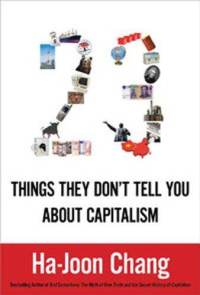
A sample of the pap I usually hear, coherently summarized by Mr.Chang and his book I happen to be reading right now.
“We should leave markets alone, because, essentially, market participants know what they are doing – that is, they are rational. Since individuals (and firms as collections of individuals who share the same interests) have their own best interests in mind and since they know their circumstances best, attempts by outsiders, especially the governement, to restrict freedom of their actions can only produce inferior results. It is presumptuous of any government to prevent market agents from doing things they find profitable or force them to to do things they do not want to do, when it possesses inferior information.
What they don’t tell you…
People do not necessarily know what they are doing, because our ability to comprehend even matters that concern us directly is limited – or, in the jargon, we have “bounded rationality”. The world is very complex and our ability to deal with it is severely limited. Therefore, we need to, and usually do, deliberately restrict our freedom of choice in order to reduce the complexity of the problems we face. Often, government regulation works, especially in complex areas like the modern financial market, not becaues the government has superior knowledge but because it restricts choices and thus the complexity of the problems at hand, thereby reducing the possibility that things may go wrong.”
-Excerpt from 23 Things they don’t tell you about Capitalism – Ha – Joon Chang. pp. 168-169
People always seem to forget that the rational self maximizing actors they talk about in economics text books are merely theoretical constructions and do not figure prominently in the real world. We are neither rational nor do we have complete information when it comes to making economic decisions. Therefore, as Mr. Chang implies government regulation can be a good, even helpful thing, when it comes to market conditions.











 bleatmop
 Mystro


 Dead Wild Roses
9 comments
April 4, 2011 at 9:07 am
Vern R. Kaine
We are neither rational nor do we have complete information when it comes to making economic decisions. Therefore, as Mr. Chang implies government regulation can be a good, even helpful thing, when it comes to market conditions.”
I don’t think there are too many true capitalists who think opposite of what you/Mr. Chang say or believe above. I’d like to meet your “free market indoctrinated friends” who actually believe we have anything close to a free market right now, or if one could really ever exist in this day and age. At any rate, the lack of possibility for one makes their desire for one useless, so I don’t pay those people too much attention.
I think you’ll find that most “real” capitalists are against too much regulation, or regulation that costs a lot and does nothing (see Obama’s “Financial Reform”, for instance, which was sold as a correction to “free market capitalism” yet has done more to fuel the problem than solve it, or the new 1099-MISC rule). Beyond that, once the excessive and ridiculous rules are gone, I think you’ll find that most capitalists really just want to know what the rules are (see the U.S. Tax Code, for instance).
Also, we could substitute the word political for “economic” in the quote above. People who get too hung up on theories and ideologies with their dollar votes as well as their ballot votes are dangerous to both economics and politics no matter which side one happens to be on.
LikeLike
April 4, 2011 at 5:26 pm
Alan Scott
So Central Planning is better than free markets ? Central Planners are free from corruption , political influence, and know more about the complexities of the industries they regulate ? The Central Planners will shut down the widget factory and put workers out of a job when there are too many widgets and there is a cheaper, better widget available ?
LikeLike
April 4, 2011 at 5:56 pm
The Arbourist
So Central Planning is better than free markets ?
The claim you just mentioned was not made. The idea that one end of the spectrum or the other the “correct” mode of economics is supercilious at best and blinding at worst.
States with a different mix of central planning and free markets have done better with regards to the GNP and how they survived the current economic meltdown than Canada and the United States.
In the US, the current mix of planning and free markets is out of balance, but this insight would require you Mr.Scott to acknowledge the fact that for the last 30 years the US has been deregulating and moving further toward the free-market end of the spectrum.
If, you’re liking current inflationary cycle of ever greater bubbles in finance and real estate then staying the course is indeed the choice to embrace.
Here is the thing, might it not be prudent to look to what other countries are doing, who have a different mix to see what is really working (and not working for them) for them and perhaps see what is up that? What would it take to bypass the knee-jerk “my system is the best system no matter what” attitude and just look at what is going in the rest of the world?
This is a good book Mr.Scott, it is accessible and easy to read and understand. Believe me, as I am no expert in economics, but I understood what Mr.Chang had to say.
Is the book about bashing capitalism? No, it is most certainly not, what it does is strip away the “home team” veneer and seriously look at some of the real problems our system is facing. Read the amazon preview and evaluate for yourself whether this is the boogy-man you seem to think it is…
LikeLike
April 4, 2011 at 6:11 pm
The Arbourist
At any rate, the lack of possibility for one makes their desire for one useless, so I don’t pay those people too much attention.
And that is a good thing Vern, but at the same time the people that advocate for the free-market have a certain set of assumptions that do not always reflect reality.
For instance, the free-marketeers make much hay on how dynamic and creative free market systems are and how stifling other systems are. However, when actual indicies of innovation and productivity are referenced countries that have explicitly less “free market” are doing better than countries that have more “free market” policies in place.
This, like many other arguments for the particular vein of free market capitalism, then are often inaccurate and based more on ideology than fact.
Consider the “big government” meme which many conservatives seem to bandy about. As it turns out, more government/bigger government is actually better for a society and business in the long run. But that, substantiated fact, is rarely mentioned over all the erroneous “free-market” noise.
People who get too hung up on theories and ideologies with their dollar votes as well as their ballot votes are dangerous to both economics and politics no matter which side one happens to be on.
I’m gonna read between the lines and guess that people aka me think that my ideological leanings are getting in the way of my view of the capitalism and the free market.
You are fairly familiar to where I stand on the political spectrum and where my preference lays onto what sort of economic overlay politics should dictate to a nation. To be honest I cheered a couple of time while reading this book because I saw arguments that I run into all the time (here in alberta) that do not reflect the truth of how the system is run, but rather the dogma that insists the current version we have is the be all and end all and there is no room for improvement or change.
I think that this book, and I probably will post a few more of the chapter beginning quotes because they do inspire discussion, is very important because it is so critical of our system and it cuts through the “home team/home system” gloss that obscures substantive, necessary debate on how to make our system better for our societies.
LikeLike
April 4, 2011 at 8:30 pm
Vern R. Kaine
“I’m gonna read between the lines and guess that people aka me think that my ideological leanings are getting in the way of my view of the capitalism and the free market.”
Actually, that wasn’t a “between the lines” attack or insinuation at all. (Am I not usually more blunt than that anyways when it is?! :))
I think the argument of either more government or less government is really an argument that boils down to “we’ll see” in the practical sense. That’s society – when we go “left”, we often go too far, and then to correct, we go “right”, and often go too far again. The pendulum continues to swing back and forth and we never seem to get it right for the moment. What works well at a particular point in time seems to be disastrous in others, and even then what we think we’re getting, or what we think we have isn’t really what we actually have.
Take “U.S. Financial Reform” for instance. We demand “Wall Street reform!” and then “Obama Introduces Sweeping Financial Reform” , yet what we actually get is hardly anything and by the time it’s put in place, the crisis has passed and the culture has already shifted. That’s not Obama, that’s just the big, slow beast of government in general.
I think you can argue philosophies or ideologies behind individual cases, but as a whole, I don’t think a philosophy or ideology can fully or actually ever truly apply. Plus, there’s the problem that anyone arguing for one side or the other is always coming from that side and therefore trying to protect it at all costs. Both sides try and argue for what’s “fair” from their perspective, yet both sides deep down know that life isn’t fair, so they grab all they can as quick as they can, and once again the pendulum swings one way or the other.
Call me a pessimist, but I don’t think we’ll ever get past these pendulum swings. So, instead of actually trying to improve the system we’re in as a whole, I think it’s smarter just to better understand the system from both sides so we can better navigate through these pendulum swings as individuals in the meantime.
As a society, the only time I think we will ever do anything to truly “get better” is after a major disaster, which we have no control over. Perhaps a better goal, then, than “making our system better for our societies” might be to instead answer “how do we prepare ourselves in the meantime for the next disaster?” With the next two economic bubbles about to burst, it might be a safer bet for even the most staunch Communist or Socialist to take a more Capitalist approach for the next two years regardless of their politics.
LikeLike
April 5, 2011 at 2:15 am
We are not smart enough to leave things to the Market. (via Dead Wild Roses) « Living on the Left Means I'm in the Right Side of My Mind
[…] As I am often told by my free market indoctrinated friends the market will solve societies problems, if….(insert the big whingy diatribe about government interfering here) it was just left to its own devices. A sample of the pap I usually hear, coherently summarized by Mr.Chang and his book I happen to be reading right now. "We should leave markets alone, because, essentially, market participants know what they are doing – that is, they are rat … Read More […]
LikeLike
April 5, 2011 at 3:53 pm
Alan Scott
The Arbourist ,
You bash capitalism a lot . Granted we are not totally capitalist or regulated . I think you come down heavily on the socialist side . I read a lot of current articles on economics . Probably not what you are familiar with .
Capitalism does tend to blow up periodically . You left wingers always use that as an opening to scrap it . It still generates far better living standards and wealth for it’s citizens than your alternatives .
Also when it does blow up do not pretend there was no regulation . In this latest nightmare there was plenty of it . The problem was the political corruption of the regulators , not the lack of regulators . The problem was the social engineering that the regulators brought to the table . That some capitalists exploited this corruption is not a pox on all capitalists .
LikeLike
April 8, 2011 at 4:32 pm
Alan Scott
Oil just hit $ 112 per barrels . You oil barons in Canada must be happy ? Free market oil . Can’t you give your neighbors south of the border a break ?
LikeLike
April 9, 2011 at 7:53 am
The Arbourist
Given the current conditions Mr.Scott I would give North American’s a break rather than throwing up my hands and saying it is what the market price dictates. Chavez did it for heating oil a few winters back for the US, I cannot see why a similar cross border program cannot be instituted here.
Well, actually I can, a subsidized price for the US would cut into profit. Sorry Alan, no can do. :/
LikeLike