
You are currently browsing the monthly archive for April 2011.
Is this a Craps game we should play?
“The consequences of the Japanese earthquake – especially the ongoing crisis at the Fukushima nuclear power plant – resonate grimly for observers of the American financial crash that precipitated the Great Recession. Both events provide stark lessons about risks, and about how badly markets and societies can manage them.
 Of course, in one sense, there is no comparison between the tragedy of the earthquake – which has left more than 25,000 people dead or missing – and the financial crisis, to which no such acute physical suffering can be attributed. But when it comes to the nuclear meltdown at Fukushima, there is a common theme in the two events.
Experts in both the nuclear and finance industries assured us that new technology had all but eliminated the risk of catastrophe. Events proved them wrong: not only did the risks exist, but their consequences were so enormous that they easily erased all the supposed benefits of the systems that industry leaders promoted.”
The elites who are insulated from many of the problems they cause, continue to promote ideas and systems that are destructive to the people and very societies that allow them to become wealthy.
“Before the Great Recession, America’s economic gurus – from the head of the Federal Reserve to the titans of finance – boasted that we had learned to master risk. “Innovative” financial instruments such as derivatives and credit-default swaps enabled the distribution of risk throughout the economy. We now know that they deluded not only the rest of society, but even themselves.”
Not a bad description of the state of the financial sector in North America these days. Deluded, self-absorbed and self interested individuals dedicated to getting their profits at any cost.
“These wizards of finance, it turned out, didn’t understand the intricacies of risk, let alone the dangers posed by “fat-tail distributions”- a statistical term for rare events with huge consequences, sometimes called “black swans”. Events that were supposed to happen once in a century – or even once in the lifetime of the universe – seemed to happen every ten years. Worse, not only was the frequency of these events vastly underestimated; so was the astronomical damage they would cause – something like the meltdowns that keep dogging the nuclear industry.”
Yep, with less regulation and less government interventions the cycles become even more unstable and prone to catastrophic failure.
“Research in economics and psychology helps us understand why we do such a bad job in managing these risks. We have little empirical basis for judging rare events, so it is difficult to arrive at good estimates. In such circumstances, more than wishful thinking can come into play: we might have few incentives to think hard at all. On the contrary, when others bear the costs of mistakes, the incentives favour self-delusion. A system that socialises losses and privatises gains is doomed to mismanage risk.”
Ah, but socialism for the rich is GOOD. It is what the keeps the country running, it is the heroic investment/business class that is building society… except, while on its never-ending quest for profit, it is actively destroying the fundamental supports and institutions required to keep society running.
“Indeed, the entire financial sector was rife with agency problems and externalities. Ratings agencies had incentives to give good ratings to the high-risk securities produced by the investment banks that were paying them. Mortgage originators bore no consequences for their irresponsibility, and even those who engaged in predatory lending or created and marketed securities that were designed to lose did so in ways that insulated them from civil and criminal prosecution.”
For politicians who preach responsibility, it would seem that the message is only for the poor who have to continually tighten their belts, while the message of irresponsibility aka the status quo, is maintained for the financial sector.
“This brings us to the next question: are there other “black swan” events waiting to happen? Unfortunately, some of the really big risks that we face today are most likely not even rare events. The good news is that such risks can be controlled at little or no cost. The bad news is that doing so faces strong political opposition – for there are people who profit from the status quo.
We have seen two of the big risks in recent years, but have done little to bring them under control. By some accounts, how the last crisis was managed may have increased the risk of a future financial meltdown.”
Oh hey you really screwed up, just keep doing what you’re doing we’ll let the public take care of the herculean pile of debt you amassed while shuffling your paper around. And yet at the same time conservative politicians preach austerity for poor people and deride people on welfare for ‘abusing the system’. The irony is galling.
“Too-big-to fail banks, and the markets in which they participate, now know that they can expect to be bailed out if they get into trouble. As a result of this “moral hazard”, these banks can borrow on favourable terms, giving them a competitive advantage based not on superior performance but on political strength. While some of the excesses in risk-taking have been curbed, predatory lending and unregulated trading in obscure over-the-counter derivatives continue. Incentive structures that encourage excess risk-taking remain virtually unchanged.
So, too, while Germany has shut down its older nuclear reactors, in the US and elsewhere, even plants that have the same flawed design as Fukushima continue to operate. The nuclear industry’s very existence is dependent on hidden public subsidies – costs borne by society in the event of nuclear disaster, as well as the costs of the still-unmanaged disposal of nuclear waste. So much for unfettered capitalism!”
Ah yes, externalities, the Capitalists best friend. See the concept of private profits and public risk…gambling with other peoples money is always so much easier. Given the course of our society, I think a serious reevaluation of the concept of limited liability is in order.
 The American public is starved for actual news. The conservative propaganda mill that masquerades as fox news is the premier example of a society that is becoming insular and uncritical of its policy and place in the world. For a country that purports to value the idea of freedom of speech and the marketplace of ideas, the US certainly seems to define Al-Jazzera outside the acceptable limits of discourse for the public.
“The network has been targeted by the US government since 2003, when former vice president Dick Cheney and former defence secretary Donald Rumsfeld described it as tantamount to an arm of al-Qaeda.
Two of its reporters were later killed in Baghdad when US missiles hit its office. Al Jazeera and others voiced suspicions that the channel’s reporters had been deliberately targeted.
And, to this day, Al Jazeera, which, together with BBC News, has become one of the premier global outlets for serious television news, is virtually impossible to find on televisions in the US.
The country’s major cable and satellite companies refuse to carry it – leaving it with US viewers only in Washington, DC and parts of Ohio and Vermont – despite huge public demand.”
Ah, that must be the market making the correct decision about the needs and wants of its consumers. Or perhaps it is the politics that actually drive the market as a opposed to the cherished notion of supply demand.
“The station’s US push could hardly be more necessary – to Americans. By being denied the right to watch Al Jazeera, Americans are being kept in a bubble, sealed off from the images and narratives that inform the rest of the world. Consider the recent scandal surrounding atrocity photos taken by US soldiers in Afghanistan, which are now available on news outlets, including Al Jazeera, around the globe.
In America, there have been brief summaries of the fact that Der Spiegel has run the story. But the images themselves – even redacted to shield the identities of the victims – have not penetrated the US media stream. And the images are so extraordinarily shocking that failing to show them – along with graphic images of the bombardment of children in Gaza, say, or exit interviews with survivors of Guantanamo – keeps Americans from understanding events that may be as traumatic to others as the trauma of the terrorist attacks of September 11, 2001.”
Not surprising, as the forces of the status-quo do not need inflammatory images stirring up the population. Seeing the actual face of American foreign policy and what it is responsible for might waken the good altruism in the American people and have them demand a stop to the atrocities committed in their name.
“For example, the leading US media outlets, including the New York Times, have not seen fit to mention that one of the photos shows a US soldier holding the head of a dead Afghan civilian as though it were a hunting trophy.
So, for America’s sake, I hope that Al Jazeera penetrates the US media market. Unless Americans see the images and narratives that shape how others see us, the US will not be able to overcome its reputation as the world’s half-blind bully.
Indeed, Egyptians are in some ways now better informed than Americans (and, as Thomas Jefferson often repeated, liberty is not possible without an informed citizenry). Egypt has 30 newspapers and more than 200 television channels.
America’s newspapers are dying, foreign news coverage has been cut to three or four minutes, at most, at the end of one or two evening newscasts, and most of its TV channels are taken up with reality shows.”
The people of America are good decent people, but are purposefully being kept in the dark about what their role in the world is and how their corporations and government are acting internationally.
“Americans have a hunger for international news; it is a myth that we can’t be bothered with the outside world. Maybe Americans will rise up and threaten to boycott their cable and satellite providers unless we get our Al Jazeera – and other carriers of international news.
We would then come one step closer to being part of the larger world – a world that, otherwise, will eventually simply leave us behind.”
Ahh, if only the war on woo was going so well. Relax with Mr.Minchin as he disassembles the irrational in his poetry and bask in his defence of the real and the rational.

Southern Iceland
Banks responsible for their actions? People not wanting Public dollars to repay private investment failures? The people of Iceland got it right unlike our neighbours who throw billions into the private investment arena and then cry poverty when it comes to budget time and suddenly finding the need to cut public programs to ‘balance’ the budget. Iceland though is refusing to play the game.
“Icelanders say citizens should not bail out irresponsible bankers who were blamed for the collapse of the Icesave bank and the loss of hundreds of millions of dollars.”
I wonder if anyone during the referendum said that “Icesave was too big to fail…”
“The debt was incurred when Britain and the Netherlands compensated their nationals who lost savings in online Icesave accounts owned by Landsbanki, one of three Icelandic banks that collapsed in late 2008.
Icelandic lawmakers in February backed the repayment plan agreed with creditors in December, but the president refused to sign the bill, triggering the referendum.
In March 2010, Icelanders rejected an earlier Icesave repayment blueprint in a referendum.”
The will of the people of Iceland should serve as an example to all when it comes to the financial sector and how to deal
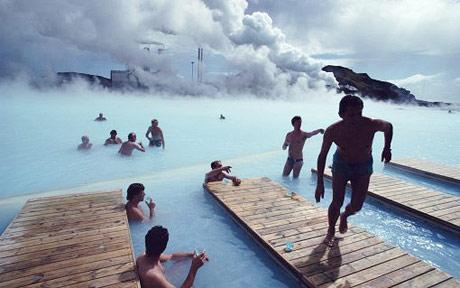
An Icelandic volcanic spa
with the inevitable static produced by the strongmen of the system.
“In a first stage in legal proceedings last year, ESA said that Iceland should pay compensation to Icesave depositors.
Danny Alexander, Britain’s chief secretary to the treasury said on Sunday he was disappointed that Icelanders had again rejected an “Icesave” debt deal.
“It is obviously disappointing that it seems that the people of Iceland have rejected what was a negotiated settlement,” Alexander told BBC television.
“Of course we respect the will of the Icelandic people in this matter and we are going to have to now go and talk to the international partners with whom we work, not least the government of the Netherlands.
“It now looks like this process will end up in the courts,” he said.”
The people of Iceland have a point, why should they shoulder the burden of a private company that made bad business decisions? The idea of privatizing the profit and leaving the risk to the public clearly has no currency in Iceland.
“I know this will probably hurt us internationally, but it is worth taking a stand,” Thorgerdun Asgeirsdottir, a 28-year-old barista said after casting a “no” vote at the Reykjavik city hall.
Svanhvit Ingibergs, 33, who works at a rest home, said: “I had no part in causing those debts, and I don’t want our children to risk having to pay them. It would be better to settle this in a court.”
The dispute over repayment has soured relations between the small North Atlantic island nation and the two other countries.”
Hopefully the courts will rule with the people on this one and in this case the financial sector will not be repaid for its avarice and foolhardy behaviour.
Observe the chilling conclusions when you start believing in magic and fairy tales.
The religious often have the notion that somehow they are favoured and they are special because they believe in a particular brand of religious horseshit. This particular belief once examined, leaves only the smell behind.

Submergible bird sanctuary reporting for duty!
The Canadian Navy is silly.
The questionable purchase of four submarines from the British in 1998 is still haunting our humble navy.
“In the year 2010 alone, the Canadian navy spent $45 million on repairs to HMCS Windsor. It had budgeted to spend just $17 million, the documents show.
It appears that every system on the British-built submarine has major problems, according to the documents, including bad welds in the hull, broken torpedo tubes, a faulty rudder and tiles on the side of the sub that continually fall off.”
One would think that if, when buying a new vehicle, one would check to see if you could actually steer it. Apparently a radical notion back in the heady 1990’s.
There is an upside, the birds seem to looooove our submarines!
“Because the submarine has been in drydock in Halifax for so long, it has become a bird sanctuary. The navy spent thousands of dollars just trying to keep the pigeons from roosting in the vessel.”
Imagine the changing of the submarine guard with all the regal and pomp of any important military, tourists flock to see the changing of the pigeon patrol and the handing over of the air horns and .22’s. If this regal spectacle is not on your eastern Canadian trip itinerary you are missing out. “But what about the torpedoes Arb?” says my gentle readership. I’m getting there, be patient the stage needs to be set to fully appreciate the magnitude of how far the Canadian navy is willing to piss up this particular rope.
“The country’s stock of second-hand submarines – already beleaguered with repairs and upgrades — is incapable of firing the MK-48 torpedoes they currently own.
When Canada purchased its current fleet of four submarines from Britain in 1998, they were fitted for British torpedoes. At the time, Canada was heavily invested with the modern MK-48 torpedo system and did not want to abandon it.
Like any shopper trying to justify a second-hand purchase in the face of an obstacle, they figured it was still a good deal. They “Canadianized” the submarines, but, 13 year later, they still haven’t got around to the “weaponization” part.
“The Canadian Forces has always intended for the Victoria Class submarines to carry and fire the Mark 48 torpedo,” wrote Denise LaViolette, the director of navy public affairs, in an email. “Initial weapons certification will be progressed early in 2012 in HMCS Victoria for Pacific operations followed that year by HMCS Windsor for Atlantic operations.”
It is like buying a car without a windshield for highway driving. The splatty-stingy bug impacts of common sense have no effect on our heroic Navy highway-driver, damn the windscreen we need to upgrade the tires! No torpedoes AND submarines that regularly catch on fire, sounds like a good idea upgrade them further:
“In late March, Canadians discovered their government has been cross-border window shopping for 36 “Torpedo Conversion Kits” when the U.S. Defense Security Cooperation Agency issued a release. These kits come with spare parts and logistical support to upgrade the current stock of MK-48 torpedoes from Mod 4 to Mod 7. The estimated cost is $125 million, but the sale hasn’t been completed yet.”
While our benevolent conservative government pleads poverty and belt tightening they spend like drunken sailors on torpedoes we can’t fire on submarines that are better suited to be bird sanctuaries than actual naval vessels.
Just the first movement in today’s classical music interlude and unfortunately Smalin has not encoded it into his visual performance program. Bells and whistles aside, the majesty of Brahms work shines through and he takes you into his musical fortress demanding only your attention for his stately vision to work its magic.
Brahms began composing his first symphony in 1854, but much of his work underwent radical changes.[2] The long gestation of the symphony may be attributed to two factors. First, Brahms’ self-critical fastidiousness led him to destroy many of his early works. Second, there was an expectation from Brahms’ friends and the public that he would continue “Beethoven’s inheritance” and produce a symphony of commensurate dignity and intellectual scope—an expectation that Brahms felt he could not fulfill easily in view of the monumental reputation of Beethoven.
The value and importance of Brahms’ achievements were recognized by Vienna‘s most powerful critic, the staunch conservative Eduard Hanslick.[2] The conductor Hans von Bülow was moved in 1877 to call the symphony “Beethoven’s Tenth“, due to perceived similarities between the work and various compositions of Beethoven.[3] It is often remarked that there is a strong resemblance between the main theme of the finale of Brahms’ First Symphony and the main theme of the finale of Beethoven’s Ninth Symphony. Also, Brahms uses the rhythm of the “fate” motto from the opening of Beethoven’s Fifth Symphony. This rather annoyed Brahms; he felt that this amounted to accusations of plagiarism, whereas he saw his use of Beethoven’s idiom in this symphony as an act of conscious homage. Brahms himself said, when comment was made on the similarity with Beethoven, “any ass can see that.”[4] Nevertheless, this work is still often referred to as “Beethoven’s Tenth”.[5] However, Brahms’ horn theme, with the “fate” rhythm, was noted in a letter to Clara Schumann (dated 1868), overheard in an alphorn‘s playing.[6]











 bleatmop
 Mystro
 The Arbourist


 Dead Wild Roses
Your opinions…