
You are currently browsing the daily archive for August 9, 2025.
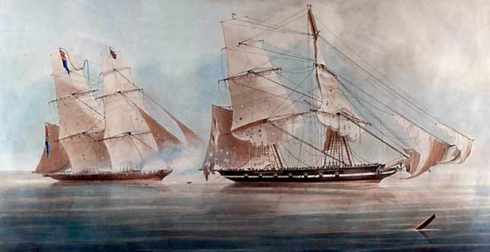
The British Empire, for all its flaws, wielded its vast influence as a decisive instrument in dismantling the global scourge of slavery—a system that violated human dignity on a global scale. By the late 18th century, Britain’s economic and naval dominance positioned it uniquely to challenge the transatlantic slave trade, which it had once profited from immensely. The 1807 Slave Trade Act, driven by relentless abolitionist campaigns from figures like William Wilberforce and Thomas Clarkson, outlawed the trade across the empire, striking a blow at the economic arteries of slavery.1 This was no mere moral posturing: Britain’s West Africa Squadron, deployed from 1808, patrolled the Atlantic, intercepting slave ships and liberating over 150,000 enslaved Africans by 1860.2 Yet the squadron’s operations were not without contradiction—many of the “liberated” were later conscripted into naval service or settled in British colonies under paternalistic regimes.
Behind these legislative shifts stood a groundswell of popular activism—thousands of petitions, boycotts of slave-grown sugar, and the mobilization of dissenting religious groups, particularly the Quakers. As J.R. Oldfield has shown, Britain’s anti-slavery effort marked one of the earliest examples of coordinated mass politics in a liberal democracy.3 This popular moral awakening fueled legislative change but faced resistance from powerful interests, particularly in the colonies. The 1833 Slavery Abolition Act, which emancipated nearly 800,000 enslaved people across British territories, was a monumental step, but it came with caveats—planters were compensated handsomely, while freed individuals received no reparations and faced exploitative “apprenticeship” systems.4 Abolition, in this context, was less a moral epiphany than a negotiated dismantling of a profitable institution.
Britain’s abolitionist zeal extended outward, forcing other nations—such as France, Spain, and Brazil—to curtail their own slave trades through a combination of treaties, naval pressure, and economic leverage. The 1841 Quintuple Treaty bound several major European powers to suppress the transatlantic trade, demonstrating Britain’s capacity to turn moral authority into diplomatic influence.5 This was less about universal brotherhood than about asserting moral and geopolitical superiority over rivals. At home and abroad, Britain leveraged its economic clout—offering trade incentives or threatening sanctions—to coerce reluctant powers into compliance.
However, abolition did not signal the end of coerced labor; rather, it marked a transition to new forms of economic exploitation. Indentured labor, particularly from India and China, was recruited under harsh conditions and deployed across the empire to fuel plantation economies. Critics have rightly argued that this was “a new system of slavery” in all but name, replicating colonial hierarchies under the guise of freedom.6
The British Empire’s crusade against slavery, while imperfect, reshaped the global moral landscape, proving that imperial might could be harnessed for transformative ends. Its abolitionist policies rippled across the Americas, Africa, and beyond, hastening the decline of legalized slavery worldwide. By the mid-19th century, the empire’s relentless naval patrols and diplomatic arm-twisting had rendered the transatlantic trade increasingly untenable. Yet this legacy is no hagiography: Britain’s earlier profiteering from slavery and its post-abolition labor practices expose a hypocrisy that tempers its triumphs. Nonetheless, the empire’s unparalleled capacity to enforce change—through law, force, and influence—demonstrates a singular truth: no other power of the era could have so decisively tilted the scales against a centuries-old institution. The British Empire, for better or worse, was the fulcrum on which the global fight against slavery pivoted.
Footnotes
- Drescher, Seymour. Abolition: A History of Slavery and Antislavery. Cambridge University Press, 2009. https://www.cambridge.org/core/books/abolition/9780521606592 ↩
- “The West Africa Squadron.” The National Archives, UK. https://www.nationalarchives.gov.uk/education/resources/atlantic-world/west-africa-squadron/ ↩
- Oldfield, J.R. Popular Politics and British Anti-Slavery: The Mobilisation of Public Opinion against the Slave Trade, 1787–1807. Manchester University Press, 1995. https://manchester.universitypressscholarship.com/view/10.7228/manchester/9780719038570.001.0001/upso-9780719038570 ↩
- “Slavery Abolition Act 1833.” UK Parliament. https://www.parliament.uk/about/living-heritage/transformingsociety/tradeindustry/slavetrade/ ↩
- Huzzey, Richard. Freedom Burning: Anti-Slavery and Empire in Victorian Britain. Cornell University Press, 2012. https://www.cornellpress.cornell.edu/book/9780801451089/freedom-burning/ ↩
- Tinker, Hugh. A New System of Slavery: The Export of Indian Labour Overseas 1830–1920. Oxford University Press, 1974. https://global.oup.com/academic/product/a-new-system-of-slavery-9780195600749 ↩











 bleatmop
 Mystro


 Dead Wild Roses
Your opinions…