
You are currently browsing the monthly archive for December 2025.
The blog Dead Wild Roses (deadwildroses.com), authored by The Arbourist (who also runs the associated X account
@TheArbourist), can be characterized politically as gender-critical radical feminist with roots in traditional left-wing politics but a significant evolution toward critiquing modern progressive or “woke” ideologies.
It is not easily pinned to conventional left-right spectra, as it combines elements that might appear contradictory at first glance but are coherent within a specific feminist framework.
Origins and Evolution: The blog began around 2009–2012 as a broadly leftist platform: skeptical of religion, critical of conservatism and crony capitalism, supportive of social democratic ideas, and aligned with second-wave feminist principles emphasizing women’s liberation from patriarchy. Early content often featured critiques of religious dogma, pro-choice advocacy, anti-capitalist commentary, and classical music interludes alongside political posts.
Over time—particularly from the mid-2010s onward—the focus shifted sharply toward gender-critical feminism (often labeled “TERF” by critics, a term the blog rejects as a slur). This involves strong opposition to gender ideology, queer theory, transgender activism (especially regarding women’s spaces, sports, prisons, and youth medical transitions), and what the author calls “postmodern fluff” or identity politics excesses. Recent posts criticize “woke extremism,” compelled speech laws, DEI initiatives, and policies like British Columbia’s reconciliation efforts or hate speech bills as authoritarian overreach.
Current Political Stance
- Feminist Core: Radical feminist, prioritizing sex-based rights for women and girls. It defends single-sex spaces, opposes self-ID policies, and highlights issues like female erasure in language/institutions.
- Anti-“Woke” Left: Fiercely critical of contemporary progressive movements (e.g., trans-inclusive feminism, queer theory, intersectionality when it prioritizes gender identity over sex). The author sees these as betraying women’s rights and aligning with patriarchal or neoliberal interests.
- Free Speech and Anti-Authoritarianism: Strong defense of free expression, criticism of cancel culture, and opposition to what it views as state-enforced ideological conformity (e.g., hate speech laws, compelled apologies).
- Residual Left Elements: Occasional critiques of conservatism, capitalism, or religious fundamentalism persist, but the dominant tone is now combative toward the mainstream left.
- Not Right-Wing: Despite overlapping with conservative concerns on gender issues, the blog explicitly distances itself from right-wing politics and has historically opposed it.
Politically, this aligns with a growing cohort of “politically homeless” gender-critical leftists (similar to figures like J.K. Rowling or some detransitioner advocates) who feel exiled from progressive spaces but reject conservatism. The X bio (“Canadian barefoot dissident. Slaying gender ideology and postmodern fluff. Pro-merit, pro-naps, pro-Stoic vibes”) reinforces this: anti-ideological dogma, merit-based, individualistic.
Pursuit of Truth Perspective:
From a centrist, truth-seeking viewpoint valuing evidence over ideology: The blog’s strength lies in its willingness to challenge prevailing narratives in progressive circles, often citing sources like the WPATH files, detransition stories, or critiques of queer theory to argue positions with references to biology, statistics, and historical feminism. This evolutionary shift appears driven by principled disagreement rather than opportunism—the author has reflected on it openly.
However, the tone is often sharply polemical (“vituperation optional” in the blog description), which can prioritize rhetorical combat over nuanced dialogue. Some arguments frame opponents in stark terms (e.g., “authoritarian drift,” “ideological dissolution”), potentially echoing ideological rigidity from the other side.
It represents one side of a polarized debate on gender, substantiated by selected evidence but not always engaging counterarguments comprehensively.
Overall, if you’re a centrist prioritizing truth, the blog offers a valuable counter-narrative to dominant progressive views on gender, grounded in a feminist tradition that emphasizes material reality (sex over identity).
It’s worth reading critically, alongside diverse sources, to weigh the claims against broader evidence.
Thanks Grok, we’ll see what comes in the New Year. :)
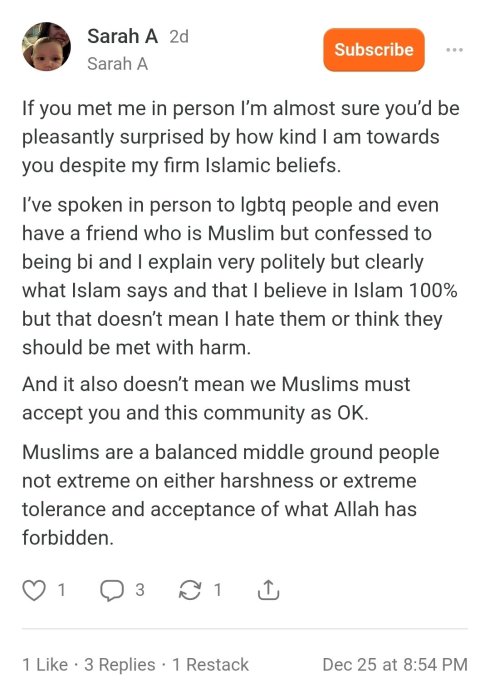
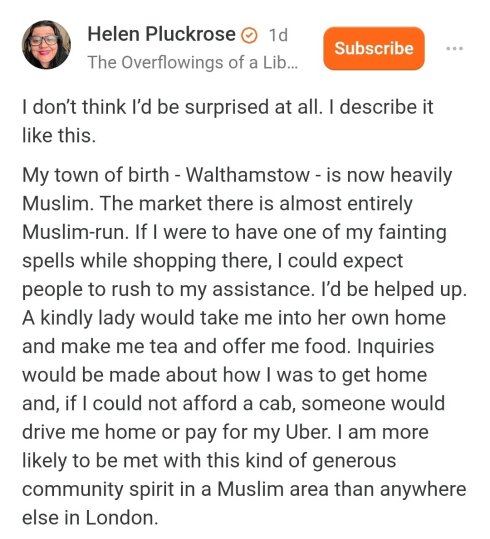
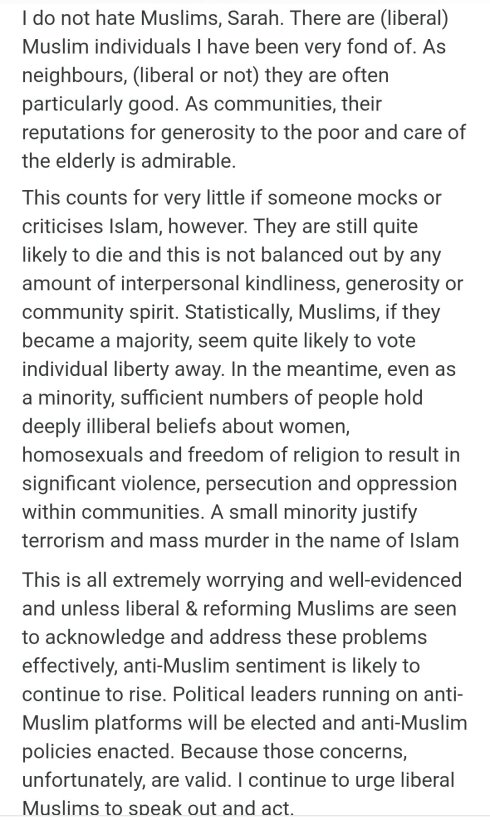
In a thoughtful exchange highlighted by James Lindsay, liberal writer Helen Pluckrose responds to a Muslim commenter who shares personal experiences of generosity within Muslim communities. While warmly acknowledging the kindness and charity she’s witnessed among individual Muslims, Pluckrose firmly points out the broader issue: widespread support in some Muslim populations for Sharia-based views that endorse severe punishments—including violence or death—for apostasy, homosexuality, adultery, and blasphemy. She argues that ignoring these illiberal attitudes, backed by polling data, risks fueling unnecessary backlash against Muslims while failing to address genuine incompatibilities with Western liberal values.

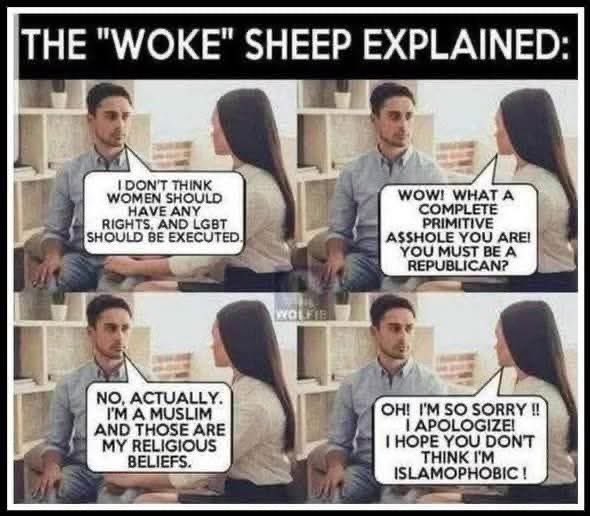
The meme is considered “fairly accurate” by critics of progressive politics because it captures a perceived double standard: while left-leaning activists routinely and aggressively condemn anti-LGBTQ+ views among Christians (e.g., evangelical opposition to same-sex marriage), they often hesitate to apply the same scrutiny to similar or stronger opposition within Muslim communities, instead framing such criticism as Islamophobic or culturally insensitive.
Surveys consistently show that Muslims, particularly in Europe and Muslim-majority countries, hold more conservative attitudes toward homosexuality than the general Western population—often viewing it as morally unacceptable due to religious interpretations—yet progressive voices tend to prioritize anti-Islamophobia efforts, sometimes downplaying or excusing these views under cultural relativism or minority protection. This selective outrage, observers argue, reflects a hierarchy of sensitivities where fear of racism accusations trumps consistent advocacy for LGBTQ+ rights, allowing illiberal positions to persist unchallenged in one context while being fiercely opposed in another.
For most of my adult life, I identified as left-of-centre. I supported progressive policies on social issues, the environment, and equality. But over the past few years—especially now, at 51—I’ve found myself increasingly out of step with parts of the contemporary left. Not because my values changed, but because many of the policies being pushed today feel more disruptive than constructive. They often reshape core institutions, family structures, or economic systems without clear evidence that the changes will work long-term.
This isn’t a turn toward extremism. I still care deeply about compassion, fairness, and progress. What has changed is my tolerance for sweeping experimentation without rigorous testing. I want policy that is incremental, evidence-based, and willing to adjust when data shows something isn’t working. That’s not ideology—it’s responsibility.Seeking evidence-driven solutions isn’t inherently “right-wing.” Both sides claim to follow the data, but in practice, good policy should transcend labels. Historically, Canadian conservatism has often embodied this approach: balanced budgets, stable institutions, and pragmatic reforms that build on what already works rather than tearing systems down in pursuit of unproven theories.
Yet critics are quick to slap on labels like “Maple MAGA”—a term meant to equate any Canadian centre-right view with the most polarizing elements of U.S. Trumpism. It’s a lazy shortcut, designed to shut down conversation rather than understand it. Not every conservative is a populist firebrand. Many people—myself included—are simply tired of rapid, ideologically driven changes that risk destabilizing society without demonstrating clear benefits.
I’m not closed off. If strong evidence emerges showing that bold progressive policies genuinely improve stability, opportunity, and quality of life, I’m willing to reconsider. But right now, I see more promise in cautious, proven approaches that respect the complexity of the systems we’re trying to improve.
What about you? Have your views shifted as you’ve gained more life experience? I’m interested in real dialogue: no smears, no lazy labels, and no assumptions that a shift in perspective means abandoning core values.

To all of my friends and followers I wish you the most merry of holiday times. May the long nights be filled with warm blankets, hot chocolate, and holiday cheer. Thank you for your time and engagement here at DWR I appreciate your comments and contributions to the blog.
Bach’s Mass in B minor BWV 232 needs no introduction. It is “The Mass” that stands above all sacred works. I present it here in full realized by the Netherlands Bach Society.
May the Mass take you where you need to go to pause and reflect on this time year.
Happy Holidays, Folks! Take care of yourselves.
The Arbourist
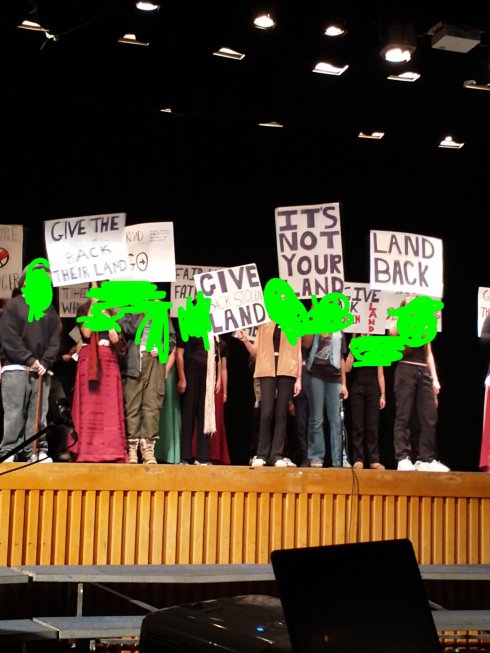
In recent years, Canadian public schools have increasingly incorporated political themes into extracurricular events, including winter concerts. A widely discussed example occurred at Karen Kain School of the Arts in Toronto, where Grade 8 students performed a skit during a December “winter concert” featuring protest‑style signs such as “Give Back Stolen Land” and “Land Back.” The performance replaced traditional seasonal programming with messaging aligned with the contemporary “Land Back” movement. While the intent may have been to highlight Indigenous history, the choice of format and venue raises important questions about the appropriate boundaries between education and activism in publicly funded schools.
To evaluate this incident fairly, it is essential to distinguish between curricular education—which is mandated, necessary, and valuable—and extracurricular political advocacy, which carries different expectations and responsibilities.
Ontario’s curriculum explicitly requires students to learn about Indigenous histories, treaties, residential schools, and the Truth and Reconciliation Commission’s Calls to Action. These topics are not optional; they are embedded in the Social Studies and History curriculum for Grades 1–8. Teaching them is not activism—it is education grounded in historical fact and national responsibility. When taught in the classroom, these subjects can be explored with nuance, context, and opportunities for critical thinking.
The issue at Karen Kain is not the subject matter itself, but the format and framing. A winter concert is traditionally a community‑building event: inclusive, celebratory, and accessible to families of all backgrounds. Parents attend expecting music, dance, or drama that reflects seasonal themes or showcases student creativity. Transforming such an event into a protest‑style performance shifts the purpose from celebration to advocacy. It also removes the pedagogical safeguards—balanced discussion, guided inquiry, and contextual explanation—that exist in the classroom.
The “Land Back” movement, while rooted in legitimate discussions about Indigenous rights and historical treaties, is also a politically contested movement with a wide range of interpretations and significant implications for land ownership, governance, and public policy. Presenting it through slogans and protest imagery, without space for analysis or alternative perspectives, risks conveying a single ideological stance rather than fostering informed understanding. For 13‑ and 14‑year‑old students, who are still developing the ability to evaluate complex political claims, this can blur the line between learning about a movement and being encouraged to endorse it.
This concern is not hypothetical. Surveys consistently show that many Canadian parents prefer schools to avoid pushing students toward political activism, even on causes they personally support. Parents generally want schools to prioritize academic learning, critical thinking, and balanced instruction rather than advocacy. When extracurricular events adopt activist framing, it can erode trust by making families feel blindsided or excluded from decisions about what messages their children are asked to perform publicly.
None of this means schools should avoid difficult topics or silence discussions of Indigenous rights. On the contrary, these subjects deserve thoughtful, rigorous treatment. But context matters. A winter concert is not the venue for dramatizing contested political movements. Doing so risks reducing complex issues to slogans, bypassing critical engagement, and placing students in the role of political actors rather than learners.
A healthier approach would preserve the distinction between education and advocacy. Teach Indigenous history thoroughly in the classroom, as the curriculum requires. Encourage students to analyze movements like Land Back with intellectual seriousness. But keep extracurricular performances focused on inclusive, community‑oriented themes that unite rather than divide.
By maintaining this boundary, schools can honour both their educational mission and their responsibility to provide neutral, welcoming environments for all families—ensuring that learning remains grounded in inquiry, not activism, and that public events remain spaces of shared celebration rather than ideological theatre.
References
Original Incident and Reporting
Pfahl, Chanel (@ChanLPfa). “A parent at the Toronto District School Board sent me these pictures from the ‘Winter Concert’…” X (formerly Twitter), 18 Dec. 2025. https://x.com/ChanLPfa/status/2001719861723173203
“Toronto Grade 8 students stage ‘Land Back’ protest at school ‘winter concert’.” Juno News, 19 Dec. 2025. https://www.junonews.com/p/toronto-grade-8-students-stage-land
Ontario Curriculum Requirements
Ontario Ministry of Education. “Indigenous Education in Ontario.” Government of Ontario, updated 2 Sept. 2025. https://www.ontario.ca/page/indigenous-education-ontario
“Indigenous history, culture now mandatory part of Ontario curriculum.” CBC News, 8 Nov. 2017. https://www.cbc.ca/news/indigenous/indigenous-history-culture-mandatory-ontario-curriculum-1.4393527
Context on the “Land Back” Movement
“The Indigenous ‘Land Back’ Movement: A Land Mine for Canadians.” C2C Journal, 28 Oct. 2024. https://c2cjournal.ca/2024/10/the-indigenous-land-back-movement-a-land-mine-for-canadians/
Parental Attitudes Toward Activism in Schools
Zwaagstra, Michael, and Alex MacPherson. “Canadian parents don’t want schools to push students into political activism.” Fraser Institute, 2024. https://www.fraserinstitute.org/commentary/canadian-parents-dont-want-schools-to-push-students-into-political-activism
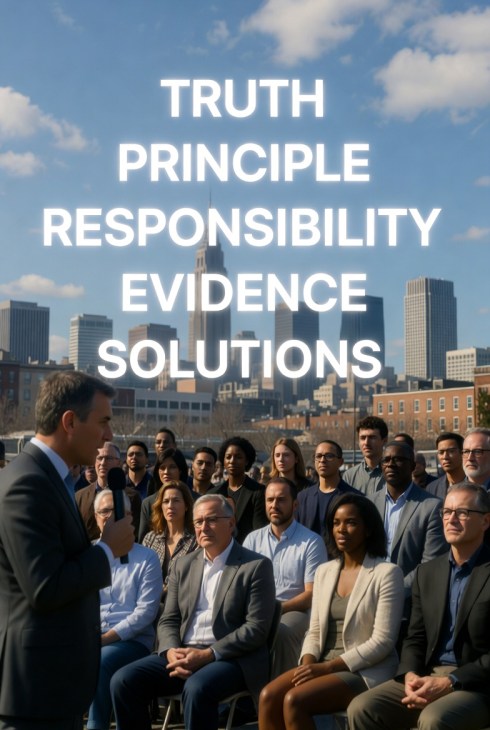
To speak publicly about politics is to shape how people understand the world. That power is a privilege—and a civic responsibility. A public voice can clarify or distort, empower or demoralize, elevate or degrade. Too many voices in today’s public square choose the latter, trading integrity for attention or tribal loyalty. The only antidote is a higher standard: one demanded by audiences and upheld by those who choose to speak.Anyone who steps into the political arena owes their audience five core duties.
- Truth
The first duty is truth—plain, direct, and unvarnished. Truth requires more than avoiding lies; it demands clarity. Deliberate vagueness, selective omission, and euphemistic fog are forms of manipulation. They create suspicion without resolution and leave audiences less informed than before.
A responsible speaker illuminates. They do not hide the ball, blur the edges, or gesture toward implications they refuse to own. Truth is the foundation on which every other duty rests. - Principle Over Personal Feeling
Public speech must be anchored in principle, not personal loyalty or emotional comfort. Friendship with a public figure who behaves badly is not a shield against accountability. Silence in the name of loyalty is complicity.
This duty is difficult—because it asks us to prioritize values over relationships, and integrity over tribe. But politics is not a social club. It is the arena where ideas shape real lives. If we sacrifice principle for personal feeling, we betray the very people we claim to serve. - Responsibility for the Platform
A platform is not a megaphone; it is an editorial choice. Anyone who invites a guest, amplifies a voice, or endorses a narrative is responsible for that decision.
This means asking real, truth-seeking questions, being transparent about agreement or disagreement, acknowledging when a promoted voice proves flawed, and refusing to hide behind “I’m just giving them a platform.”
Public speakers are not neutral conduits. They are curators. And curation carries moral weight. - Evidence
Claims require evidence. Not vibes, not insinuation, not “just asking questions.” Evidence.
In a fragmented information landscape, audiences are already overwhelmed by speculation and outrage. A responsible speaker cuts through the noise by grounding arguments in verifiable facts. Evidence-based inquiry is not the enemy of passion—it is what gives passion legitimacy.
Without evidence, rhetoric becomes manipulation. With evidence, it becomes persuasion. - Solutions and Agency
The final duty is to offer solutions—real ones, grounded in reality. Telling people that everything is rigged or hopeless may generate clicks, but it destroys agency. A population convinced that nothing is within their control will stop trying to improve anything at all.
Responsible voices do the opposite. They show paths forward. They encourage personal responsibility. They foster hope rooted in action, not fantasy. They remind people that while the world is imperfect, it is not immovable.
Solutions are not about optimism; they are about empowerment.
The Standard We Should Demand
These duties are not optional. They are the price of admission for anyone who chooses to influence public understanding. Frauds and opportunists thrive by exploiting fear, tribalism, and cynicism. They will continue to do so until audiences refuse to reward them—and until speakers commit to something better.
When we insist on truth, principle, responsibility, evidence, and agency, we build a healthier public square. Not a perfect one, but a stronger one—one capable of sustaining a free society.











 bleatmop
 Mystro
 The Arbourist


 Dead Wild Roses
Your opinions…