
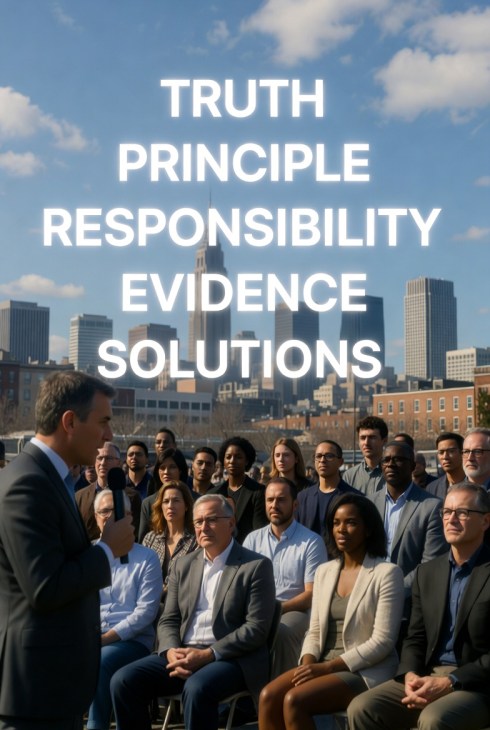
To speak publicly about politics is to shape how people understand the world. That power is a privilege—and a civic responsibility. A public voice can clarify or distort, empower or demoralize, elevate or degrade. Too many voices in today’s public square choose the latter, trading integrity for attention or tribal loyalty. The only antidote is a higher standard: one demanded by audiences and upheld by those who choose to speak.Anyone who steps into the political arena owes their audience five core duties.
- Truth
The first duty is truth—plain, direct, and unvarnished. Truth requires more than avoiding lies; it demands clarity. Deliberate vagueness, selective omission, and euphemistic fog are forms of manipulation. They create suspicion without resolution and leave audiences less informed than before.
A responsible speaker illuminates. They do not hide the ball, blur the edges, or gesture toward implications they refuse to own. Truth is the foundation on which every other duty rests. - Principle Over Personal Feeling
Public speech must be anchored in principle, not personal loyalty or emotional comfort. Friendship with a public figure who behaves badly is not a shield against accountability. Silence in the name of loyalty is complicity.
This duty is difficult—because it asks us to prioritize values over relationships, and integrity over tribe. But politics is not a social club. It is the arena where ideas shape real lives. If we sacrifice principle for personal feeling, we betray the very people we claim to serve. - Responsibility for the Platform
A platform is not a megaphone; it is an editorial choice. Anyone who invites a guest, amplifies a voice, or endorses a narrative is responsible for that decision.
This means asking real, truth-seeking questions, being transparent about agreement or disagreement, acknowledging when a promoted voice proves flawed, and refusing to hide behind “I’m just giving them a platform.”
Public speakers are not neutral conduits. They are curators. And curation carries moral weight. - Evidence
Claims require evidence. Not vibes, not insinuation, not “just asking questions.” Evidence.
In a fragmented information landscape, audiences are already overwhelmed by speculation and outrage. A responsible speaker cuts through the noise by grounding arguments in verifiable facts. Evidence-based inquiry is not the enemy of passion—it is what gives passion legitimacy.
Without evidence, rhetoric becomes manipulation. With evidence, it becomes persuasion. - Solutions and Agency
The final duty is to offer solutions—real ones, grounded in reality. Telling people that everything is rigged or hopeless may generate clicks, but it destroys agency. A population convinced that nothing is within their control will stop trying to improve anything at all.
Responsible voices do the opposite. They show paths forward. They encourage personal responsibility. They foster hope rooted in action, not fantasy. They remind people that while the world is imperfect, it is not immovable.
Solutions are not about optimism; they are about empowerment.
The Standard We Should Demand
These duties are not optional. They are the price of admission for anyone who chooses to influence public understanding. Frauds and opportunists thrive by exploiting fear, tribalism, and cynicism. They will continue to do so until audiences refuse to reward them—and until speakers commit to something better.
When we insist on truth, principle, responsibility, evidence, and agency, we build a healthier public square. Not a perfect one, but a stronger one—one capable of sustaining a free society.











 bleatmop
 Mystro


 Dead Wild Roses
2 comments
Comments feed for this article
December 23, 2025 at 12:35 pm
Paul S. Graham
For the most part, these are worthwhile standards that ought to apply to anyone who participates in a discussion – public or otherwise. No. 5 – offering solutions – seems a bit unrealistic. Often the solutions are not obvious to the commentator, even one offering solid analysis. In these situations, a more realistic approach would be to admit that the speaker does not have any solutions to offer, and/or to ask the audience for its suggestions.
LikeLiked by 1 person
December 23, 2025 at 12:41 pm
windupmyskirt
We should demand the same from religious institutions.
LikeLiked by 1 person