
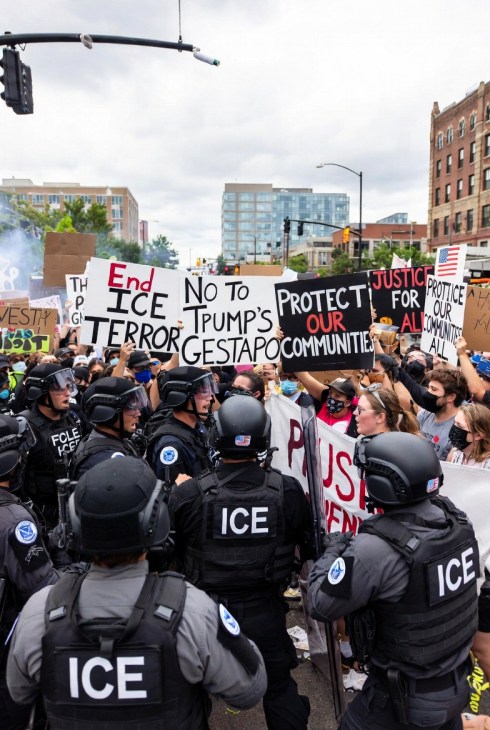
In his January 16, 2026 X post, James Lindsay treats the “ICE is Trump’s Gestapo” line as more than overheated language. He reads it as a political technique: a framing move that aims to provoke escalation, polarize interpretation, and sap legitimacy from federal immigration enforcement by making every subsequent clash look like retroactive confirmation.
Even if you don’t accept the strongest version of his claim (that it is centrally orchestrated), the underlying mechanism is worth taking seriously—because it doesn’t require orchestration to work. It requires an audience that consumes politics in fragments, and a media ecosystem that pays for heat.
The point of media literacy here is not to pick a side. It is to recognize when you are being handed a frame that’s designed to steer your moral conclusion before you are allowed to know what happened.
The loop, reduced to mechanics
The escalation loop has four moves.
1) Load the moral frame early.
“Gestapo” is not an argument. It is a verdict. It tells the audience what they are seeing before they see it. It collapses a contested enforcement dispute into a single image: secret police.
2) Convert observation into resistance.
Once people believe they’re facing secret police, ordinary scrutiny becomes morally charged. Disruption can be reframed as defense. Escalatory behavior becomes easier to justify, especially in crowds, especially on camera.
3) Force a response that looks like the frame.
As tension rises, agents harden posture: more crowd-control readiness, more force protection, more aggressive containment. Some of that may be lawful, and some may be excessive; the loop does not depend on the fine print. It depends on optics.
4) Circulate optics as proof.
Clips win. Captions win. The most provocative 15 seconds becomes “what happened,” for millions who will never read a court filing. The frame spreads because the frame is legible in low context.
Frame → friction → hardened posture → optics → reinforced frame. Repeat.
Notice what’s missing: slow adjudication of facts. The loop thrives on speed. It preys on low-context attention.
Why Minnesota is an instructive case
Minnesota matters here because the escalation loop is visible across multiple lanes at once: street-level conflict, political rhetoric, and rapid legal constraint.
Recent reporting describes the Department of Homeland Security deploying nearly 3,000 immigration agents into the Minneapolis–St. Paul area amid intense protests and public backlash. In that environment, a fatal shooting—Renée Good, shot by an ICE agent on January 7, 2026—became a catalytic event for further demonstrations and scrutiny.
Then the conflict moved into procedural warfare. On January 17, a federal judge issued an injunction restricting immigration agents from detaining or using force (including tear gas or pepper spray) against peaceful protesters and observers absent reasonable suspicion of criminal activity. That order is narrow, but it is not trivial: it codifies a boundary in exactly the arena where optics are most easily weaponized.
The rhetorical layer matters too. DHS has publicly condemned Minnesota Governor Tim Walz for using “modern-day Gestapo” language about ICE (and the White House has amplified that criticism). Whatever you think of the underlying enforcement operation, this is the accelerant: the label that turns complexity into a single moral picture.
If you want a single media-literacy takeaway from Minnesota, it’s this: the escalation loop often ends up constraining policy through courts and procedure, not merely through street confrontation. Once the story becomes “secret police,” legal process itself becomes part of the narrative battlefield—injunctions and motions become content, and content becomes legitimacy.
“Low information public” is the wrong diagnosis
“Low information” is typically used as a sneer. The sharper term is low context.
Most people aren’t stupid; they’re busy. They consume politics the way they consume weather: by glance. They get fragments, and fragments invite frames.
The “Gestapo” label works on low-context audiences because it is:
- Instantly moralized: villain and victim are assigned immediately.
- Highly visual: it primes the brain to interpret normal enforcement cues (gear, urgency, crowd control) as secret-police signals.
- Clip-native: it fits perfectly into captions and short video, where emotional clarity beats evidentiary completeness.
- Correction-resistant: anyone who says “slow down” can be painted as defending tyranny.
This is the real vulnerability narrative warfare exploits: not ignorance, but context starvation.
The key analytical distinction: intent vs incentives
Here’s where writers often lose credibility: they jump from “this pattern exists” to “this was orchestrated.”
Sometimes there is coordination. Often there isn’t. And you typically don’t need it to explain outcomes.
Shared incentives can produce coordinated-looking behavior without a central planner:
- Outrage frames mobilize attention.
- Attention produces fundraising, followers, and headlines.
- Headlines pressure officials and constrain institutions.
- Institutions respond in ways that produce more outrage footage.
That is enough.
The media action depends on showing a self-reinforcing system: rhetoric that increases confrontation risk, confrontation that increases hardened posture, posture that increases “secret police” plausibility to spectators.
That is media literacy: the ability to separate “this felt true on my feed” from “this is true in the world.”
How to defuse the loop
Defusing the escalation loop means starving it of inputs. That requires two fronts: institutional discipline and citizen discipline.
What institutions can do
1) Treat optics as a real constraint (not PR garnish).
In a clip-driven environment, unnecessary spectacle is narrative fuel. If tactics can be lawful and less visually coercive, the second option is often the strategically sane one.
2) Over-communicate rules, thresholds, and remedies.
Explain what triggers stops, detentions, and uses of force; explain complaint pathways; publish policy boundaries. If courts are drawing bright lines around peaceful protest and observation, those lines should become part of the public-facing doctrine, not buried in litigation.
3) Correct fast and publicly when mistakes occur.
Silence functions as permission for the loudest interpretation to win. Delay is a gift to the escalation loop.
4) Avoid “timing that reads like punishment.”
Even lawful actions can look retaliatory if they cluster around protests. In narrative warfare, timing becomes motive in the audience’s mind.
What readers can do
1) Treat moral super-labels as a stop sign.
When you see “Gestapo,” “fascist,” “terrorist,” “insurrection,” assume you’re being pushed into a conclusion. Slow down.
2) Refuse clip capture.
Ask: what happened thirty seconds before this clip starts? If you can’t answer, you’re watching a weaponized excerpt.
3) Use a two-source minimum.
One source gives you mood. A second source often provides the missing constraint—timeline, legal posture, or what is actually being alleged. The injunction’s specific limits, for example, are precisely the kind of detail clips rarely include.
4) Separate event, legality, and morality.
“This happened” is not “this was lawful,” and neither is “this was tyranny.” Narrative warfare succeeds by collapsing those categories into one reflex.
5) Ask what behavior the story is trying to elicit.
Is it trying to make you understand, or to make you react—share, donate, show up, escalate? That question alone breaks many spells.
Where this ends if we don’t learn
If the escalation loop runs unchecked, politics becomes performance for low-context consumption. Enforcement becomes optics. Protest becomes optics. Courts become props. Everyone plays to the camera because legitimacy is increasingly adjudicated there.
The antidote isn’t bland neutrality. It’s refusing to let a frame do your thinking for you—especially one engineered to convert fragments into certainty.
That’s what media literacy looks like now: not knowing everything, but knowing when you’re being steered.
“When a word arrives preloaded with a verdict, your job is to slow the tape.”
References
- James Lindsay, X post (January 16, 2026), “ICE is Trump’s Gestapo” narrative thread. (X (formerly Twitter))
- Reuters (January 17, 2026), report on federal judge’s injunction limiting immigration agents’ tactics toward peaceful protesters/observers in Minneapolis–St. Paul; includes mention of DHS deploying nearly 3,000 agents and context following Renée Good’s death. (Reuters)
- Associated Press (January 17, 2026), coverage of the same injunction and the lawsuit context, including limits on detentions and crowd-control measures against peaceful protesters/observers. (AP News)
- ABC News (January 14, 2026), background reporting confirming Renée Good was fatally shot by an ICE agent on January 7, 2026 and noting an FBI probe. (ABC News)
- U.S. Department of Homeland Security (May 19, 2025), DHS statement criticizing Gov. Tim Walz’s “modern-day Gestapo” language about ICE (useful for documenting the rhetoric’s public circulation). (Department of Homeland Security)
- White House (January 2026), article compiling public statements about ICE and “modern-day Gestapo” language (useful as an example of administration amplification rather than a neutral factual source). (whitehouse.gov)











 bleatmop
 Mystro
 The Arbourist


 Dead Wild Roses
5 comments
Comments feed for this article
January 20, 2026 at 8:30 am
Carmen
To think that this man, Arb, used to be an advocate for downtrodden, marginalized women.
So disturbing to read this, a ‘word salad’ if I’ve ever read one.
Sigh. .
LikeLike
January 20, 2026 at 8:32 am
Carmen
To think that Arb used to be an advocate for women. . . Sigh. . .
LikeLike
January 20, 2026 at 8:42 am
tildeb
The weaponized use of narrative over inquiry was revealed in all its glory during the Floyd coverage: a journalist on camera (I think CNN) with burning buildings in the background reporting, “mostly peaceful rioting and looting.” Umm…
LikeLike
January 20, 2026 at 8:44 am
tildeb
Carmen, why do you think Arb is no longer an advocate for downtrodden, marginalized women?
LikeLike
January 20, 2026 at 8:47 am
The Arbourist
@Carmen
Hi Carmen, you seem a little judgemental today.
“To think that this man, Arb, used to be an advocate for downtrodden, marginalized women.”
I still am, and still do. I’m not really sure where this is coming from, but the conclusions you seem to be jumping to are patently false.
Did you want to engage with the actual issue the post is addressing?
Hope your day gets better, take care.
LikeLike