
Jean Piaget is still worth reading because he blocks a common adult mistake: treating children’s words as if they carry adult concepts. Children do not merely know fewer facts. They use different cognitive tools at different ages, and those tools change what their categories can mean. That matters whenever adults take a child’s self-label and translate it into a fixed inner essence. Piaget’s basic warning is simple: the same vocabulary can sit on top of a different kind of understanding, and adults are very good at smuggling their own meanings into what a child says. The rest of his theory is an attempt to explain why that translation error is so easy to make.
Piaget’s machinery for explaining the gap is spare and still useful. Children build schemas, mental frameworks for understanding objects, actions, and categories. They update those schemas through assimilation, which fits new experience into an existing framework, and accommodation, which changes the framework when the fit fails. The friction between “make it fit” and “change the model” is not a bug. It is the engine. Piaget calls the longer-term settling of that friction equilibration, the push toward a workable balance where the child’s model of the world holds together and predicts better.
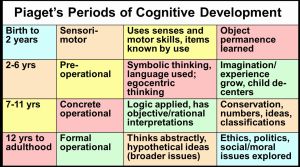
Piaget is best known for his four-stage outline. In the sensorimotor stage (birth to about 2), infants learn through perception and action, and one classic milestone is object permanence, the idea that things still exist when out of sight. In the preoperational stage (about 2 to 7), children gain symbolic thought: language, pretend play, mental imagery. They also show characteristic limits on many tasks, including egocentrism in perspective-taking and failures of conservation (for example, thinking a taller glass has “more” of the same liquid).
Those limits are real, but they are not always as simple as “the child cannot do it.” Modern researchers have shown that the timing can shift when you change the method. Studies using “violation-of-expectation” designs often find signs of earlier object knowledge than Piaget’s original search tasks detected. The clean takeaway is not that Piaget collapses. It is that measurement matters. Some tasks load children with extra demands (motor planning, inhibition, working memory) that can hide understanding that is present in a simpler form. Task demands can mask competence.
In the concrete operational stage (about 7 to 11), children become capable of logical operations tied to tangible situations. Conservation stabilizes, classification becomes more systematic, and seriation appears more reliably, as when a child can order sticks from shortest to tallest without guesswork. In formal operational thought (roughly adolescence onward, and unevenly across people and domains), abstract and hypothetical reasoning becomes more consistent. Even here, performance can be uneven across closely related tasks, a pattern discussed under the label horizontal décalage. That unevenness is a warning against treating stages as rigid ceilings. Read them instead as a map of typical reorganizations in thinking: a useful guide to what changes, and when, without pretending every child hits every milestone on the same schedule. The practical payoff is blunt. When adults treat a child’s words as adult-level commitments, they risk importing meanings the child has not yet built.
Glossary
- Schema: A mental framework for organizing and interpreting experience.
- Assimilation: Fitting new experience into an existing schema.
- Accommodation: Modifying a schema when the old one does not fit.
- Equilibration: The balancing process that restores or maintains cognitive stability through assimilation and accommodation.
- Object permanence: Understanding that objects continue to exist when hidden.
- Conservation: Understanding that quantity stays the same despite changes in appearance if nothing is added or removed.
- Horizontal décalage: Uneven mastery across related tasks; competence does not arrive all at once.
Endnotes
- Encyclopedia Britannica — Piaget overview: stages, age ranges, and constructivist framing.
- APA Dictionary of Psychology — Piagetian terms: schema, assimilation, accommodation.
- APA Dictionary of Psychology — “Equilibration” definition.
- Baillargeon, Spelke & Wasserman (1985) — early object knowledge via violation-of-expectation methods (PubMed record and related materials).
- Lourenço (2016) — stages as conceptual tools/heuristics (ScienceDirect).
- Neo-Piagetian review discussing horizontal décalage and unevenness as a complication for strict stage-uniformity (UCL Press journals).











 bleatmop
 Mystro


 Dead Wild Roses
Leave a comment
Comments feed for this article