
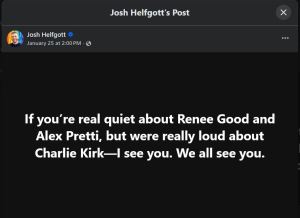
A meme slid past my feed this week that’s basically a whole comment section compressed into one sentence:
“If you’re real quiet about Renée Good and Alex Pretti, but were really loud about Charlie Kirk—I see you. We all see you.”
You can feel what it’s trying to do. It’s not asking a question. It’s issuing a verdict — and inviting the crowd to clap. 👀
Before we get moral about it (or defensive about it), it helps to name what’s happening. This kind of meme is a conversational device. It’s a way of sorting people into “clean” and “suspect” without having to do the slow work of inquiry.
This post isn’t about denying hypocrisy exists. Selective empathy is real. It’s ugly. It’s also common — across every tribe that’s ever existed. The point here is narrower:
When we treat silence as proof of motive, we stop talking about what’s true and start talking about who’s safe.
And once the conversation becomes “who’s safe,” facts arrive late and leave early.
What the meme is actually doing
That one sentence performs four moves:
- An observable claim: “Some people were loud about X and quiet about Y.”
- A measurement dodge: “Loud” and “quiet” are undefined (posts? news coverage? your feed? my feed?).
- A motive leap: The difference is taken as evidence of moral defect.
- A social threat: “I see you. We all see you.” = reputational enforcement.
In other words: it skips the checkable part (#1) and jumps straight to the morally satisfying part (#3), backed by a crowd (#4).
If you want conversation instead of sorting, you reverse the order: connect → define → test → then (carefully) infer.
The best one-sentence reply is not a rebuttal
Before you ask any questions, you lower the temperature:
“All political violence and unjust killing is wrong. If selective empathy is happening, I agree it’s worth confronting.”
That sentence does two things: it refuses the tribal frame, and it makes your questions sound like inquiry rather than evasion.
Make the meme’s claim testable
Here are the three questions that turn heat into light:
- “When you say loud vs quiet, what counts as loud/quiet?”
- “Do you mean the same individuals, or the general vibe of your feed?”
- “On a 0–10, how sure are you it’s the same people — and what gets you to that number?”
If the conversation can’t answer those, it isn’t actually about truth. It’s about loyalty.
“Real conversations” in action (composites)
What follows are composites — not quotes — written to sound like the kinds of exchanges that reliably show up under posts like this. The point is not to win. The point is to keep two minds in the same room long enough to examine certainty.
Conversation A: The public comment (low bandwidth, high heat)
Them: “If you were loud about Kirk but quiet now, you’re telling on yourself.”
You: “I hear the frustration. Selective empathy is real, and it’s corrosive.”
Them: “Exactly. People only care about their team.”
You: “Can I ask one clarifying question — when you say ‘quiet’ and ‘loud,’ do you mean the same individuals, or the general vibe of your feed?”
Them: “Same individuals.”
You: “On a 0–10, how sure are you it’s the same individuals?”
Them: “Nine.”
You: “What gets you to 9?”
Them: “I saw them post about Kirk immediately.”
You: “Okay. What would move you to an 8? Would it matter if some of them simply never saw the other story, or didn’t know enough yet to comment?”
Them: “Maybe, but come on.”
You: “Fair. I’m not denying hypocrisy exists. I’m trying to separate ‘didn’t see / didn’t know’ from ‘doesn’t care.’ If we’re going to accuse motives, I want it to land on something we can actually verify.”
Notice the move: you don’t “defend the quiet.” You ask whether the accusation is evidence-based or feed-based.
Conversation B: The DM (relationship context)
Friend: “I’m sick of fake empathy.”
You: “I get that. Can I ask what you want to happen with a post like this — reflection, apology, pressure, unfriending?”
Friend: “I want people to admit they’re biased.”
You: “Okay. On a 0–10, how sure are you it’s bias rather than attention/algorithm/people being afraid to say the wrong thing?”
Friend: “Nine.”
You: “What’s the strongest thing that puts it at 9?”
Friend: “They posted about Kirk instantly.”
You: “That’s a real data point. Would you be willing to test one person you mean? If they genuinely didn’t see the other story, would you want to know that before concluding motive?”
Friend: “…Yeah.”
You: “That’s all I’m guarding: one small door for ‘maybe there’s another explanation’ before we turn silence into a moral indictment.”
This is the “impossible conversations” pivot: from verdict to conditions for revising certainty.
Conversation C: The trap (“You were loud about Kirk”)
Them: “Funny you’re talking now. You were loud about Kirk.”
You: “Fair question. What are you inferring from that?”
Them: “That your empathy is tribal.”
You: “I don’t want that to be true. My honest answer is: the Kirk story saturated my feed, so I reacted fast. I saw the other story later.”
Them: “Convenient.”
You: “Maybe. So let’s test it. If you saw me condemn violence consistently across cases, would that move your certainty down even one point?”
Them: “Possibly.”
You: “Then we’re not stuck. And I’ll take the lesson too: I should be slower to mind-read others, because I don’t want it done to me.”
You decline the moral cage match and offer a falsifiable check: consistency over time.
The hidden leap: silence equals motive
The meme’s real power comes from a hidden assumption: silence proves character.
Sometimes silence is cowardice. Sometimes it’s indifference. Sometimes it’s ignorance. Sometimes it’s grief in private. Sometimes it’s uncertainty. Sometimes it’s algorithmic — people genuinely did not see what you saw.
If you want to accuse motives, you can. But if you want to persuade people who don’t already agree with you, you need to do the hard part first: define what you’re measuring, and test whether your inference survives alternative explanations.
A few clarifications before the comments do what comments do
- “So you’re saying hypocrisy isn’t real?” No. I’m saying hypocrisy accusations land harder when they’re grounded rather than assumed.
- “So you’re saying violence isn’t political?” No. I’m saying political interpretation isn’t a substitute for checking claims.
- “So you’re tone-policing?” No. I’m trying to keep inquiry alive when the conversation is about to be sealed shut.
- “So this is manipulation?” Only if you use it to stall forever. The point is mutual standards and one testable claim. If we can’t do that, we exit.
Suggested reading
- How to Have Impossible Conversations — the toolkit behind the “connection → certainty → one claim” pattern
- The Righteous Mind — why moral intuitions lead and reasoning follows
- Mistakes Were Made (But Not by Me) — why doubling down feels like integrity
- Never Split the Difference — practical emotional-safety tactics
- How Minds Change — what actually shifts belief over time











 bleatmop
 Mystro


 Dead Wild Roses
Leave a comment
Comments feed for this article