
Iran, American Hegemony, and Western Resolve.
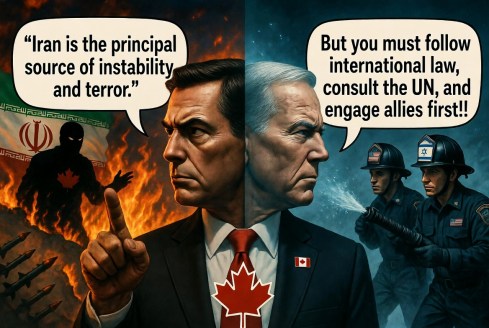
For years, Iran has functioned not as a normal state with normal ambitions, but as a regime that exports pressure through proxies, intimidation, missile programs, and calibrated disorder. Ottawa itself has repeatedly described Iran as “the principal source of instability and terror in the Middle East,” while stressing that Tehran must never be allowed to obtain or develop nuclear weapons. That matters because it cuts through the usual fog. This was not a strike against a harmless status quo. It was a strike against a regime that has spent years making the region more combustible, more violent, and more difficult to govern. (Canada PM)
That does not make war clean. It does not make every target choice wise. It does not make every legal question disappear. But it does clarify the strategic question. If a regime repeatedly funds, arms, and directs forces that destabilize the region, then eventually someone must decide whether deterrence is a word or a policy. The American and Israeli action in Iran is best understood in those terms. Not as a fantasy of moral purity, but as a decision to reimpose costs on a state that had grown used to exporting them. Ottawa’s own language makes that case harder to evade than many critics would like. (Canada PM)
This is the part many Western governments still struggle to say plainly. Order is not maintained by sentiment alone. It is not maintained by declarations, concern, and another exhausted appeal to “the international community.” Canada’s March 3 statement admitted the core reality: years of negotiations, sanctions, international monitoring, and multilateral pressure did not neutralize the Iranian threat. That is a brutal admission, and an important one. It means the soft-language consensus failed on its own stated terms. At some point, if the threat remains, either somebody acts or the speeches become a form of theatre performed over a steadily deteriorating map. (Canada PM)
“American hegemony, however much the word offends refined opinion, has often been the hard outer shell of a wider Western order.”
So yes, there is a case for saying the strikes were good in strategic terms. Iran was not a stabilizing power that got misunderstood by the usual Western moralists. It was a revolutionary regime that helped build and sustain a network of armed clients and auxiliaries across the region. Striking at that centre of gravity carries risks, but so did allowing it to operate under the assumption that the West had become too managerial, too conflict-averse, and too morally confused to act decisively. The risk of action is real. The risk of permanent indulgence was real too, and too often treated as invisible. (Canada PM)
That is why this moment matters beyond Iran. Not because one campaign settles the world. Not because every adversary will instantly become cautious. But because power still communicates. It communicates especially to regimes that have spent years studying the West and concluding that we prefer procedure to force, messaging to punishment, and managed humiliation to escalation. The lesson of Iran may not be that America will always act. It is simpler and more important than that: America still can act, and under some conditions still will. Even the White House’s preferred language of “peace through strength” matters less here as slogan than as signal. Adversaries do not have to admire the wording to understand the demonstration. (Canada PM)
That broader message is where China enters the discussion, but only carefully. It would be too strong, and probably false, to say Beijing has “backed down” because of Iran. Reuters reporting on Chinese military activity around Taiwan points to a narrower and more ambiguous picture: visible Chinese air activity around Taiwan has fallen sharply, but Taiwanese officials and analysts offered multiple possible explanations, including a possible Trump-Xi meeting atmosphere and internal turbulence inside China’s military. They explicitly warned against reading too much into a short lull. So the honest claim is not that China has folded. It is that Beijing is being reminded, in public, that the United States still possesses both the means and, at times, the appetite to use hard power. That is an inference. It is not yet a proved geopolitical shift. (Reuters)
The January Venezuela raid helps make that point, though only in a limited sense. Reuters reported that U.S. officials explicitly framed the operation as a warning to Beijing to keep its distance from the Americas. That does not prove deterrence has been restored, and it does not establish a new global pattern on its own. It does show that the message was sent. In Venezuela and now Iran, Washington has demonstrated that recent American power has not been purely rhetorical. Rivals may draw their own conclusions, but they are being given fresh evidence that the United States still possesses both the means and, at times, the appetite to use hard force. (Reuters)
And that matters because American hegemony, however much the word offends refined opinion, has served for decades as the hard outer shell of a wider Western order. It has not produced a perfect world. It has produced something rarer: a world in which hostile powers, rogue regimes, and ambitious revisionists often had to think twice. That “think twice” space is not everything, but it is a great deal. Lose it, and you do not get peace. You get more tests, more probes, more daring clients, more rulers gambling that the old sheriff now prefers seminars to force. The language may rankle. The reality remains. (Reuters)
“Ottawa could identify the arsonist, but still felt compelled to lecture the firefighters on process before the building stopped burning.”
And then there is Canada, performing once again its favourite late-imperial routine: saying the truest thing in the room and then rushing to blur it. On March 3, Carney said Iran is the principal source of instability and terror in the Middle East and condemned Iranian violence against civilians. On March 4, he also stressed that the United States and Israel acted without engaging the United Nations or consulting allies, including Canada, and reaffirmed that international law binds all belligerents. In other words, Ottawa could identify the arsonist, but still felt compelled to lecture the firefighters on process before the building stopped burning. (Canada PM)
That is the embarrassment. Not caution as such. Caution can be prudent. The embarrassment is the inability to rank moral and strategic realities in the right order. A serious government can say: Iran is the principal destabilizing force, diplomacy failed, the strikes carry grave risks, and the next task is preventing a wider regional catastrophe. That would at least sound like an adult hierarchy of judgment. What we got instead was a familiar Canadian blend of partial clarity and procedural recoil, as if sounding too decisive might itself be a diplomatic offence. (Canada PM)
The deeper issue is civilizational confidence. A West that cannot impose costs on regimes that menace its allies, fuel regional disorder, and exploit every sign of hesitation will not be admired for its restraint. It will be read as tired. The value of American hegemony, whatever its flaws, has never been that it creates a frictionless world. It is that it has often underwritten a world in which enemies of the West had reason to fear miscalculation. That fear is not barbarism. It is one of the costs of preserving order. Remove it, and you do not get a more humane international system. You get a more predatory one. (Canada PM)
So the case for the strikes is not that war is noble or that consequences will be tidy. It is that deterrence sometimes has to become visible again. Iran built power by betting that the West preferred delay to decision. In this case, that bet was answered with force. Even America’s enemies, and Canada’s evasive political class, may have been reminded of something they had started to forget: strength still speaks, and sometimes it is the only language a revolutionary regime believes. (Canada PM)
References
Prime Minister of Canada. “Statement by Prime Minister Carney on the evolving situation in the Middle East.” March 3, 2026.
Prime Minister of Canada. “Prime Minister Carney delivers remarks to media in Sydney, Australia.” March 4, 2026.
Reuters. “Chinese military flights around Taiwan fall, Trump-Xi meeting may be factor.” March 5, 2026.
Reuters. “With Venezuela raid, US tells China to keep away from the Americas.” January 11, 2026.











 bleatmop
 Mystro


 Dead Wild Roses
5 comments
Comments feed for this article
March 8, 2026 at 9:11 am
Steve Ruis
Re “That does not make war clean. It does not make every target choice wise. It does not make every legal question disappear. But it does clarify the strategic question. If a regime repeatedly funds, arms, and directs forces that destabilize the region, then eventually someone must decide whether deterrence is a word or a policy. The American and Israeli action in Iran is best understood in those terms.”
You are kidding right? As to “If a regime repeatedly funds, arms, and directs forces that destabilize the region …” you are referring to the U.S., no?
As to “someone” it is now clear that Israel pressured the U.S. into joining them in their warmongering.
US officials stated clearly that Iran was not on the verge of creating a nuclear weapon. They also agreed that Iran was not on the verge of attacking either the U.S. or Israel. But now they can … out of self-defense.
So, both Israel and the U.S. violate international law because “someone must decide whether deterrence is a word or a policy?”
I hope you have “thoughts and prayers” prepared for Israel, because being an ally of the U.S. doesn’t always turn out so well. Iran’s strategy is to blind the opposition (by taking out radars around the region), then use inexpensive missiles to exhaust the supplies of anti-missile defenses and then pound the shit out of both Israel and US bases. Even if it does not work in its entire, this strategy is paying dividends. “Allies” of the U.S. in the region are already questioning that role as the U.S. is unable to protect them or their bases on their land from the missile barrages. Qatar, for example, has about a week’s worth of food left as almost all of it was shipped through the Straight of Hormuz.
None of this was necessary and it is turning out to be a big gamble, so do you trust Trump to have thought it through? I don’t.
LikeLike
March 8, 2026 at 9:13 am
tildeb
CSIS reported to Trudeau Jr’s government that they were aware of over 700 IRGC ‘assets’ in Canada involved in everything from fund raising to money laundering, assassinations to disappearances of Iranian government critics. The RCMP has not only done nothing but has actively interfered with US investigations into this threat and Canadian legislation and courts have facilitated this capitulation to theocratic fascism using Canada as the most friendly western nation to Middle East Islamic death cults. Part of that funding has been successfully used to turn our youth into foot soldiers of the regime. Just look at demonstrations and encampments and student capture. This is the grey war we’ve been losing for 30 years, meaning western citizens work tirelessly undermining their own systems of incompatible principles. It’s not a mystery that Chinese, Indian, cartel, Hezbollah, Hamas, Muslim Brotherhood work in tandem. In OPEN cooperation in Canada. In LEGAL cooperation. And we presume that the US is going to ‘respect’ Canada as a close ally? Seriously? This is delusional thinking of the worst kind when we see the US step up and put their military where their mouths are and – one at a time – dismantle the capabilities and influence of these obvious enemies… most notably China’s attempt at global hegemony with public support by Carney (in so many ways) but in this case about using the yuan over the dollar. We stand aside at our peril because the US has demonstrating to every Middle East power that it is a more than capable ally when its strategic interests are at stake. In comparison, Iran has demonstrated that the Chinese, Russians, and themselves cannot be trusted to be the same level of capable and strong ally as the US. Canadians need to wake the fuck up to reality and either get onboard the US’ foreign policy as a stalwart ally or understand why we will become roadkill of our own stupidity.
LikeLike
March 8, 2026 at 9:17 am
tildeb
To Steve: I wrote, “This is the grey war we’ve been losing for 30 years, meaning western citizens work tirelessly undermining their own systems of incompatible principles.”
One has to (or at least should) ask one’s self: am I a part of helping or hindering this grey war against the west?
LikeLiked by 1 person
March 8, 2026 at 11:10 am
The Arbourist
I think you raise two fair points. First, the legal justification is contested, and I don’t think that should be brushed aside. Second, skepticism about Trump’s judgment is entirely reasonable.
Where I disagree is in the move from those points to the claim that Iran was therefore not a serious strategic threat, or that the U.S. and Iran are somehow equivalent regional actors. They are not. Iran has spent years backing proxies and exporting instability, and even Ottawa has described it as the principal source of instability and terror in the Middle East.
It is also important to distinguish between “not actively assembling a warhead right now” and “not posing a grave nuclear or regional threat.” The IAEA found Iran in breach of its non-proliferation obligations, and its enrichment program had advanced to a level that plainly exceeded any normal civilian explanation. That does not prove imminence. It does mean the danger was not invented.
So my argument is not that legality no longer matters, or that every strike was wise, or that escalation risks are trivial. It is narrower than that: a regime can be both a real destabilizing force and the beneficiary of years of failed diplomacy; and once that is true, the deterrence question becomes real whether we like it or not. You can still conclude the strikes were a bad gamble. But that is a different argument from pretending there was no strategic problem to deter in the first place.
LikeLike
March 8, 2026 at 11:18 am
The Arbourist
@tildeb
I think some of the Canadian media has really done us a disservice as far as equipping Canadians with some of the basic facts of the world. There are, out there in the real world, regimes that do not give one iota for human rights, due process, and freedom of speech and movement. To think that they will somehow ‘come around’ and see the light or behave nicely when strong words are spoken against them is well – folly.
It is dangerous notion to hold while still under the hegemonic protection of the United States. Canada’s recent flip flop as per the OP and embrace of communist authoritarian China is proof positive that Canadians are not firmly connected to the geopolitical reality we share, whether we like it or not.
The two-tier policing of radical groups, as you mentioned, is just another example of the willful societal and institutional blindness we are presently suffering through.
Canada, needs to give its head a shake and return to a sane set of values that prioritize reality, unity, and transparent fact-based governance. The sooner the better.
LikeLike