
You are currently browsing the category archive for the ‘Atheism’ category.
This small clip features Hitchens at his best, dismantling the arguments of Christian apologists and believers with his acerbic wit and argumentation. Consider the horrible implications of the all knowing, all seeing, all father. I for one reject the tyrannical celestial dictatorship and the misanthropic beliefs it spawns.
What? No religious tomfoolery to debunk and slam? Even the practiced old hands here at DWR need a break from the usual turkeyshoot of specious religious arguments that get passed off as ‘debate’ these days. In that light, I present this article from Alternet that attempts to give us non believers some categories to feel happy in. If you spot anything missing, feel free to proclaim so in the comment section.
 1. Atheist. The term atheist can be defined literally as lacking a humanoid god concept, but historically it means one of two things. Positive atheism asserts that a personal supreme being does not exist. Negative atheism simply asserts a lack of belief in such a deity. It is possible be a positive atheist about the Christian God, for example, while maintaining a stance of negative atheism or even uncertainty on the question of a more abstract deity like a “prime mover.” In the United States, it is important to know that atheist may be the most reviled label for a godless person. Devout believers use it as a slur and many assume an atheist has no moral core. Until recently calling oneself an atheist was an act of defiance. That appears to be changing. With the rise of the “New Atheists” and the recent atheist visibility movement, the term is losing its edge.
2. Anti-theist. When atheist consistently evoked images of Madeline Murray O’Hare, hostility toward religion was assumed. Now that it may evoke a white-haired grandmother at the Unitarian church or the gay kid on Glee, some people want a term that more clearly conveys their opposition to the whole religious enterprise. The term anti-theist says, “I think religion is harmful.” It also implies some form of activism that goes beyond merely advocating church-state separation or science education. Anti-theism challenges the legitimacy of faith as a moral authority or way of knowing. Anti-theists often work to expose harms caused in the name of God like stonings, gay bating, religious child maltreatment, genital mutilation, unwanted childbearing or black-collar crime. The New Atheist writers including Christopher Hitchens and Richard Dawkins might better be described as anti-theists.
3. Agnostic. Some atheists think of agnostic as a weenie term, because it gets used by people who lack a god-concept but don’t want to offend family members or colleagues. Agnostic doesn’t convey the same sense of confrontation or defiance that atheist can, and so it gets used as a bridge. But in reality, the term agnostic represents a range of intellectual positions that have important substance in their own right and can be independent of atheism. Strong agnosticism views God’s existence as unknowable, permanently and to all people. Weak agnosticism can mean simply “I don’t know if there is a God,” or “We collectively don’t know if there is a God but we might find out in the future.” Alternately, the term agnosticism can be used to describe an approach to knowledge, somewhat like skepticism (which comes next in this list). Philosopher Thomas Huxley illustrates this position:
Agnosticism is not a creed but a method, the essence of which lies in the vigorous application of a single principle… Positively the principle may be expressed as ‘in matters of intellect, do not pretend conclusions are certain that are not demonstrated or demonstrable.’
These three definitions of agnosticism, though different, all focus on what we do or can know, rather than on whether God exists. This means it is possible to be both atheist and agnostic. Author Phillip Pullman has described himself as both.
The question of what term to use is a difficult one, in strict terms I suppose I’m an agnostic because of course the circle of the things I do know is vastly smaller than the things I don’t know about out there in the darkness somewhere maybe there is a God. But among all the things I do know in this world I see no evidence of a God whatsoever and everybody who claims to know there is a God seems to use that as an excuse for exercising power over other people, and historically as we know from looking at the history in Europe alone that’s involved persecution, massacre, slaughter on an industrial scale, it’s a shocking prospect.
4. Skeptic. Traditionally, skeptic has been used to describe a person who doubts received religious dogmas. However, while agnostic focuses on God questions in particular, the term skeptic expresses a broader life approach. Someone who calls him- or herself a skeptic has put critical thinking at the heart of the matter. Well known skeptics, like Michael Shermer, Penn and Teller, or James Randi devote a majority of their effort to debunking pseudoscience, alternative medicine, astrology and so forth. They broadly challenge the human tendency to believe things on insufficient evidence. Australian comic Tim Minchen is an outspoken atheist who earns a living in part by poking fun at religion. But his most beloved and hilarious beat poem, Storm, smacks down homeopathy and hippy woo.
5. Freethinker. Free-thinker is a term that dates to the end of the 17th Century, when it was first used in England to describe those who opposed the Church and literal belief in the Bible. Freethought is an intellectual stance that says that opinions should be based on logic and evidence rather than authorities and traditions. Well known philosophers including John Locke and Voltaire were called freethinkers in their own time, and a magazine, The Freethinker, has been published in Britain continuously from 1881 to the present. The term has gotten popular recently in part because it is affirmative. Unlike atheism, which defines itself in contrast to religion, freethought identifies with a proactive process for deciding what is real and important.
6. Humanist. While terms like atheist or anti-theist focus on a lack of god-belief and agnostic, skeptic and freethinker all focus on ways of knowing—humanist centers in on a set of ethical values. Humanism seeks to promote broad wellbeing by advancing compassion, equality, self-determination, and other values that allow individuals to flourish and to live in community with each other. These values drive not from revelation, but from human experience. As can be seen in two manifestos published in 1933 and 1973 respectively, humanist leaders don’t shy away from concepts like joy and inner peace that have spiritual connotations. In fact, some think that religion itself should be reclaimed by those who have moved beyond supernaturalism but recognize the benefits of spiritual community and ritual. Harvard Chaplain Greg Epstein dreams of incubating a thriving network of secular congregations.
7. Pantheist. As self-described humanists seek to reclaim the ethical and communitarian aspects of religion, pantheistscenter in on the spiritual heart of faith–the experience of humility, wonder, and transcendence. They see human beings as one small part of a vast natural order, with the Cosmos itself made conscious in us. Pantheists reject the idea of a person- god, but believe that the holy is made manifest in all that exists. Consequently, they often have a strong commitment to protecting the sacred web of life in which and from which we have our existence. The writings of Carl Sagan reflect this sentiment and often are quoted by pantheists, for example in a “Symphony of Science” video series which mixes evocative natural world images, atonal music, and the voices of leading scientists, and has received 30 million views.
If none of these fit . . . . Keep looking. Many of the American founding fathers were deists who didn’t believe in miracles or special revelation through sacred texts but thought that the natural world itself revealed a designer who could be discovered through reason and inquiry. Naturalists assume a philosophical position that the laws operating within the natural realm are the only laws governing the universe and no supernatural realm lies beyond. Secularists argue that moral standards and laws should be based on whether they do good or harm in this world and that religion should be kept out of government. Pastafarians playfully claim to worship the Flying Spaghetti Monster, and their religion is a good-humored spoof on Abrahamic beliefs and rituals.
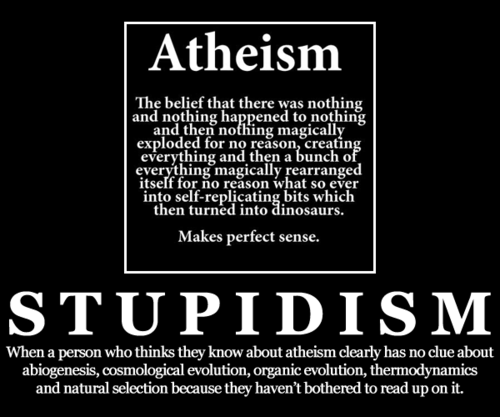
Made for our friends down south, but really our fine Harperites are feeding from the same trough so it applies to them as well.
This is a technical look at religious arguments, both for and against the way way in which religion describes our experience. I suggest you skim the preview of the paper for more understanding, but the video is an adequate primer for answering the following question – Are your beliefs, theistic or non-theist,ic causing you to beg the doxastic question?
Spit in the eye of religious stupidity. Proclaim a mighty “Frack You!” to the people who seriously believe in screwed up shite. Mark Twain said it best:
“Will a day come when the race will detect the funniness of these juvenilities and laugh at them–and by laughing at them destroy them? For your race, in its poverty, has unquestionably one really effective weapon–laughter. Power, Money, Persuasion, Supplication, Persecution–these can lift at a colossal humbug,–push it a little– crowd it a little–weaken it a little, century by century: but only Laughter can blow it to rags and atoms at a blast. Against the assault of Laughter nothing can stand.”
– “The Chronicle of Young Satan,” Mysterious Stranger Manuscripts
And of course, let us not forget the blasphemy itself – Enjoy!
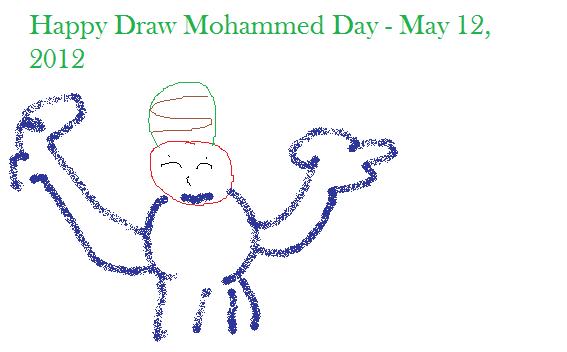
Err…may 20th, apparently as soon as I get to use coloured text, my mind turns to goo.
 There is a conversation that happens all the time between theists and non-believers. I have engaged in it many times myself as well as observed others engaging in it more times than I can count. While there are a number of seemingly valid ways atheists could deal with this conversation, I have come to believe that many of these methods merely lead to baited traps.
This conversation starts with the theist coming up with Claim X, asserting that no one could explain Claim X without invoking god, and smugly concluding that god must exist.
There are four categories Claim X might fall into:
1) Claim X is simply false
2) Claim X is easily explained without invoking god
3) Claim X is explained without invoking god, but it’s complex
4) Claim X actually has no current non-god explanations
While there have been millions of examples of ‘Claim X’ used in these conversations, scant few still fall into the fourth category. Because it’s so rare, most atheist responses to such a conversation ignore this category. This, I think, is the major reason such conversations can (and have) gone on for seeming eternities. To illustrate, let’s look at each of the categories.
Claim X is simply false
The bait here is nigh on irresistible. One of the theist’s premises are wrong, thus the argument is invalid and the conclusion does not follow! It’s irrefutable!
What do you mean it isn’t? Oh silly secularist, you fell into a trap of perpetual distortions.
Showing Claim X to be false simply invites the theist to propose ‘Claim X-prime’ that is slightly different or a bit more vague than Claim X. And when you do the same for Claim X-prime, the theists alters it again, and so on ad infinitum. Should you ever get to the point where all versions of Claim X are shown to be false, the theist then just says something to the effect of ‘Look at all that contorting and effort you had to do, just to grasp at straws. Your desperation indicates your flaw. Your story keeps changing, while my answer, “God”, stayed constant.’
Is that rational?
No.
But discourse is not based on rationality. It’s based on persuasion. As such, the theist is right, you have failed to be persuasive. To the theist, that is. Those exercising reason may indeed enjoy your absolute thrashing of whatever B.S. the theist churns up. But then, if we were only trying to persuade people with reason, we wouldn’t be talking to theists, would we?
Claim X is easily explained without invoking god
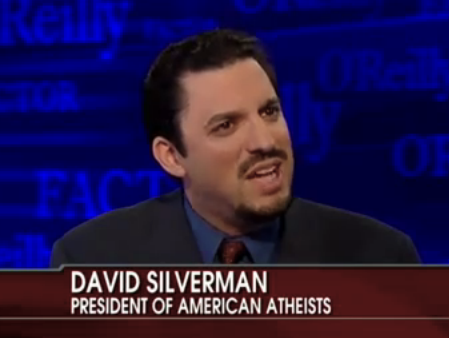 A wonderful example of this is Bill Head-Up-My-Arse O’Reilly’s infamous ‘Tide goes in, tide goes out’ line. Again, the pull here to shove reality based ideas in the theist’s face is often overwhelming. But, like in our previous case, just because the secularist is right, doesn’t mean they win. Once more, the theist backs up a bit and makes Claim X slightly harder to explain, and then slightly harder still and so on until it eventually turns into…
Claim X is explained without invoking god, but it’s complex
Now things can get tricky. We saw this as O’Reilly responded to the initial wave of attacks with his ‘How’d the moon get there?’ bit. Answering the theist’s challenge might now actually require formal education to supply the answer. In some cases, it might require a fair deal of study just to understand the answer. I personally enjoy listening to responses from people who have done the requisite schoolwork, as it can be a fun way to learn about things (I highly recommend TheLivingDinosaur ‘s “Holy Hallucinations” series) but alas, these are also doomed to fail. As the answers are now further away from the layman, the theist is safe to ignore all presented evidence. It’s not as if anyone in their camp is going to actually research this stuff. Thus, the theist vision of what fits into the next and final category is quite bloated.
Claim X actually has no current non-god explanations
This is where the theist wants to go and, as I’ve described above, there is little to be done to stop them from getting here, other than infinite loops of explanations that are ever more easily discarded. And you can’t get anywhere inside of an infinite loop.
A key point to realize is that in these conversations, the theist doesn’t really care to which category their particular ‘Claim X’ belongs. Rather, what matters is that somewhere out there, some ‘Claim X’ does reside in the fourth category.
And, ultimately, the theist is right. There are things that currently cannot be explained. There are things that may never be explained. Further, there may be things that inherently defy human understanding and are impossible to explain. So the theist wins. God exists. Accept it and go home.
Wait a minute…That can’t be right. Let’s back things up and look at the original argument structure.
1) Claim X is true
2) Claim X cannot currently be explained by humans without invoking god
3) Therefore god exists
There are two huge problems with this structure, regardless on the truth of the first two premises. The first problem is a false dichotomy implied by 2): as Claim X cannot be explained without god, it is explained *with* god. “God did it” does not explain anything. If I ask you ‘how does a clock work?’ and you reply ‘a clock-maker makes it work’, have I gained any understanding at all? Not one lick. All the god “answer” does is avoid explaining anything at all.
But a theist could potentially offer an actual explanation that is based on the god hypothesis. This tactic is used less and less, as these explanations are invariably discovered to be wrong (see Thunderf00t’s wonderful ‘Why people laugh at creationists‘ series). But lets say a brilliant theist comes up with an explanation that cannot be disproven by even the most intense scrutiny carried out by our most brilliant minds. If this were to ever happen (don’t hold your breath) we then run into the second problem: 3 does NOT follow from 1 and 2. Just because a hypothesis CAN explain a phenomenon, does not mean it DOES explain it.
 Going back to our clock, consider if, instead of “a clock-maker makes it work / god did it”, you replied “inside there is a team of invisible gremlins with perfect timing. They were captured and placed in this clock and forced to move the hands of the clock in order to relay time to outside viewers,” and there was an elaborate tale explaining all the ins and outs, and further, we had no way of observing the gremlins inside this clock to verify this (or any other) story. According to the theist’s argument model, we’ve just proven the existence of clock gremlins. The god hypothesis is a worthless ad-hoc conjecture as it is dependent on nothing, predicts nothing, and is non-falsifiable. As such, any of an infinite of imagined things could take god’s place in the theist’s argument and it would be equally valid.
The theist wants their argument to come off like this:
1) Claim X
2) Claim X would be impossible unless god exists.
3) Therefore god exists.
But the theist will never say anything close to this, because then the onus is obviously on them to demonstrate 2) and they just can’t do it. It is an impossible premise to validate. So they twist and distort until their argument takes the fallacious form we see so often, to try and shirk the onus of proof onto non-believers.
So how should one react to Claim X?
I would recommend immediately acknowledging that there are things that current science cannot explain, regardless of under which category Claim X falls. Resist the bait. Then, address how a gap in knowledge cannot prove any supernatural entity, as otherwise it could prove any of an infinite possible deities.
Remember, it doesn’t matter to the theist’s argument if Claim X is wrong or currently understood – even though it should – so it shouldn’t matter to yours.
The lengths we go through to gain the illusion of control… Enjoy this thoughtful exploration of death and atheism.











 bleatmop
 Mystro


 Dead Wild Roses
Your opinions…