
You are currently browsing the category archive for the ‘Canada’ category.
The debate over respecting the boundaries of females has spilled over the border and has galvanized protests at the Alberta legislature.
“Both were there as participants in two similar, yet very different, rallies scheduled only an hour apart. The crux of both protests was the controversial Bill 10. The first one took place to support trans rights while the second was organized to give displeased parents a voice against the bill. The bill, originally passed by the Progressive Conservative government in March 2015, focuses on students having access to gay-straight alliances.”
No problem with GSA’s, but what the protesters are objecting to is this from the guidelines sent to the public schools. This quote from page 6 of that document:
“Some students have not disclosed their sexual orientation, gender identity and gender expression beyond the school community for a variety of reasons, including safety. In keeping with the principles of self-identification, it is important to:
• inform students of limitations regarding their chosen name and gender identity or gender expression in relation to official school records that require legal name designation; and
• protect a student’s personal information and privacy, including, where possible, having a student’s explicit permission before disclosing information related to the student’s sexual orientation, gender identity or gender expression to peers, parents, guardians or other adults in their lives.
Wherever possible, before contacting the parents or other adults involved in the care (such as social workers or caregivers) of a student who is trans or gender-diverse, consult with the student to determine an appropriate way to reference the student’s gender identity, gender expression, name and related pronouns.”
One can see where parents might be concerned as schools have been directed to withhold information regarding their children. Keeping parents out of the loop with critical information regarding their children isn’t a good policy as parents or one’s family is responsible for the child’s well being for all the time the child is outside of school.
Conversely, a child from a family holding traditional views on gender or sexuality would be placed in a tenuous position, facing a bevy of negative consequences at home for going against her or his family’s values.
The legislation as worded has the very distinct possibility of creating a culture of distrust between the school and the parents. Open discourse and communication are key in maintaining the school/home relationship that is vital for student success in the academic environment.
Adequate supports must be in place for students whose values differ from their parents, and schools should be facilitating the dialogue between children and their parents. Withholding pertinent information from parents only places schools in opposition to families thus removing a foundational connective bridge in educational process – and that benefits no one.

As the fire continues to rage around Fort McMurray, Alberta, it’s natural to want to help, and Albertans – and Canadians, and others around the world, are stepping up in a heart-opening outpouring of generosity. Over and over again, authorities have emphasized, the best thing you can do is donate to the Red Cross or other NGO involved in the effort. Donating goods, or showing up uninvited to volunteer, can often cause more trouble to those on the ground, than your heartfelt contribution can ever be worth to them. Edward McIntyre, who was involved in disaster relief efforts in the Slave Lake fire in 2011, and the Calgary floods in 2013, explains why, in his piece, When Helping Hurts: Why you should never donate physical goods during a disaster:
[…]why more organizations don’t accept physical goods. Here are a few reasons why:
- Warehouseing and sorting donated goods is a logistical nightmare
- Individuals affected often don’t have anywhere to store donated items
- The majority of donated items are not fit for redistribution for health and safety concerns
- Costs for shipping & storing donated items often outweigh the cost of buying new
- Donations rarely fill the actual need at the moment
- NGO’s such as the Red Cross have pre-existing agreements in place to fulfill the basic needs of food, shelter & clothing
- The collective buying power of an NGO can stretch your dollar further
In Slave Lake, for example, many generously and sincerely donated items ended up having to go to the landfill for these reasons.
Volunteering without a clear plan can also cause problems, especially when conditions are life-threatening: rather than helping, unsolicited volunteers can take trained workers’ attention off the job at hand, and onto wrangling people. And if conditions turn dire, it can just mean more people to rescue.
So what can you do that will actually help? McIntyre suggests:
1. Make a financial donation to an NGO involved in the relief effort
We always have a hard time with when it comes to giving financially to an organization but this is the absolute best thing you can do. The Canadian Red Cross does need assessments on every individual and endeavors to provide for their specific needs. This includes getting them back to work by providing items like work boots and specially items such as prescription eyewear or medical aids. Their support often stretches out for years and when you donate to an financial appeal the money is earmarked for that and only that.
2. Help others on an individual basis
If you see a direct ask or need from a family or individual and you have the means to provide it, please do so. Just be cautious about spreading the word and collecting more then they need.
3. Volunteer
This can be tricky as everyone wants to help but in these times skilled and highly trained individuals are required. Keep an eye our for calls for volunteers from reputable organizations and remember that volunteers will be needed for months to come.
4. Thank the Volunteers
I can tell you from personal experience that volunteering during a disaster is extremely taxing. You work long hours, get very little sleep and being there for people effected means you also carry their emotional burden. Volunteers may not always be willing to talk about their experiences but taking the time to thank them for their service can provide much needed energy and prevent burnout. During the Slave Lake fires comedian Tracy Morgan invited volunteers to attend his show free of charge and it gave me the mental break I needed to push through another week.
One doubt people often express about donating cash to charitable organizations is that these organizations will use some of their donation for administration and/or fundraising, rather than their money going to those in need. It’s a valid concern; relying as it does on the goodness of people’s hearts, the charitable sector is ripe for exploitation by the greedy and unscrupulous. But, having examined the audited financial statements of literally hundreds of charitable organizations as part of my work in a previous job, I can tell you that while it does happen, it’s exceedingly rare. And between that broad exposure, and my specific experience volunteering for a variety of charitable organizations from tiny to very large, I can also tell you, that having some of your donation go to administration and fundraising expenses, is actually a Very Good Thing.
Some charitable organizations are very small, and have no, or almost no, administration and fundraising costs, because they’re basically just a handful of passionate, dedicated volunteers. Never underestimate the good these small organizations can do – it can be amazing! But as an organization grows and develops, and becomes capable of bigger things, it needs more and more time from skilled people to keep it running, both at its charitable purpose and also behind the scenes. And if you want significant, ongoing contributions of time from people with specialized skills, you eventually have to start paying them.
Probably the first paid position you’ll have is an office person. Somebody to answer the phone, handle the mail, manage the financials and the website, coordinate the volunteers – and that person is fundamentally necessary to growing your organization and keeping it running smoothly, but because she’s not involved directly in doing the organization’s actual charitable work, you have to count her pay as an administrative expense.
Or maybe you have some paid staff who do specialized work towards the organizations’ charitable purpose. That’s great, you can count their pay as a program expense. But who handles their payroll and human resource needs? Do you take them away from their specialized work, and make them double as HR and payroll, or do you get a HR person? Guess what, she’s an administrative expense too, even though without her, nobody would get paid, and so nobody who needs money to eat would be coming to work for very long.
As your organization grows further, your one office person is going to get progressively overworked, and if you don’t get her some help, she’ll quit. So maybe now you have an admin support person, and a web person, and a volunteer coordinator, and a HR person, and a financial person – and at this point you’ve got enough people that you probably need a manager or a director. All administrative expenses. Grow enough, and those individuals eventually become teams, all of which need team leads, who in turn need somebody to coordinate them. And whether it’s helping homeless animals or running a symphony orchestra, even though none of these people may ever touch a dog or a violin, and have to be counted as administrative expenses, without them the organization wouldn’t be able to function at its present level of scope and complexity. Paying for specialized people to invisibly support the visible work of the charitable organization, is not a misdirection of your donation, or the charity “keeping” some of your money; it’s an investment in the organization’s continued effectiveness.
 Wouldn’t it be nice if people, for once, didn’t decide to make money of the misery of others? (I know, I know. Capitalism would collapse the End Times would start, et cetera). One news story that caught my eye was the tomfoolery going on with some Immigration Consultants and their business of getting Syrian refugees to Canada.
“CBC News has learned about a troubling aspect of the drive to bring Syrians to Canada: professional immigration consultants, in partnership with some refugee sponsorship groups, are charging refugees thousands of dollars in arrangements that critics say are unethical and violate federal rules on sponsorship.
The immigration consultants have been targeting Syrians living in the Gulf states, many of whom are there on work permits and are able to earn a living. In that sense, they are potentially a more lucrative client base than those in refugee camps in Jordan, Lebanon and Turkey.”
Well so far, not bad. I’m sure unethical people wouldn’t try to game the system to rich themselves based on the misery of others…
In the case of one such agency, information available online and documents obtained by CBC News reveal that the consultant is not only charging prospective refugees thousands of dollars to process their applications but also asking them to pay the full cost of their resettlement up front, which violates the financial guidelines of the Private Sponsorship of Refugees Program.
Whoops, there we go. The dark side of what humans are capable of has come front and centre once again. Would more people be left in trouble without these private companies working their magic? Would it be wrong to legislate them out of the picture?
I understand that the entrepreneurial spirit thrives in conditions such as these, but I think in the case of refugees we should prioritize their safety rather than the profits of these so called ‘Immigration Consultants’. Let’s close with what Jackie Swaisland has to say on the issue, as she frames the problem quite concisely:
“There are still people who are incredibly vulnerable. There are still people who don’t know what tomorrow holds for them, or they are in dire circumstances,” she said.”So, to sort of charge those individuals, even if they can technically afford to pay for it, a large fee for your services, I think that becomes unethical.”
Unethical, indeed.
[Source:cbc.ca]
Canadian society, especially the justice system, just isn’t ready to hear women when they speak the truth…
This is an amazing post detailing all the conditioning, socialization, and patriarchal f*ckery that women have to fight through, just to be heard.

There’s a question people keep asking about the Ghomeshi trial, and I was up most of last night trying to think of how to answer it. I finally shut my brain off by picturing, in as much detail as possible, a solid wall of packed dirt in the dark above me. I spent the rest of the night mentally attacking my invisible wall. When I finally went to sleep it was what I dreamed about.
Between pretend punches, the words crept in.
Why
punch
did
punch
they
punch
lie?
If they were telling the truth about the assaults, why did they lie about other things? Why didn’t they just tell the truth?
“Manipulative”
punch
“Deceptive”
punch
Why?
I’d like to try to answer that question for you because I’m in an oddly perfect position to do so.
As the verdict of the Ghomeshi case came out, I…
View original post 1,127 more words
 In the business lexicon I think polite somehow equals naive or stupid. Neil Macdonald examines some of the hi-jinks our corporate leadership in Canada feels it can get away with.
“A letter arrived last week from TD Bank. “In order to continue to meet your banking needs …” it began.
Try to guess what came next. Hint: I’m a customer at a Canadian bank.
Sure enough, “We sometimes need to adjust our pricing.”
Unsurprisingly, the prices being adjusted were not being adjusted downward.
As of March, the bank’s “non-TD ATM fee” is being raised 33 per cent.
Fees for cancelling an Interac e-transfer and for holding a post-dated cheque at a branch are going from free to $5. And the fee for transferring a tax-free savings account to another bank is going from free to $75.
These are huge increases, far in excess of growth or individual spending power.
Now, it’s important to understand TD’s position. The bank’s profits were $8.02 billion last year, up only slightly from $7.88 billion the year before.”
Our banks do this sorta shit all the time. Hmm..bottom line looking a bit thin? Let’s put the screw to our customers, they’ll smile and say ‘thank-you’.
“It’s worth noting, though, that in the U.S., where TD is now a serious player, with more branches than in Canada, the bank plans to impose no fee increases on customers come March.
“Totally different environment,” a TD spokeswoman told me.
Translation: There’s a lot more competition there, and if TD tried charging the sorts of fees it imposes on the bank’s supine Canadian flock, some other U.S. bank would be in there siphoning off business before you could say “special offer.”
Up here in Canada, TD’s letter advises customers that if they don’t want to accept the fee hikes, they are free to close their accounts, “without cost or penalty.”
Generous, that.”
It is really as simple as that? Because we in Canada don’t allow the wild west capitalism that typifies our good neighbours to the south we have to accept the fact that the fox is in charge of the henhouse?
“It’s all part of being Canadian. The equation is simple: Canadian consumers and workers are protected from certain free-market excesses, but that coddled security comes with a price: oligopolies, in which a few firms dominate, and all the behaviour that flows from that.”
If this is the price we have to pay to be able to weather the financial shit-storms that brew in the US, I might be able to accept that – but I think that the cost benefit analysis is still up for debate.
“If you want a really depressing bit of Canadian reading, go look at the Canadian Competition Bureau’s policy on “price maintenance,” something most of us know as “price-fixing.”
Certain companies, especially in the luxury trade, try to see to it that their products never go on sale. Rolex is one. Canada Goose, the world-famous Canadian parka-maker, is another.
This offends capitalism: in a free market, one of the few responsibilities of government is to monitor and punish efforts to deaden competition”
Looking at you telecoms :/
“In fact, “price maintenance behaviour” was a criminal act in Canada, until Stephen Harper’s Conservatives changed the law in 2009 (though some forms of price-fixing still remain a crime).
The new law reduced price maintenance to a non-criminal offence, and even at that, it now has to be proven that “price maintenance conduct has had, is having or is likely to have an adverse effect on competition in a market.”
In other words, the government has to prove that price fixing results in fixed prices.”
Another gifted poison pill from our beloved former conservative government. It is shit like this that ruins their airs toward being business friendly and being friends of the market and all of the other hooey they exude from their weaselly mouths. They lay down on market policy that hugely distorts the market – and in the end makes Canadians pay more – and then have the audacity to make ‘sad face’ and shrug their shoulders laying the blame on the ‘free market’. Conservative economic policy is made of pure unadulterated rannygazoo from top to bottom.
“After trying to make sense of the gibberish on its website, I asked the Competition Bureau how many times it’s gone after companies for what it calls price maintenance since it issued its new “enforcement guidelines” in 2014.
The answer: None. Zero.
“Nevertheless,” said a spokeswoman in an email, Canadians should rest assured the bureau remains vigilant: “The Competition Bureau will not hesitate to take appropriate action where it believes price maintenance has occurred.”
Okay. Good to know.”
*sigh* – WTG Competition Bureau. :/
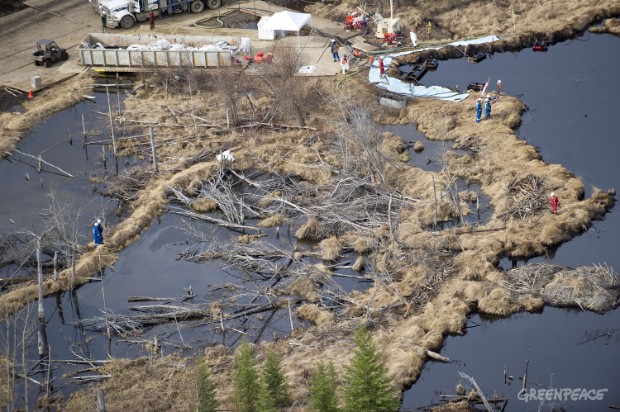
20110505 – Evi, Alberta, Canada – Crews work to clean up at Rainbow Pipeline’s oil spill, the worst Alberta oil spill in 35 years, dumping 28, 000 barrels of oil into a wetland area at Evi, Alberta which is near Little Buffalo, Alberta, Canada.
Progress in the laying of plans for Canada’s build-your-own-envirnomental-disaster have hit a snag. The people’s land that we want to endanger are saying no way, and no how. Pretty rude considering that one of our more outspoken Premier’s comments ,“Let those Eastern bastards freeze in the dark.” Oh Ralph, how we miss those straight talkn’, shoot from hip’in, shod in political clown shoes days of yesteryear (not at all actually).
Now, it seems, Alberta may need the dreaded Easters help in order to get our tar-sands products to market. Strangely enough, they seem to be not acquiescing to our requests. The Mayor of Montreal responds:
“Montreal Mayor Denis Coderre announced the city’s official opposition to proposed Energy East pipeline project Thursday, saying the potential risks outweigh its possible economic benefits to communities including his. Coderre was joined by mayors from neighbouring cities including Laval and Longueuil that make up the Montreal Metropolitan Community.
“We are against it because it still represents significant environmental threats and too few economic benefits for greater Montreal,” said Coderre on behalf of the MMC.”
I imagine it would have been easier to make a case for the pipeline if much of Eastern Canada had not been forced to look elsewhere in the market for oil, because apparently the Dreaded National Energy Program (western Canada selling oil to Eastern Canada for a fair price) was to risky a venture for the Western Canadian oil capitalists. Fast forward to the present and now we in the west are wondering why these bastards are not helping us out.
This state of affairs does not sit will for the political representative of the business sector in the Alberta Legislature. Cue the stolid Brian Jean to microphone:
“In a statement, Brian Jean, leader of Alberta’s Wildrose Party, called Coderre’s position “disgraceful.”
“While Mr. Coderre dumps a billion litres of raw sewage directly into his waterways and benefits from billions in equalization payments, his opposition to the Energy East pipeline is nothing short of hypocritical,” Jean said.
Jean claimed the project would entail economic benefits of $9.2 billion for Quebec, citing numbers provided by TransCanada.”
Well, your claim is only made much more substantial by using the figures provided by the oil company. We shan’t tarry to long with sources though, because this was just the opening salvo in the great West VS East energy pipeline showdown.
Coderre replies:
“”First of all, you have to allow me a moment to laugh at a guy like Brian Jean, when he says he relies on science. These are probably the same people who think the Flintstones is a documentary. But that’s another story.”
Ouch. But our intrepid Wild Rose Leader fires back..
“I had an opportunity to serve with Mr. Coderre in federal politics for many years, and I’m used to watching him float up and down the gutter,” said Jean, who was a Conservative MP for a decade before entering provincial politics in Alberta.”
Oh Brian, politics is hard and nasty eh? We’ll finish with Mr.Coderre:
“The community of metropolitan Montreal isn’t nothing,” he said. “It’s four million residents, it’s 82 municipalities, it’s 50 per cent of the gross domestic product, population and jobs of Quebec.
“We have committees of engineers, so we are working with credible data. We realized that when you build it, you can say it will bring this or that, and it will create so many jobs. But the economic reality is that it’s only 33 jobs and at most $2 million per year of municipal revenue.”
Two million is far cry from 9.2 billion dollars. I’m sure the real number lies *somewhere* between those two extremes, but that isn’t the point. It is Mr.Coderre that we are trying to win over to our side, and calling him a gutter inhabitant is not going to get the pipeline built. This kind of grandstanding might win you the populist vote from rural Alberta (hurrah for the Sticks!), but it doesn’t play very well on the national stage.
On the upside, Brain Jean and band of merry corporatists are doing a lovely PR job, making the Energy East pipeline much less likely to happen. Perhaps the Suzuki Foundation will give them an award or something.
Perceptions are so important when dealing with societies problems. How Canada’s wealth is perceived to be divided and how it actually is obscures the need for greater measures to insure wealth equality in our nation.
Check out the full report here(pdf).











 bleatmop
 Mystro


 Dead Wild Roses
Your opinions…