
You are currently browsing the category archive for the ‘Canada’ category.
This feature length investigative documentary, about the aftermath of the Kamloops mass grave deception, was produced by Simon Hergott and Frances Widdowson. The backdrop is the March 30 talk that Frances Widdowson gave in Powell River about “Uncovering the Grave Error at Kamloops and its Relationship to the [Powell River] Name Change and UNDRIP”. Hergott and Widdowson use the issues raised in the talk to explore a number of aspects of the deception: claims about “missing children”, a lack of journalistic objectivity, and the misleading use of Ground Penetrating Radar. The role played by the Aboriginal Industry – a group of mostly non-indigenous lawyers and consultants – in instigating grievances to divert funds away marginalized communities is also examined.
Every September 30th across Canada, Orange Shirt Day (now National Day for Truth and Reconciliation) is observed with solemnity. Citizens wear orange, school announcements, flags, ceremonies, all to remember Canada’s residential school system. It’s portrayed as a day to heal, teach and reconcile. But when you scratch beneath the surface, something troubling appears: decades of government dependence and ritual symbolism have not ended the suffering of Indigenous peoples; instead, they may have become a vector for grift, misdirection, and a self-hating narrative that benefits activists more than the communities they claim to help.
The origin story is widely told: Phyllis Jack Webstad, a six-year-old Indigenous girl, arrives at the St. Joseph Mission Residential School wearing a new orange shirt her grandmother bought, only to have it stripped from her, never to be returned. That orange shirt became a symbol: a signifier of loss, assimilation, the shaming of identity. The symbol is powerful. However, many of the policy promises, social programs, treaties, financial transfers, and activist campaigns tied to this narrative have failed to produce meaningful outcomes. Indigenous communities still suffer high rates of poverty, addiction, substandard housing, educational deficits, health disparities. Charities, NGOs, and governments use the orange shirt repeatedly — for visibility, for fund-raising, but without accountability or measurable improvement. The result? A recurring narrative of victimhood and dependence that seems endless.
Worse, this narrative is used to silence dissent. If you question the efficacy of current reconciliation policies, or ask why measurable metrics remain so poor, you are accused of “denial,” “insensitivity,” or “racism.” If you point to failures of governance, internal corruption, or poor leadership within Indigenous administrations, you are told you are denying colonial oppression’s continuing harm. The universal assumption is that the only problem is insufficient funding or lack of heartfelt apology — never that the policies themselves, or their administration, may be part of the problem. This is pernicious because it stifles honest discussion, innovation, and real solutions. Orange Shirt Day is no longer just a remembrance day; it’s become a sacred narrative that many are afraid to critique — and in a liberal democracy that prides itself on free speech, that should set off alarm bells.
Suggested Improvements / Alternatives
- Shift the emphasis from symbolism to outcomes: Measures of educational attainment, health improvements, housing quality in Indigenous communities compared over 10, 20, 30 years.
- Hold those in authority accountable: Indigenous governments, federal & provincial governments, NGOs — what have they done concretely?
- Allow critique: Encourage the voices of Indigenous people who say reconciliation policy has failed, rather than centering only activists’ rhetoric.
- Reduce dependency: Focus on policy reform that encourages independence, local governance, entrepreneurship, merit-based support, not perpetual victimhood.

References
- Orange Shirt Day, The Canadian Encyclopedia. Details on the origin with Phyllis Webstad, residential schools system, “Every Child Matters.”
- Al Jazeera: “What is Orange Shirt Day and how is it commemorated in Canada?” — background, statistics, origin story, ceremony and observance practices. (Al Jazeera)
- Centennial College Library Guides: institutional summary of Orange Shirt Day history & schooling context. (Centennial College Library Guides)
- Peace Arch News: Orange Shirt Society founder’s concern about Orange Shirt Day being co-opted, misremembered, or replaced in official messaging. (peacearchnews.com)
- Montreal CityNews: issues with merch, designers, t-shirts, people profiting off the symbol. (CityNews Montreal)
The UK government under Prime Minister Keir Starmer has introduced the so-called BritCard proposal: a mandatory digital identity (ID) scheme set to roll out by 2029. According to Reuters and other major outlets, the idea is that workers will need this digital ID for right-to-work checks, and over time it may be extended to access public services like tax records, childcare, welfare, etc. (reuters.com) Critics argue it creates centralized databases, raises risks of surveillance, invites overreach, and may pave the way for a social credit framework. (theguardian.com)
A social credit system, like the one China is implementing, is where citizens are monitored, graded or blacklisted for various behaviors (both major and minor), and then rewarded or punished accordingly. In China, examples include: blocking millions of people from buying airplane or train tickets due to “discredited behaviour” (which might include unpaid fines or minor public misbehavior); preventing access to education or luxury purchases; placing people or companies on public blacklists affecting their livelihoods; and using facial recognition and wide surveillance to monitor compliance. (theguardian.com) Such a system curtails freedoms: freedom of movement, career opportunities, public participation, and even speech if one criticizes the state or fails to conform to expected norms.
The UK’s BritCard digital ID proposals, alongside other legislative trends, are troubling signs of creeping authoritarianism—where government tools offer the capacity for control as much as for convenience. Canada shows similar risks: its proposed Combatting Hate Act includes expanding definitions of hate speech, creating new offences for obstruction, intimidation, and streamlining hate-speech and propaganda prosecutions. (canada.ca) While aiming to protect vulnerable communities, such expanded powers risk chilling free speech, targeting dissent, and giving the state too much discretion over what is or isn’t allowable expression. As free societies, the West must resist anything resembling social credit systems dressed up as digital ID or online-hate regulation.

The Panopticon come to life.
What Social Credit Means for Freedom
Here’s what is at stake if systems like China’s are ever adopted in the West:
- Freedom of Movement: Bans on travel by air, train, or road for those with low “scores.”
- Freedom of Speech: Criticism of the government or “unharmonious” views can lower your score.
- Economic Opportunity: Blacklisting can prevent people from starting businesses, holding jobs, or receiving loans.
- Privacy & Autonomy: Facial recognition, mass surveillance, and data collection track daily life in detail.
- Access to Education & Services: Children of “blacklisted” parents have been denied access to private schools.
- Social Participation: Public shaming lists and score rankings reduce citizens to state-monitored reputations.
- Rule of Law: Arbitrary and opaque standards allow punishment without due process.
References
- Reuters – Britain to introduce mandatory digital ID cards
- FT – Digital ID: what is the UK planning, and why now?
- The Guardian – Digital ID plan for UK risks creating an ‘enormous hacking target’
- The Guardian – China bans 23m ‘discredited’ citizens from buying travel tickets
- CNBC – China to stop people traveling who have bad ‘social credit’
- Sohu – Examples of Chinese blacklists and restrictions
- Government of Canada – Combatting Hate Act – proposed legislation
On September 21, 2025, Prime Minister Mark Carney announced that Canada officially recognizes the State of Palestine, aligning with over 140 UN member states. This decision, made ahead of the UN General Assembly, has been met with criticism, particularly from Israel, which views the move as a reward for Hamas and a setback for peace efforts. Carney emphasized that the recognition is contingent upon the Palestinian Authority holding elections in 2026 and excluding Hamas from governance (Reuters).
Critics argue that this recognition overlooks the complexities of the Israeli-Palestinian conflict. They point out that Hamas, which controls the Gaza Strip, has a history of violence and has been designated as a terrorist organization by Canada. The decision to recognize Palestine without addressing Hamas’s role raises questions about the effectiveness of such diplomatic gestures in promoting peace and stability in the region.
Furthermore, some view this move as a political maneuver to distance Canada from its traditional ally, the United States, and to align more closely with European nations that have recognized Palestinian statehood. However, without a comprehensive strategy that includes addressing the influence of Hamas and ensuring the security of all parties involved, this recognition may be seen as a symbolic gesture rather than a step toward a lasting resolution to the conflict.

References
- Reuters: Carney says Canada recognises a Palestinian state
- AP News: Canada joins other countries in recognizing a Palestinian state ahead of UN General Assembly
- New York Post: Canada, UK and Australia all recognize Palestinian state as rebuke to Israel for Gaza war
- Washington Post: U.K., Canada, Australia recognize Palestine as a state, breaking with U.S.
- Al Jazeera: Canada, UK and Australia announce recognition of Palestinian statehood
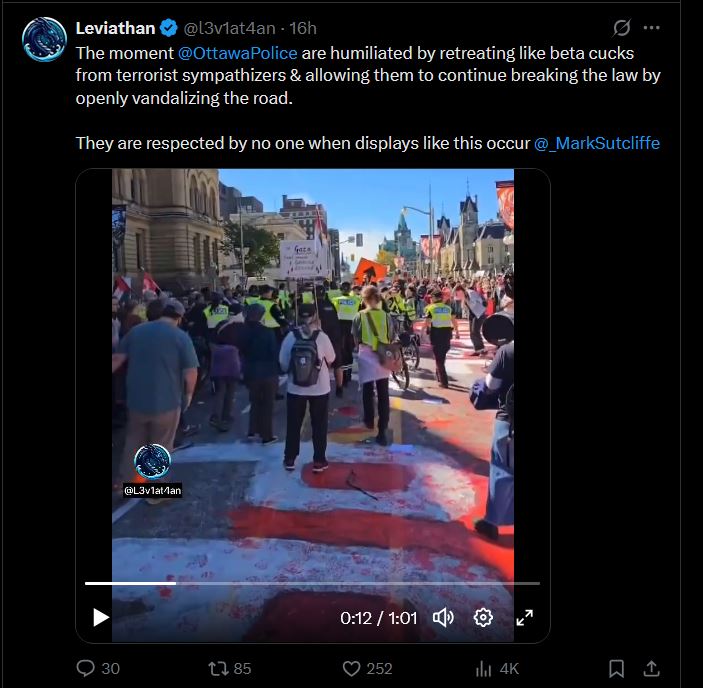
On September 20, 2025, activists from the “Draw the Line” movement staged a highly visible protest directly in front of Parliament Hill, painting a large red-and-white mural on Wellington Street. Ottawa Police closed the street for hours to facilitate the action, citing the use of washable paint, though critics noted that under Canada’s Criminal Code and municipal bylaws, the activity qualifies as vandalism. Two arrests occurred during clashes as protesters attempted to expand the mural near the Prime Minister’s Office. Hundreds participated, and cleanup concluded later the same day, with no reported injuries but lingering questions about liability for slippery surfaces (Ottawa Citizen, CTV News Ottawa, Ottawa CityNews, CBC News). Video evidence posted on X by @l3v1at4an shows police standing by as activists painted, sparking over 450 replies highlighting perceived enforcement disparities (X Thread).
Contrast this with the 2022 Freedom Convoy protests: organizers faced weeks of sustained police enforcement, arrests, and eventually prosecutions including mischief and counselling to disobey court orders. High-profile participants like Tamara Lich and Chris Barber were convicted and sentenced, while the federal government invoked the Emergencies Act — a level of response not seen for the mural or similar protests. The discrepancy demonstrates a clear selective approach in how law enforcement applies the law depending on the protesters’ affiliation, cause, or perceived political stance (AP News, CBC).
The mural incident, combined with historical patterns, fuels concerns over two-tier policing: some groups are allowed to vandalize public property with minimal immediate consequence, while others are met with swift arrest, prosecution, or extraordinary federal enforcement. Canadians deserve equal application of the law — whether it’s a climate mural, a roadblock, or any form of civil demonstration. When enforcement varies by cause, political affiliation, or identity, trust in public institutions erodes, and the perception of injustice becomes reality.
References
- Ottawa Citizen — “Two arrests amid Wellington Street mural painting” (Sept 20, 2025) — https://ottawacitizen.com
- CTV News Ottawa — Coverage of Draw the Line protest and police confirming street closure for washable paint removal — https://ottawa.ctvnews.ca
- Ottawa CityNews — “Hundreds participate in 65-foot mural as part of nationwide rallies” — https://ottawacitynews.ca
- CBC News — “Mural in front of Carney’s office with police aiding the demonstration” — https://cbc.ca
- X Thread by @l3v1at4an — Video evidence of police standing by as activists paint; 450+ replies discuss selective enforcement — https://x.com/l3v1at4an/status/1969466596499308628
- AP News — “Prominent figure from Canada’s trucker protests found guilty” — https://apnews.com/article/3975bb6bbd0c089e0c56cebbe9187fd2
- CBC News — Freedom Convoy prosecutions (Tamara Lich, Chris Barber, Chris) — https://cbc.ca
Mark Carney launched his new “Build Canada Homes” initiative with the Liberals at a construction-themed event, complete with hard hats, lumber, and the imagery of homes being built. Mainstream outlets like CBC and BNN Bloomberg covered the announcement and confirmed the backdrop included construction visuals and talk of modular housing. However, Conservative MP Barbara Bal and several CPC social media accounts have claimed the set was little more than a temporary stage — alleging that when they returned to the site, nothing was actually there. It is important to note: these allegations come from partisan and social sources, not from mainstream media confirmation.
Even if one accepts the stronger claim that the site was a prop, the larger problem is not theatricality but the substance. After nine years of Liberal government under Justin Trudeau, housing affordability has collapsed: mortgage interest costs have more than doubled since 2015 according to Statistics Canada, rents have spiked across major cities according to CMHC, and Canada now has the fewest homes per capita of any G7 country. Liberal promises to “get housing built” ring hollow given this record of failure.
That is where the hypocrisy cuts deepest. A party that has presided over a historic affordability crisis now rolls out a former Bank of Canada governor to stage glossy announcements about “change.” Whether or not the Vaughan backdrop was literally a Potemkin village, it symbolizes the Liberal pattern: photo-ops and slogans standing in for tangible progress. Canadians don’t need props — they need homes they can afford.

References
- CBC News / Yahoo: “The way we build homes needs to change: Carney makes housing announcement” – https://ca.news.yahoo.com/way-build-homes-needs-change-024451476.html?utm_source=chatgpt.com
- BNN Bloomberg (Canadian Press): “Liberals promise to build nearly 500,000 homes per year, create new housing entity” – https://www.bnnbloomberg.ca/federal-election-2025/2025/03/31/liberals-promise-to-build-nearly-500000-homes-per-year-create-new-housing-entity/?utm_source=chatgpt.com
- Barbara Bal (Conservative MP) Instagram reel alleging staged backdrop – https://www.instagram.com/reel/C-1lE9YtZ8p?utm_source=chatgpt.com
- Conservative Party of Canada X/Twitter account repeating claim – https://x.com/cpc_hq
- Statistics Canada: “Mortgage interest cost index, May 2024” – https://www150.statcan.gc.ca/n1/daily-quotidien/240620/dq240620a-eng.htm?utm_source=chatgpt.com
- CMHC: “Canada Housing Market Report” – https://www.cmhc-schl.gc.ca/professionals/housing-markets-data-and-research/market-reports/canada-housing-market-report?utm_source=chatgpt.com
- OECD Housing Data – https://data.oecd.org/price/housing-prices.htm?utm_source=chatgpt.com
Canada’s crime landscape resists neat storytelling. After nearly a decade of steady increases—especially in violent offenses, property thefts, and youth crime—2024 marks a notable pivot downward.
According to Statistics Canada, the overall police-reported crime rate fell 4% to 5,672 incidents per 100,000 people, ending three consecutive years of growth (Statistics Canada). The Crime Severity Index (CSI)—which captures both volume and seriousness—also dipped 4% nationally, with Non-violent CSI down 6% and Violent CSI down 1% (Statistics Canada). Homicide rates slid 4%, from 1.99 to 1.91 victims per 100,000, with eight fewer lives lost than the year before (Global News, Statistics Canada).
Still, narratives of escalating crime haven’t vanished. And it’s not hard to understand why. From 2014 to 2023, Canada saw violent crime rise nearly 30%, with 2023 registering approximately 1,427 incidents per 100,000—up 3.7% from the previous year (X (formerly Twitter)). This contrasts sharply with the U.S., where violent crime grew about 5% and property crime fell 24% over the same decade (X (formerly Twitter), Fraser Institute).
Youth crime follows a similar pattern. Between 2022 and 2023, violent youth crime jumped 10%, with overall youth crime up 13% (Ministère de la Justice). On a regional level, Western provinces—especially Saskatchewan and Manitoba—continue to report some of the highest crime rates, while Ontario and Quebec remain comparatively stable (Government of Nova Scotia, Statistics Canada).
The Takeaway
Crime in Canada isn’t spiraling, nor is it fully under control. The 2024 decline is welcome, but it follows substantial, worrying increases. The story lies between alarm and apathy—calling for careful, evidence-driven policy, not sensational headlines or complacency.

References
- Statistics Canada. “Police-reported crime statistics in Canada, 2024.” Overall crime rate – 5,672 per 100,000; CSI changes. (Statistics Canada)
- Global News (citing StatsCan). Homicide rate down to 1.91 per 100,000 in 2024 (4% decline). (Global News)
- Statistics Canada. Homicide victims – 788 in 2024, eight fewer than in 2023. (Statistics Canada)
- Statistics Canada. 2023 crime stats: 3% rise in crime rate to 5,843/100k; violent incidents up 4%; CSI up 2%. (Statistics Canada)
- Crime comparison data: Violent crime +30% (2014–2023); 2023 rate ~1,427/100k (up 3.71%); Canada vs U.S. trends. (X (formerly Twitter), Fraser Institute)
- Justice Canada. Youth crime: +10% violent youth crime; +13% overall youth crime (2022–2023). (Ministère de la Justice)
- Nova Scotia stats: Regional disparities, highest in Manitoba/Saskatchewan. (Government of Nova Scotia)











 bleatmop
 Mystro


 Dead Wild Roses
Your opinions…