
You are currently browsing the category archive for the ‘Canada’ category.
At the core of much of the tension surrounding transgender issues lies a profound and inescapable cognitive dissonance.
P
Biological reality is clear and immutable.
P
Human sex is binary—male or female—and determined at conception. No medical intervention, no amount of social affirmation, and no subjective feeling can change this fundamental fact. You will always and forever remain the sex you were born.
P
Transgender ideology asserts the opposite. It claims that whatever sex you feel you are, you become in reality. Your internal sense of self overrides chromosomes, reproductive anatomy, and every observable marker of biological sex. This ideology is inherently anti-reality.
P
Those who fully internalize it place themselves in a state of permanent conflict—not just with their own bodies, but with the entire external world. Reality itself becomes the enemy, repeatedly negating their subjective self-perception.
P
Queer Theory provides the escape hatch. Rather than confronting the mismatch between feelings and facts, adherents are guided to externalize the source of their distress. Through an oppressor/oppressed lens, the cause of their pain is never their own faulty perception of self—absolutely not. Instead, it is “normative” society that is actively oppressing them, enforcing rigid gender norms and inflicting all their suffering. This framework transforms personal dissonance into righteous grievance. The distress is no longer internal; it is the fault of everyone else.
P
Medical interventions amplify the problem. So-called “gender-affirming care”—puberty blockers followed by cross-sex hormones—adds fuel to the fire. These treatments carry serious, well-documented deleterious effects on both mental and physical health. Far from resolving underlying issues, they often deepen psychological instability while creating permanent physical changes.
P
The result is a perfect storm: individuals who were already vulnerable, now further destabilized, carrying a massive chip on their shoulders. They view the rest of society—the “normative” majority—as the active source of their pain. To defend their constructed identity and quiet the cognitive dissonance, they feel compelled to strike back against this perceived evil force: you and me.In this worldview, disagreement equals enmity.
P
If you refuse to affirm their ideology, you are not offering a different opinion—you are the oppressor who must be confronted, silenced, or defeated.
P
Dissent is violence.
P
Reality itself is violence.
P
This dynamic helps explain patterns of hostility, aggression, and, in extreme cases, violence that emerge from certain segments of transgender activism. It does not stem primarily from societal rejection, but from a foundational rejection of biological reality and the refusal to address internal distress with honesty.
True compassion does not mean enabling delusion.
P
It means grounding support in reality—the only place where genuine mental health and social peace can be found.

If a government’s job is to steward the conditions for ordinary people to build, trade, invest, and plan a life, then our federal leadership has been doing that job badly.
Not because Canadians are lazy. Not because the world is easy. But because the governing reflex is wrong: when something breaks, Ottawa reaches for a new program, a new credit, a new rebate, a new subsidy, a new “strategy.” It treats the economy like a patient that can be stabilized indefinitely with IV drips.
That approach can buy headlines. It cannot buy prosperity.
The best indicator is per-person performance. We can argue about which yardstick matters most, but the story is consistent: Canadians are producing less per person than we should be, relative to peers and especially relative to the United States. When per-capita output stagnates, everything gets harder at once: housing feels unaffordable, healthcare feels strained, wages feel thin, and every problem becomes a fight over slices instead of a discussion about baking more bread.
The policy style matters because it shapes incentives. When governments patch symptoms with cash transfers while leaving the cost structure and the approval structure untouched, they teach the country the wrong lesson: don’t fix the machine; keep bribing the machine not to squeal.
The mechanism: why “more programs” keeps failing
Here’s the basic mechanism, stripped of moral drama:
- High costs and slow approvals choke supply.
Housing, energy, infrastructure, major projects, even small-business expansions: Canada is a country that says “no” and “later” far more often than it says “yes” and “go.” Every delay is a tax. Every duplicated review is a tax. Every veto point is a tax. - Government then tries to “help” people pay the tax it created.
Rebates, credits, subsidies, targeted relief. It’s a strange kind of compassion that insists on first inflating the cost of living and then offering a coupon to survive it. - Those programs don’t increase productivity.
They redistribute purchasing power. Sometimes that’s justified in emergencies. But as a governing model it becomes a treadmill: you need ever-larger transfers to offset the same underlying frictions. - Meanwhile investment goes elsewhere.
Capital avoids uncertainty, delays, and politicized approvals. If the return on effort is higher across the border, it doesn’t matter how many committees we convene about “competitiveness.” The money leaves. So do the high-productivity jobs.
That’s the loop.
Steelman: “But the government is trying to protect people”
Yes. There are real hardships and real shocks: pandemic aftershocks, energy volatility, inflation waves. A modern state can’t pretend none of that exists.
But a serious government distinguishes relief from policy habit.
Relief is temporary and humble. It treats symptoms while it removes the causes.
Policy habit is permanent and proud. It treats symptoms and declares victory.
Canada’s problem is not that government ever helps. It’s that government too often helps in a way that replaces fixing the constraints. Then it wonders why the constraints keep biting.
The verdict
If your economic model is “make life expensive, then subsidize the expense,” you don’t get abundance. You get dependency, resentment, and a widening gap with jurisdictions that still know how to build.
You also get a politics where every election becomes a bidding war over who will mail the bigger cheque, because structural reform has been quietly taken off the table.
That’s not leadership. It’s managed decline with better graphics.
Three solutions that trust Canadians
These aren’t “one weird trick” fixes. They’re principles that put choice back in the hands of households and entrepreneurs rather than bureaucracies.
1) Let people keep more of what they earn, especially on essentials
If Ottawa wants to help with affordability, it should stop pretending price pressures are solved by “targeted” programs. The cleanest help is broad, simple tax relief that lets people choose.
- Cut taxes that hit basics hardest (and stop layering cost-pushers into the production chain).
- Prefer lower rates and fewer carve-outs over boutique credits that require a rulebook and a caseworker to access.
- If a policy goal requires a price signal, keep it simple and transparent, not buried across permits, compliance, and pass-through.
This trusts Canadians because it doesn’t tell them what to buy. It stops taking their money and then re-selling it back to them with a government logo.
2) Slash approval times and regulatory duplication so builders can build
Canada does not have a “housing feelings” problem. It has a permission structure problem.
- Set hard timelines for approvals and treat missed deadlines as automatic escalation or approval, not “we’ll get back to you.”
- Collapse overlapping reviews and require agencies to coordinate rather than serially veto.
- Align incentives so provinces and municipalities that approve homes and infrastructure fast aren’t punished for growth.
This trusts Canadians because it assumes the default answer to a lawful project is “yes,” and it lets builders, trades, and communities respond to demand without waiting years for permission.
3) Open the country internally: real competition, real mobility, real choice
A country shouldn’t feel like 10 small markets with paperwork toll booths between them.
- Remove internal trade barriers so goods, services, and workers can move freely across provinces.
- Make credential recognition faster for skilled trades and professionals so talent isn’t trapped behind provincial gatekeeping.
- Reduce the habit of picking “future sectors” by subsidy and instead create conditions where any sector can win if it serves customers.
This trusts Canadians because it relies on competition and mobility, not bureaucratic selection. It lets consumers choose, lets workers move, and lets businesses scale without needing a lobbyist.
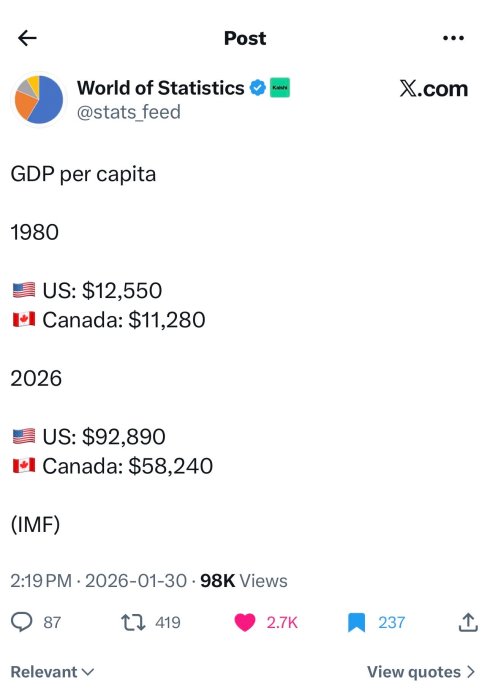
If Ottawa keeps governing by bandage, the next few years will look like the last: higher spending, louder announcements, thinner per-person results, and a country that feels like it’s working harder for less. The gap won’t close by intention. It will close only when we stop confusing “more government activity” with “more national competence.”
Tyler Cowen once tried to name the biggest “revolutions” he’s lived through—moon landing, collapse of communism, the internet, and now AI. In the middle of that list he drops one that most people still don’t treat like a revolution at all: “Feminization.” (Marginal REVOLUTION)
That word isn’t a complaint. It’s a category. It says: a long-run compositional change is underway, and it matters.
Helen Andrews’ “Great Feminization” thesis—popularized in a talk and elaborated in her Compact essay—takes the next step: as women become a larger share of institutions, institutions don’t merely “include” women; they become substantively feminized, and what we call “wokeness” is basically the cultural exhaust of that process. (Compact)
Here’s my position up front: the demographic shift is real and measurable in Canada; the “feminization = wokeness” equation is an overconfident master key.
It explains too much, too easily, by psychologizing demographics instead of interrogating incentives.
Canadian anchors: the shift is measurable (not vibes)
Start with a handful of Canadian facts you can actually point to.
- Parliament: the House of Commons sits at 104 women out of 343 MPs (30.3%). (IPU Parline)
- Judiciary: the share of federally appointed judges who are women rose from 43.8% (2021) to 46.7% (2023), per Statistics Canada. (Statistics Canada)
- Universities: women are 43.7% of full-time teaching staff in 2024/2025, up from 15.9% in 1984/1985. (Statistics Canada)
- Management: women are 51.9% of public-sector managers but 35.2% of private-sector managers (2023), and hold 42.7% of middle management vs 30.8% of senior management (2021). (Statistics Canada)
- Psychology (Alberta snapshot): Job Bank puts psychologists at 81% women / 19% men in Alberta. (Job Bank)
You don’t need to think any of this is good or bad to recognize the basic point: elite and semi-elite Canadian pipelines have changed composition in living memory. The “Great Feminization,” at minimum, names something real.
Why composition changes institutions (and why noticing this isn’t misogyny)
Here’s the move that poisons discussion: someone observes a demographic shift and asks what it does to norms; the response is to treat the question itself as hatred.
That’s not an argument; it’s a veto.
Institutions aren’t just rulebooks. They are reward systems: what gets you promoted, what gets you ostracized, what gets you hauled into a meeting, what everyone learns not to say out loud. When composition changes, the informal equilibrium can change too—sometimes for the better, sometimes not.
Before anyone reaches for the “misogyny” stamp, three obvious distinctions:
- Descriptive claims aren’t moral verdicts. Saying “X is now 47% female” is not saying “women ruined X.”
- Group averages aren’t destinies. Even if differences exist on average, overlap is huge. Plenty of women are rule-first and combative; plenty of men are harmony-first and censorious.
- The target is incentives, not women. If a system rewards reputational risk-avoidance and punishes open conflict, it will drift toward soft enforcement and speech management—regardless of who staffs it.
Those distinctions don’t sanitize the topic. They make it discussable.
Where Andrews helps—and where her thesis becomes a master key
Steelman Andrews first: she’s right that the shift is large, and she’s right that institutions can be remade through changes in who occupies them. If you pretend otherwise, you’re pretending humans don’t do social enforcement.
Where she overreaches is the claim (often treated as self-evident) that “feminization = wokeness.” (Compact)
Two problems.
1) One variable can’t carry a multi-cause phenomenon
The rise of “woke” managerial dynamics tracks at least four forces that are not reducible to gender composition:
- social media: instant reputational escalation; permanent records of mistakes; a public audience for internal disputes
- liability culture: institutions optimizing to avoid lawsuits, complaints, and scandal
- bureaucratic expansion: more compliance, more policy, more internal language policing
- credential sorting: ideological clustering in certain professional strata
In Canada, you can see the basic direction without naming villains: risk management becomes a career track; “process” becomes protection; disputes become “incidents”; leaders learn to value quiet over truth because quiet is legible as safety.
You can believe feminization is one contributor. But treating it as the engine is an interpretive leap, not an established causal law.
2) It tempts essentialism even when it gestures at nuance
If “wokeness” is “women’s morality,” you’ve turned a complex institutional pathology into a personality profile of half the species. That’s analytically brittle and politically stupid: it hands critics the easiest rebuttal (“you’re essentializing women”) and it blinds you to male-led versions of the same pathologies (purges, conformity spirals, status policing), which history supplies in bulk.
If you want to criticize a norm regime, criticize the regime. Don’t smuggle in contempt.
What the evidence can support—more modestly
A defensible claim, one that doesn’t require you to psychologize women as a class, looks like this:
- Some sex-linked preference gaps show up in some contexts, especially around speech, conflict, and social sanction. For example, a Knight Foundation/College Pulse study reports large gender differences among U.S. college students: 41% of college women prioritized protecting free speech versus 71% of college men, while women were more likely to prioritize promoting an inclusive society.
- Institutions are sensitive to preference distributions because norms are enforced socially, not just formally.
- Incentives decide which preferences become “policy.” Liability, reputation, and managerial bureaucracy amplify harm-avoidance.
And this is the part Andrews gestures at, but doesn’t fully own: if you want to understand modern speech policing, HR creep, and the new professional fearfulness, start with incentives. The incentives turn every controversy into a corporate emergency; then people behave accordingly.
On that view, feminization isn’t the whole story. It’s a relevant input—and its effects depend on the system it enters.
The real Canadian question: can we preserve hard virtues mid-transition?
Canada is useful here because we’re visibly mid-shift rather than at some imagined endpoint. Parliament is at 30% women, not parity. (IPU Parline) The federal judiciary is closing on parity. (Statistics Canada) Universities have moved dramatically since the 1980s, but remain below parity in full-time teaching staff. (Statistics Canada) Management splits sharply by public vs private sector, and senior leadership remains male-skewed. (Statistics Canada)
So the live question isn’t “should women be here?” They are here, and they belong here.
The question is narrower and more urgent:
As composition changes, what norms do we want to protect because they are fragile?
A short list:
- due process and evidence standards (law)
- viewpoint tolerance and intellectual risk-taking (academia)
- candid disagreement and non-performative conflict (organizations)
- the capacity to make decisions that feel “unkind” but are necessary (policy)
If you think those virtues are real and fragile, you don’t need to scapegoat women. You need to design institutions that reward truth-telling and competence more than “harm management” and reputational prophylaxis. That means fewer performative “values” rituals and more procedural backbone: clear standards, clearer speech norms, and leaders who can say “no” without laundering it through therapy language.
Verdict and prediction
The Great Feminization is real in Canada. The numbers are not subtle. (IPU Parline)
But “feminization = wokeness” is a bad master key. It explains too much, too easily, by psychologizing demographics rather than interrogating incentives. (Compact)
My bet is that the next decade won’t be settled by shouting “misogyny” or shouting “women did this.” It will be settled by whether our institutions relearn a difficult skill: distinguishing “this feels harmful” from “this is false,” and building cultures where adults can endure disagreement without turning every conflict into a moral emergency.

Glossary
- Confounders — other factors that could be the real cause, making cause-and-effect hard to prove.
- Essentialism / essentialize — treating a group as if it has one fixed “essence” (“women are X”), ignoring variation.
- Epiphenomenon — a byproduct; something that looks important but is really “exhaust” from a deeper cause.
- Monocausal — blaming one cause for a complex outcome.
- Pathology (institutional pathology) — a recurring dysfunctional pattern inside an institution.
- Prophylaxis — preventative action; here, pre-emptive “avoid scandal” behavior.
- Psychologizing — explaining political/institutional behavior by reducing it to personality traits or “mental makeup.”
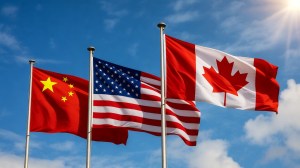
Canada is in the middle of a familiar temptation: the Americans are difficult, therefore the Chinese offer must be sane.
The immediate backdrop is concrete. On January 16, 2026, Canada announced a reset in economic ties with China that includes lowering barriers for a set number of Chinese EVs, while China reduces tariffs on key Canadian exports like canola. (Reuters) Washington responded with open irritation, warning Canada it may regret the move and stressing Chinese EVs will face U.S. barriers. (Reuters)
If you want a simple, pasteable bromide for people losing their minds online, it’s this: the U.S. and China both do bad things, but they do bad things in different ways, at different scales, with different “escape hatches.” One is a democracy with adversarial institutions that sometimes work. The other is a one-party state that treats accountability as a threat.
To make that visible, here are five egregious “hits” from each—then the contrast that actually matters.
Five things the United States does that Canadians have reason to resent
1) Protectionist trade punishment against allies
Steel/aluminum tariffs and recurring lumber duties are the classic pattern: national-interest rhetoric, domestic political payoff, allied collateral damage. Canada has repeatedly challenged U.S. measures on steel/aluminum and softwood lumber. (Global Affairs Canada)
Takeaway: the U.S. will squeeze Canada when it’s convenient—sometimes loudly, sometimes as a bureaucratic grind.
2) Energy and infrastructure whiplash
Keystone XL is the poster child of U.S. policy reversals that impose real costs north of the border and then move on. The project’s termination is documented by the company and Canadian/Alberta sources. (TC Energy)
Takeaway: the U.S. can treat Canadian capital as disposable when U.S. domestic politics flips.
3) Extraterritorial reach into Canadians’ private financial lives
FATCA and related information-sharing arrangements are widely experienced as a sovereignty irritant (and have been litigated in Canada). The Supreme Court of Canada ultimately declined to hear a constitutional challenge in 2023. (STEP)
Takeaway: the U.S. often assumes its laws get to follow people across borders.
4) A surveillance state that had to be restrained after the fact
Bulk telephone metadata collection under Patriot Act authorities became politically toxic and was later reformed/ended under the USA Freedom Act’s structure. (Default)
Takeaway: democracies can drift into overreach; the difference is that overreach can become a scandal, a law change, and a court fight.
5) The post-9/11 stain: indefinite detention and coercive interrogation
Guantánamo’s long-running controversy and the Senate Intelligence Committee’s reporting on the CIA program remain enduring examples of U.S. moral failure. (Senate Select Committee on Intelligence)
Takeaway: the U.S. is capable of serious rights abuses—then also capable of documenting them publicly, litigating them, and partially reversing course.
Five things the People’s Republic of China does that are categorically different
1) Mass rights violations against Uyghurs and other Muslim minorities in Xinjiang
The UN human rights office assessed serious human rights concerns in Xinjiang and noted that the scale of certain detention practices may constitute international crimes, including crimes against humanity. Canada has publicly echoed those concerns in multilateral statements. (OHCHR)
Takeaway: this is not “policy disagreement.” It’s a regime-scale human rights problem.
2) Hong Kong: the model of “one country, one party”
The ongoing use of the national security framework to prosecute prominent pro-democracy figures is a live, observable indicator of how Beijing treats dissent when it has full jurisdiction. (Reuters)
Takeaway: when Beijing says “stability,” it means obedience.
3) Foreign interference and transnational pressure tactics
Canadian public safety materials and parliamentary reporting describe investigations into transnational repression activity and concerns around “overseas police stations” and foreign influence. (Public Safety Canada)
Takeaway: the Chinese state’s threat model can extend into diaspora communities abroad.
4) Systematic acquisition—licit and illicit—of sensitive technology and IP
The U.S. intelligence community’s public threat assessment explicitly describes China’s efforts to accelerate S&T progress through licit and illicit means, including IP acquisition/theft and cyber operations. (Director of National Intelligence)
Takeaway: your “market partner” may also be running an extraction strategy against your innovation base.
5) Environmental and maritime predation at scale
China remains a dominant player in coal buildout even while expanding renewables, a dual-track strategy with global climate implications. (Financial Times)
On the oceans, multiple research and advocacy reports emphasize the size and global footprint of China’s distant-water fishing and associated IUU concerns. (Brookings)
Takeaway: when the state backs extraction, the externalities get exported.
Compare and contrast: the difference is accountability
If you read those lists and conclude “both sides are bad,” you’ve missed the key variable.
The U.S. does bad things in a system with adversarial leak paths:
investigative journalism, courts, opposition parties, congressional reports, and leadership turnover. That doesn’t prevent abuses. It does make abuses contestable—and sometimes reversible. (Senate Select Committee on Intelligence)
China does bad things in a system designed to prevent contestation:
one-party rule, censorship, legal instruments aimed at “subversion,” and a governance style that treats independent scrutiny as hostile action. The problem isn’t “China is foreign.” The problem is that the regime’s incentives run against transparency by design. (Reuters)
So when someone says, “Maybe we should pivot away from the Americans,” the adult response is:
- Yes, diversify.
- No, don’t pretend dependency on an authoritarian state is merely a swap of suppliers.
A quick media-literacy rule for your feed
If a post uses a checklist like “America did X, therefore China is fine,” it’s usually laundering a conclusion.
A better frame is risk profile:
- In a democracy, policy risk is high but visible—and the country can change its mind in public.
- In a one-party state, policy risk is lower until it isn’t—and then you discover the rules were never meant to protect you.
Canada can do business with anyone. But it should not confuse trade with trust, or frustration with Washington with safety in Beijing.
If Canada wants autonomy, the answer isn’t romanticizing China. It’s building a broader portfolio across countries where the rule of law is not a slogan in a press release.
References
- Canada–China trade reset (EV tariffs/canola): Reuters; Guardian. (Reuters)
- U.S. criticism of Canada opening to Chinese EVs: Reuters. (Reuters)
- U.S. tariffs/lumber disputes: Global Affairs Canada; Reuters. (Global Affairs Canada)
- Keystone XL termination: TC Energy; Government of Alberta. (TC Energy)
- FATCA Canadian challenge result: STEP (re Supreme Court dismissal). (STEP)
- USA Freedom Act / end of bulk metadata: Lawfare; Just Security. (Default)
- CIA detention/interrogation report: U.S. Senate Intelligence Committee report PDF. (Senate Select Committee on Intelligence)
- Guantánamo context: Reuters; Amnesty. (Reuters)
- Xinjiang assessment: OHCHR report + Canada multilateral statement. (OHCHR)
- Hong Kong NSL crackdown example: Reuters (Jimmy Lai). (Reuters)
- Transnational repression / overseas police station concerns: Public Safety Canada; House of Commons report PDF. (Public Safety Canada)
- China tech acquisition / IP theft framing: ODNI Annual Threat Assessment PDF. (Director of National Intelligence)
- Coal buildout: Financial Times; Reuters analysis. (Financial Times)
- Distant-water fishing footprint / IUU concerns: Brookings; EJF; Oceana. (Brookings)
The Federal Court of Appeal’s January 16, 2026 decision in Attorney General of Canada v. Canadian Civil Liberties Association (2026 FCA 6) is not a cultural commentary on the Freedom Convoy. It is a narrower—and more consequential—statement about threshold: what must be true before the federal executive can lawfully reach for extraordinary powers.
The Court’s conclusion is unambiguous: “every appeal before this Court should be dismissed.” It affirms that “the declaration of a public order emergency was unreasonable,” and it adopts the word that matters in a rule-of-law system: “ultra vires.” It also states that “parts of the Regulations and Economic Order infringed paragraph 2(b) and section 8 of the Charter.” That is the spine of the judgment. Everything else is the anatomy supporting it.
What happened, in the Court’s own framing
The decision “results from the Proclamation Declaring a Public Order Emergency … issued … on February 14, 2022,” declaring “reasonable grounds to believe a public order emergency existed under subsection 17(1),” followed by “Emergency Measures Regulations” and the “Emergency Economic Measures Order” on February 15, 2022. Those instruments were deployed in the midst of what “came to be known as the ‘Freedom Convoy 2022’,” as “hundreds of vehicles” converged on Ottawa, alongside “a number of border blockades,” including the “Sweetgrass-Coutts, Alberta border crossing” and the “Ambassador Bridge.”
The Court also records the litigation path. On January 29, 2024, the Federal Court found “the reasons provided for the decision to declare a public order emergency did not satisfy the requirements” of the Act, and that some temporary measures “infringed section 8 and paragraph 2(b) … and were not justified under section 1.” The Attorney General appealed those findings; civil-liberties groups cross-appealed on peaceful assembly. The Federal Court of Appeal’s answer to the main question—was the invocation lawful and reasonable?—is no.
“Last resort” is not a slogan; it is a constraint
The most useful line in this decision is not a flourish. It is an instruction.
The Federal Court (quoted and endorsed in the appellate reasons) states: “Due to its nature and to the broad powers it grants the Federal Executive, the Emergencies Act is a tool of last resort. The GIC cannot invoke the Emergencies Act because it is convenient, or because it may work better than other tools at their disposal or available to the provinces.” It then ties that principle to factual assessment: “the evidence is clear that the majority of the provinces were able to deal with the situation using other federal law, such as the Criminal Code, and their own legislation.”
That pair of sentences does the real work. It rejects the idea—common in crisis politics—that “better” justifies “exceptional.” It anchors emergency powers to necessity, not preference.
The Court of Appeal adds a helpful nuance later: while the Act is “meant to be an instrument of last resort,” it “cannot be construed as a straitjacket” that forces Cabinet to exhaust every imaginable legal tool before acting. But that is not a concession to improvisation. It is a warning that the reasoning still has to be there, and it still has to meet “exacting” statutory demands.
Evidence, not atmosphere: “compelling and credible information”
A second throughline runs alongside “last resort”: the requirement that the executive’s belief be anchored in something sturdier than fear, political pressure, or generalized disorder.
The Court states the prerequisite in crisp terms: “the GIC must have reasonable grounds to believe, based on compelling and credible information, that threats to the security of Canada as described in section 2 of the CSIS Act existed.” And then it drops the verdict: “this evidence was lacking here.”
This is where the decision becomes a rebuke rather than a mere disagreement.
The Court rejects the attempt to stretch the statutory trigger to match the government’s policy urgency. It insists, “For the time being, we must take the Act as it reads, and not as the AGC would like it to read.” And it draws a sharp boundary around the phrase doing much of the litigation’s heavy lifting: “It would stretch beyond rationality the meaning of the words ‘serious violence’ … if they were to encompass purely economic consequences or speculative disruption of essential goods and services.”
That is a judicial way of saying: you don’t get to expand the fuse because you prefer the explosion.
When it turns to violence, the Court is equally direct. It notes that “the evidence is quite simply lacking” for serious violence against persons; and that, aside from the economic disturbance, “the only incident of violence put forward by the AGC was the seizure of a cache of firearms and ammunition at Coutts, as well as vague reports” of harassment, intimidation, and assault, plus the fact that Ottawa police were overwhelmed. “In our view, this is insufficient” to meet the “compelling and credible information” requirement for reasonable grounds.
Even where the protests were “disturbing and disruptive,” the Court concludes “they fell well short of a threat to national security.” It notes that this was “borne out by CSIS’s own threat assessment,” and it flags that an alternative assessment was requested but the Act was invoked “before it was completed.”
The implication is not subtle: emergency powers require proof-grade reasoning at the time of decision, not post-hoc narrative scaffolding.
Charter impacts: expression and financial measures
On expression, the Court endorses the Federal Court’s findings as to overbreadth and unjustified limits. It records that “the Regulations were overbroad to the extent that they criminalized the entire protest,” and that “the freedom of expression of peaceful protestors who did not participate in the actions of those disrupting the peace was infringed.” The appellate court’s own conclusion at the front end of the reasons affirms that “parts of the Regulations and Economic Order infringed paragraph 2(b) and section 8 of the Charter.”
It also disposes of the peaceful assembly cross-appeal without enlarging the rights analysis: “We are satisfied that the paragraph 2(b) infringement sufficiently accounts for the related right to assemble under paragraph 2(c), and decline to address the cross-appeal.”
On the financial measures, the Court’s concern is about sweeping power paired with loose identification and weak safeguards. It calls out “the lack of rigour contemplated in identifying individuals” who may have been subject to information-sharing provisions. Then it names the operational hazard bluntly: “The suggestion that financial institutions may have been expected to rely on information they obtained from news or social media reports or the internet … is troubling in the extreme.”
That line will survive because it captures a broader institutional truth: when the state deputizes private actors into enforcement, the state inherits the private actor’s epistemic sloppiness—unless it builds guardrails. The Court is signaling that the guardrails were not proportionate to the power.
What this decision changes (and what it doesn’t)
This judgment doesn’t settle the political argument about 2022. It does something more important: it narrows the legal escape hatch for future governments.
It teaches three lessons that will matter the next time Ottawa faces a sprawling, ugly, high-pressure public disorder:
- “Last resort” means necessity, not superiority. “Convenient” and “works better” are not lawful triggers.
- Economic harm is not a magic synonym for statutory violence thresholds. If Parliament wrote “serious violence,” courts will not applaud a creative rewrite.
- Extraordinary powers demand evidentiary discipline and procedural safeguards that can withstand sunlight. “Troubling in the extreme” is what happens when you skip that.
If the government seeks further appeal, the next stage will likely fight over deference, evidentiary sufficiency, and how “exacting” the threshold must be under real-time stress. But the shape of the precedent is already clear: the Act is not a general-purpose crisis broom. It is a weapon with a trigger guard, and the Court has just tightened the guard.

References
- Attorney General of Canada v. Canadian Civil Liberties Association, 2026 FCA 6 (Federal Court of Appeal, judgment delivered January 16, 2026; PDF).
- Justice Laws Website, Emergencies Act (R.S.C., 1985, c. 22 (4th Supp.); enactment note “[1988, c. 29, assented to 21st July, 1988]”). (Department of Justice Canada)
- The Canadian Encyclopedia, “War Measures Act” (notes repeal in 1988 and replacement by the Emergencies Act). (The Canadian Encyclopedia)
- Public Order Emergency Commission (POEC), Order in Council P.C. 2022-392 (April 25, 2022) and POEC site summary of establishment. (publicorderemergencycommission.ca)
Suicidal empathy is a term Dr. Gad Saad uses to describe a specific failure mode of compassion: empathy that gets detached from boundaries, reciprocity, and cost-accounting—until it starts producing outcomes that harm the very people and institutions doing the empathizing.
Read it less as a diagnosis and more as a warning label. Empathy is normally a pro-social tool. It helps humans cooperate, care for dependents, and build trust. But like any tool, it can be misapplied. When empathy becomes an unconditional rule (“the compassionate option must always win”), it stops asking the questions that keep compassion functional: Who pays? Who benefits? What incentives are we creating? What happens if this scales?
That’s the central mechanism. Unbounded empathy deactivates trade-offs. It treats limits as moral failure, and it treats enforcement as cruelty. In public life, that often looks like policies designed around the needs of the claimant while steadily eroding the duties owed to the steward—the taxpayer, the law-abiding neighbor, the already-vulnerable person living downstream of disorder. It isn’t that compassion is wrong; it’s that compassion without accounting becomes a transfer of risk onto the conscientious.
If you want this concept to be useful—rather than partisan—you need a clean heuristic. Here’s one:
The Suicidal Empathy Test (a quick diagnostic)
When you see a “compassion-first” policy, norm, or movement, ask:
-
Where does the cost land?
Is the cost paid by decision-makers, or exported onto people with less voice? -
What happens at scale?
Would this still work if adopted widely, or is it only viable as a boutique exception? -
What incentives does it create?
Does it reward responsibility and reciprocity—or does it reward manipulation, noncompliance, or repeat harm? -
Are boundaries being treated as immoral by definition?
If the only “good” option is the one that refuses limits, you’re not doing ethics—you’re doing sentiment. -
Does it erode the conditions that make generosity possible?
High-trust societies can afford softness because they still enforce norms. If the proposal weakens trust, safety, or shared obligation, it may be burning the fuel empathy runs on.
You don’t need cynicism to apply this test. You just need the willingness to treat compassion as something that must be paired with responsibility. The point isn’t to feel less—it’s to see more: the second-order effects, the incentives, the people who silently pay. If empathy can’t survive contact with those questions, it isn’t moral courage. It’s moral vanity with a body count.

References
Suicidal Empathy (publisher page – HarperCollins / Broadside Books)
https://www.harpercollins.com/products/suicidal-empathy-gad-saad
Gad Saad – Concordia University faculty profile
https://www.concordia.ca/faculty/gad-saad.html
The Parasitic Mind (publisher page – Simon & Schuster)
https://www.simonandschuster.com/books/The-Parasitic-Mind/Gad-Saad/9781621579939
Gad Saad – Psychology Today contributor page
https://www.psychologytoday.com/ca/contributors/gad-saad-phd
Suicidal Empathy (Audible Canada listing – includes release date/details)
https://www.audible.ca/pd/Suicidal-Empathy-Audiobook/B0FZ6JMVFQ
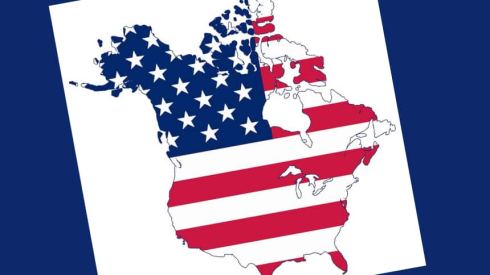
In late 2024 and early 2025, U.S. President Donald Trump repeatedly referred—sometimes jokingly, sometimes provocatively—to the idea of Canada becoming the “51st state.” These remarks reportedly began during conversations with then–Prime Minister Justin Trudeau and later appeared in public comments tied to trade disputes, tariffs, and economic leverage. Early reporting in both U.S. and Canadian outlets frequently described the remarks as characteristic of Trump’s hyperbolic negotiation style rather than as indicators of formal U.S. policy.
Canadian media coverage, however, quickly amplified the comments. Headlines and commentary increasingly framed the remarks as symbolic of American overreach or a potential threat to Canadian sovereignty. This framing coincided with heightened public attention to U.S.–Canada trade tensions and broader anxieties about economic dependence.
Following Trudeau’s resignation and Mark Carney’s rise to Liberal leadership, a snap federal election was called for April 28, 2025. At the outset of the campaign, the Liberals were trailing significantly in public polling. During the campaign, Liberal messaging increasingly emphasized the need to “stand up” to Trump-era pressure, warning that a Conservative government led by Pierre Poilievre could leave Canada exposed to U.S. demands or coercion. References to Trump’s “51st state” comments featured prominently in this broader narrative.
The election concluded with an unexpected Liberal minority victory, widely interpreted by commentators as influenced by a surge in nationalist sentiment and voter backlash against perceived American bullying. After the election, no U.S. policy moves or official statements suggested any genuine intent to pursue annexation, and Trump’s remarks continued to be linked primarily to trade pressure rather than territorial ambition.
Analytical Interpretation.
From an analytical standpoint, this sequence of events raises questions about how ambiguous external rhetoric can be transformed into domestic political leverage. Trump’s comments were provocative but informal; their political impact in Canada appears to have depended less on their substance than on how they were framed, repeated, and contextualized within a domestic campaign.
One interpretation is that Canadian media dynamics and electoral incentives interacted to elevate a symbolic remark into a perceived existential issue. In this reading, uncertainty itself became politically useful: the lack of a clear U.S. position allowed competing narratives to flourish, some of which emphasized worst-case scenarios rather than probable outcomes.
Another, more charitable interpretation is that heightened sensitivity to sovereignty concerns was a rational response to Trump’s unpredictability. Even without formal policy intent, critics argue, repeated rhetorical pressure from a powerful neighbor can legitimately influence voter behavior and campaign strategy.
A third interpretation lies between these poles: that while no annexation threat existed, the rhetoric nonetheless provided a mobilizing frame that shifted attention away from domestic issues such as housing affordability, inflation, and economic stagnation. Whether this constituted deliberate fear-manufacturing or opportunistic narrative adaptation is ultimately a matter of judgment rather than documentation.
Inviting the Reader’s Conclusion
What is clear is that the “51st state” rhetoric had political consequences in Canada despite the absence of any corresponding policy action. Whether those consequences reflect justified caution, media amplification, strategic political framing, or some combination of all three remains open to interpretation.
Readers may reasonably conclude that the episode demonstrates how modern democratic politics often operate less on concrete policy threats than on perceived risk shaped by narrative repetition. Others may see it as a case study in responsible vigilance toward an erratic ally. The available evidence supports multiple readings—and the distinction between them depends less on disputed facts than on how one interprets political incentives and media behavior in high-stakes elections.
Selected Sources
BBC News – Canadian PM reveals Trump brought up ‘51st state’ on March call (April 2025)
The Guardian – Trump’s chaotic threats won Mark Carney the Canadian election (April 2025)
The New York Times – On Canada’s Election Day, Trump Repeats ‘51st State’ Threat (April 2025)
CBC News – Carney says Trump raised ‘51st state’ during their call (April 2025)
CBS News – Canada’s Liberal Party wins election in turnaround seen as reaction to Trump threats (April 2025)
Wikipedia – 2025 Canadian federal election (accessed January 2026)











 bleatmop
 Mystro
 The Arbourist


 Dead Wild Roses
Your opinions…