
You are currently browsing the category archive for the ‘Canada’ category.
Bill C-9, officially titled the Combatting Hate Act and introduced in September 2025, amends the Criminal Code to address rising hate crimes by creating new offences, codifying a definition of “hatred,” and streamlining prosecutions. Key provisions include a new hate-motivated crime offence applicable to any Criminal Code violation (potentially carrying enhanced penalties, including life imprisonment in severe cases), criminalizing the willful promotion of hatred through public display of certain hate or terrorism symbols, and removing the requirement for Attorney General consent in hate propaganda cases. The bill also introduces offences for intimidating or obstructing access to places of worship, schools, or community centres used by identifiable groups. While presented as a response to increased antisemitism, Islamophobia, and other hatreds, critics argue it expands state power over expression in ways that threaten fundamental freedoms.
A particularly alarming development is the proposed amendment—supported by the Liberals in a deal with the Bloc Québécois—to repeal section 319(3)(b) of the Criminal Code. This longstanding defence protects individuals from conviction for wilfully promoting hatred if, in good faith, they express an opinion on a religious subject or based on a religious text. Removing it would expose pastors, priests, imams, and everyday believers to prosecution for faithfully teaching or quoting sacred scriptures on contentious issues like marriage, sexuality, or morality. The Canadian Conference of Catholic Bishops has warned that this risks criminalizing core religious doctrine, disproportionately targeting Christianity’s traditional teachings while undermining freedom of religion under the Charter.
Beyond religious discrimination, Bill C-9 erodes cognitive liberty—the right to hold and express unpopular thoughts without fear of state punishment—and free speech more broadly. By codifying a definition of “hatred” as detestation or vilification (explicitly stating it does not include mere dislike, disdain, or offence), the bill arguably lowers the high bar set by Supreme Court precedents like R. v. Keegstra and Whatcott, potentially chilling debate on public issues. Removing Attorney General oversight for prosecutions invites politically motivated charges, while broad new offences around symbols and obstruction could capture peaceful protest or artistic expression, despite carve-outs for legitimate purposes like education or journalism.
This bill exemplifies a broader authoritarian drift in Canada, where the state increasingly polices thought and belief under the guise of combating hate. Existing laws already prohibit incitement to violence and genuine hate propaganda; expanding them risks turning disagreement into crime and faith into liability. Cognitive liberty demands that Canadians can think, speak, and worship freely, even when offensive to others—yet Bill C-9 subordinates these rights to subjective interpretations of “hatred.”
As Parliament debates this legislation amid reports of a Liberal-Bloc agreement to strip religious protections, citizens must demand its rejection or substantial amendment. True tolerance protects unpopular speech, including religious conviction; suppressing it paves the way for tyranny. Canada’s Charter promises freedom of conscience, religion, thought, and expression—Bill C-9 puts them all at grave risk.

References
- Official text of Bill C-9: https://www.parl.ca/DocumentViewer/en/45-1/bill/C-9/first-reading
- Department of Justice summary: https://www.justice.gc.ca/eng/csj-sjc/pl/c9/index.html
- Charter Statement on Bill C-9: https://www.justice.gc.ca/eng/csj-sjc/pl/charter-charte/c9_2.html
- Canadian Conference of Catholic Bishops on religious exemption removal (December 2025): https://www.cccb.ca/media-release/proposed-restrictions-on-religious-freedom-bill-c-9/
- CBC News on Bloc-Liberal deal to remove religious defence (December 2025): https://www.cbc.ca/news/politics/c9-hate-speech-religion-9.7001891
- National Post on implications for faith (December 2025): https://nationalpost.com/opinion/changes-to-bill-c-9-arent-combating-hate-theyre-criminalizing-faith
- LEGISinfo page for Bill C-9: https://www.parl.ca/legisinfo/en/bill/45-1/c-9
- Canadian Civil Liberties Association concerns: https://ccla.org/press-release/ccla-bill-c-9-risks-criminalizing-peaceful-protest/
Canada finds itself at a crossroads. In recent years, per capita GDP growth has stalled, productivity remains sluggish, and housing, healthcare, and infrastructure face mounting pressure. These trends have prompted urgent debate about the causes of stagnation, ranging from global economic shifts and demographic aging to domestic policy decisions. Among commentators, JD Vance recently sparked attention with pointed critiques of Canada’s immigration policies and multicultural model, framing them as principal contributors to declining living standards. Beyond the immediate provocation, his intervention highlights a deeper question: how should Canadians assess responsibility for the state of their economy?
Immigration, Policy Choices, and Economic Outcomes
Canada’s foreign-born population now stands at approximately 23 percent, the highest in the G7, reflecting a sharp rise over the past decade. This increase was accelerated by post-pandemic labor shortages and policy decisions prioritizing high-volume admissions. While immigration is a crucial driver of population growth and labor supply, recent evidence indicates that integration has lagged, particularly for newcomers with credentials or skills mismatched to domestic demand. Unemployment rates among recent immigrants are approximately twice those of Canadian-born workers, and overall productivity growth has remained below historical trends.
These outcomes underscore a key point: while external factors including global commodity cycles, trade dynamics, and U.S. policy affect Canada’s economy, domestic decisions regarding immigration volume, infrastructure investment, and skills integration exert primary influence over living standards. The choice to expand immigration without simultaneously scaling capacity for integration, housing, and healthcare has consequences that voters ultimately authorize at the ballot box.
Stoic Lessons for Civic Responsibility
Confronted with these structural and policy realities, Canadians might feel tempted to externalize blame to markets, foreign governments, or pundits. Here, the Stoic philosophers offer timeless guidance. Marcus Aurelius wrote in his Meditations: “You have power over your mind—not outside events. Realize this, and you will find strength.” Epictetus similarly asserted: “It’s not what happens to you, but how you react to it that matters.” These principles demand that citizens distinguish between factors within their control and those beyond it, focusing energy on the former.
Stoicism is not a creed of passivity. It insists on rigorous self-examination and deliberate action. In Canada’s context, this means acknowledging the consequences of policy choices and recognizing that solutions—whether adjusting immigration strategy, improving integration programs, or investing in productivity-enhancing infrastructure—lie within domestic capacity.
Pathways to Renewal
Practical measures aligned with these principles include:
- Aligning immigration targets with absorptive capacity: Recent adjustments to temporary resident admissions, reducing projected numbers by approximately 43 percent, illustrate the potential for recalibration.
- Prioritizing skill-aligned integration: Investing in credential recognition, language training, and targeted labor placement can ensure that new arrivals contribute effectively to productivity.
- Strengthening domestic infrastructure and services: Housing, healthcare, and transportation require proportional investment to match demographic growth.
- Informed civic engagement: Voting with awareness of policy consequences is fundamental to maintaining democratic accountability and ensuring long-term economic stability.
By taking responsibility, Canadians act in accordance with Stoic precepts: focusing on what they can control rather than scapegoating external forces. The challenge is not merely economic—it is moral and civic. Prosperity depends as much on deliberate collective action as on external circumstance.
Conclusion
Canada’s stagnating living standards are the product of complex factors, yet domestic choices remain decisive. While commentary from external observers like JD Vance may provoke discomfort, the underlying lesson is clear: sovereignty entails responsibility, and agency begins at home. To confront stagnation, Canadians must embrace candid assessment of policy outcomes, deliberate reform, and disciplined civic engagement. In the words of Seneca: “We suffer more often in imagination than in reality.” Facing the realities we have constructed—and acting to improve them—is the first step toward renewal.

References
- Statistics Canada. Labour Force Survey, 2025. https://www150.statcan.gc.ca/n1/en/type/data
- Government of Canada. Immigration, Refugees and Citizenship Canada: Annual Report to Parliament on Immigration, 2024. https://www.canada.ca/en/immigration-refugees-citizenship/corporate/publications-manuals/annual-report-parliament-immigration.html
- Marcus Aurelius. Meditations. Trans. Gregory Hays, 2002.
- Epictetus. Enchiridion. Trans. Elizabeth Carter, 1758.
- Seneca. Letters from a Stoic. Trans. Robin Campbell, 2004.
Glossary
- Per Capita GDP: The average economic output per person, often used as a measure of living standards.
- Productivity: Output per unit of input; a key driver of sustainable economic growth.
- Integration Programs: Policies and services designed to help immigrants participate effectively in the labor market and society.
- Absorptive Capacity: The ability of a system (economy, infrastructure, institutions) to accommodate growth without adverse effects.
- Stoicism: Philosophical framework emphasizing rational control over one’s mind and actions rather than external circumstances.
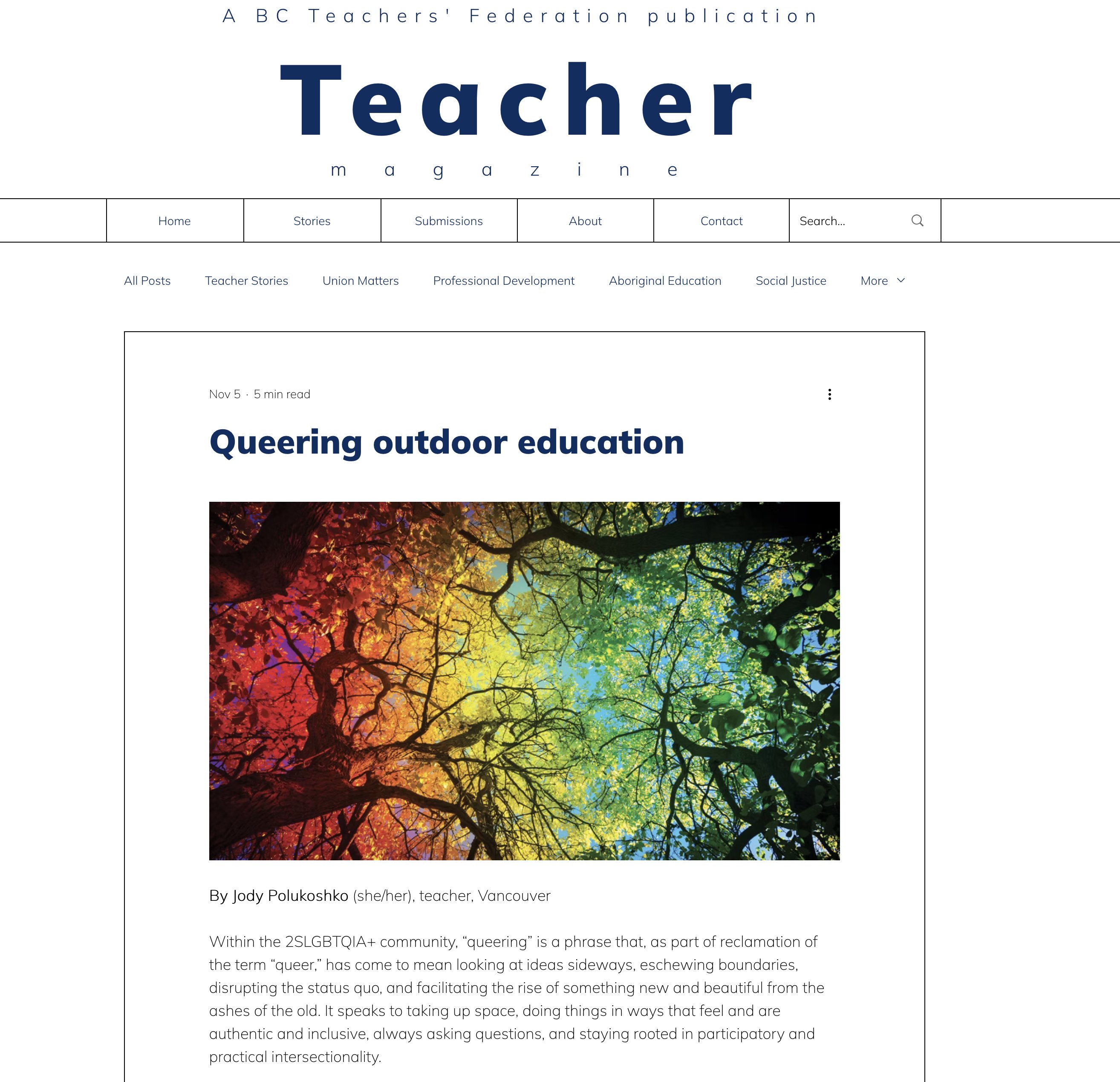
See Jonathan Kay’s X thread on the queering of outdoor education.
The British Columbia Teachers’ Federation (BCTF) has introduced a framework termed “Queering Outdoor Education,” which integrates queer theory, drag pedagogy, and decolonial approaches into environmental learning. This curriculum comprises lessons that encourage students to interpret natural phenomena through the lens of fluid identities, anti-normative critique, and social justice. While the framework is promoted as fostering inclusivity and challenging colonial and heteronormative assumptions, it raises substantive concerns regarding developmental appropriateness, educational clarity, and the potential for early ideological enculturation.
Metaphor and Conceptual Instability
The initial lessons employ metaphor as a primary pedagogical tool. Students are encouraged to draw analogies between natural elements—such as clouds, logs, or plants—and human identities, emphasizing fluidity and anti-essentialist perspectives. While metaphor can be valuable in education, these lessons risk overextending conceptual abstraction, replacing concrete environmental observation with ideological instruction. For children, particularly in early or middle childhood, excessive abstraction can hinder cognitive development by conflating empirical phenomena with normative social and political constructs.
Additionally, the curriculum critiques conventional linguistic frames, including metaphors like “birds and the bees,” positioning them as instruments of colonial and heteronormative power. Such framing may introduce complex sociopolitical interpretations into contexts traditionally reserved for foundational biological and ecological learning, potentially overwhelming young learners.
Moralizing Nature and Identity
Subsequent lessons extend these metaphorical frameworks into moral and social instruction. Students are asked to emulate the perceived allyship of natural objects and to conceptualize human identities in terms of ecological hierarchies, categorizing queer identities as “native” and others as “invasive.” While intended to promote reflection on inclusion and belonging, these exercises risk essentializing human worth according to ideologically charged criteria, substituting experiential learning with prescriptive social norms. By conflating ecological systems with social hierarchies, the curriculum may foster confusion rather than ethical understanding, undermining both environmental literacy and social cohesion.
Sexualization and Performative Instruction
The later lessons introduce overtly sexualized and performative elements, including the celebration of non-reproductive animal behaviors and the incorporation of drag-based exercises into outdoor activities. While drag pedagogy emphasizes self-invention and challenges normative binaries, its application to children’s environmental education raises questions of age-appropriateness. Embedding explicit discussions of sexuality and performative gender in contexts intended to cultivate observation, curiosity, and engagement with nature may distract from core learning objectives and impose adult conceptual frameworks onto immature cognitive and moral development.
Implications for Pedagogy
The queering of outdoor education exemplifies a broader pedagogical tension between radical inclusivity and the developmental needs of children. Integrating complex adult theoretical frameworks into early environmental education risks destabilizing students’ conceptual understanding, substituting guided inquiry with ideological instruction. While well-intentioned, such approaches may inadvertently limit children’s capacity for independent exploration, critical reasoning, and unmediated interaction with the natural world. Educational practice promote the idea of equality, not equity, along with the preservation of developmental appropriateness and cognitive accessibility.
Glossary
- Queer Pedagogy: An educational approach that incorporates queer theory to challenge traditional assumptions about gender, sexuality, and identity.
- Drag Pedagogy: A subset of queer pedagogy emphasizing performance, self-invention, and the destabilization of normative social roles.
- Decolonial Education: Curriculum frameworks aimed at addressing and countering the legacies of colonialism, often by centering Indigenous perspectives.
- Anti-Normative Critique: A critical approach that questions conventional social, cultural, or gender norms.
- Cognitive Development: The mental growth and acquisition of knowledge, reasoning, and understanding in children.
- Ideological Enculturation: The process of instilling a particular worldview or set of political beliefs, often through education.
References
- British Columbia Teachers’ Federation. Queering Outdoor Education Newsletter. 2025.
- Lacandona, Gaia. Drag Pedagogy: Performance and Learning. 2018.
- Polukoshko, Jody. Queer and Decolonial Approaches to Outdoor Learning. BCTF publication, 2024.
- Sumara, Dennis. Alternative Pedagogies and Cognitive Development: A Critical Review. 2017.
Suggested Readings Critiquing Queer Pedagogy
- Lindsay, James & McEwen, Bob. Critical Pedagogy and the Limits of Ideological Education. 2021.
- Wood, Peter. The Manipulation of Youth: How Ideology Enters the Classroom. 2019.
- Scholes, Robert. Childhood, Ideology, and the Limits of Social Theory. 2018.
- Davies, Belinda. Rethinking Radical Curricula: Balancing Innovation with Developmental Appropriateness. 2020.
That time is coming again, folks. Winter is Coming, and with it the familiar mix of beauty, inconvenience, and the kind of treachery only an Alberta chinook can undo.
Pretty soon the sidewalk in front of your house — that narrow strip we all share — will turn into a skating rink unless we do something about it. The goal is simple: get it down to dry pavement so the mail carrier, the kids heading to school, the dog-walkers, and that older couple two doors down don’t end up on their backsides with a broken wrist.
I used to think the shopping-cart test revealed everything you needed to know about a person. Turns out shoveling your walk is the grown-up version, with higher stakes. Returning a cart is easy. Clearing a sidewalk when it’s minus twenty and your snow blower is coughing its last breath? That’s real work. And some of us simply can’t do it — age, injury, travel, money, life. Totally understood.
But for those of us who can, even a half hour with a shovel keeps the whole block safer and friendlier. It means the paramedics don’t have to haul someone away from in front of your house. It means Mrs. Henderson doesn’t have to tiptoe in the street because the sidewalk’s an ice sheet. It means we all get to live in a neighbourhood that quietly says: we look out for each other here.
So when the snow flies, let’s grab the shovel, clear our stretch, and—if you’ve got it in you—give the neighbour’s corner a quick pass if they’re away or hurting. Those small, extra gestures are what make winter survivable and community real.
Winter is Coming. Let’s not let it win—and let’s make our block somewhere worth walking.

The rapid proliferation of gender ideology over the past decade—especially the surge of adolescent-onset gender dysphoria—stands as one of the clearest examples of social contagion in modern Western societies. A clinical framework once reserved for a very small number of adults with persistent, childhood-onset dysphoria was transformed into a cultural mandate through the convergence of three forces: institutional capture, algorithm-driven identity formation, and activist-driven medical practice.
Between 2015 and the early 2020s, referrals for gender services exploded—driven overwhelmingly by teenage girls with no prior history of dysphoria. Peer-group clustering, sudden identity shifts following intense online exposure, and the complete inversion of historic sex ratios all point to a socially transmitted phenomenon rather than a newly discovered biological one. Yet under the “affirmation” model, minors were placed on puberty blockers, cross-sex hormones, and permanent surgeries despite limited evidence, poorly understood risks, and a professional culture that increasingly discouraged clinical skepticism.
The hardest obstacle to unwind, however, will not be the institutions that enabled this shift. Policies can change, clinics can be restructured, and professional bodies can revise guidelines—as they already have across parts of Europe. The most immovable barrier will be parents. Many acted from compassion, social pressure, or a sincere desire to be “supportive,” but they now face an excruciating truth: they approved irreversible medical interventions on psychologically vulnerable teenagers during a developmental window historically marked by transient distress, identity confusion, and social sensitivity.
Double mastectomies on minors, lifetime fertility loss, and surgeries with complication rates exceeding anything considered acceptable elsewhere in medicine are not abstract debates. They are lived consequences. For parents, acknowledging error would require confronting a moral reality few can bear: that they were active participants in harming their own child. The human mind is built to avoid that revelation at all costs.
As a result, the detransition wave—real, growing, and increasingly documented—will face its fiercest resistance not from clinics or activists, but from within families. Parents will cling to the “lifesaving care” narrative long after the institutions that encouraged it have quietly retreated. They will reinterpret events to preserve psychic stability, even if doing so deepens the suffering of the child who must now live with the consequences.
Reversing the damage will require more than policy reform or legal accountability. It will require a public reckoning with the psychological mechanisms of self-deception, moral injury, and sunk-cost loyalty that allowed an entire society to medicate and operate on distressed adolescents in the name of affirmation. That reckoning—private, painful, and unavoidable—is the hardest part still to come.

References
-
The Cass Review – Independent Review of Gender Identity Services for Children and Young People (Interim Report) — NHS-commissioned review (Feb 2022) by Dr. Hilary Cass. Sex Matters
-
The Cass Review: Final Report (April 2024) — Hilary Cass’s full independent review. BASW+1
-
NHS England: Public Consultation Analysis & Summary – Interim Clinical Policy on Puberty-Suppressing Hormones (Jan 2024) — analysis of feedback on proposed policy changes. NHS England
-
Commission on Human Medicines (UK) Report – Proposed Restriction on GnRH Agonists for Under-18s — recommendation to restrict puberty blockers. GOV.UK
-
Equality & Health Inequalities Impact Assessment (EHIA), NHS England — assessment of health-inequality risks from the policy change on puberty blockers. GOV.UK+1
-
Karolinska Institutet Systematic Review on Hormonal Treatment in Youths (<18) — finds that GnRHa treatment should be considered experimental due to lack of long-term data. Karolinska Institutet News
-
Karolinska Hospital Policy Statement (April 2021) — stops prescribing puberty blockers and cross-sex hormones to minors under 16 except in research settings. Feminist Legal Clinic
The Stoics taught that excess corrupts both the soul and the body politic. Seneca warned that chasing boundless expansion courts ruin — true prosperity lies not in defiance of limits, but in living in accordance with nature’s measure. Marcus Aurelius similarly counseled restraint, urging us to act within the bounds of reason and accept the limits placed upon us. Applied to governance, this means a nation — like an individual — must assess its capacities before inviting more mouths to the table.
Canada’s recent immigration trajectory betrayed this principle. In 2023, the country added more than 1.27 million people — an annual growth rate of roughly 3.2 percent, driven overwhelmingly by international migration. (Statistics Canada) Over just a few years, the population climbed from under 39 million to over 41 million.
For years, permanent-resident targets hovered near 500,000, and temporary resident classes — students, workers, etc. — swelled. By 2025, however, disturbing strains were showing: housing shortages, rent and price inflation, pressure on health services, and signs of wage stress.
These were not speculative risks. Empirical analyses from bodies such as the Bank of Canada and CMHC correlate rapid population inflows with housing-market pressure. Public opinion followed suit. By late 2025, polling indicated that nearly two-thirds of Canadians considered even the then-reduced target for permanent residents (395,000) too high; roughly half held consistently negative views on immigration, not out of xenophobia, but from perceived stress on infrastructure and housing.
Recognizing this, Ottawa has begun to recalibrate. In its 2025–2027 Immigration Levels Plan, released publicly, the government committed to 395,000 permanent residents in 2025, then reducing to 380,000 in 2026 and 365,000 in 2027. (Canada) Even more significantly, temporary resident targets dropped: from 673,650 new TRs in 2025 to 516,600 in 2026, with further moderation planned. (Canada)
The demographic effects are already materializing. As of mid-2025, Canada’s estimated population growth slowed to 0.9 percent year-over-year, according to RBC Economics, with non-permanent residents making up a smaller share. (RBC) This slowdown itself validates the Stoic critique of overreach — a moment of reckoning for policy driven by expansion rather than equilibrium.
This retreat is welcome, but it remains reactive. From a Stoic perspective, reactive virtue is still virtue, but prudence demands more: a wisdom that designs policy proactively, not merely corrects after crisis. A Stoic polity would have matched immigration flows to real, measurable capacity long ago — gauging housing pipelines, healthcare strain, wage effects, and social cohesion.
Immigration in moderation enriches: it brings talent, innovation, and human flourishing. But unmoored from institutional capacity, it sows fragility, inequality, and resentment.
Going forward, Canada needs to institutionalize sophrosyne — the classical virtue of temperance and self-mastery. Targets should be set not by political fantasy or corporate lobbying, but by clear metrics: housing completions, per-capita infrastructure strain, healthcare wait-lists, and social stability.
The recent dialing back is a start. But true Stoic governance demands that moderation becomes a structural norm, not just a temporary correction. Only then can the polity live in accord with nature — virtuous, resilient, and enduring.

References
- Government of Canada, 2025–2027 Immigration Levels Plan. Permanent resident targets: 395,000 (2025), 380,000 (2026), 365,000 (2027). (Canada)
- Canada.ca, Government of Canada reduces immigration. Temporary resident reductions, projected decline in temporary population by 445,901 in 2025. (Canada)
- RBC Economics, Canada’s population growth slows… — mid-2025 year-over-year growth of 0.9%, share of non-permanent residents falling. (RBC)
- Statistics Canada, Population estimates, Q4 2024. International migration accounted for 98.5% of growth in Q4 2024. (Statistics Canada)
- CIC News, 2026-2028 Immigration Levels Plan will include new measures… — TR targets for 2026: 385,000 quoted, among other reductions. (CIC News)
- CIBC Thought Leadership, Population-growth projections… — analysis of visa expiry, outflows, and the challenge of non-permanent resident accounting. (cms.thoughtleadership.cibc.com)
Glossary of Key Terms
| Term | Meaning / Explanation |
|---|---|
| Sophrosyne | A classical Greek virtue (especially important to Stoics): moderation, temperance, self-control, and harmony with nature. In this context, it means setting immigration policy in proportion to real capacity. |
| Non-Permanent Resident (NPR) | Individuals in Canada on temporary visas: students, temporary foreign workers, etc. Not permanent residents or citizens. |
| Permanent Resident (PR) | Someone who has been granted permanent residency in Canada: not a citizen yet, but has the right to live and work permanently. |
| Levels Plan / Immigration Levels Plan | The Canadian government’s multi-year plan setting targets for new permanent and temporary immigrant admissions. |
| Absorptive Capacity | The realistic capacity of a country (or region) to accommodate newcomers without undue strain: infrastructure, housing, healthcare, labour market, social services. |
| Reactive Virtue vs. Proactive Wisdom | In Stoic terms: responding wisely after the fact (reactive) is good, but better is anticipating and designing policy with foresight (proactive). |
A recent B.C. Supreme Court ruling has intensified long-standing concerns about the direction of Indigenous-rights jurisprudence in Canada. In Cowichan Tribes v. Canada, Justice Barbara Young recognized that the Cowichan may hold Aboriginal title to a major tract of land in Richmond—land that has been surveyed, subdivided, and privately owned for more than a century. While the court did not transfer property or invalidate existing titles, the judgment rests on principles and evidentiary approaches that critics say could destabilize the foundations of Canada’s property-rights system.
As Peter Best argues in Manufactured Judgements: How Canada’s Courts Promote Indigenous Radicalism (C2C Journal, 2025), the case illustrates a broader judicial shift: courts are increasingly interpreting history, Aboriginal rights, and Crown obligations through the lens of reconciliation, sometimes in ways that depart from established legal norms, evidentiary standards, and basic assumptions about the security of freehold property.
Historical Context and the Cowichan Claim
The Cowichan, based on Vancouver Island, assert that a portion of modern Richmond corresponds to an ancestral summer fishing site. Their claim rests largely on oral traditions and historical references, including Governor James Douglas’s 1853 pledge to treat the Cowichan “with justice and humanity.”
At the time, mainland British Columbia had not yet been formally established as a British colony; governance was conducted through the Hudson’s Bay Company.
After Confederation in 1871, the disputed lands were surveyed, granted, and sold as fee-simple parcels. These titles have since passed through generations of owners, now covering dense residential neighborhoods, commercial districts, and major infrastructure. A witness in the case estimated the present value of the affected area at approximately $100 billion.
The Cowichan assert that their title to the land was never extinguished. Justice Young agreed that Douglas’s 1853 actions engaged the “honour of the Crown,” giving rise—retroactively—to a fiduciary obligation that the court believes may have been breached when settlers later acquired the land.
Shifts in Terminology, Ceremony, and the Courtroom Atmosphere
Best notes that the judgment reflects more than a legal analysis—it also signals cultural and symbolic alignment. Justice Young explicitly avoids the term “Indian,” adopts Indigenous linguistic framing, and opens proceedings with hən̓q̓əmin̓əm̓ phrases such as Huychqʼu, without translation. She thanks Indigenous witnesses for their “bravery” in testifying.
Best argues that such gestures, however well intentioned, risk creating the perception that the court identifies with one side’s worldview. Similar patterns appear in other major cases, such as Restoule v. Ontario and Gitxaala v. B.C., where courts incorporated Indigenous ceremonies, eagle staffs, and spiritual claims directly into proceedings. Higher courts, including the Supreme Court of Canada, have endorsed such practices.
While symbolic recognition is not inherently problematic, Best contends that the cumulative effect may undermine the appearance of judicial neutrality.
Evidentiary Standards: Expanded Oral Histories, Reduced Weight for Documentary Records
A central critique concerns how the court treated historical evidence.
Justice Young acknowledges that oral history “includes subjective experience” and may contain elements “not entirely factual.” Yet she relies heavily on recently recorded testimony to support the Cowichan claim, while discounting earlier documentary sources.
For example:
- Older anthropological evidence, such as the work of Diamond Jenness—who reported that Cowichan leaders in the mid-19th century denied fishing rights on the lower Fraser—was treated as less credible.
- Hearsay rules were relaxed, consistent with existing Supreme Court precedents (Delgamuukw, Tsilhqot’in), allowing extensive oral and spiritual testimony that would be inadmissible in other civil trials.
- In Gitxaala, courts recognized the existence of naxnanox (supernatural beings) and restricted mining exploration to avoid disturbing their “dens.” Best argues that importing spiritual cosmology into secular legal frameworks risks eroding basic evidentiary principles.
From his perspective, the cumulative effect is an evidentiary imbalance that places spiritual narratives and reconstructed oral histories on equal or greater footing than contemporaneous written records.
Historical Judgments Applied Selectively
Best argues that the judgment applies modern legal and moral frameworks to colonial actors—accusing them of dishonourable conduct—while refusing to apply modern moral standards to pre-contact Indigenous practices such as warfare, enslavement, or internecine violence. This asymmetry, he argues, reflects a reconciliation-oriented narrative that treats Indigenous groups as bearers of inherent moral authority while treating colonial figures primarily as agents of oppression.
The “honour of the Crown,” originally a narrow doctrine designed to ensure fair dealing in modern administrative decisions (Haida Nation, 2004), is expanding into an all-purpose lens for assessing and revising historical events. When applied retroactively to 19th-century decisions, Best contends, it risks collapsing the distinction between historical understanding and contemporary political aspirations.
Implications: Legal and Social Consequences
Although the Richmond ruling does not extinguish private property rights, it raises several concerns:
1. Uncertainty in Freehold Property Systems
If courts continue to recognize Aboriginal title in densely settled regions, the legal interface between ancient claims and freehold property becomes increasingly unclear. Even if governments—not homeowners—carry the liability, uncertainty around title affects markets, investment, and long-term planning.
2. A Growing Precedent
Should appellate courts affirm the judgment, it may encourage similar claims in other urban or developed areas. The jurisprudential trajectory appears to be expanding the geographic and historical scope of Aboriginal title.
3. Financial Risk for Governments and Taxpayers
A potential $100 billion liability—referenced in testimony—highlights the scale of future compensation, negotiation, or settlement costs.
4. Judicial Activism and the Role of Courts
Best argues that many judges now see themselves as agents of reconciliation, advancing broader societal transformation rather than resolving discrete legal disputes. Whether one views that as overdue correction or ideological mission, the implications for democratic legitimacy and legal certainty are substantial.
Conclusion
Peter Best’s critique raises difficult but important questions. The evolution of Aboriginal title law reflects sincere efforts to redress historical wrongs—but also reveals an increasingly expansive approach that reaches deep into settled expectations about property, historical evidence, and judicial neutrality.
The Cowichan case illustrates the tension between reconciliation and legal stability: a conflict not easily resolved, but one that demands scrutiny, clarity, and public debate.
Glossary of Legal Terms
Aboriginal Title
A constitutionally protected form of land ownership held communally by Indigenous groups, based on pre-contact occupation. It is distinct from fee-simple title and is difficult to extinguish without explicit government action.
Chain of Title
The documented historical sequence of legal transfers from the first grant of land to the current owner.
Fee-Simple Property
The most complete form of private land ownership in Canadian law, allowing full use, sale, and inheritance, subject only to zoning and taxation.
Fiduciary Duty
A legal obligation requiring one party (e.g., the Crown) to act with loyalty, fairness, and care toward another (e.g., Indigenous peoples), particularly in matters involving land or treaty rights.
Honour of the Crown
A legal doctrine requiring governments to act honourably in their dealings with Indigenous peoples. Courts apply it broadly, including to historical events, treaty interpretation, and modern administrative actions.
Hearsay Rule
A rule that generally excludes statements made outside court from being used as evidence. In Aboriginal rights cases, the rule is relaxed to allow oral histories.
Nullity
A legal status meaning something—such as a deed or grant—is void from the outset and therefore lacks legal effect.

References
Best, Peter. “Manufactured Judgements: How Canada’s Courts Promote Indigenous Radicalism.” C2C Journal, September 30, 2025.
https://c2cjournal.ca/2025/09/manufactured-judgements-how-canadas-courts-promote-indigenous-radicalism/
Supreme Court of Canada. Delgamuukw v. British Columbia, [1997] 3 S.C.R. 1010.
Supreme Court of Canada. Haida Nation v. British Columbia (Minister of Forests), 2004 SCC 73.
Supreme Court of Canada. Tsilhqot’in Nation v. British Columbia, 2014 SCC 44.











 bleatmop
 Mystro
 The Arbourist


 Dead Wild Roses
Your opinions…