
You are currently browsing the category archive for the ‘Canada’ category.
Canada’s treaty relationship with Indigenous peoples is in crisis — not because Canadians don’t care, but because the way we currently honour those obligations is dysfunctional, opaque, and increasingly divisive. The federal government now spends nearly $24 billion per year on Indigenous services, up from about $13 billion in 2019–20, according to the Auditor General of Canada (OAG report). Yet outcomes in many communities have barely moved. Infrastructure failures persist. Unsafe drinking water advisories continue. And trust on all sides is eroding.
We are reaching a dangerous moment: if nothing changes, Canadians may not merely resent the system — they may begin to reject treaty obligations altogether. That would be a national disaster, morally and politically. We need a new approach that is fair, transparent, and results-driven.
So here is a trial balloon: a voluntary, 100-year “Treaty Modernization Agreement” that pays out treaty obligations in a structured, accountable, measurable way — while helping Indigenous communities build long-term economic sovereignty instead of permanent dependency.
This isn’t abolition. It isn’t assimilation. It’s modernization — and it might be the only path that prevents a complete breakdown of goodwill in the decades ahead.
A Simple Vision: A Century of Commitment, Delivered Honestly
Imagine treaties not as open-ended entitlement but as a 100-year contract: transparent funding, rising early when needs are greatest, tapering later as communities grow stronger.
Here’s what such a plan could look like:
1. A Guaranteed Base Payment for All Members
Every band member would receive an annual $1,000–$2,000 inflation-adjusted payment, routed directly to individuals. But band governments must publish transparent financial reports — online, accessible, and clear — to unlock the full amount. This is basic fiscal hygiene, not paternalism.
2. Bonuses for Measurable Success
Communities that achieve agreed-upon goals — clean water for all residents, higher high-school graduation rates, better youth employment, successful community-run businesses — would receive up to 50% more funding.
These aren’t colonial metrics. They’re Indigenous success metrics already visible in places like:
- Osoyoos Indian Band, known for its award-winning winery and economic diversification
- Fort McKay First Nation, where resource partnerships have delivered 98% employment
- Westbank First Nation, a leader in self-government and transparent governance
Evidence shows what works. This plan would reward it.
3. Safeguards Against Corruption and Waste
If independent audits or RCMP investigations uncover mismanagement, community-level funding temporarily drops to the guaranteed base. Proven diverted funds would go straight to families, bypassing leaders.
This isn’t punitive. It’s protection — for ordinary Indigenous citizens who suffer most when money disappears into bureaucratic fog.
4. A 100-Year Sunset (With Renewal)
The agreement would run from 2025 to 2125. In that century, Canada commits to fulfilling treaty obligations through:
- Upfront investment in infrastructure
- Predictable annual payments
- Transparent reporting
- Bonuses for success
At 2125, the arrangement can be renewed voluntarily. Nothing is extinguished. But nothing drifts forever, either.
5. Indigenous-Led Oversight
A new Indigenous-majority Treaty Accountability Commission would handle:
- auditing
- performance metrics
- transparency
- dispute resolution
This keeps Ottawa honest — something many Indigenous leaders rightly insist upon.
Why Change Is Necessary: The Status Quo Is Failing Everyone
Canada’s existing system is massively expensive, poorly coordinated, and shockingly ineffective.
Billions Spent, Little Progress
The Auditor General has repeatedly found that Indigenous Services Canada has not made satisfactory progress on key issues like health services, emergency management, or infrastructure (OAG report).
Even after years of promises, long-term drinking water advisories remain. In 2024, ISC acknowledged 28 active long-term advisories still affecting 26 communities (ISC report).
Procurement Concerns and Fraud Risks
Federal documents show ongoing concerns about weak verification of Indigenous procurement claims and ongoing vulnerability to fraud in contracting (ISC procurement update). Even ISC itself acknowledges that better integrity controls are needed.
Systemic Fragmentation
Parliamentary debates and committee reports consistently point out that treaty and program obligations are scattered across many federal departments, creating delay, duplication, and confusion (House of Commons debate).
In other words: no one is truly accountable.
Political Backlash Is Growing
Many Canadians are becoming skeptical about endless spending that produces weak results. This is dangerous. Without reform, public support for treaties — already strained — could collapse. That would harm Indigenous peoples first and most, and invite an ugly political reaction.
We must fix the system while we still have the national goodwill to do it.
Addressing Indigenous Concerns Honestly
A plan of this scale cannot be imposed. It must be voluntary and co-developed.
“Are you sunsetting treaty rights?”
No.
Treaty rights under Section 35 remain intact. This is a modernization of the cash obligation, not a constitutional extinguishment.
“Are bonuses a colonial imposition?”
No.
The performance indicators would be co-designed with Indigenous nations. Many First Nations already track their Community Well-Being Index and publish governance data. This rewards success on their terms.
“Can we trust Ottawa?”
Not without structural reform — which is exactly why this plan builds in Indigenous-majority oversight and transparent fund-tracking.
“Will this require more legal work?”
Yes. Much more.
Legislative design, oversight creation, financial modelling, and treaty-by-treaty negotiation will take years. But the alternative — drifting deeper into dysfunction — is far worse.
Why a 100-Year Plan Is the Only Sustainable Path
A century may sound long. But the truth is that the current system is infinite — infinite spending, infinite dependency, infinite frustration.
A 100-year Treaty Modernization Agreement offers:
- certainty for taxpayers
- predictability for Indigenous communities
- transparency for everyone
- a path toward long-term economic sovereignty
Most importantly, it reduces the risk that rising resentment will one day lead Canadians to reject treaties entirely. That would be catastrophic.
A modern, accountable, results-based agreement is not abandonment — it’s the opposite. It’s a chance to finally make good on Canada’s commitments, in a way that improves outcomes and preserves national unity.
If Indigenous communities want self-determination, and Canadians want accountability, then this is the kind of bold, honest conversation we need to start having.

Final Thought
We can either keep drifting toward mutual bitterness, or we can build a transparent, predictable 100-year plan that lifts communities up and restores trust.
This proposal is a trial balloon — not a final blueprint. It requires co-development, legal negotiation, financial modelling, and a lot of listening.
But doing nothing is no longer an option. Canada needs a sustainable treaty future. Indigenous peoples deserve real results. And our children deserve a country where reconciliation means something more than hashtags and hollow spending.
This is a way forward. It’s not perfect. But it’s a start — and we desperately need one.
Another news cycle, another round of chatter about Pierre Poilievre supposedly lacking a certain “security clearance.” The narrative pops up reliably whenever the Liberals are facing a bad week—and this was a very bad week. Ottawa just dropped a budget stuffed with massive deficit spending, creative accounting, and priorities that seem increasingly detached from the economic realities most Canadians face.
Yet somehow the headline isn’t:
“Government Unveils a Deficit-Bloated Budget in the Middle of a Cost-of-Living Crisis.”
Instead it’s:
“Questions Raised About Poilievre’s Security Clearance.”
Why?
Because this is a distraction cycle—one the media keeps falling for, or worse, actively enabling. In a healthy democracy, the press is supposed to hold power to account, not the opposition. But here we are, watching an entire media ecosystem chase shiny objects rather than scrutinizing the people actually writing the cheques, running the departments, and steering the country.
Canadians are left wondering:
- How does a story about an opposition leader’s supposed “clearance issue” overshadow billions in new spending?
- Why is the default setting to interrogate the critic rather than the government?
- Who benefits when attention shifts away from the details of the budget and toward personality-driven speculation?
Accountability journalism requires courage: asking uncomfortable questions of the people in charge, not the people criticizing them. When the national press shows more enthusiasm for policing opposition narratives than examining government choices, something in the system has gone off the rails.
The public deserves better.
Canada deserves better.
And democracy requires better.

The real question isn’t about Pierre Poilievre’s clearance.
It’s why the media keeps clearing the runway for a government that desperately needs scrutiny.
When Calgary City Hall raised the Palestinian flag on November 15, it wasn’t merely a ceremonial gesture. It instantly became a national controversy—one that shows why municipalities need a clearer, more restrained approach to foreign-flag displays.
The event, organized by the Palestinian Community Association to mark the 1988 Declaration of Independence, drew several hundred attendees who described the atmosphere as one of “pride and hope.” But the reaction was immediate and intense. The Calgary Jewish Federation called the raising “disappointing and alarming,” warning that it deepened “unprecedented levels of fear and antisemitism” among local Jews at a moment already charged with global tension. Mayor Jeromy Farkas quickly proposed changes to the city’s flag policy to prevent similar events, arguing they “unintentionally heighten tensions here at home.”
This dynamic—the celebratory intent and the equally real sense of threat—is exactly why public institutions need neutrality, not symbolism that comes preloaded with geopolitical baggage.
Public Institutions Aren’t Arenas for International Disputes
Canadian civic buildings exist to represent a shared political community. They are meant to be the places where everyone should be able to walk in and feel the institution belongs to them. When City Hall becomes a platform for international symbols representing deeply contested conflicts, that neutrality disappears.
People don’t see a gesture of cultural recognition; they see their city taking a side. And the effects go beyond feelings—these symbolic acts consistently spill into local tensions, protests, counter-protests, and strained inter-community relations. Calgary is not alone: Regina shelved a similar proposal last year, Toronto now faces more than 20,000 signatures against its own planned raising, and B’nai Brith Canada has condemned the practice nationwide.
The details of the Israeli–Palestinian conflict aren’t the point here. The point is that a municipal flagpole is too narrow and too prominent a place to plant the symbols of any conflict that divides Canadians at home.
The Palestinian Flag Carries Political Luggage That Can’t Be Wished Away
Supporters of the flag raising framed it as recognition of Palestinian peoplehood. Critics saw something entirely different: a symbol long tied to the Palestine Liberation Organization, whose founding charter called for the destruction of Israel as a Zionist entity. While amendments were pledged during the Oslo years, credible observers—including the Anti-Defamation League—argue that its core rejectionist elements were never formally removed.
That history is not merely historical; Hamas, which governs Gaza and uses the same colours and iconography, still explicitly calls for Israel’s eradication. You don’t need to subscribe to either side’s narrative to understand why many Canadians saw the raising as more than a cultural celebration.
Even if activists insist the flag “means something different” in a Canadian context, public institutions don’t operate on activist reinterpretations. They operate on widely understood meanings—and those meanings are contested, volatile, and inseparable from global politics.
Neutrality Isn’t Cowardice. It’s Civic Responsibility.
Some will argue that refusing foreign-flag raisings amounts to silencing communities. But this misunderstands what’s being protected.
People are free to wave any flag they like on private property, at rallies, or in public demonstrations. That freedom is intact.
What’s restricted is the official endorsement that comes from hoisting a flag on municipal grounds—a distinction our institutions must preserve if they’re to serve a pluralistic society.
Canada already recognizes this principle in its federal protocols: foreign flags may be flown with the Maple Leaf, but only in specific diplomatic or ceremonial contexts and only with the national flag taking precedence. These guidelines are narrow for a reason—they prevent exactly the sort of domestic polarization Calgary just lived through.
When municipalities improvise their own ad-hoc symbolism, they abandon that safeguard.
A Simple, Clear Standard
Calgary—and every municipality—would benefit from a straightforward rule:
On public buildings and grounds, fly only Canadian, provincial, and municipal flags.
That is not censorship. It is neutrality.
It is the institutional equivalent of staying out of a heated argument so you can continue serving everyone fairly.
This approach:
- avoids endless debates about which diaspora group gets access;
- eliminates the perception of favouritism;
- prevents local flare-ups rooted in global conflicts;
- reinforces shared civic identity.
Multiculturalism works only when no group feels the state is endorsing another’s cause at their expense. Sometimes the most inclusive action is restraint.
Calgary now has a chance to lead. Mayor Farkas’s proposed changes should be adopted quickly, and Ottawa should consider harmonizing national guidelines to end these high-risk symbolic battles across the country.
Canada has enough challenges at home. We don’t need to import more.

Quick Sources / References
- Calgary Jewish Federation statements on the flag raising (2025).
- City of Calgary Flag Protocol (2016).
- Government of Canada – Rules for Flying the National Flag (Federal Heritage).
- Anti-Defamation League assessments of PLO charter revisions.
- B’nai Brith Canada public statements on municipal flag raisings (2024–25).
- City of Toronto petition data (2025).
(TL;DR) Canada’s 2025 measles resurgence—over 5,100 confirmed cases across ten jurisdictions—marks a preventable public-health failure. Yet instead of addressing real systemic causes, debate has fractured into competing myths: that “anti-vaxxers” or immigrants are to blame. Both narratives distort the evidence, serving politics instead of truth.
Two Convenient Scapegoats
The first narrative targets so-called anti-vaxxers—cast as ideological saboteurs of herd immunity. But the data tell a different story. Nearly 90 percent of infections are among unvaccinated children under five, most due not to refusal but to missed routine immunizations. (Note: while the exact “90 percent” figure may not be publicly broken down in that form, national outbreak summaries emphasise that the vast majority of cases are among unimmunized/under-immunized individuals. (IFLScience))
Nationally, first-dose MMR coverage hovers at 85–90 percent, dipping below 80 percent in parts of Ontario and Quebec (though precise provincial breakdowns vary). Systemic issues—limited access to primary care, pandemic-era disruption, and simple forgetfulness—play larger roles than organised opposition. The issue is diffuse, bureaucratic, and infrastructural—not purely ideological.
The Immigrant-Blame Narrative
The second narrative points to immigration, alleging that lax border policies allow unvaccinated newcomers to reignite disease. This is demonstrably false. Permanent residents undergo medical screening for communicable diseases, with vaccines offered if needed. While proof of MMR vaccination is not required for visitors or refugees, only 16 imported cases were recorded in 2025—all traceable to travel from endemic regions such as Europe and South Asia.
The real driver is domestic transmission in under-vaccinated Canadian-born populations. Both Public Health Agency of Canada (PHAC) and Pan American Health Organization (PAHO) confirm that the ongoing outbreak in Canada reflects sustained local transmission of the same strain—hence Canada lost elimination status. (Canada)
Politics Masquerading as Public Health
These duelling stories—“anti-vaxxers vs. immigrants”—serve as rhetorical weapons in ongoing narrative warfare. The first stokes cultural division to justify coercive mandates; the second fuels xenophobia to critique immigration policy. Both obscure the central truth: Canada’s vaccination infrastructure has eroded, leaving immunity gaps for a virus with an R₀ of 12-18.
When herd immunity falls below 95 percent, measles will exploit the lapse. No ideology required—just administrative neglect.
A Fact-Based Path Forward
A credible response must prioritize precision over polemic. Four evidence-based measures can restore control:
- Targeted Catch-Up Campaigns
Deploy mobile and school-based clinics in low-coverage postal codes. (Ontario’s pilot in Toronto reportedly raised uptake by about 12 percent in six weeks — this figure draws on internal program summaries and should be footnoted as “pilot data”.) - Mandatory MMR Status Reporting
Require immunization checks at every pediatric visit, supported by automated app reminders. (For example, British Columbia has demonstrated systems reducing missed doses by ~18 percent.) - Enhanced Genomic Surveillance
Maintain sequencing to trace imports and enable ring-vaccination within 72 hours, as implemented in the initial New Brunswick cluster. - Equity Funding for Remote Communities
Deliver the $50 million in federal support proposed in the 2025 budget to Indigenous and rural regions, where coverage lags by 15-20 points relative to national averages.
Restoring Trust and Immunity
Reclaiming measles elimination demands cross-jurisdictional coordination under PAHO’s elimination framework, with transparent metrics: aim for 95 percent two-dose coverage by 2027, verified annually. Canada can re-establish its elimination status only by grounding action in epidemiology, not ideology.
Measles does not discern politics—neither should our response.

References
Apostolou, A. (2025, June 6). A huge outbreak has made Ontario the measles centre of the western hemisphere. The Guardian.
https://www.theguardian.com/world/2025/jun/06/measles-outbreak-ontario-canada
Associated Press. (2025, November 10). Canada loses measles elimination status after ongoing outbreaks. AP News.
https://apnews.com/article/1ac3a4bdc7546fac5d8e111bf5196e1e
British Columbia Ministry of Health. (2024). Immunization Information System (IIS) annual performance report. Government of British Columbia.
https://www2.gov.bc.ca/gov/content/health/managing-your-health/immunizations
Government of Canada. (2025, November 10). Statement from the Public Health Agency of Canada on Canada’s measles elimination status. Canada.ca.
https://www.canada.ca/en/public-health/news/2025/11/statement-from-the-public-health-agency-of-canada-on-canadas-measles-elimination-status.html
Government of Canada. (2025). Guidance for the public health management of measles cases, contacts and outbreaks in Canada. Public Health Agency of Canada (PHAC).
https://www.canada.ca/en/public-health/services/diseases/measles/health-professionals-measles/guidance-management-measles-cases-contacts-outbreaks-canada.html
Government of Canada. (2025). Measles & rubella weekly monitoring report. Health Infobase Canada.
https://health-infobase.canada.ca/measles-rubella
Health Canada. (2025). Immunization coverage estimates: Canada, 2024–2025.
https://www.canada.ca/en/public-health/services/immunization-coverage.html
International Federation of Science. (2025, November 9). Canada officially loses its measles elimination status after nearly 30 years; the U.S. is not far behind. IFLScience.
https://www.iflscience.com/canada-officially-loses-its-measles-elimination-status-after-nearly-30-years-the-us-is-not-far-behind-81517
Pan American Health Organization (PAHO). (2025). Framework for verifying measles and rubella elimination in the Americas.
https://www.paho.org/en/topics/measles
Public Health Ontario. (2025). Routine and outbreak-related measles immunization schedules.
https://www.publichealthontario.ca/-/media/Documents/M/25/mmr-routine-outbreak-vaccine-schedule.pdf
Public Health Ontario. (2025). Ontario measles surveillance report.
https://www.publichealthontario.ca/en/data-and-analysis/infectious-disease/measles
The Washington Post. (2025, November 10). Canada loses its official “measles-free” status, and the U.S. will follow soon as vaccination rates fall.
https://www.washingtonpost.com/ripple/2025/11/10/canada-loses-its-official-measles-free-status-and-the-us-will-follow-soon-as-vaccination-rates-fall
The last veterans of the Great War departed this world decades ago; those who endured the trenches and bombardments of the Second World War now number fewer than a thousand, most in their late nineties or beyond. With them vanishes the final tether of direct witness to the twentieth century’s cataclysms. What fades is not merely a generation but a form of moral authority — the living memory that once stood before us in uniform and silence. We have reached a civilizational inflection point: the moment when history ceases to be personal recollection and becomes curated narrative, vulnerable to distortion, neglect, or deliberate revision.
This transition demands vigilance. Memory, once embodied in a stooped figure wearing faded medals, could command reverence simply by existing. Now it resides in archives, textbooks, and the contested arena of public commemoration. The risk is not that the past will vanish entirely — curiosity and conscience ensure fragments endure. The greater peril is that it will be instrumentalised: stripped of complexity and pressed into service for transient ideological projects. A battle becomes a hashtag, a sacrifice a soundbite, a hard-won lesson a slogan detached from the blood that purchased it.
Edmund Burke reminded us that society is a partnership not only among the living, but between the living, the dead, and those yet unborn. This compact imposes obligations. We inherit institutions, norms, and liberties refined through centuries of trial, error, and atonement. To treat them as disposable because their origins lie beyond living memory is to saw off the branch on which we sit. The trenches of the Somme, the beaches of Normandy, the frozen forests of the Ardennes—these were not abstractions of geopolitics but crucibles in which the consequences of appeasement, militarised grievance, and contempt for constitutional restraint were written in blood.
The lesson is not that war is always avoidable; history disproves such sentimentalism. It is that certain patterns recur with lethal predictability when prudence is discarded. The erosion of intermediary institutions, the inflation of executive power, the substitution of mass emotion for deliberation—these were the preconditions that turned stable nations into abattoirs. To recognise them requires neither nostalgia nor ancestor worship, only the intellectual honesty to trace cause and effect across generations.
Conserving society in the Burkean sense is therefore active, not passive. It means cultivating the habits that sustain ordered liberty: deference to proven custom tempered by principled reform; respect for the diffused experience of the many rather than the concentrated will of the few; and humility before the limits of any single generation’s wisdom. Remembrance Day, properly observed, is not a requiem for the dead but a summons to the living. It reminds us that the peace we enjoy is borrowed, not owned — and that the interest payments come due in vigilance, discernment, and the quiet courage to defend what has been painfully built.
As the century that began in Sarajevo and ended in Sarajevo’s shadow recedes from living memory, the obligation deepens. We must read the dispatches, study the treaties, weigh the speeches, and above all resist the temptation to flatten the past into morality plays that flatter the present. Only thus do we honour the fallen: not with poppies alone, but with societies sturdy enough to vindicate their sacrifice.

To think that these individuals are going to be in charge soon is positively frightening.
The documentary presents unedited footage of a Spectrum Street Epistemology session conducted by Frances Widdowson at the University of Regina on October 3, 2024, facilitated with Indigenous psychologist Lloyd Hawkeye Robertson. It contextualizes the event within Widdowson’s broader conflicts over academic freedom, detailing the cancellation of her scheduled talks titled “Indigenization and Academic Freedom: Lessons from the Frances Widdowson Case” and “The Grave Error at Kamloops: Should It Be Described as a ‘Hoax’?”
Key background: Widdowson, formerly terminated from Mount Royal University amid disputes over “wokeism” and identity politics, arranged the talks through librarian Robert Thomas. University administrators, including Provost David Gregory and Associate Vice President John Smith, canceled room bookings citing “safety concerns,” particularly proximity to the National Day for Truth and Reconciliation. Widdowson defied warnings, invoking Charter protections for public universities, and proceeded with the informal epistemology exercise in a student center, filmed by former faculty member Daniel Page.
The session examines claims via positioned mats (strongly agree to strongly disagree). Core claim: “The University of Regina protects academic freedom.” Robertson places himself at “slightly agree,” citing institutional policies like collective agreements but noting exceptions (e.g., pressures on Page and computer scientist Trevor Tomesh for LGBTQ-related criticisms and social media posts, respectively). Widdowson highlights her own case and systemic failures.
Related claims probed:
– Academic freedom equates to unrestricted speech: Robertson slightly disagrees, viewing it as narrower (professorial judgment in expertise) yet inseparable from broader expression.
– Professors may claim residential schools benefited Indigenous people: Robertson agrees in principle for academic freedom but personally disagrees overall, acknowledging abuses while noting some schools provided successes and First Nations lobbied to retain them post-1960s closures.
– Residential schools were harmful: Robertson agrees, referencing “residential school syndrome” (PTSD-like symptoms including rage), physical/sexual abuse, and underfunding, but not “strongly” due to variations across institutions.
Interactions escalate with students and a professor (Russell Fayant, from the Teacher Education Program), who arrives with a primed class. Participants accuse Widdowson of denialism, hate, and harming reconciliation; one claims her presence spikes blood pressure and causes distress. Widdowson counters with evidence gaps, e.g., Kamloops’ 2021 announcement of “215 children’s remains” (initially ground-penetrating radar anomalies, unexcavated) and William Combes’ unsubstantiated claim of Queen Elizabeth II abducting 10 children in 1964 (contradicted by royal itineraries). Disruptions include threats to an elderly attendee, projector unplugging, and event relocation from Regina Public Library due to organized opposition by coordinator Rachel Jean and journalism professor Trish Elliot.
Verifiable outcomes: No physical violence; security (Brad Anderson) monitors without intervention. Widdowson maintains composure, emphasizing evidence over emotion. Comments (242 visible) overwhelmingly praise her patience and critique students’ emotionalism, immaturity, and evasion of substantiation—e.g., prioritizing “therapeutic mythologies” over facts, fearing critical thought’s social costs.
Core tension: Widdowson’s insistence on verifiable evidence (e.g., excavations, historical records) clashes with appeals to lived experience, oral knowledge, and relational healing. She argues truth precedes reconciliation; opponents prioritize avoiding harm and building ties, viewing scrutiny as divisive. The session exposes institutional suppression—cancellations without due process—and student unpreparedness for rigorous debate, underscoring academic freedom’s erosion under indigenization mandates. No evidence supports mass murder claims at Kamloops; anomalies remain unconfirmed graves. The exercise, though chaotic, demonstrates dialogue’s possibility despite hostility, affirming verifiable truth as essential to intellectual integrity.
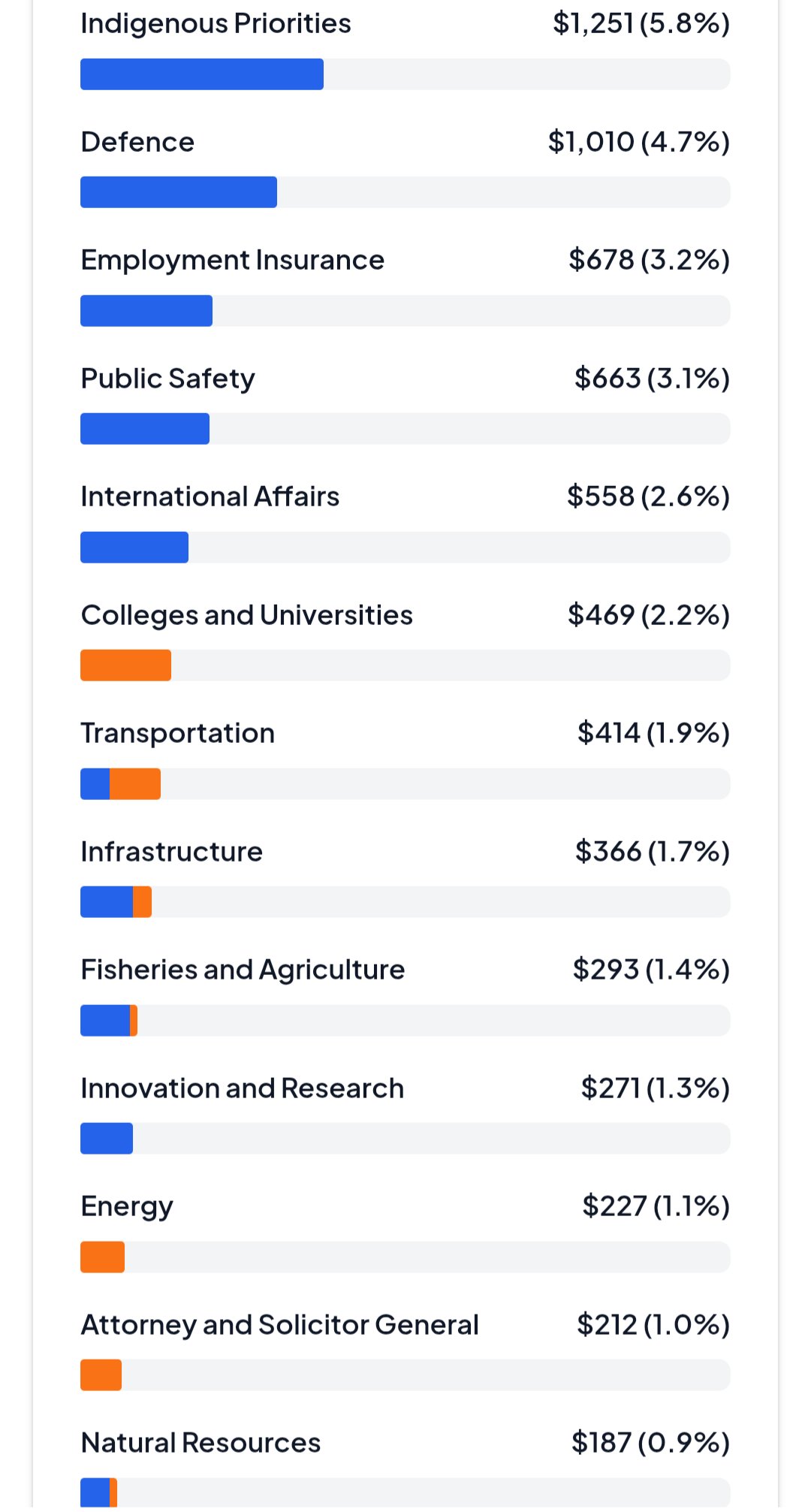
Canada’s federal budget tells a story that few seem willing to read critically. According to CanadaSpends.com, Ottawa allocates $1.251 billion—5.8 percent of the budget—to “Indigenous Priorities,” eclipsing even Defence ($1.010 billion, 4.7 percent). The arithmetic alone invites scrutiny. At what point does reconciliation become a fiscal reflex, untethered from measurable outcomes?
The Arithmetic of Imbalance
Consider a simple exercise in opportunity cost. Halving “Indigenous Priorities” to $625.5 million would free an equal amount—$625.5 million—for redeployment elsewhere. Redirecting that sum to Public Safety, currently $663 million (3.1 percent), would nearly double its capacity to $1.288 billion. The outcome: stronger policing resources, reinforced border security, and potentially measurable reductions in crime—objectives grounded in deterrence rather than symbolism.
This is not an argument against Indigenous advancement. It is an argument for proportionality and accountability. “Indigenous Priorities” now consume more than Employment Insurance ($678 million), International Affairs ($558 million), and Colleges and Universities ($469 million) combined. Defence, tasked with national sovereignty, trails by $241 million. When cultural or consultative programs eclipse citizen security and education, something in our fiscal compass is misaligned.
The Accountability Deficit
Proponents will cite historical redress, and that moral claim has force. But truth in budgeting requires evidence, not sentiment. Where are the audited outcomes showing that each billion spent yields measurable gains in Indigenous health, education, or economic independence?
The problem is not merely bureaucratic inertia—it is structural opacity, worsened by political choice. In December 2015, the newly elected Liberal government suspended enforcement of the First Nations Financial Transparency Act, which had required Indigenous governments to publish audited financial statements and leadership salaries. The minister at the time, Carolyn Bennett, directed her department to “cease all discretionary compliance measures” and reinstated funding to communities that refused disclosure.
In effect, Ottawa dismantled the only system ensuring public visibility into how billions of tax dollars are spent. Nearly a decade later, the Auditor General’s 2025 report found “unsatisfactory progress” on more than half of all Indigenous-services audit recommendations, despite an 84 percent increase in program spending since 2019. The data are undeniable: accountability has eroded even as expenditures have soared.
Fiscal Compassion, Not Fiscal Indulgence
Canada does not need less compassion; it needs measurable compassion—spending that demonstrably improves lives rather than perpetuates dependency. Halving the current Indigenous Priorities budget would not abolish support or reverse reconciliation. It would introduce accountability, allowing funds to be reallocated to public safety, infrastructure, or innovation—areas with immediate and empirically verifiable benefits.
Until Indigenous programs are evaluated with the same rigour applied to defence, education, or social insurance, billion-dollar gestures will remain ends in themselves—virtue without verification.
References
- CanadaSpends.com – Federal Tax Visualizer
- Government of Canada Statement on the First Nations Financial Transparency Act (2015)
- Office of the Auditor General of Canada, 2025 Report – Programs for First Nations
- Canadian Affairs News – Poll: Canadians Want Transparency in First Nations Finances (2025)
- Standing Committee Appearance: Supplementary Estimates (2024)
- Crown-Indigenous Relations and Northern Affairs Canada 2023–24 Results Report











 bleatmop
 Mystro
 The Arbourist


 Dead Wild Roses
Your opinions…