
You are currently browsing the category archive for the ‘Feminism’ category.
The piece is jam-packed with stupid, so we’ll just hit the highlights here and dissect the inanity RPOJ style. :) Check out the original post here.
“Let’s get the most obvious out of the way first: TERFs are about as feminist as Jim Davidson. They’re also very comfortable with forming political alliances with conservative men, and indeed prefer to date conservative men as they have more in common with them politically.”
Can you see the fallacy here? I know I sure can. Rhymes with Fad Pomulem. Oh those dastardly radical feminists how could they even consider dating conservative men?!?!? Sounds like some serious shaming going on by ‘liberal feminist’ (NB: Shaming is what lib-fems do to shut people up when their faux-empowerment is shown to be a lie within the context of society: prostitution for example has been shown irrefutably to harm women, naming this problem for women as class angers the choosy-choice feminists to no end, as it illustrates that choices offered within a patriarchal context are quite the opposite of empowering) The irony along with the crappy argumentation is quite thick already.
“So it’s hardly a shock that they’ve been parroting patriarchal talking points.”
Which talking points exactly are you referring to? You don’t bother to mention it, so I guess we’ll have to take your word about radical feminists parroting patriarchal talking points. *rollseyes* Those radfems talk about how men should own up and take responsibility for their shitty behaviour – nothing but patriarchal talking points after all…
“Then we have the media transmisogynists like to pretend that trans women pose a problem for reproductive rights activism, which is a deliberately disingenuous misrepresentation of the fairly uncontroversial demand that when we talk about reproductive organs and human bodies, we’re gender-neutral about it, because that’s more precise. “
Read this fucking paragraph twice. First, the claim that ‘the media’ is transmisogynistic? Really? Transactivism is the new misogyny and finds near universal support in the mainstream media as it is not a threat to male power, or male preeminence in society. Transactivism is patriarchally approved, through and through and is treated a such.
Let’s look at the next nugget of wisdom. Trans identified Males (TiM’s) do not pose a problem to reproductive rights activism. Quite frankly, TiM’s don’t give a shit about reproductive rights activism because it doesn’t involve them because men (*trigger alert for those who don’t ‘do’ biological facts*) can’t get pregnant.
What I have seen the trans-activists push for is the removal of the mention of females regarding their biological processes – “Chestfeeding” “Birth Parent” and other female erasing poppy-cock.
So if your activism is includes erasing females and their biological processes from the public sphere it goddamn well is ‘a problem’ for reproductive rights activism.
Uncontroversial demands? That we separate the idea that reproductive organs (which generally determine biological sex) from the sex that they are associated from? How can disassociating male – has penis, and female – has vagina be fucking uncontroversial. The last time I checked I didn’t see any free floating vagina’s hanging around with a without a person of the matching biological sex attached to it.
You can fuck right off with your free form facts and redefintions of material reality. Your ideology is bunk, and you do not get to take me with you on your baseless twisted flights of fancy.
“It simply isn’t true that trans women are a block to reproductive rights. In fact, they’re doing more than any media transphobe ever has.”
Men are a barrier to reproductive rights. Whether or not they happen to believe they are women is irrelevant.
“How do we know this? One of the places to look is Ireland, where there is a huge struggle for access to abortion. I follow this activism keenly, and do what I can to support and boost their work,”
Handmaiden status achieved! You are so much closer to being regarded as fully human, just keep on supporting men and putting down females fighting for liberation from patriarchy – you will be granted human status soon…really soon, just around the corner…
” so I’m aware that there are a lot of trans women deeply involved in this crucial action. I’ve met many Irish trans feminists who participate in reproductive freedom work. And likewise, Irish feminists don’t want these UK TERFs anywhere near their work, having recently produced a widely-signed open letter telling TERFs exactly where to fuck off to.”
Yep, because chastising females for daring to speak against legislation that has negative effects on them is a completely feminist thing to do. Telling women to ‘fuck off’ and shut-up about their problems just resonates with empowerful female affirming action. Yeah, no.
“If you actually care about reproductive rights, you’d know this, and that’s how it becomes abundantly clear that your transmisogynistic bigots are simply using abortion access as a dogwhistle for “women are defined by reproductive organs and only that.”
Wow. It’s so nice to see the trans-rhetoric so powerfully restated with all relevant distortions intact. Radical feminists are not arguing that women are just vaginas, they are saying that the female class of people that happen to have vaginas are oppressed by patriarchal society *because* they possess these organs. One of the main axis of oppression for females in society is their biological sex. Funny how intersectionality when properly used never comes up when dealing with transactivist crowd.
“To me, feminism is always and has always involved liberating women from our biology. A refusal to define us by whether or not we can bear children. I’ve written before about how this biological essentialism promulgated by transmisogynistic bigot feminists is identical to that promulgated by misogynists. I’ve also defined my stance as pro-trans and pro-choice.”
Nice. Liberating does not mean erasing female biology from the public sphere. Acknowledging that biological sex is real and is a foundational source of oppression for women might be a start.
“But I want to say it once more, loudly, for the people at the back: trans rights and reproductive rights are intimately linked. You cannot have one without the other. It all boils down to bodily autonomy.”
Reproductive rights and right to self identify are not linked in any way. Females should have the right to determine what is best for themselves in terms of their reproductive choices. How the male ‘right’ to call themselves something they are not – even if they really really really really …really… feel it – isn’t even in the same fucking ballpark. It’s quite insulting to equate one of the most important struggles for female liberation with the insipidly desultory gender ‘self-identifications’ of men.
“Our struggles are the same, and scratch a transmisogynist, and it’ll bleed womb-botherer in the end. Don’t let them win, and let’s continue to stand shoulder to shoulder against these attacks.”
Just shaking my head. This is what happens when you let men centre themselves in feminism. This is why Feminism needs to centre females in their struggles to gain liberation in society, because once men get in, it becomes all about men and their problems.
Standing shoulder to shoulder with your oppressors! FML. This shambolic, inclusivity laced, Orwellian bafflegab that is masquerading as feminism needs to stop.
Wow, I found this piece languishing in my my drafts section. A critical analysis of how BDSM and rape culture intersect and how unsurprisingly it is a bad deal for women and good one for men.
“BDSM is NOTHING to do with rape culture though? It’s completely and utterly different…”

answered:
There are detailed explanations for why that’s not true. Explanations that include studies that reveal the high rates of rape and abuse in the BDSM community. In other words, kink culture is a rape culture.
Just search these anti-BDSM, kink culture, and kink critical tags for more resources and information.
On top of that I’m going to publish this post (unlike my privately sent rushed responses to the 5 short consecutive messages that you sent me which were more expressive of my annoyance-tinged displeasure with your misunderstanding of Feminism and your repeated insistence that there’s absolutely nothing abusive about practicing a sexual or “kinky” ((that makes it sound quite innocuous, doesn’t it?)) Bondage, Domination, Sadist, masochist or Bondage, Dominant, slave/submissive, Master lifestyle, that “consent” is all that matters – that analysis and criticism of what factors into consent and what is being consented to be damned, that as a sub you’re the one with the power in a BDSM scene, or a sequence of BDSM scenes, or an extensive BDSM lifestyle, or Total-Power-Exchange, and the use of generic pro-BDSM sexually liberal slogans (e.g.: “BDSM IS NOT ABUSE!”). You shared something personal with me that I cannot answer to (I can only offer emotional support by way of more private messaging) but I can publicly answer to the pro-BDSM arguments you, and many who share your sexual politics, put forward to those, such as myself, who you say are “giving Feminism a bad name” (to paraphrase one of the statements you’ve made towards me).
The following is by C.K Egbert at FeministCurrent:
C.K. Egbert is a current graduate student in the Philosophy Department at Northwestern University. Her research focuses on feminism and equality.
Note: This post as well as the links and resources contained in this post may contain graphic descriptions of violence against women.
Inspired by Meghan’s post on burlesque and the work of feminists and commentators on this site, I’ve outlined responses, in three parts, to the most common objections presented when feminists critique BDSM. My intention is not necessarily to convince BDSM supporters or practitioners to change their beliefs or behaviour (because I don’t believe most will), but rather to help articulate why these objections are problematic/illogical. Another useful post addressing BDSM can be found here, for your reference.
Throughout this post, I refer to the submissive as “she” — both as a reflection of the actual sexual gender dynamics under patriarchy and because I am concerned with how BDSM affects women in particular. It is not because I think that all “submissives” in BDSM are women, and it is not because I think sexual submission or masochism is an inherent or natural feature of female sexuality.
“You shouldn’t judge others for their sexual preferences. You are kink-shaming. This is just like homophobia. You are a prude, pearl-clutching, moralizing, etc.”
This group of objections has the same origin: the presupposition that insofar as an activity or institution involves “sex” it must be immune from critique. Feminists are accused of “shaming” whenever they attempt to analyze or critique any (male-oriented) sexual attitude, preference, or behavior, and thus “shaming” is employed to shut down critical thinking by painting critique as harmful. This perceived harm is considered by sex positivists as more important than the actual harm that occurs to women because of those attitudes, preferences, and behaviors.
If we were to take seriously the presupposition behind these objections, namely, that we can never judge or apply moral standards to sexual behaviors, we could never criticize sexual behaviors at all. In fact, using “consent” as a justification for any and all sexual practices and behaviours is a form of “moralizing” because consent is used to determine what is rightful versus wrongful behavior (even though consent is insufficient). Thus, objections to critiques of BDSM cannot be said to be against “moralizing” per se — this presupposes that whatever norms or “morals” the sex-positivists endorse are the “right” ones whereas all other norms or “morals” are paternalistic or oppressive.
The analogy to homophobia is a false equivalence. Since some conservative, homophobic segments of society are known to criticize sexual behaviors, the claim is that anyone who critiques any form of sexuality or sexual practice is necessarily a conservative (this is also often attached to other kinds of sexist and ageist name-calling, for example, “pearl-clutching prudes”). With homophobia, the perceived harm is that one is not having sexual relations with the “right” type of person (and that the patriarchal, heterosexist family/social order will be disrupted). With BDSM, the harm is the presence of violence, coercion, and reinforcing sexual subordination.
“BDSM is subversive”
The sex-positivist idea is that in doing something (seemingly) taboo, one “subverts” patriarchy by challenging our social norms. However, the effectiveness of subversion depends on what norm one subverts. What “norm” is really being challenged by BDSM?
By definition, BDSM eroticizes inequality, domination, pain, and abuse; thus it doesn’t challenge any patriarchal norms. Patriarchy exists because men enjoy hurting and dominating women. Men have carefully constructed our social and legal institutions in order to promote and ensure men’s ability to violate, abuse, and subjugate women. The norm is men hurting women during sex, coercing women into sex, dominating women during sex, and having non-mutual sex. BDSM says the same thing about sexuality as patriarchy: hurting women is sexy. It merely dresses it up in fancy leather outfits and increases the level of acceptable sexualized violence from the “norm” (e.g., painful or unwanted intercourse, compulsory intercourse) to more extreme (sexualized torture, mutilation).
The only norm that is being “subverted” by BDSM is the “norm” against abuse and torture — but that should be a “norm” feminists want to promote.
“What about lesbians/female dominants?”
Some might argue that BDSM is “subversive” because it (sometimes) places women in the “dominant” position. However, feminism’s goal has never been to reverse roles of domination and subordination, but rather to eliminate power inequalities and violence in sexual relations altogether.
Lesbians, gays, and female dominants can also internalize heterosexist and misogynist norms, just like anyone else. An incident of a woman abusing a man doesn’t change the gender dynamics of violence or sexual assault any more than an incident wherein a minor abuses their parent indicates child abuse does not exist.
In reality, BDSM is rather traditional in its gender dynamics — submissiveness is still associated with females and denigrated in males, and “submissives” often continue to be treated as subordinates outside of the “scene.”
“You need to educate yourself about it first. You aren’t in the ‘scene’ therefore you cannot judge what we do.”
I’m calling this the “mystical experience” class of objections: they presume the ignorance of the objector and also assert that there is something about BDSM that cannot be understood without actually engaging in the practice. In some cases, “you can’t know” is a legitimate objection. For example, a woman or a non-white person can claim special knowledge of what it is like to be oppressed. But this is not the case in with regard to BDSM; the argument is comparable to saying that childfree people cannot make claims about what constitutes child abuse.
Another flaw is that there’s no way to differentiate the “mystical experience” from Stockholm Syndrome and trauma bonding. Human beings adapt to make their experiences tolerable, and enthusiastically supporting the conditions of their abuse (or not seeing it as abuse) is a common survival strategy. In fact, many of the self-described psychological elements of BDSM mirror that of survivors of severe abuse: forming a positive self-concept around enduring torture and “craving” abuse; the perpetrator gaining the victim’s trust and normalizing the abuse; victims going into a trance-like state (or disassociating) during the abuse; feeling bonded to the abuser (trauma-bonding); and the abuser “rewarding” the victim by demonstrations of kindness or comforting the victim after engaging in cruelty in order to further bond the victim to the abuser. The latter is actually formally integrated into BDSM practice as “aftercare.”
In fact, pro-BDSM writers even acknowledge that the cycle of violence and trauma-bonding doesn’t look much different from what they choose to consider “abusive” relationships — the distinguishing element, though, is always the ethereal and magical “consent.” This should not surprise us, as the practice of BDSM consists [of] the same acts of violence.
“That’s not real BDSM”
This is known as the “no true Scotsman” fallacy — in order to differentiate oneself from an undesirable behavior of group members, one claims that they are not “really” members of the group (in the same way that men proclaim that “real” men don’t rape in an attempt to preclude recognition that sexual violence is a gendered crime).
But what did they do wrong? Let’s take the case of the University of Illinois student who assaulted a young woman, afterwards claiming he was merely enacting Fifty Shades of Gray. Did BDSM supporters believe it was wrong that he enjoyed hurting her? No, that’s exactly what BDSM promotes. Was it that they felt it was wrong that the victim was harmed and traumatized? No again.
The only thing that went “wrong” in this encounter, according to the BDSM community, was that they didn’t follow the proper protocols — she should have “agreed” to her abuse and had a “safe word.” The sex-positivists spend their time either condoning or promoting men’s desire to hurt women and then act surprised … when men hurt women.
“BDSM is not really abuse.”
BDSM proponents promote the illusion of fantasy using Orwellian-style language manipulation. They discuss the eroticization of slavery and abuse as a “kink” (and presented in opposition to the derogatorily-termed “vanilla” sexuality); torture methods are described as “play” (e.g., suffocation becomes “breath play,” etc.); actual abuse is described as a “scene” (invoking the idea of a performance); and the more extreme or dangerous practices are described as “heavy” or “advanced” (as though the more torture involved, the more “skilled” at sex one happens to be).
But while fantasy stays in your head; this actually happens in real life, to real people. There is actual infliction of pain, actual infliction of injury and torture, actual control and domination of another human being. There is nothing about BDSM that is fake, and BDSM proponents acknowledge that a lot of what occurs in abusive relationships also occurs in BDSM, including “head games.”
In order to side-step reality, BDSM advocates will instead claim that nothing counts as abuse as long as it is “consensual.” There are two problems with this: the first is that BDSM practitioners do not eroticize consent. They eroticize pain, injury, harm, domination, coercion, and control. The second is that the mere presence of rules does not mean that there is no violence or subordination; with the exception of war or anarchy, men’s violence against women has always been regulated by certain norms (e.g., men can rape their wives or girlfriends or daughters, but not the “property” of another male). Similarly, consent in BDSM is used to legitimate and regulate violence, not eliminate it. There’s a reason “she was asking for it” is used to exculpate men from accusations of sexual violence: it exculpates men by virtue of their “good intentions” and encourages women to blame themselves for the trauma they experience at the hands of men (because, after all, they “consented”).
Let’s presuppose that we live in the world the BDSM people would like, where the “physical details really only matter in the contexts of safety [sic]…and consent…” There are several problems with the idea that we should divorce harm from wrong. The first is that there is no longer any way to conceptualize bodily integrity (including the harm of pain or suffering); consent by itself cannot differentiate between the harm of rape and the harm of a stolen pencil. Any attempt at putting limits on the violence, or adding in additional constraints, will be merely arbitrary and ad hoc.
As a result, there are no limits to the abuse men can inflict upon women (even to the point of murdering women through sexualized torture, as happened in the Cindy Gladue case). It will be even more difficult for women to prove assault or abuse (in addition to the inherent problems with proving non-consent) because it will be presumed that a woman could have consented to anything.
This also gaslights women into a double-bind. Actual harms become unthinkable and unspeakable through the rhetoric of consent, rendering them invisible and thus impossible to redress. The only harm that is recognized is when the woman herself sees it as a harm, and yet she is being told every day of her life (through pornography, socialization, and through our social responses to violence) that she deserves to be hurt, used, and violated. This is especially pernicious given that women already minimize and deny their experiences of abuse. I have a not-so-sneaking suspicion that pro-BDSM people would like to see all legal protections against assault eliminated, which would ensure that women are never shown that any form of male violence is abnormal, wrong, or abusive.
We already know how “fantasy” plays out in real life. Many men would be willing to rape using physical force or intimidation, if they think they could get away with it (if we include emotional coercion, bullying, pressuring, and manipulation, no doubt the numbers would be much higher). Thanks to increasingly violent pornography and the mainstreaming of BDSM, men are coercing women into more painful, dangerous, and violent sex acts.
“The submissive has the real power because she can say no.”
This objection is actually simply another version of the old misogynist trope that women have “power” over men by denying men sex. Besides the fact that this is obviously false (men coercing women and girls into sex is the norm, not the exception) women have to say “no” because they are already in a position of vulnerability — of needing to defend themselves — against male aggression.
The person who is vulnerable and powerless is the one who is tied up and being beaten. The one who is in power is the person who is doing the beating. There is no “real power” because the dominant can always choose to ignore the “no” (and they often do), and putting the responsibility on the submissive to actively resist her assault is merely victim-blaming.
“But BDSM has such great standards of consent!”
Ongoing and affirmative consent involves explicit expression or active participation throughout the entire encounter. Affirmative consent means that there is no coercion, pressuring, or manipulation, and that both partners are emotionally and physically able to communicate (including their desire to stop, if that happens). Importantly, affirmative consent helps us understand non-abusive sex as sex that is wanted and not simply endured. But this is not the standard of consent used in BDSM relationships. Consent in BDSM instead appears to be based on the idea of contract agreement and lack of active resistance.
First, affirmative and ongoing consent is precluded by the practice itself of dominating or controlling another person. One cannot consent to what happens unless one actually has input in the moment as to what happens, and thus there is no ongoing consent when one person is controlling the encounter and determining what happens. Consent before the sex acts merely establishes limits; it does not in itself constitute consent any more than claiming that I enjoy a certain sex act means that I consent to that sex act. Nor does BDSM practices preclude, or even condemn, various forms of coercion and manipulation. In one blog post, a male BDSM practitioner related the story of a woman who was raped with a knife. The author described the rapist’s grooming behavior (subjecting his victim to other forms of penetration and lying about what he was doing) thusly: “It’s not a bad way, this sort of mind game, to move towards opening up a limit.” [emphasis mine]. Respecting a boundary is to take the boundary as an absolute limitation on behavior; not something to be pushed, or worn down, or (euphemisms again!) “opened up.” The author condones the grooming because the victim “didn’t say no,” in spite of the fact that the victim was uncomfortable with the perpetrator’s behavior. Insofar as they condone grooming, manipulation, and coercion to violate boundaries (and this author apparently does), BDSM practitioners cannot claim that they respect consent.
On the same blog, this author dismisses unwanted torture and assault, as well as resulting permanent trauma, as “shit happens” (which sounds disturbingly like the oft-cited dismissal that various forms of sexual violence or abuse are simply “bad sex”). Some of this, he claims, is due to “miscommunication” and the fact that a “good top” is not going to do simply what has been explicitly discussed. A very flimsy excuse — if there is the slightest ambiguity about whether a partner is uncomfortable with a sexual activity, one can always ask.
This leads to another problem. A submissive may be in such a state of fear, pain, or disassociation she is unable to give or withdraw consent: “Lots of bottoms, especially subs, are not really in a state of mind mid-scene to advocate for themselves… Some folks just can’t use safe words at all because they can’t access them in scene: they have to negotiate up front and then trust.” But if there is no consent if someone is in such a state of pain, fear, or disassociation — or for any reason feels unsafe expressing her feelings — that she cannot withdraw consent or communicate (certainly no one could claim that someone in such a state is actively giving consent). Deliberately putting someone into a state where she may be unable to consent is predatory behavior, just like getting someone drunk so that she cannot resist or make informed decisions.
If we consider the pro-BDSM stance on abuse victims (claiming that it is good and empowering for women who feel that they deserve to be abused to continue to be subjected to violence in BDSM), social norms, and economic coercion, the picture of consent promoted is even flimsier. For example, the selfsame blogger quoted above supports the rights of men to torture a woman who is desperate for money in order to avoid losing custody of her children.
“There are abusive people everywhere.”
Certainly men everywhere are abusive, but it so happens that BDSM — in spite of all the propaganda about it — is rife with abuse. As many as one in three “kinksters” report an assault (or, as they would call it, “consent violation”) and the BDSM community has its own share of problems with shaming victims and protecting abusers.
It’s clear that the lines BDSM advocates try to draw between “kink” and abuse, oppression, and violence against women, are not are firm as they say.
This is the second of a three-part series. Read part one here.
“What about aftercare?”
The mere fact of aftercare should clue people into the abusiveness of BDSM when a BDSM encounter leaves someone emotionally distressed, unable to communicate, or in need of “processing.” Processing is something one does with a traumatic experience, not a pleasurable sexual encounter.
Aftercare, in this context, is used as a means of reassuring the submissive it wasn’t “really” abuse. It is a form of gaslighting — an attempt to claim that what actually happened (deliberate infliction and enjoyment of the submissive’s suffering) did not “really” happen. It is also a common technique practiced by abusers to engage in “rewards” of affection after abuse, in order to further confuse and maintain a bond with the victim. It is not a surprise, then, that aftercare involves the same sort of brainwashing tactics that abusers typically employ.
“It involves a lot of trust”
It is hard to understand why someone would think this is a justification. Women trust men who hurt them all the time. In fact, one of the main ways that abusers get access to their victims is precisely by exploiting a position of power or a position of trust — this is one of the many reasons why most sexual predators are friends, teachers, coaches, pastors, or family members. Having someone’s trust is not the same as being trustworthy.
It should at least be counterintuitive that a dominant — a person who wants to abuse and enjoys causing the submissive pain and degradation — could ever care for the person that they want to abuse. But it isn’t for most people; precisely because the perversion of patriarchalism teaches women that “love” is about being hurt and abused.
“It’s not like it’s a 24/7 relationship”
Except, of course, when it is … And when one partner is given license to control and possibly psychologically or physically abuse his partner (once again, affirmative consent is stunningly absent). If you are wondering how this is different than a domestic violence relationship, it isn’t. Domestic violence is about control. The mere fact that the submissive “agrees” means nothing; women agree to stay with and even protect their abusers all the time and often feel they deserve the abuse they receive.
Even in a non-24/7 relationship, the only difference is the duration of the abuse. And that isn’t terribly different from domestic violence relationships either. Many abusers are not always abusive or always controlling. Putting arbitrary limits on the duration and place of the abuse does not thereby mean that women are no longer being abused. At best, it demonstrates to women that no matter how successful they may become in the pubic realm, no matter how “equal” the relationship appears in other spheres, there is always a realm where she is nothing more than an object to be used and hurt by a man.
“People do all sorts of risky things because they like it. We consent to painful things all the time (like tetanus shots). People like pain because of endorphins.”
This class of objections is a red herring mixed with some false analogy. The false analogy comes with “other painful things” — with the exception of tetanus shots, this involves things that we do to ourselves and that don’t involve a sexual context. In the case of the tetanus shot, the doctor is presumably poking the needle in your arm as a matter of medical treatment, not because the doctor enjoys making her patients suffer.
The fact that someone “enjoys” it is not, in itself, a justification for making violence permissible. People could easily get their adrenalin and endorphin rushes through other activities; if they really wanted to be in pain, there are plenty of ways to self-harm. What differentiates BDSM is that it does involve, and is used to justify, interpersonal and sexualized violence.
“You assume that women who like it are brainwashed/broken. You are saying submissive women do not exist. I’ve always felt this way since I was a child, therefore it cannot be because of social influences.”
These objections are predicated on the idea that being submissive or masochistic is an “authentic” desire for women. The claim to an existential crisis is an easy way to justify one’s perspective and to side-step critique.
The problem is, of course, that this relies upon the hubris that we exist in a social vacuum and are completely unaffected by social influences (even though socialization and exposure to rape culture occurs from the day we are born) and the fallacy that becomes [since] something exists it must therefore be justified. Neither of those assumptions are true. But in the end, whether it is an “authentic” desire misses the point; the point, instead, is whether violence against women is acceptable.
“Women like it and feminism is about CHOICES. You are taking away women’s agency!”
Feminists called themselves “women liberationists,” not “women libertarians.” And, as Meghan Murphy has said, “just because you like it doesn’t make it feminist.”
The fact is that if men did not want to hurt women, it wouldn’t matter whether women enjoyed subjugation or not; sexualized abuse requires the participation of a minimum of two people. When people say, “But what if women like to be hurt? They have a right to do what they want,” what they are actually saying is, “But men enjoy hurting women! They have the right to hurt women!” (Doesn’t sound so feminist anymore, does it?)
This is a clever reversal that obscures the real issue by “disappearing the male.” The issue never has been about what women choose but about how men choose to treat women. Even if we were to effectively outlaw violence tomorrow, it wouldn’t impact women’s agency at all; they would be free to do the same things that they did before. It would merely affect men’s ability to engage in violence against women. Masochistic women couldn’t even claim a harm, since no one is entitled to demand that anyone else participate in their sexual practices or desires (whatever they may be). However, and importantly, feminists do believe that women are entitled to freedom from violence.
“If you don’t like it, don’t do it”
It might be hard for sexual neoliberals to understand, but I actually care about what happens to people other than myself. But I also have to live with men who enjoy making women suffer in the most horrendous ways possible, and with the knowledge that my pain, suffering, and degradation is something which society condones and glorifies. And in a society that does not acknowledge or validate women’s humanity, it is no wonder that women have a hard time seeing themselves as human beings worthy of respect.
My Challenge to the BDSM and Sex-Positivists
So here’s my challenge to the BDSM advocates (adapted from a comment on a previous blog post):
- How would you teach women that they are owed bodily integrity, freedom from violence, and mutually pleasurable activities if they are also taught that it’s normal for sex to be degrading, painful, and non-mutual?
- How do you expect to prosecute and prevent domestic violence when you promote controlling relationships, sexualized abuse, and psychological and physical abuse as part of “healthy” relationships?
- How would you teach men to respect women and want to engage in mutually pleasurable activities if they are also taught that it is sexy to hurt, dominate, and coerce women?
- How do you expect to teach men about affirmative consent when BDSM practices themselves do not embody affirmative consent — including situations where consent is physically impossible?
- How would you prevent emotional and social coercion into these practices?
I haven’t heard a satisfactory answer to these concerns, and I don’t think that there are any, because to really eliminate sexual violence we need to change the way men treat women. In the sex-positivist vision of society, nothing changes from the old patriarchal order. Women (and girls) are still bought and sold like commodities. Women and girls are groomed into non-mutual, uncomfortable, or painful sex by pornography and socialization; girls are still told they are mere objects to be used and hurt by men; men inflict violent, painful, or degrading sex upon women. The difference is that women are told that these institutions are acceptable because of “choice.”
But this is not a satisfactory conclusion for any feminist. Because when we say we are working for sexual liberation, we should mean it.
This is the third of a three-part series. Read part one and two here.
There are also issues of pervasive whiteness in the BDSM community/ kink culture.
“The [BDSM] scene in San Francisco, at least the pansexual scene, is almost entirely white, which was surprising to me given the demographics of the Bay Area, and that was something that most of the white people that I interviewed didn’t seem to notice. It wasn’t until [the BDSM organization] Society of Janus did a panel presentation on race in the scene that the people I was interviewing said, “Oh yeah, I guess the scene really is white, that’s so strange.”
The people of color I talked to felt marginalized by the scene’s normative whiteness. It wasn’t so much that white people doing S/M were overtly racist or didn’t want to play with people of color, it was that the scene itself had a normative, assumptive whiteness at its center, so that people of color doing S/M experience themselves as marginal to that community.
Most people that I talked to didn’t see S/M slavery play as having anything to do with historical slavery in the United States — but none of the people of color I talked to thought that this was the case. I talked to an African-American woman in the scene who’s well-known for doing race play and she said, “You know, I don’t think these white people ever think about handcuffs and whipping and the slave auction as connected to histories of slavery, but I can’t help but think about that when I play.” — BDSM: It’s less transgressive than you think, So says the author of a new book on white, middle-class kinksters in the San Francisco Bay Area, Tracy Clark-Flory
[Content warning for detailed black slavery reenactment]
“A young African-American woman walked onstage, led by a white man holding a leash attached to a collar around her neck. “As he spoke, he yanked up her dress to display her shaved genitals, and he then turned her around,” writes anthropologist Margot Weiss. “Still holding her dress above her waist, he smacked her ass so hard she pitched forward; the leash attached to the collar around her neck stopped her fall.”
Then the bidding began.
This scene from a BDSM “slave auction” — before a predominantly white audience – makes for one of the most viscerally challenging passages in “Techniques of Pleasure,” Weiss’ book-length investigation of San Francisco’s kink community, although there are other examples, ranging from father-daughter incest to Nazi guard-prisoner scenarios. These encounters aren’t described in much detail — instead, they’re used as passing evidence of the depths of politically incorrect play that she observed, or heard about, during the three years spent observing this world.
Most kinksters see such “scenes” as standing apart from racism, sexism and all manner of ugliness that happens in the real world — but Weiss does not. “The fantasy of the scene as a safe space of private desire justifies and reinforces certain social inequalities,” she argues. The truth, she says, is that S/M “depends for its erotic power on precisely these real-world relations, within which it is given form and content.”
That said, Weiss objects to the idea that this sort of sexual make-believe is “the same as the violence that it mimes,” as some BDSM critics argue. Instead, Weiss looks at how particular scenes, whether it’s a slave auction or make-believe child abuse, affect the people participating, watching or (here’s looking at you) reading about it.
She also zeroes in on the contradictions of kink: “On the one hand, SM is figured as outlaw: as transgressive of normative sexual values,” Weiss writes. “On the other hand, SM is dependent on social norms: practitioners draw on social hierarchies to produce SM scenes.” The mostly-white, mostly-middle-class community is itself an example of real-world social inequality: “These [sexual] experiments are more possible and more accessible to those with class, race and gender privilege: heterosexual men playing with sexism, white bodies at a charity slave auction, professional information technology (IT) workers with several rooms filled with custom-made bondage toys.” ” — BDSM: It’s less transgressive than you think, So says the author of a new book on white, middle-class kinksters in the San Francisco Bay Area, Tracy Clark-Flory
The majority of kinksters (i.e.: BDSM practitioners) are white. Try to make logical connections between having white privilege and feeling comfortable fetishizing human slavery. This is not a coincidence.

The majority of BDSM Dominants are male. Try to make logical connections between having male privilege and male socialization (which encourages men to use their bodies to dominate, intimidate, control, and inflict violence) and them feeling comfortable in a controlling, abusive, dominant sexual “role”. This is not a coincidence.

There’s also this study which revealed that 71% of heterosexual males are in the Dominant role when practicing BDSM:
A study looking at message board posts found 71% of heterosexual males but only 11% of heterosexual females and 12% of homosexual males prefer a dominant role when engaging in sexual bondage. (Ernulf, 1995.)
Ernulf, K. E., & Innala, S. M. (1995). Sexual bondage: a review and unobtrusive investigation. Archives of Sexual Behavior, 24(6).
Here’s why:

Wow. You go to Banff for a choral workshop for one weekend and it seems like ‘all the news’ happens while you are away. Meghan Murphy has been busy on the Feminist Current detailing the latest assault on Feminism led by – completely shocked here – Transactivists (read Male Rights Activists). Munroe Bergdorf, the latest dude who thinks its his god-given role to tell females how to act and speak – demonstrates how to incorrectly use feminist terminology on a veritable bevy of levels.
I cannot stress this enough – intersectionality – is the idea that oppression can (and most often does) occur along multiple axis. What dudes in skirts and their handmaidens always conveniently forget is that one of the major axis of oppression is biological sex (you know, that thing you can’t change even if you try super real hard). Females are oppressed because they are born with the female reproductive anatomy the marks them as the sex class, and thus second class human beings. Not acknowledging this basic and grim feature of our society tends to make one’s analysis shit (see most of ‘queer’ theory) .
Anyhow, here is the juicy bits from the FC article and a nice comment from the comment section as the actual feminists were schooling a dude on what feminism is and how basic biology works.
“Trans model and recently appointed member of the LGBT+ advisory board for the Labour Party, Munroe Bergdorf, recently demonstrated his allegiance to New Feminism by demanding those formerly known as women stop talking about our bodies at our feminist marches, lest we alienate mankind by acknowledging the fact that all of mankind comes out of our vaginas (also by advocating empowerment through cutting up your face in order to appear more feminine and buying makeup).
“I also want to stress that if you do attend, it is CRUICIAL that you do with an INTERSECTIONAL mindset. Centering reproductive systems at the heart of these demonstrations is reductive and exclusionary.
— Munroe Bergdorf 🌹🌹 (@MunroeBergdorf) January 20, 2018}
Today, he has further demonstrated his generosity towards ex-women, gifting us his feminist leadership via an article for Grazia about how the vagina’d are getting vagina all over his feminism.
“Feminism: the advocacy of women’s rights based on the equality of the sexes. A simple enough concept, right? Wrong!”, Bergdorf writes. “This is 2018 and if the past two years have taught us anything, it’s that feminism isn’t for women, it’s for everyone except women, and it’s particularly not for women who have human female bodies, which came out of the box defective, full of holes and with missing parts.” Perhaps not a direct quote, but my ovaries are really a pair of extra eyes that allow me to read between the lines. Neat!
Bergdorf goes on to explain that “woman” no longer means anything, and that no one really knows what one is anymore; maybe it is your mom, but also maybe it is that old banana you bought thinking maybe you would start eating fruit in the New Year but that now has become a part of the basket on top of your microwave.
It is specifically because “woman” is now everything from an old banana to the collection of hair behind your bathroom door, and also possibly your mom, though we will never know for certain, that feminism must serve as an inclusive tool of liberation for all old bananas and other feminine-type experiences (that means you, no-elastic leopard print thong from 2005!), not just some (#notallwomensavealltheir2005leopardprintthongs). “This is where so many women are still getting it wrong,” Bergdorf explains.
Lest you get stuck here, wondering, “If an old banana can be a woman, why can’t I, with my woolen pink vagina that also has cat ears?”, Bergdorf would like you to know that that the hot pink vagina that allows babies to emerge from your skull drives woman-types things apart. Our attempt at uniting females failed, he argues, explicitly because we acknowledged females share something in common, causing them to be an oppressed class of people under patriarchy. It’s impossible to know what the thing we share in common that leads us to be oppressed is, of course, but it’s probably the fact that men hate old bananas, don’t have hair collections behind their bathroom doors, and hardly ever give birth via pink cat ear hats.”
Thank you, the ever facetious Meghan Murphy… :) Now to the nice comment I found. Mind the argument from authority though…


The pull quote I like is this: “Trans ideology is castles in the sand, abusive nonsense that is ushering in totalitarianism and doublethink into our world. It is based on [a] conflation of sex and gender in the English language, and deep-seated misogyny and homophobia.”
“Why did I speak out? Why can I not stop speaking out?
I cannot stay silent whilst Lesbians are being given the ultimatum of ‘sleep with someone who says they’re a woman even though they have a penis or be labelled Transphobic?’ (I will not apologise for saying this sounds like harassment at best and rape culture at worst.)
I could not stay silent whilst men with penises demanded access to women’s prisons, shortlists, changing rooms, hospital wards, shelters, sports, bathrooms and safe zones. In fact according to gender identity activists there is no place on earth that should be PENIS FREE. (Not even Lesbian relationships.)
Up until a few weeks ago I believed I was a Trans ally. I accept Transsexual women, I can appreciate that their journey cannot have been easy; I would never intentionally disrespect someone or refer to them by a pronoun which they didn’t recognise as being appropriate. If you’d asked me should a Transsexual woman who has undergone sex reassignment surgery be housed in a man’s prison I would have said absolutely not, they would become as much of a target as a woman being incarcerated there.
Women are raped by penises, not identities and it is for this reason also that I believe someone with a penis who says they feel like a woman should not be jailed along with women.
The complete refusal to accept that Male Violence is perpetrated by those who have a penis along with the refusal to accept biological reality just leaves me baffled. How can you have a sensible debate with someone who won’t present any evidence but insists on their view being correct. It’s kind of like being back in the Pentecostal church I used to attend. One of the church goers claimed God had given her Gold teeth, my best friend Sarah took a look and said, “No, they’re your Mercury fillings.” We need more women like Sarah in the world.”
-Noracalder (post found here)
There are lots of problems with how most of society treats transgendered people. Trying to sort out how best to rectify this has lead to many unproductive clashes. A major disagreement centres around whether biologically male transgendered people are actually women. My question to the BioMaleTrans is this: Why do you think you’re a woman?
I commonly see two answers to this question. The first of which is ‘I identify as a woman’. This doesn’t actually provide any information and is, therefore, not actually an answer. It is merely restating the original position that was being questioned in the first place. In this case, “I think I am” is perfectly synonymous to “I identify as”.
The second common answer is pretty much the same: ‘I feel like I’m a woman’. Still no new information, still synonymous with the original. Still not an answer.
So let’s get specific. Let’s do away with the vague, the obscure, and the etherial. Let’s dispose of brevity and confusion. Let’s look at some possible detailed answers as to why you think you are / feel you are / identify as a woman.
Do you like to wear skirts, dresses, and/or lingerie?
Well, that may be common in women, but it is in no way tied to them being women.
There are women who don’t like to wear any of those thing, but that does not mean they are somehow not women.
There are non-women who do like to wear some or all of those things, but that does not magically turn them into women.
Do you like having long hair and/or wearing make up.
Well, that may be common in women, but it is in no way tied to them being women.
There are women who don’t like either of those things, but that does not mean they are somehow not women.
There are non-women who do like both of those things, but that does not magically turn them into women.
Do you speak with what today’s society might consider a “feminine” lilt?
Well, that may be common in women, but it is in no way tied to them being women.
There are women who don’t speak with such a lilt, but that does not mean they are somehow not women.
There are non-women who do speak so, but that does not magically turn them into women.
Do you like the colour pink, romantic comedies, stuffed toys, spa days, looking at attractive men and/or any other thing that fits some version of the “feminine” stereotype?
Well, that may be common in women, but it is in no way tied to them being women.
There are women who don’t like any of these things, but that does not mean they are somehow not women.
There are non-women who do like many of these things, but that does not magically turn them into women.
Do you more easily connect with women than you do with men?
Well, that may be common in women, but it is in no way tied to them being women.
There are women who get along better with men, but that does not mean they are somehow not women.
There are non-women who get along better with women, but that does not magically turn them into women.
Do you express emotions in what much of our culture would call a “feminine” manner?
Well, that may be common in women, but it is in no way tied to them being women.
There are women who express their emotions in non “feminine” ways, but that does not mean they are somehow not women.
There are non-women who express themselves in all kinds of “feminine” ways, but that does not magically turn them into women.
Do you constantly get bullied, ostracized, and/or mistreated by entitled fuckwit men?
Well, that may be extremely common in women, but it is in no way tied to them being women.
There are a few women who aren’t consistently mistreated, but that does not mean they are somehow not women.
There are non-women who do suffer unimaginably because of these bastards, but that does not magically turn them into women.
Any reason, or combination of reasons, a BioMaleTrans could possibly give for ‘being a woman’ would necessarily be tied to a gender stereotype. That is, any claim of actually being a woman is inextricably rooted in harmful bullshit gender roles. There is only one valid claim to womanhood, and it is one that a BioMaleTrans is inherently excluded from: biology.
If there is anything that will enrage men more is women speaking out against their view of the world. The first class citizens get mighty mad when the second class start challenging their assertions and interpretations of the world.
This post delves into the war of words that is currently raging between transactivists and radical feminists in the wake of the Vancouver Women’s March.
It starts with one courageous individual at the Women’s march who expressed herself via a sign which, of course, was immediately labelled ‘transphobic’ and caused much consternation for certain trans identified males involved with the march.
Keep in mind the woman’s only ‘crime’ is expressing her opinion while at a Women’s march.

So then this happened. One fine TIM (trans identified male) decided he wanted to go after this woman carrying a sign at the protest. This next screen shot is from The Feminist Current.
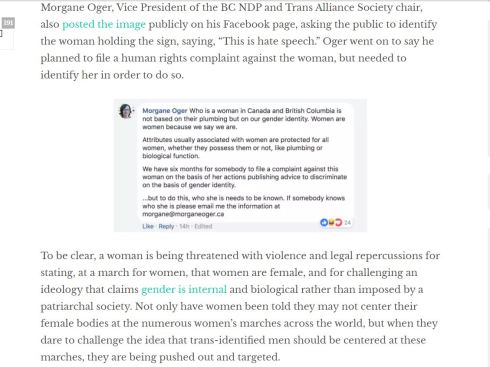
We pick up the conversation on twitter between Meghan Murphy and Morgane Oger.

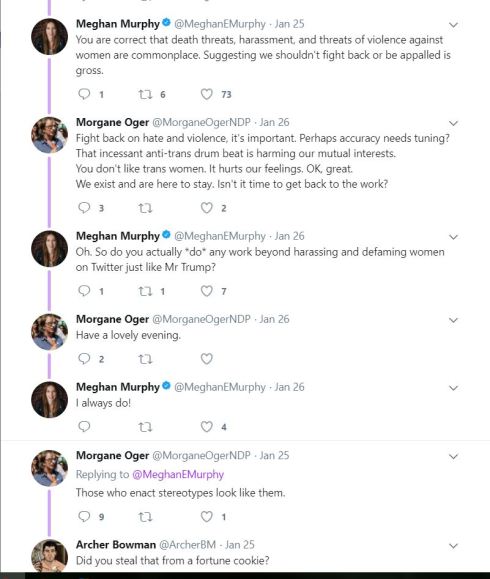
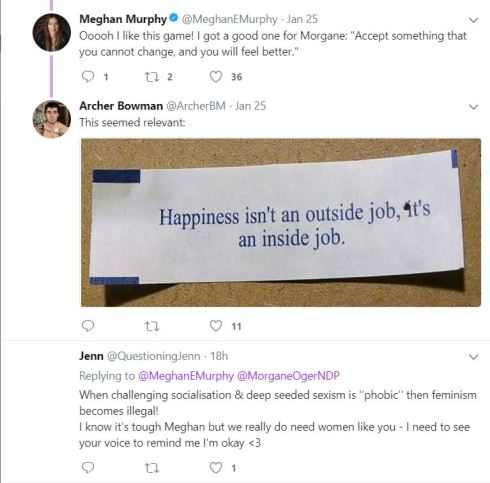
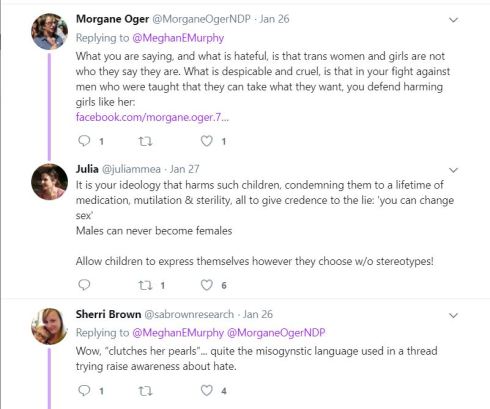

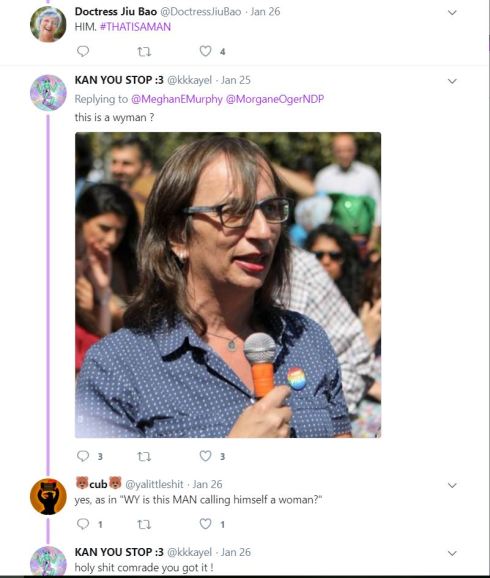
The battle against transactivism is being fought now. Patriarchy 2.0 is happening and Meghan Murphy along with other feminists are on the front lines defending women and the right to speak the truth about their bodies and experiences.











 bleatmop
 Mystro
 The Arbourist


 Dead Wild Roses
Your opinions…